Key takeaways
- ✓A social media content strategy is five written decisions: the business goal and the next action each post drives, your audience and language, your pillars and formats, your production capacity and rhythm, and how you measure results.
- ✓Work out posting frequency from the hours your team actually has, not from “post every day” advice. A rhythm you keep beats a bigger one you drop by week six.
- ✓For most Malaysian businesses the next action is a WhatsApp message, so the strategy has to say who answers the chat and how fast.
- ✓The template below fits on one page. Fill it in once, check it every month and reset it every 90 days.
What a Social Media Content Strategy Actually Is (and Why Yours Fits on One Page)
Your social media strategy covers the bigger questions: which platforms you use, how the budget splits between organic and paid, and what social is meant to do for the business. If those aren’t settled yet, start with your wider social media marketing strategy and come back to this page.
A content strategy sits underneath it. It decides what you publish, why, how often, in which language, and what the reader should do once they’ve seen it. Once it’s written down, that’s your social media content plan. Keep it short enough that whoever posts can check it in two minutes. Five decisions cover it.
| Decision block | Question it answers | Where most brands get it wrong |
|---|---|---|
| 1. Goal and next action | What should this post make someone do? | Judging posts on likes, with no next action defined |
| 2. Audience, platform, language | Who are we talking to, where, and in which language? | Five platforms and one translated caption |
| 3. Pillars, formats, mix | What do we post about, and in what format? | Pillars named after the company, not buyer questions |
| 4. Capacity and rhythm | How often can we really post? | Frequency copied from generic advice, not team hours |
| 5. Measurement | How do we know it’s working? | Nobody counts the WhatsApp enquiries |
Block 1: The Business Goal and the One Action Each Post Should Drive
Most accounts we review have plenty of content but no stated job for it. Pick one primary goal per quarter: enquiries, bookings, store visits or online sales. Then name the one thing a reader should do next. For a clinic, that’s a booking. For a renovation contractor, it might be a WhatsApp message with a photo of the space.
Block 1 checklist
- ✓One primary goal for this quarter, written down with a number you check monthly.
- ✓The next action named: WhatsApp message, booking link, phone call or store visit.
- ✓A decided split between posts that carry a direct call to action and posts that build trust (reviews, behind the scenes, answers to common questions).
- ✓Links on CTA posts go straight to that action, not to your homepage.
- ✓A named person who answers WhatsApp, with a target reply time during business hours.
The mistake we see most often here is judging content by likes. A Reel with 40,000 views and no messages has done less for the business than a plain carousel that brought in six enquiries. Likes tell you a post was seen. They don’t tell you it worked.
In Malaysia, most enquiries end up in a WhatsApp chat, so the strategy also has to cover what happens after someone taps. If messages wait half a day for a reply, the content did its job and the business didn’t. Set up WhatsApp Business with a greeting message and quick replies. If you later run Click-to-WhatsApp ads, the same rule applies: the person answering the chat is part of your content strategy.
Block 2: Audience, Platform and Language Choices for Malaysian Buyers
A content strategy for social media in Malaysia needs two decisions that most overseas templates skip: which platforms your buyers really use, and which language they want to hear from you in.
Block 2 checklist
- ✓The buyer described in one sentence: who decides, what worries them, and what makes them message you.
- ✓One main platform and one secondary, chosen by where those buyers already spend time.
- ✓Language segments listed (English, Bahasa Malaysia, Chinese, Manglish for casual content), each getting its own creative.
- ✓A written rule for which language runs on which platform.
- ✓A short list of platforms you’ve decided not to use, so nobody opens a new account on impulse.
From running accounts across industries, this is what we see. Facebook still reaches older and family decision-makers, like the parent choosing a tuition centre or the adult child booking care for a parent. TikTok and Instagram Reels reach younger buyers. Xiaohongshu is where many Chinese-Malaysian shoppers discover lifestyle, beauty and food brands. LinkedIn is the place for B2B.
On language, make separate creative for each segment instead of translating one caption. A Bahasa Malaysia video needs a BM speaker on camera and a BM hook. Adding BM subtitles to an English video rarely lands the same way. That’s why our strategists work in English, Bahasa Malaysia and Chinese rather than passing captions through a translator.
A quick decision rule for picking platforms
Block 3: Content Pillars, Formats and the Content Mix
Content pillars are the 3 or 4 topics you keep coming back to. The useful ones come from questions buyers ask, not from your list of services. “Our services” isn’t a pillar. “What happens at your first visit” is. Our guide to content pillars for Malaysian SMEs has worked examples by industry.
Block 3 checklist
- ✓3 to 4 pillars, each tied to a question buyers ask before they buy.
- ✓One main format per pillar: short-form video, carousel, live or single image.
- ✓A starting content mix on paper, adjusted from your own numbers after 90 days.
- ✓A hook for the first 1 to 3 seconds of every video, written before filming starts.
- ✓At least one pillar that puts customers, staff or creators on camera instead of studio footage.
A reasonable starting content mix is about half answering buyer questions, a quarter showing proof (reviews, results, behind the scenes) and a quarter making a direct offer. It’s a starting point, not a rule. After a quarter, let your own enquiry numbers move it.
Most organic reach right now goes to short-form video content: Instagram Reels, TikTok and YouTube Shorts. Native beats polished. A phone video of your physiotherapist showing one stretch often holds attention better than a studio ad, because it looks like the rest of the feed. If filming and editing are where your team stalls, that’s the gap short-form video production fills.
Three hook formulas that work for the first three seconds:
- The mistake callout: “Three things people get wrong before their first physio session.”
- Result first, then rewind: open on the finished kitchen, then cut to “here’s what it looked like six weeks ago.”
- A local trigger: “If you sit on the Federal Highway every morning, your lower back is probably paying for it.”
Block 4: Production Capacity, Posting Frequency and Your Content Calendar
This is the block where most strategies break. Advice online usually says to post once or twice a day. That number means nothing until you check it against the hours your team actually has. Work backwards from those hours.
Worked example (illustrative numbers): one marketing executive with about 12 hours a week for social.
Count the real hours
After other duties, our example exec has 12 hours a week. Use the honest number, not the one in the job description.
Take out the time that isn’t production
Community management (replying to comments and DMs) takes about 3 hours here, and planning and reporting take 1. That leaves 8 hours to make content.
Put an hour cost on each format
In this example, one short video takes about 3 hours: scripting, shooting on a phone, editing in CapCut and captions in two languages. A Canva carousel takes about 1.5 hours.
Divide, then set the frequency
8 hours covers 2 videos and 1 carousel a week (7.5 hours), with a little slack. On paper, 12 hours looked like 4 videos. In practice, 4 videos means nobody answers the comments.
Batch the production
Film all of the week’s videos in one session, edit in one block, then schedule them in Meta Business Suite. Switching between tasks is where the hours disappear.
So the honest posting frequency in this example is three posts a week. Three posts kept up for twelve weeks will beat daily posting that stops in week five.
Then plan around Malaysia’s festive and sales calendar: Ramadan and Hari Raya, Chinese New Year, Deepavali, Merdeka and Malaysia Day, and the 9.9, 10.10, 11.11 and 12.12 sales. Ad costs and competition for attention rise around these dates. Plan festive content 6 to 8 weeks ahead so it’s filmed before the busy weeks, and so the BM, Chinese and English versions are each made properly instead of translated the night before.
Your content calendar only needs six columns. Here’s an outline for one month:
| Week | Pillar | Format | Language | CTA | Owner |
|---|---|---|---|---|---|
| 1 | Buyer questions | Reel | BM | WhatsApp to ask a question | Exec films, specialist on camera |
| 2 | Proof | Carousel | English | None (trust post) | Exec |
| 3 | Behind the scenes | Short video | Chinese | Visit the outlet | Exec with Chinese-speaking staff |
| 4 | Offer (festive) | Reel plus single image | EN and BM versions | WhatsApp to book | Exec, approved by owner |
For tools, layouts and approval flows, see our guide to building a social media calendar.
Where organic stops and paid starts
On organic vs paid social, think of it this way: organic builds proof (comments, saves, reviews, people tagging friends) and paid buys reach to people who don’t follow you yet. Most SMEs need both, and the order matters. Let organic show you which posts work, then put money behind those. Boost them on Meta, or use Spark Ads on TikTok to run a post that’s already doing well as an ad from your own account. Don’t boost a post that got nothing organically. You’ll just pay more for the same weak result.
If the capacity maths shows your team can’t keep up the rhythm you need, that’s useful to know, not a failure. Once a business outgrows one person’s 12 hours, handing production and community management to a social media marketing agency in Malaysia is often the realistic option.
Not sure your posting plan fits your team’s real hours? We’ll review it and tell you what to keep, cut or hand over.
Block 5: How to Measure Whether the Strategy Is Working
Block 5 checklist
- ✓UTM parameters (short tags added to a link) on every link in bio and every post link, so you can see which platform and post sent the visit.
- ✓GA4 reporting sessions and conversions by source and medium.
- ✓WhatsApp enquiries counted, using a “how did you hear about us?” question in the first reply, a WhatsApp Business label per source, or a separate number for social.
- ✓A fixed monthly review date in the calendar, with all five blocks on the agenda.
- ✓Reply time for comments and messages tracked alongside reach.
Most measurement gaps are in WhatsApp. With the right setup, GA4 can record the visit and the tap on your WhatsApp button, but it can’t see the conversation. Counting chats by hand with labels is a cheap fix, and it’s the number your boss actually cares about. To turn those counts into ringgit, use our guide to measuring social media ROI.
Check the metrics below on a fixed schedule, and put them into a monthly social media report that someone can read in five minutes.
| Metric | What it tells you | Review cadence |
|---|---|---|
| Hook rate (share of viewers who watch past the first 3 seconds) | Whether your opening stops the scroll | Weekly, per video |
| Saves and shares | Whether a post was useful enough to keep or pass on | Monthly |
| Engagement rate (interactions divided by reach) | Whether people respond. Compare it with your own past posts, not with industry averages | Monthly |
| Profile visits and link clicks | Whether content makes people curious about the business | Monthly |
| WhatsApp enquiries from social | Whether content creates demand | Weekly |
| Cost per qualified lead (paid only) | What a real prospect costs, after removing time-wasters | Weekly while ads run |
Treat community management reply time as a performance metric too. A comment asking “how much?” that gets an answer two days later is a lost lead. In your social media reporting, put reply time next to enquiries so the connection is obvious.
The One-Page Social Media Content Strategy Template
Here’s the social media content strategy template. Copy the middle column into a document and answer each prompt in a sentence or two. The right-hand column is filled in for a fictional business, a physiotherapy centre in Petaling Jaya, to show the level of detail that’s useful.
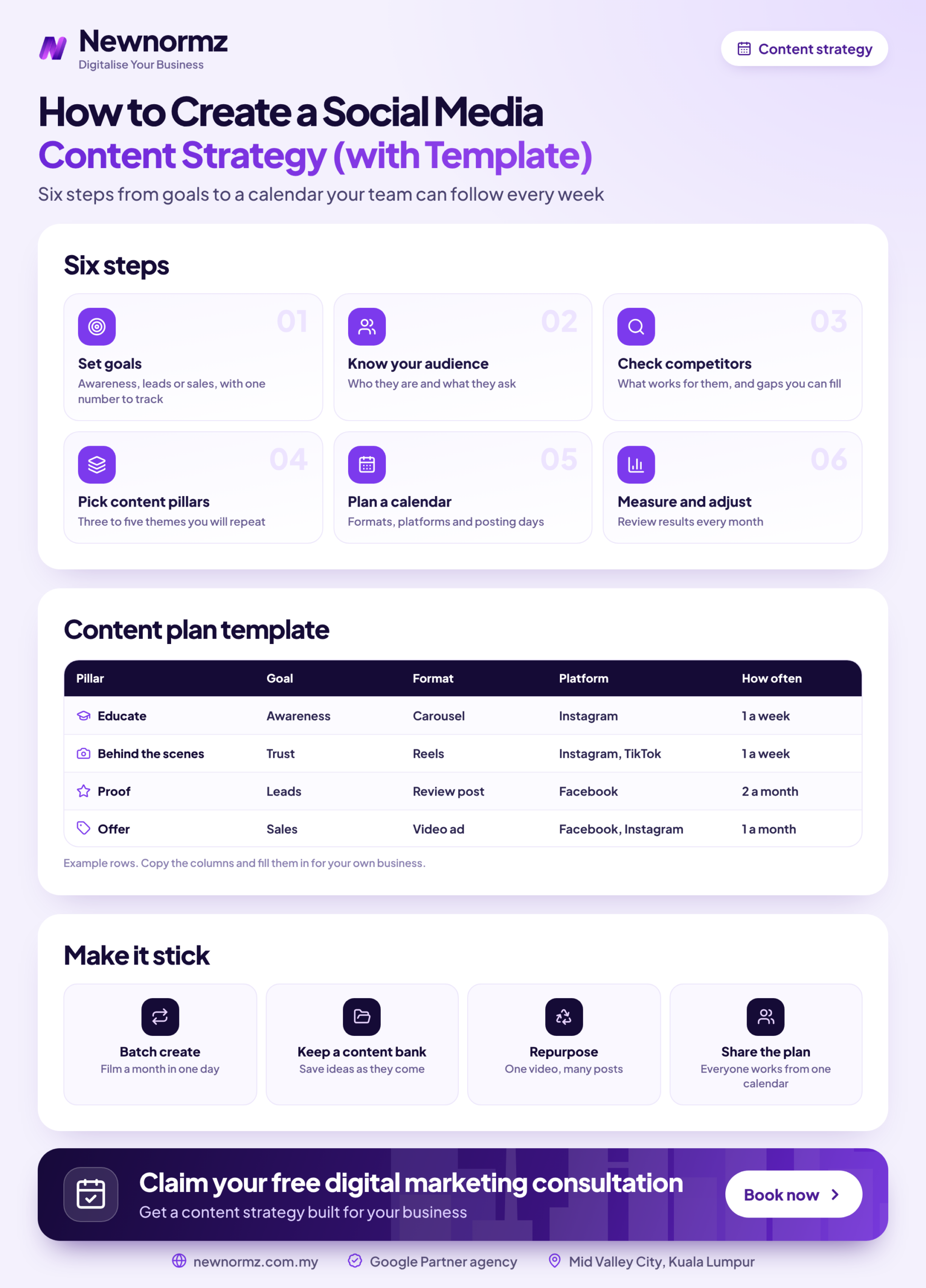
| Block | Fill in | Fictional example: PJ physiotherapy centre |
|---|---|---|
| 1. Goal and next action | Primary goal this quarter? The next action? Who answers, and how fast? | More new-patient enquiries. Next action: WhatsApp to book an assessment. Front desk replies within 30 minutes during opening hours. |
| 2. Audience, platform, language | Buyer in one sentence? Main and secondary platform? Which languages? | Office workers with back and neck pain, plus adult children booking for parents. Main: Facebook. Secondary: Instagram Reels. English and BM, with separate scripts. |
| 3. Pillars, formats, mix | 3 to 4 pillars from buyer questions? A format for each? Starting mix? | “Is this pain serious?” (Reels), “What happens at the first visit?” (carousel), patient stories (short video, with written consent and a check against healthcare advertising rules), monthly offer (single image). Mix: 50% education, 25% proof, 25% offer. |
| 4. Capacity and rhythm | Hours per week? Hours per format? Frequency? Festive plan? | 12 hours, 8 of them for production. 2 Reels and 1 carousel a week, filmed in one Tuesday batch. Merdeka “desk posture” series planned 7 weeks ahead. |
| 5. Measurement | Tracking? Which metrics? Review date? | UTMs on all links, GA4 by source, “how did you hear about us?” in the first WhatsApp reply, a label per platform. Review on the first Monday of each month, full reset every 90 days. |
How to Prioritise the Gaps You Find in Your Current Plan
Fill the template in against what you actually do today, not what you intend to do, and the gaps will show. Fix the high-impact, low-effort ones first.
| Issue | Impact | Effort | First fix |
|---|---|---|---|
| No defined next action on posts | High | Low | Give every post one CTA type, or mark it as a trust post |
| Posting rhythm above team capacity | High | Low | Redo the hours maths and cut to a rhythm you can hold |
| No tracking on WhatsApp enquiries | High | Low | Source labels plus a first-reply question |
| No hook in the first 3 seconds | High | Medium | Write the hook before the script, and test two per video |
| One translated caption for all languages | Medium | Medium | Separate scripts for your top two language segments |
If the problems go deeper, such as inconsistent branding across accounts, ad accounts nobody can log in to, or years of untracked posts, run a full social media audit before you rewrite the plan.
From our audits
The pattern we see most often is a strategy built on a posting frequency the team drops by week six, followed by a month of silence. That silence costs more than a lower frequency would have. Followers stop expecting you, and the team stops trusting the plan. The fix is simple: plan for 70% of what you think you can do, hold that rhythm for 90 days, then add.
Social Media Content Strategy FAQs
What should a social media content strategy include?
It should include five written decisions: the business goal and next action, audience and language, content pillars and formats, production capacity and posting rhythm, and how you’ll measure results. Anything beyond that, like mood boards and brand stories, is useful but optional. If the five decisions don’t fit on one page, the plan is too vague to follow.
How often should a Malaysian business post on social media?
Post as often as your team can keep up without the quality dropping, and work that out from real hours, not general advice. In our worked example, one executive with 12 hours a week ends up at three posts a week once community management is included. Keeping the same rhythm for months matters more than the exact number.
What is the difference between a social media strategy and a content strategy?
A social media strategy decides where you show up and how you invest: platforms, budget and the balance of organic and paid. A content strategy decides what you publish there, how often, in which language and what the reader does next. Settle the first, then write the second.
Should I post in English, Bahasa Malaysia and Chinese, or pick one language?
Post in the languages your buyers actually use, with separate creative for each, and start with your top one or two segments. A translated caption on the same video usually underperforms a script written and filmed for that audience. Add a third language once you can produce the first two without falling behind.
How long before a new content strategy shows results?
There’s no fixed timeline, so judge it on a set review rhythm rather than waiting for a date. Check early signals monthly (hook rate, saves, WhatsApp enquiries) and judge the strategy as a whole at a 90-day reset. That gives you enough posts to see a pattern without spending a year on the wrong plan.
Our own process follows the same shape as this template: strategy development, content creation, campaign execution and engagement, then performance tracking and optimisation. Because the team also runs SEO and Google Ads, we can connect what you post with the searches and WhatsApp enquiries it leads to.
Is your content plan bigger than your team can actually keep up?
Newnormz plans, creates and runs social media and paid social for Malaysian brands, and judges every campaign on enquiries, not just views. 5.0 rating from 214+ Google reviews. Send us a WhatsApp message and a strategist will reply within business hours.
Prefer a form? Free social media audit

Bryan Tan is an SEO Specialist and CEO at Newnormz, helping hundreds of businesses achieve first-page rankings on Google. With a passion for driving organic growth, Bryan blends innovative strategies with hands-on experience to optimize websites for maximum visibility. Always at the forefront of the latest SEO insights and trends, he consistently adapts to the evolving digital landscape.