
It’s a meeting a lot of business owners know. The agency slide shows 200,000 views and 4,000 likes. The owner asks how many enquiries came in, and the answer is three. That gap is why the most useful social media case study Malaysia businesses can learn from is rarely the one with the biggest view count. The useful one shows the ad spend, the cost per qualified lead and how many of those leads became paying customers. If a case study can’t trace that path, it hasn’t proven anything yet.
This guide is for Malaysian business owners and marketing managers who are comparing agency portfolios or planning their own campaign. It shows you how to read any case study like an auditor, then breaks down three example campaigns the way a real case study should be written.
Why Most Social Media Case Studies in Malaysia Prove the Wrong Thing
A social media marketing case study should answer one question: did the money come back? Look through the social media marketing Malaysia agencies showcase on their websites, and most of it never asks. They show the numbers that look biggest on a slide, and those are usually the numbers that are easiest to buy.
Views and Followers Are the Cheapest Numbers to Produce
Reach is something you pay for. Platforms charge by CPM (cost per 1,000 impressions, meaning how much you pay each time your ad is shown 1,000 times). Say your CPM is RM10. Then RM2,000 buys 200,000 impressions. That figure tells you what was spent. It doesn’t tell you what the campaign achieved.
Engagement rate has the same problem. It’s usually interactions divided by reach or followers. Boosting a post pushes it up, and so does a “comment and tag three friends” giveaway, which mostly attracts people who want the prize, not your product. High engagement can sit alongside zero sales. That’s how you end up with 200,000 views and three enquiries.
The Money Path a Real Case Study Must Show
A credible case study follows each step: spend → CPM → clicks or chats → leads → qualified leads → customers → revenue. Every arrow is a point where money leaks, and a good report shows how much leaked at each one.
Two numbers do most of the work. Cost per qualified lead is ad spend divided by the leads that meet your criteria (right location, real budget, buying soon), not all leads. ROAS (return on ad spend) is revenue from the ads divided by the ad spend. If you want the full formulas, this guide on how to calculate social media ROI covers them with worked examples.
If a case study stops at reach, the campaign probably did too.
In Malaysia the Lead Usually Ends Up on WhatsApp, Out of View of Ads Manager
A large share of Malaysian enquiries come in through Click-to-WhatsApp ads. The ad works. Meta Ads Manager records a “messaging conversation started”. Then the actual sale happens inside WhatsApp Business, where Ads Manager can’t see it unless someone records the result and sends it back.
So when a case study comes from a WhatsApp-heavy business, ask how chats were tagged and closed. For website traffic, check for the Meta Pixel plus Conversions API (CAPI, a server-side connection that catches conversions the browser pixel misses), and UTM parameters so GA4 can show which campaign sent each visitor. For WhatsApp, it should be something as simple as labels in WhatsApp Business (“new lead”, “quoted”, “paid”) that someone actually keeps up to date.
From our audits
One of the most common problems we see: accounts that report every “messaging conversation started” as a lead. Many of those chats are a single “hi” or “price?” that nobody followed up. Before you accept any lead figure from a WhatsApp campaign, ask how many people replied after the first response, and how many booked.
Three Social Media Campaign Case Studies, Broken Down the Way They Should Be
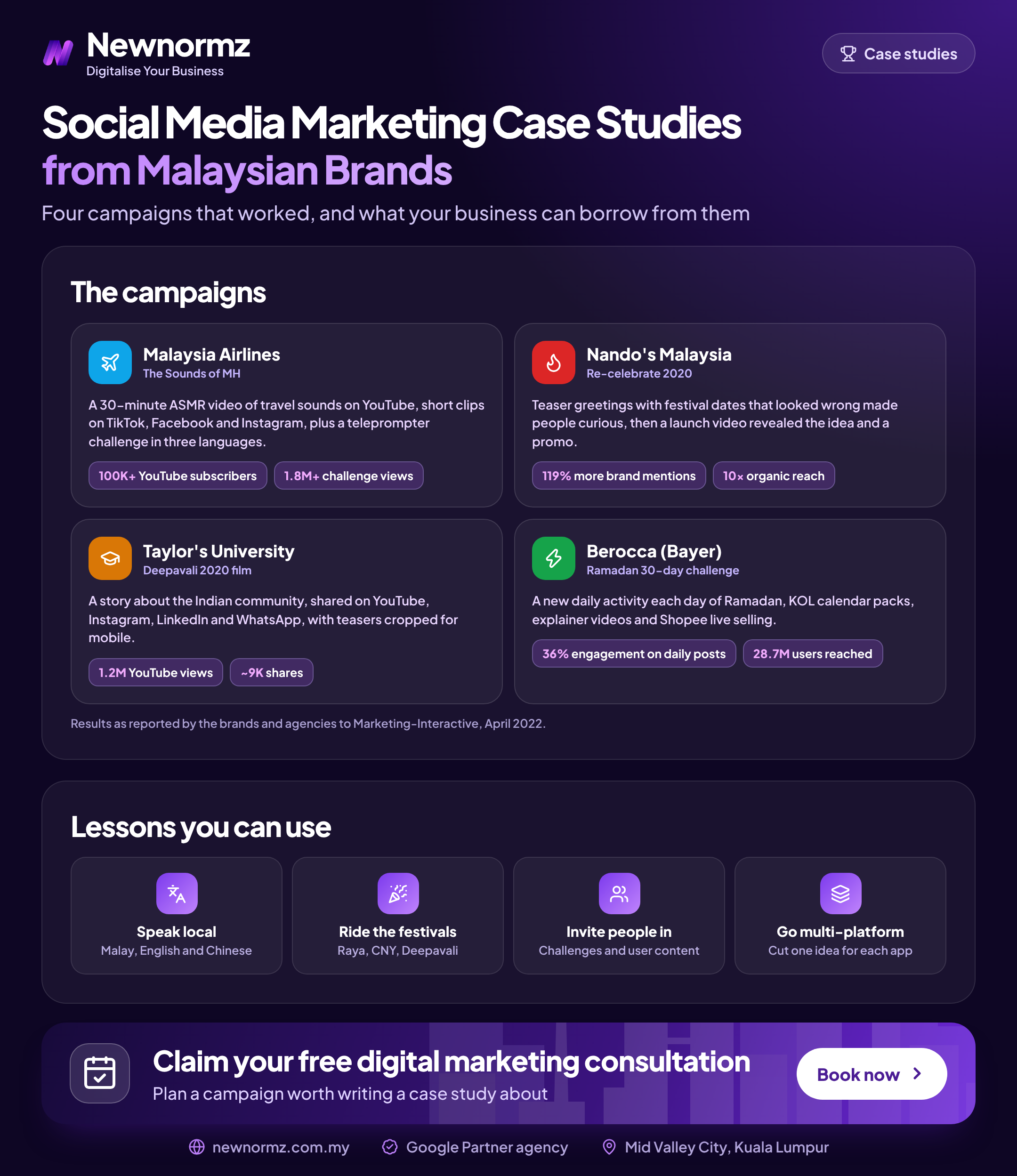
Read this first: the three campaigns below are illustrative examples with example numbers. They are not Newnormz client results. They’re built the way real Malaysian campaigns run, so you can see what a complete social media campaign case study looks like and which questions to ask at each stage.
Example 1: A Klang Valley Service Business on Click-to-WhatsApp Ads (Facebook and Instagram)
Picture a beauty or wellness clinic in Petaling Jaya spending RM3,000 a month on Click-to-WhatsApp ads across Facebook feeds and Instagram Reels. Both versions below use the same ads and the same cost per chat. The only difference is how fast someone answers WhatsApp.
| Stage | Example number | What to check |
|---|---|---|
| Monthly ad spend | RM3,000 | Does this include the tests that failed? |
| Impressions | 150,000 (example CPM RM20) | Frequency: is the same person seeing the ad six times? |
| Conversations started | 300 (RM10 per chat) | Does the Ads Manager count match the chats in WhatsApp? |
| Chats that replied after the first response | 90 (slow replies) vs 180 (replies within minutes) | Average first-reply time, including evenings and weekends |
| Bookings | 18 vs 45 | Who logged them, and where? |
| Customers who showed up and paid | 12 vs 30 | Does it match the till or invoices? |
| Cost per customer | RM250 vs RM100 | The number a case study should end on |
A RM10 chat looks cheap in both versions. Slow replies still make each customer 2.5 times more expensive. In Malaysia, who answers the chat (a trained person or an owner squeezing it in between appointments) and whether they can switch between BM, English and Chinese often matters more than the ad itself. When you review a Facebook ads case study Malaysia agencies have put together, look for the reply process, not only the creative. If you want the ads side handled properly, our Facebook ads management team sets campaigns up around chats that become bookings.
Example 2: An F&B Brand on TikTok Using Creator Content and Spark Ads
A café chain asks local food creators to post honest videos on their own accounts, then puts paid reach behind the best ones with Spark Ads (ads that run from the creator’s original post, so the likes and comments stay on it). Each language gets its own creators and hooks: BM, English and Chinese, with no translated copies. Each video carries its own redemption code, so sales in the store can be traced back to a specific video.
| Stage | Example number | What to check |
|---|---|---|
| Spark Ads spend | RM5,000 over 4 weeks | Split by language and creator |
| Impressions | 800,000 (example CPM RM6.25) | Location targeting: are viewers near an outlet? |
| Hook rate (2-second view rate) | 35% | Which opening shots held people, per language |
| Codes redeemed in store | 500 | One unique code per creator, counted at the till |
| Revenue from codes | RM14,000 (RM28 average bill) | Undercounts people who came in without a code |
| Cost per redemption and ROAS | RM10 per redemption, 2.8x revenue ROAS | Judge against gross margin, not revenue |
That’s what an honest TikTok marketing case study looks like. Views and hook rate sit beside the redemption codes, and the redemptions are what prove the result. At an example 60% gross margin, RM14,000 in sales is RM8,400 in gross profit against RM5,000 of spend, before counting any repeat visits. This is the kind of work Newnormz has run for brands like Hot & Roll on TikTok, and it reflects a wider pattern in how local Malaysian brands win on social.
Malaysia note
Around Hari Raya and Chinese New Year, more brands compete for the same feeds and costs go up. Brief creators and approve the videos weeks ahead, so your Spark Ads are ready on day one of the season instead of week two. For a Chinese-speaking lifestyle audience, test the same creator approach on Xiaohongshu as well.
Example 3: Instant Forms vs Higher-Intent Forms for a Lead Generation Campaign
This is where social media lead generation case studies most often mislead. A renovation contractor splits RM4,000 between two Meta Instant Forms. Form A uses the “more volume” setting with only name and phone. Form B uses the “higher intent” setting (an extra review screen before submitting) plus three qualifying questions: area, budget range and start date.
| Stage | Example number (Form A vs Form B) | What to check |
|---|---|---|
| Ad spend | RM4,000 each | Same period, same creative |
| Leads and cost per lead | 250 at RM16 vs 100 at RM40 | Fake numbers, duplicates, “wrong person” |
| Qualified leads | 64 vs 70 | Who defined “qualified”, and was it written down before launch? |
| Cost per qualified lead | RM62.50 vs RM57 | The real comparison starts here |
| Customers and cost per customer | 6 at RM667 vs 14 at RM286 | Signed quotes, not “interested” |
Form A wins on cost per lead and loses on everything that pays the bills. Plug your own margins into our free social media ROAS calculator to find the cost per customer you can afford.
For a benchmark of what full reporting looks like, here’s a Google Ads campaign (paid search, not social) we ran for a KL confinement centre. It reported 266 qualified leads in the first 30 days at RM9.58 per lead on a RM2,550 monthly budget. Don’t compare that cost with social: search reaches people who are already looking. Use it as a model of what a report should include, which is spend, qualified leads, cost per lead and a timeframe.
How to Judge a Social Media Agency’s Case Study Before You Hire
If you’re working out how to evaluate a social media agency, run its case studies through these rules. Use them on every social media agency Malaysia search turns up, including us. A good agency will have answers ready.
Newnormz’s own positioning is “Turn Attention into Enquiries. Not Just Views.”, so we hold our own reports to the same rules. We also run social alongside SEO and Google Ads, which lets us see where social enquiries overlap with search and WhatsApp. If you’d rather have a team build campaigns you can measure this way, see our work as a social media marketing agency in Malaysia.
What a Social Media Case Study Should Show, by Goal
Good social media reporting depends on the goal. Here’s what the headline metric should be for each goal, and which numbers should make you suspicious. For a fuller list, see our breakdown of social media KPIs that track revenue.
| Business goal | Headline metric | Supporting metrics | Red-flag metrics |
|---|---|---|---|
| Awareness | Reach in the target audience at a set frequency | Hook rate, branded search lift, direct traffic in GA4 | Total views with no audience or location breakdown |
| Leads | Cost per qualified lead | Lead-to-customer rate, reply time, cost per customer | Raw cost per lead or “conversations started” on their own |
| Ecommerce sales | ROAS or blended revenue against total spend | Average order value, new vs returning buyers, Pixel plus CAPI match quality | Add-to-carts or link clicks reported as “sales intent” |
| Recruitment | Cost per shortlisted candidate | Applications, interview show-up rate, hires | Applications counted with no screening |
| Organic vs paid social (any goal) | Organic as proof, paid as reach | Comments, reviews and creator posts that paid ads then amplify | Organic and paid results mixed together so you can’t tell which did the work |
Turn Your Own Campaign Into a Case Study Worth Showing
You don’t need an agency to produce a credible case study. You need to start recording before the campaign launches. Here’s the template.
Set up tracking before launch
Install the Meta Pixel plus Conversions API (or the TikTok Pixel and Events API), add UTM parameters to every link so GA4 shows each campaign separately, and agree on WhatsApp Business labels for every stage of a lead.
Record the baseline
Write down last month’s enquiries, sales and cost per customer. Without a “before” number, the “after” number has nothing to be measured against.
Log every creative test
For each ad, record the hook, the language, the format, the spend, the CTR and the cost per qualified lead. Failed tests belong in the case study too.
Track leads to closed sales in one sheet
Use one row per lead with these columns: date, source, campaign, qualified (yes/no), booked, paid and value. Update it weekly, or you’ll be reconstructing it from memory later.
Write it up in four parts
Problem, what we did, the numbers (spend through to revenue) and what we’d change next time. To keep the numbers coming in each month, start from a monthly social media report template.
Social Media Case Study FAQs
What should a social media marketing case study include?
It should include the ad spend, the timeframe, cost per qualified lead, how many leads became customers, and the revenue or cost per customer. It should also explain how leads were tracked, especially WhatsApp leads, and what was tested along the way.
How do I know if a social media agency’s case study is genuine?
Check that the ads actually ran, then ask for numbers that are hard to fake. Search the named brand in the Meta Ad Library, ask for a screenshot of Ads Manager covering several months, and ask the agency to talk you through its lead-to-sale tracking.
What is a good cost per lead for social media ads in Malaysia?
There’s no single good figure, because cost per lead varies widely by industry, offer and lead quality. Work out the most you can afford per customer from your margin, then work backwards using your lead-to-customer rate, as in the labelled Instant Form example above.
Should I ask an agency for access to its ad accounts before hiring?
Ask for a guided view of past results, not login access to other clients’ accounts, which an agency shouldn’t give you. More importantly, confirm in writing that you will own your own ad account, Pixel and data from day one.
How long before a social media campaign shows results?
Expect the first few weeks to be a testing period, and treat a full 3 months as the minimum for a fair verdict. Meta’s Business Help Centre says an ad set generally needs about 50 optimisation events in a week to exit the learning phase, so small budgets take longer to give reliable numbers.
Free social media audit
Send us a case study you’ve been shown, or your last campaign report, and we’ll tell you what’s missing
- ✓A check of the money path, from spend to cost per qualified lead to customers
- ✓A review of your tracking: Pixel, Conversions API, UTMs and WhatsApp lead tagging
- ✓The questions to ask before you approve the next report or sign with an agency

Bryan Tan is an SEO Specialist and CEO at Newnormz, helping hundreds of businesses achieve first-page rankings on Google. With a passion for driving organic growth, Bryan blends innovative strategies with hands-on experience to optimize websites for maximum visibility. Always at the forefront of the latest SEO insights and trends, he consistently adapts to the evolving digital landscape.



