Short verdict
Social media ROI is the profit your social activity earns for every ringgit it costs, and the social media ROI formula is: (gross profit from social minus total social cost) ÷ total social cost × 100. “Total cost” means ad spend plus content production, tools and people. “Profit” means your margin, not revenue. Most Malaysian brands get this number wrong for a simple reason: the enquiry moves into WhatsApp, nobody records where it came from, and the report falls back on likes or on the ROAS figure from Ads Manager.
This guide gives you the formula, the few metrics that actually feed it, a ringgit example worked from start to finish, and a WhatsApp tracking workflow. With those you can bring a number to the meeting and defend it.
The Social Media ROI Formula, and the Two Numbers Most Reports Get Wrong
The formula only has two inputs: what came back and what went in. Nearly every inflated social media report gets one of them wrong, and plenty get both wrong.
Return means gross profit, not revenue
Revenue tells you how much money changed hands. Gross profit is what you keep after the cost of the product or service you delivered. A furniture retailer working on a 15% margin and a consultancy working on a 70% margin can post the same revenue from the same campaign and end up with very different results.
This is how a campaign showing 7x ROAS can still lose money. Take a labelled example: RM21,600 of sales at a 15% margin leaves RM3,240 of gross profit. If the campaign cost RM5,500 in total, you lost RM2,260, even though the dashboard looked excellent. The full maths for this campaign comes later in the article.
Investment means every ringgit, not just ad spend
Ads Manager only knows what you paid Meta or TikTok. Your real investment also includes:
- Ad spend across every platform you ran
- Creative and video production: shoots, editing, designers, creator or KOL fees
- People: agency fees, or the in-house hours spent planning, posting, replying to comments and answering chats
- Tools: scheduling and analytics platforms, plus Canva, CapCut and stock subscriptions
If a marketing executive spends half the month on social, half of their salary belongs in the denominator. Leave it out and your ROI will always look better than it really is.
ROI vs ROAS: Why Ads Manager’s Number Isn’t Your Profit
Social media ROAS (return on ad spend) is revenue divided by ad spend. It’s useful for comparing campaigns against each other, but it isn’t profit. This table shows where ROI, ROAS and the two cost metrics each fit.
| Metric | Formula | What it includes | What it ignores | When to use it |
|---|---|---|---|---|
| ROAS | Revenue ÷ ad spend | Tracked sales and media cost | Margin, production, people, untracked WhatsApp sales | Comparing campaigns and creatives week to week |
| ROI | (Gross profit minus total cost) ÷ total cost × 100 | Margin and every cost | Repeat purchases, unless you add LTV | Deciding to keep, cut or scale the budget |
| Cost per qualified lead | Total cost ÷ qualified leads | Lead quality, not just volume | Whether sales closes them | Lead-gen campaigns with a sales step |
| Customer acquisition cost (CAC) | Total cost ÷ new customers | The full funnel, ad to sale | Customer value after the first sale | Setting the most you can pay per customer |
The number that ties ROAS back to profit is break-even ROAS = 1 ÷ gross margin. Here are labelled examples. At a 50% margin you break even at 2x. At 25% you need 4x. At 15% you need about 6.7x before you make a sen. Work it out against total cost, not ad spend alone, or the target will look easier to hit than it really is.
If you want to run your own numbers without building a spreadsheet, try the free social media ROAS calculator, then compare the result with the ROAS your dashboard reports.
A Worked Social Media ROI Example in Ringgit
All the numbers below are a labelled example of a Meta lead campaign for a service business. They aren’t market rates. Swap in your own figures.
Add up the full cost
RM3,000 ad spend plus RM2,500 for creative and management comes to RM5,500 total investment.
Count the funnel honestly
120 leads came in. 45 were qualified (right budget, right area, a real need), and 12 became paying customers.
Calculate revenue and ROAS
12 customers × RM1,800 average order = RM21,600. ROAS on ad spend is RM21,600 ÷ RM3,000 = 7.2x.
Convert revenue to gross profit
At a 50% gross margin, RM21,600 of revenue leaves RM10,800 of gross profit.
Apply the ROI formula
(RM10,800 minus RM5,500) ÷ RM5,500 × 100 = about 96% ROI. Each ringgit you put in came back with roughly 96 sen of profit on top.
Work out the unit costs
On full cost, the cost per lead is RM45.83, the cost per qualified lead is RM122.22 and the cost per customer is RM458.33. Ads Manager, which only sees ad spend, would show RM25 per lead.
A 7.2x ROAS, a 96% ROI and a RM45.83 cost per lead can all describe the same campaign. Only the ROI tells the owner whether to scale.
The scaling rule follows from the same numbers. Each customer brings in RM900 of gross profit and costs RM458.33 to acquire. You can keep adding budget while your cost per customer stays comfortably under RM900. Once it gets close, stop.
Add lifetime value when customers buy again
Clinics, F&B brands and subscription businesses rarely make all their money on the first sale. Customer lifetime value (LTV) is the gross profit a customer brings in over a set period. Here is a labelled example: suppose each of the 12 customers spends RM3,600 over 12 months, the first order plus one repeat. Revenue rises to RM43,200, gross profit to RM21,600, and ROI becomes (RM21,600 minus RM5,500) ÷ RM5,500 ≈ 293%.
Use the LTV figure only if your own sales records support it. Count any remarketing or retention spend in the cost as well.
What a lead-to-customer rate looks like in real data
The rate at which leads become customers is the number most social reports leave out. The client example below is a Google Ads (paid search) campaign, not a social campaign. We use it only to show how much that conversion rate moves the maths.
Client example (Google Ads, paid search)
Chiropractic centre, PJ: 224 qualified leads, 15x ROAS within 60 days
Problem: The centre needed qualified appointment enquiries on a RM4,300/month budget.
What we did: Ran a Google Ads campaign built around qualified leads and tracked which of those leads became appointments.
Result: 224 qualified leads at RM18.74 per lead, with 60 to 70% of leads becoming appointments and 15x ROAS within 60 days.
At a 60 to 70% lead-to-appointment rate, 224 leads works out to roughly 134 to 157 appointments. Halve that rate and the same cost per lead buys half as many customers. That’s why the lead-to-customer rate belongs inside the formula and not in a footnote.
The Social Media Metrics That Actually Feed the ROI Formula
Ads Manager shows you dozens of social media metrics. Only a few of them go into ROI. The rest help you diagnose problems: they explain why the money metrics moved, but they don’t measure return.
| Tier | Metrics | Role in ROI |
|---|---|---|
| Money metrics | Revenue, gross profit, CAC, LTV | Go straight into the formula. Report these to the boss. |
| Pipeline metrics | Qualified leads, cost per qualified lead, WhatsApp chats started, lead-to-customer rate | Predict ROI before sales close. Your weekly social media KPI set. |
| Diagnostic metrics | CPM, CTR, hook rate, frequency, engagement rate | Explain why the numbers above moved. Never report them as return. |
Quick definitions: CPM is what you pay for 1,000 impressions. CTR (click-through rate) is the share of people who saw the ad and clicked. Hook rate is the share of video viewers who watch past the first few seconds. Frequency is how many times, on average, each person has seen the ad, and when it climbs while CTR falls, you’re looking at creative fatigue. CAC is your total cost divided by the number of new customers.
For a fuller walk-through of each one, see our guide to the social media metrics worth tracking.
Once you know which tier each metric sits in, the next job is setting value-driven social KPIs so that weekly targets sit in the pipeline tier and not in likes.
How to Track Social Media ROI When Enquiries Go to WhatsApp
This is the gap that breaks most social media attribution in Malaysia. A Click-to-WhatsApp ad opens a chat, and the chat never touches your website. The Meta Pixel and GA4 don’t see the sale, and your report shows zero. The workflow below closes the gap without expensive software.
Tag every link with UTM parameters
UTM parameters are labels you add to the end of a URL to say where the click came from, for example utm_source=facebook&utm_medium=paid_social&utm_campaign=raya_promo. Check the source/medium report in GA4 every month so website sales are credited to the right channel.
Give each Click-to-WhatsApp ad its own pre-filled message
Set a distinct pre-filled first message for each campaign, such as “Hi, I’d like to ask about the RAYA25 package”. When that code shows up in a chat, you know which campaign sent the customer.
Label chats in WhatsApp Business
Use WhatsApp Business labels such as Lead, Qualified and Paid, and add a source label too. At the booking stage, ask “Where did you find us?” Customers who saw an ad but messaged later won’t have your code in the chat.
Log outcomes weekly in a sheet or CRM
Record one row per chat: date, source code, qualified (yes/no), paid (yes/no) and sale value. Fifteen minutes on a Friday is enough. Leave it for a quarter and the data is gone.
Send qualified and paid events back to the platforms
Upload those offline outcomes through Meta’s Conversions API or TikTok’s Events API. These send conversion data from your server or CRM straight to the platform. The algorithm then learns to find buyers, not just people who fill in cheap forms.
One more check: the attribution setting in Meta Ads Manager and TikTok Ads Manager decides how many days after a click or view a sale is still credited to the ad. Change the window and the reported ROAS changes, even though nothing real has changed. Look up which window your account actually uses before you quote any figure, and keep it the same from one month to the next.
From our audits
We keep seeing social reported as “zero ROI” while the sales team is busy closing deals from those same ads. The leaks are in the chats: nobody logged which WhatsApp conversations came from which campaign, so the budget gets cut on the strength of missing data. Steps 2 to 4 above usually fix it within a month.
If the chat side is where your leads stall, our WhatsApp marketing services cover the setup, the labelling and the follow-up flow.
Measuring ROI on Organic Social (Without Pretending It’s Free)
Organic social is harder to attribute, and you should say so in the report. It also isn’t free. In a labelled example, 20 staff hours a month at RM40 an hour is RM800 of real cost, and it belongs in the formula.
Because you can’t trace every organic sale, track proxies you can actually count:
- Clicks on UTM-tagged links in bios and posts, checked in GA4
- DM and WhatsApp enquiries labelled “organic” in WhatsApp Business
- Growth in branded searches in Google Search Console after a strong month of content
- Comments and reviews that later appear as social proof in paid ads
The way to think about organic vs paid social: organic builds trust and gives you proof, and paid buys reach. In our experience, ads that run alongside an active, credible page with real replies in the comments tend to convert better than ads from a page that has gone quiet. That difference shows up in your paid CAC, not in organic reach. Judge organic on enquiries and on how cheaply paid converts, not on likes.
If you aren’t sure which organic activity earns its hours, start with a full social media audit before you change anything.
Is Your Social Media ROI Good Enough? Decision Rules
There’s no universal “good” ROI percentage. Any figure above 0% on full cost means social is profitable. Whether it’s good enough depends on your margin, your LTV and what else the money could do. Use these rules to decide the next step.
How to Start Measuring Social Media ROI This Month
You don’t need new software to know how to measure social media ROI properly. You need four habits:
Write down your gross margin and break-even ROAS
Get the margin from finance, not from a guess. Break-even ROAS is 1 ÷ that margin.
List every social cost line
That means ad spend, production, people’s hours and tools.
Turn on source tracking
Set up UTMs, pre-filled WhatsApp codes and chat labels, as described in the WhatsApp section above.
Fill in the reporting table every month
Use the template below so every month is compared like for like.
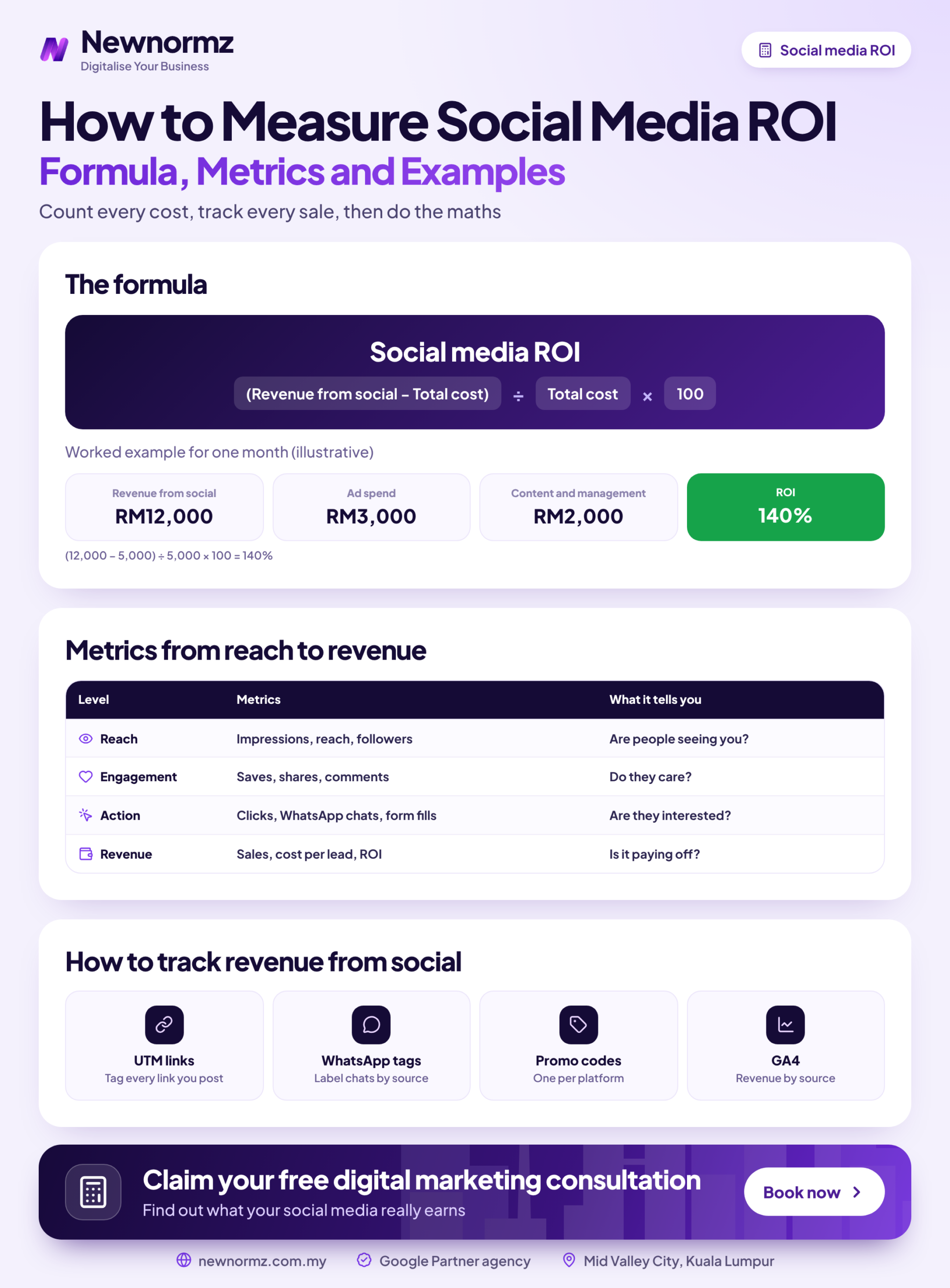
Copy this monthly social media reporting template. The example column uses the labelled campaign from earlier.
| Line | How to get it | Example month |
|---|---|---|
| Spend | Meta and TikTok Ads Manager invoices | RM3,000 |
| Production cost | Creative, people’s hours, tools | RM2,500 |
| Leads | Forms plus WhatsApp chats started | 120 |
| Qualified leads | “Qualified” label count | 45 |
| Customers | “Paid” label count | 12 |
| Revenue | Sum of sale values in your sheet or CRM | RM21,600 |
| Gross profit | Revenue × gross margin | RM10,800 |
| ROAS | Revenue ÷ spend | 7.2x |
| ROI | (Gross profit minus total cost) ÷ total cost × 100 | 96% |
| Cost per qualified lead | Total cost ÷ qualified leads | RM122.22 |
To pull the platform numbers into one place faster, compare the social media analytics tools that suit your budget.
Tracking, creative testing and honest monthly reporting add up to a lot of work. That’s where a social media marketing agency in Malaysia can take the load. Newnormz plans, creates and runs social media and paid social for Malaysian brands, including Facebook campaigns for Taiwan Excellence and TikTok for Hot & Roll. We judge every campaign on enquiries, not just views, and because we run social alongside SEO and Google Ads, we can connect it with search and WhatsApp enquiries. We hold a 5.0 rating from 214+ Google reviews.
Social Media ROI FAQs
What is a good ROI for social media marketing?
Any ROI above 0% on full cost means social is making money, but there’s no single benchmark that fits every business. A good figure depends on your gross margin, your customer lifetime value and what the same budget could earn elsewhere, so compare your result against your break-even ROAS.
What is the difference between ROI and ROAS on social media?
ROAS is revenue divided by ad spend, while ROI is gross profit minus total cost, divided by total cost. ROAS ignores your margin and your production and staff costs, so a high ROAS can still mean a loss.
How do you track social media ROI when leads come in through WhatsApp?
Give each Click-to-WhatsApp campaign its own pre-filled message code, label chats in WhatsApp Business as lead, qualified and paid, and log the outcomes every week. Then send the qualified and paid events back through Meta’s Conversions API or TikTok’s Events API so the platforms optimise for buyers.
How do you measure ROI from organic social media?
Count staff hours as cost, then track proxies: UTM-tagged link clicks, DMs and WhatsApp enquiries labelled “organic”, and branded search growth in Google Search Console. Organic will never be fully attributable, so say so in the report rather than claiming a precise figure.
How long does it take to see ROI from social media marketing?
For most SMEs, judge paid social over about 90 days rather than week by week. The first weeks go into fixing tracking and testing creative, and smaller budgets take longer to collect enough conversions. High-ticket products with long sales cycles take longer again.
Free social media audit
Turn attention into enquiries, not just views. See where your social ROI is leaking.
- ✓A review of how your spend is tracked from ad to WhatsApp chat to sale
- ✓A check of your Pixel, Conversions API and attribution settings
- ✓Your break-even ROAS and cost per qualified lead, worked out from your own numbers

Bryan Tan is an SEO Specialist and CEO at Newnormz, helping hundreds of businesses achieve first-page rankings on Google. With a passion for driving organic growth, Bryan blends innovative strategies with hands-on experience to optimize websites for maximum visibility. Always at the forefront of the latest SEO insights and trends, he consistently adapts to the evolving digital landscape.