The social media marketing strategy that works in 2026 is simple: pick two or three platforms, put short-form video at the centre of your content, and measure success by reach, engagement rate and enquiries instead of follower counts. Malaysia already has around 30.7 million social media user identities, about 85 percent of the population, according to DataReportal’s Digital 2026 report. So the real question isn’t whether your customers are scrolling. It’s whether your brand shows up there with a documented plan instead of random posting.
A Simple Way to Think About It
Shouting in a Stadium vs. Knowing Who’s Walking In
📢 Posting Without a Plan
It’s like standing in a packed stadium and shouting your offer into the crowd. A few heads turn, but nobody in there was actually listening for you.
🎯 Posting With a Strategy
It’s like a shopkeeper who already knows who walks through the door each day and stocks the shelves for exactly them. Every post has a job before it goes out.
The framework below is how you build that second kind of feed, in seven steps.
Why a Social Media Marketing Strategy Matters in 2026
Three shifts make a written plan non-negotiable this year, not just a nice-to-have.
Your feed is a storefront now, not a noticeboard. The global social commerce market is on track to reach roughly USD 2.11 trillion in 2026, and Malaysian shoppers browsing TikTok Shop and Instagram follow the same pattern: discover, browse, then buy, all inside the app.
Organic reach keeps getting harder to earn. Sprout Social’s research puts the number of people using social media worldwide at around 5.66 billion, which means every niche, including yours, is more crowded than it was two years ago. Algorithms now reward content that earns engagement quickly, not content that simply gets published.
Format matters more than frequency. HubSpot’s research found that 49 percent of marketers rank short-form video as their highest-ROI content format, ahead of every static image or long-form post. A real strategy tells your team where to concentrate effort instead of spreading a small team thin across every format at once.
Put together, a one-page plan naming your goal, your content pillars, your platforms and your KPIs will beat a competitor who posts twice as often with no plan behind it.
How to Build Your Strategy in 7 Steps
This is the sequence we walk Malaysian SME clients through. Each step builds on the one before it, so don’t skip ahead to platforms before you’ve nailed the goal.
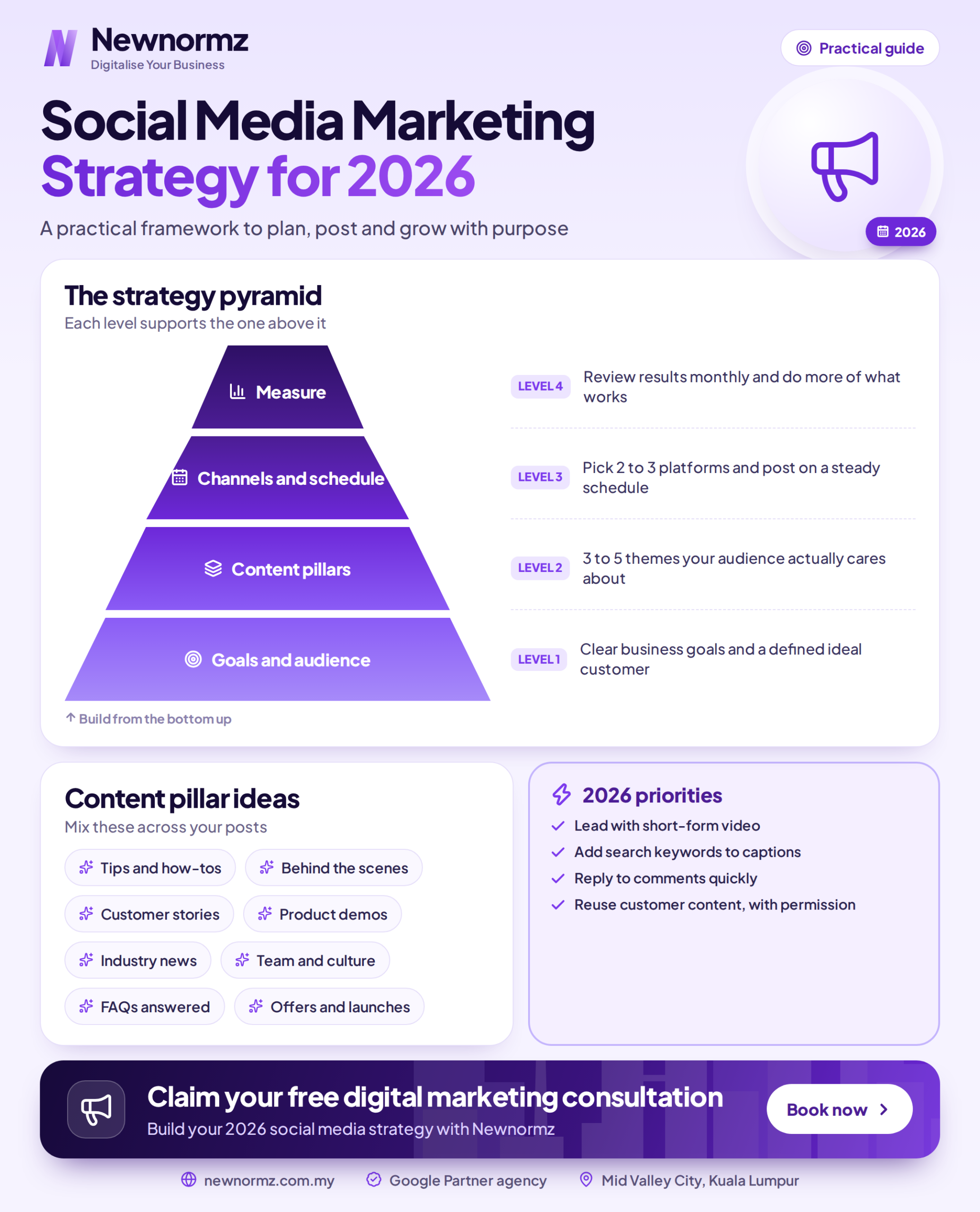
- Anchor to one business goal. Pick a single commercial outcome for the quarter: enquiries, showroom visits, online sales or booked consultations. Test every content decision against that one number.
- Define your audience in one paragraph. Write who they are, what problem they’re solving, and what’s currently stopping them from buying.
- Choose three content pillars. Pillars are repeatable themes, typically educate, show proof, and sell. Three keeps your feed coherent and makes batching content fast.
- Pick two to three platforms. Go where your buyers already spend time. For most Malaysian consumer brands, that means Facebook, Instagram and TikTok.
- Set a weekly cadence you can actually sustain. Consistency over 12 weeks beats a two-week burst followed by silence. Schedule around your audience’s peak windows.
- Define KPIs that map to money. Reach shows distribution, engagement rate shows resonance, and enquiries show commercial impact. Report all three every month.
- Add paid amplification, but only to proven winners. Once a post shows above-average engagement, scale it through a managed Google Ads or social ads campaign to reach cold audiences.
Choosing the Right Platform Mix
Don’t try to be everywhere. Match each platform to one job in your funnel, and master that job before adding another channel.
| Platform | Best role for Malaysian SMEs | Priority format | Funnel job |
|---|---|---|---|
| TikTok | Discovery and viral reach | 15 to 45 second video | Awareness |
| Brand proof and product browsing | Reels and carousels | Consideration | |
| Community, retargeting, lead ads | Video, offers, ads | Conversion | |
| B2B credibility and hiring | Founder posts | B2B trust | |
| Closing enquiries into sales | Catalogue and chat | Sales |
For a typical consumer SME, the working combination is TikTok for reach, Instagram for consideration, and Facebook plus WhatsApp for conversion. B2B firms usually swap TikTok for LinkedIn.
Content Formats and Metrics That Actually Matter
Lead with short-form video, then support it with carousels, which consistently earn some of the strongest engagement of any static format on Instagram.
On measurement, stop treating follower count as your primary KPI. A page with 3,000 followers and a 5 percent engagement rate generates more enquiries than one with 30,000 passive followers who never interact. Track four numbers every month instead:
- Reach: unique accounts that saw your content.
- Engagement rate: interactions divided by reach. Above 3 percent on Reels is healthy for an SME.
- Enquiries: DMs, WhatsApp clicks and form fills attributed to social. This is the money metric.
- Cost per enquiry: paid spend divided by enquiries. It tells you exactly when to scale budget.
A 90-Day Example: A Hypothetical Malaysian SME
Here’s a worked, illustrative plan for a fictional Klang Valley home furniture brand, “KayuHaus,” selling solid wood dining sets priced between RM2,500 and RM8,000. This is not a real client; it’s a template you can adapt with your own numbers.
Business goal: generate 120 qualified WhatsApp enquiries in 90 days, converting to at least 18 showroom visits.
Three content pillars: craft and quality (a “solid wood vs. veneer” showroom test, build time-lapses), homes like yours (customer makeover reels, before-and-after photos), and offers and answers (clearance posts, pricing Q&As).
Platform mix: Instagram as the primary channel (Reels plus carousels), TikTok for repurposed Reels to capture discovery, and Facebook for retargeting ads and lead forms feeding into WhatsApp.
Weekly cadence: 3 Reels, 2 carousels, 3 Stories sets with polls, and 1 boosted post, roughly 6 hours a week, batched on one day.
| KPI | Month 1 | Month 2 | Month 3 |
|---|---|---|---|
| Monthly reach | 40,000 | 65,000 | 90,000 |
| Average engagement rate | 2.5% | 3.0% | 3.5% |
| WhatsApp enquiries | 25 | 40 | 55 |
| Cost per enquiry (paid) | RM35 | RM28 | RM22 |
By month 3, a brand like this would shift most production toward the pillar driving the most enquiries, and scale paid budget only on creatives beating its own cost-per-enquiry benchmark.
Common Mistakes to Avoid
- Chasing followers instead of enquiries. Follower growth without engagement produces zero revenue.
- Being on five platforms badly instead of two platforms well.
- Posting only promotions. Keep the sell pillar to roughly one-third of your output.
- No link between social and website. A leaky bio link or a broken WhatsApp funnel stops engagement from ever becoming a sale. If that’s the gap, pair your social plan with an SEO service that fixes the website side too.
- Boosting random posts. Amplify only content that has already proven itself organically.
- Quitting at week 6. Most SME accounts only see compounding reach after 8 to 12 weeks of consistent posting.
The Social Media Strategy Checklist
- One written business goal for the quarter with a number attached
- A one-paragraph audience definition
- Three named content pillars with post ideas for each
- Two to three platforms selected, each with a defined funnel job
- Weekly cadence documented and batched into a production day
- A KPI dashboard tracking reach, engagement rate and enquiries monthly
- A rule to boost only posts already above your average engagement rate
- Your WhatsApp or enquiry funnel tested end to end on mobile
- A monthly review to reallocate effort toward the winning pillar
Frequently Asked Questions
How many platforms should a small business be on?
Two or three at most. Pick the platforms where your buyers actually spend time and where your team can publish consistently. A strong Instagram and Facebook presence with a working WhatsApp funnel will outperform a thin presence spread across five networks.
How often should I post on social media in 2026?
Aim for 3 to 5 quality posts per week per platform, led by short-form video. Consistency matters more than volume. A sustainable cadence held for 12 weeks builds algorithmic trust, while a two-week burst followed by silence resets your momentum to zero.
Why shouldn’t follower count be my main KPI?
Because followers don’t pay you. Platforms now show content to non-followers through recommendation feeds, so reach and engagement rate reflect real performance better. A small, engaged audience that sends enquiries is worth more commercially than a large, silent one.
What is a good engagement rate for a Malaysian SME?
As a rough benchmark, treat 1 to 2 percent on Facebook as normal, and 3 percent or higher on Instagram Reels and TikTok as healthy. Compare against your own monthly average rather than global figures, and dig into any post that performs at double your baseline.
Should I run paid ads or stay organic?
Do both, in sequence. Organic content proves which messages resonate, then paid campaigns scale those winners to cold audiences. Running ads behind already-proven creative typically lowers your cost per enquiry compared with boosting untested posts straight away.
How long before a social media strategy shows results?
Expect early signals, such as improving reach and engagement, within 4 to 6 weeks, and meaningful enquiry volume by weeks 8 to 12. Paid campaigns can produce enquiries within days, but sustainable results come from combining consistent organic posting with disciplined paid amplification.
Do I need an agency to execute this?
Not necessarily. A focused in-house person can run the organic side in 6 to 8 hours a week. Agencies tend to add the most value on paid campaign management and conversion tracking, where specialist experience reduces wasted ad spend and shortens the path to a profitable cost per enquiry.
Still posting without a plan?
Turn Your Social Media Into a System That Sends You Enquiries
Newnormz has run SEO campaigns across F&B, healthcare, ecommerce, and local services in Malaysia, backed by a performance guarantee of 70 percent of targeted keywords on Google’s first page.
30 minutes, no obligation, and no jargon.

Bryan Tan is an SEO Specialist and CEO at Newnormz, helping hundreds of businesses achieve first-page rankings on Google. With a passion for driving organic growth, Bryan blends innovative strategies with hands-on experience to optimize websites for maximum visibility. Always at the forefront of the latest SEO insights and trends, he consistently adapts to the evolving digital landscape.