Short verdict
Schema markup is a block of code (usually JSON-LD) that tells Google exactly what your page is: a business, a product, a price in RM, an address, opening hours. If you searched “schema markup Malaysia” because an audit or plugin flagged it, the short answer is yes, add it, but keep your expectations honest. It is not a ranking factor and it doesn’t guarantee rich snippets. It makes your pages eligible for rich results and helps Google and AI answer engines understand who you are. Three or four well-chosen schema types will do more for you than twenty plugin defaults.
What Schema Markup Actually Tells Google (and What It Can’t Do)
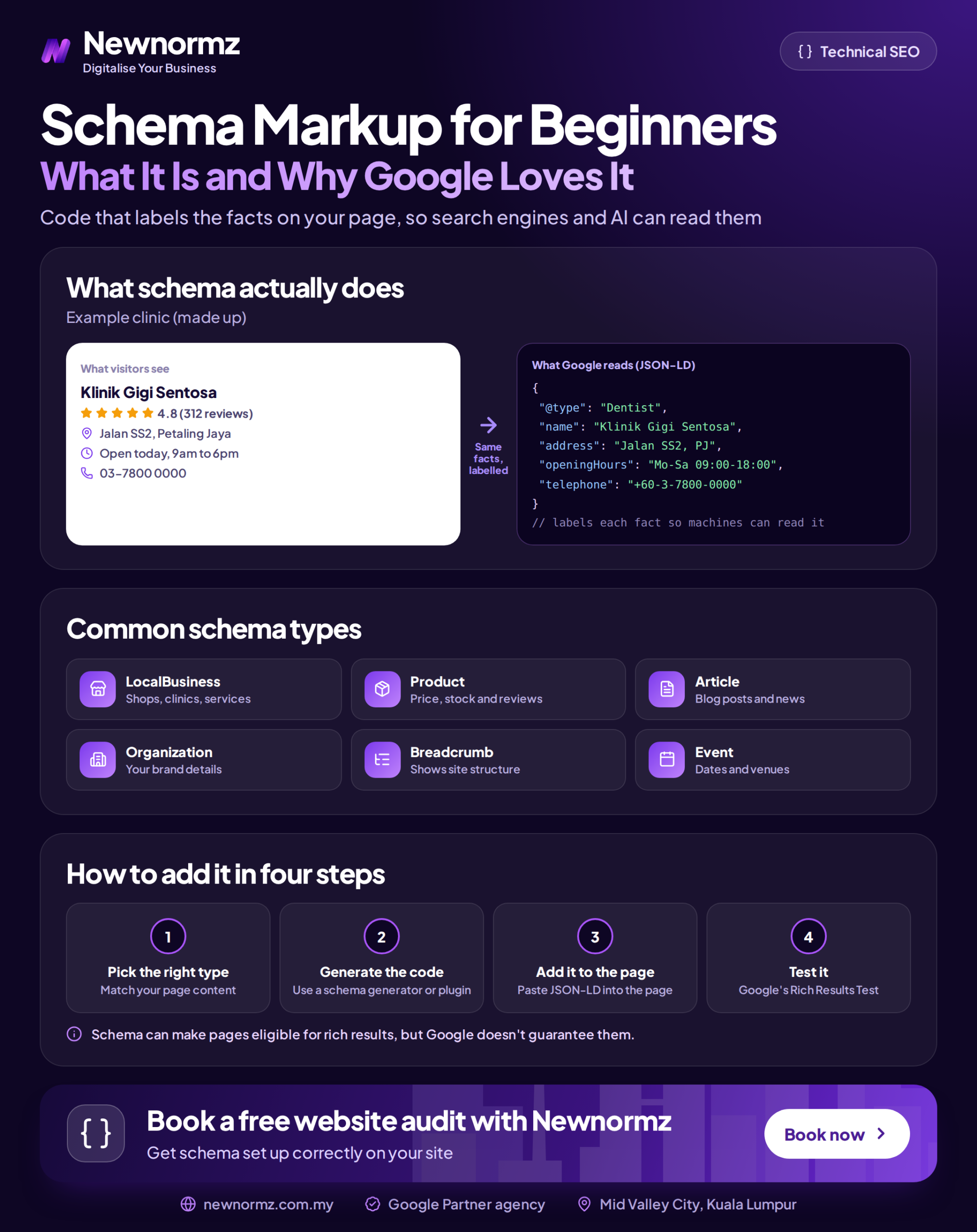
So, what is schema markup in plain terms? Your page is written for people, and schema translates its key facts for machines. A customer reading your contact page sees “Open Monday to Saturday, 9am to 6pm” and understands it straight away. Google sees a line of text it has to interpret. Schema takes away the guesswork by stating the same fact in a fixed, machine-readable format. That is the whole idea behind structured data SEO.
This matters more than most Malaysian owners assume. Google handles roughly 93 to 96% of searches in Malaysia (Statcounter), so the way Google reads your page is close to the way the whole market finds you.
Schema.org Vocabulary and JSON-LD, the Format Google Recommends
Schema.org is a shared vocabulary that Google, Bing and Yahoo launched in 2011, and Yandex joined soon after. It defines types (LocalBusiness, Organization, Product, BreadcrumbList) and the properties each type can have (address, telephone, priceCurrency). JSON-LD is the format you write them in. Google’s Search Central documentation recommends JSON-LD because it sits in one script block, separate from your visible HTML, which makes it easy to add and maintain.
Here is a short JSON-LD schema example for a fictional florist in Bangsar:
<script type="application/ld+json">
{
  "@context": "https://schema.org",
  "@type": "Florist",
  "name": "Kedai Bunga Contoh",
  "telephone": "+60 3-1234 5678",
  "address": {
    "@type": "PostalAddress",
    "streetAddress": "12, Jalan Telawi 3, Bangsar Baru",
    "addressLocality": "Kuala Lumpur",
    "postalCode": "59100",
    "addressRegion": "Wilayah Persekutuan Kuala Lumpur",
    "addressCountry": "MY"
  },
  "openingHoursSpecification": {
    "@type": "OpeningHoursSpecification",
    "dayOfWeek": ["Monday","Tuesday","Wednesday","Thursday","Friday","Saturday"],
    "opens": "09:00",
    "closes": "18:00"
  }
}
</script>
Each property is a fact Google can check against other sources, especially your Google Business Profile. That cross-checking is how Google builds its picture of your business as an entity, and it is what eventually feeds a Knowledge Panel.
If you want the bigger picture, our guide explains how Google’s Knowledge Graph works and where your markup fits into it.
Why Schema Is a Label, Not a Ranking Boost
Does schema markup help SEO? Indirectly. Google has said publicly that structured data is not a ranking factor in itself. Its structured data documentation also says markup makes a page eligible for rich results but does not guarantee they will appear. Google decides query by query, based on page quality, relevance and whether the markup matches what visitors can actually see on the page.
The real payoff is how your listing looks. A product result showing RM89, “In stock” and a star rating takes up more space and answers questions before anyone clicks. At the same position, a fuller listing usually earns more of the clicks.
Schema won’t make Google rank you. It makes sure Google can’t misunderstand you.
Schema and AI Answers: The Short Version
Google AI Overviews, ChatGPT and Perplexity need to be confident about who a business is before they name it. Organization and LocalBusiness markup that matches your Google Business Profile and other listings gives them a clean set of facts to attach to your brand name.
It supports your visibility but it isn’t a shortcut. Industry studies put about 76% of AI Overview citations on pages already ranking in the traditional top 10, so ranking work still comes first. For the AI-specific setup, read our practical guide to schema for AI search engines.
Rich Snippets Malaysia Searchers Still See in 2026
Most beginner guides still list every rich result Google has ever offered. Several of those are now gone or limited to a few sites. Here are the schema markup examples you will actually see (or no longer see) in Malaysian search results today.
| Schema type | What shows in Google | Malaysian example | Still showing in 2026? |
|---|---|---|---|
| Product | RM price, stock status, star rating | A Shopee or Lazada seller’s own WooCommerce store | Yes |
| LocalBusiness / Organization | Logo and details in the Knowledge Panel, alongside your Google Business Profile | A single-outlet bakery in Subang Jaya | Yes, but Google chooses what to display |
| BreadcrumbList | Site path (Home > Coffee > White Coffee) in place of the raw URL | Any ecommerce category page | Desktop yes; mobile has shown the domain only since early 2025 |
| Review | Star ratings under the listing | Customer reviews on a product page | Product reviews yes; reviews a business marks up about itself, no |
| Recipe | Photo, cooking time, rating | A food blog’s nasi lemak or rendang recipe | Yes |
| Event | Date, venue, ticket link | A workshop or concert at a KL venue | Yes, though display varies by query |
| FAQ | Expandable questions under the listing | A government ministry or major health site | Only for well-known government and health sites (since August 2023) |
| HowTo | Step-by-step instructions in the result | A DIY waterproofing tutorial | No, retired in 2023 |
The review row causes the most confusion. Genuine customer reviews on product pages can still earn stars. Reviews a business collects about itself and marks up as LocalBusiness or Organization reviews have not shown as stars since Google’s 2019 change on self-serving reviews. Our guide to getting star ratings in search explains what still qualifies.
FAQ markup works the same way. Most Malaysian business sites won’t get the dropdowns any more, but a clear question-and-answer format still helps AI engines lift answers from your page. That is a different goal, and we cover it in our piece on FAQ schema for AI answers.
How Oriental Kopi and Sunway TCM Centre Used Schema as Part of a Bigger Fix
Client example
Oriental Kopi: +350% ranked keywords
Problem: A national F&B and retail brand needed its products to be found and understood for high-volume coffee searches.
What we did: Optimised content around “kopi”, “white coffee” and “3 in 1 coffee”, added full schema across the site and fixed ecommerce technical issues, all as one programme.
Result: +350% ranked keywords, and 468,000 clicks and 6.31M impressions over a 2-year SEO campaign. ChatGPT now names Oriental Kopi as a top answer for the best kopi brand in Malaysia.
Sunway TCM Centre followed a similar pattern. A technical rebuild, crawl and indexing fixes and AEO structuring put 80% of its target keywords on page 1 within 4 months, and the centre now appears in Google AI Overview results for treatment searches. In both cases schema was one part of the work, not the sole cause.
Schema vs Rich Snippets vs Meta Tags: Three Things Beginners Mix Up
These three terms come up together in audits and plugin settings, but they do different jobs.
| Term | What it is | Who controls it | Visible to users? |
|---|---|---|---|
| Schema markup | Code that labels the facts on a page | You | No, only machines read it |
| Rich snippet (rich result) | An enhanced listing with stars, price or breadcrumbs | Yes, in search results | |
| Meta tags | Title and description tags that suggest how your listing reads | You suggest, Google may rewrite | In search results, not on the page |
Put simply, you write schema, and Google decides whether to turn it into a rich snippet. Once that is clear, our full list of schema types shows what exists beyond the core four.
Schema Markup Malaysia: Is It Worth the Effort for Your Business?
For most sites it is, but the order you do things in matters. Use these rules to decide where to start, and when to wait.
Your First Schema Setup: A 5-Step Schema Beginner Guide
These steps cover a schema markup WordPress setup running Rank Math or Yoast SEO, which describes most Malaysian SME sites we see. Expect it to take an afternoon, plus a few weeks of watching the results.
Check what you already have
Run your homepage, a product or service page and your contact page through the Google Rich Results Test, then through the Schema Markup Validator at validator.schema.org. The first shows what Google can use for rich results. The second shows every type on the page, including ones Google ignores.
Add Organization or LocalBusiness with exact NAP
Your name, address and phone must match your Google Business Profile character for character. Use the +60 format (+60 3-1234 5678, not 03-12345678), the five-digit Malaysian postcode, and the state written the same way each time, such as “Selangor” or “Wilayah Persekutuan Kuala Lumpur”.
Add Product or Service schema in MYR
Product schema price MYR formatting is strict. Set "priceCurrency": "MYR" and write the price as a plain number ("price": "89.00"), never “RM89”. On WooCommerce, Product schema comes from the store settings, so check that the store currency is set to Malaysian ringgit.
Validate, then watch Search Console
Re-test each page, then request indexing. Over the next 2 to 4 weeks, check the enhancement reports in Google Search Console (Products, Breadcrumbs, Merchant listings) for errors and warnings as Google recrawls.
Remove duplicate schema
If the validator shows two Organization or two Product blocks, switch off schema output in every tool except one. If you build pages with Elementor, follow our walkthrough on adding schema in Elementor so the page builder and your SEO plugin don’t overlap.
From our audits
We see the same three problems again and again. First, duplicate schema: Yoast or Rank Math, the theme and Elementor each output their own Organization block, sometimes with three different logos. Second, markup that doesn’t match the visible page, such as a sale price in the schema that the page no longer shows, which Google treats as misleading. Third, a phone number in the schema that differs from the one on Google Business Profile, which weakens the entity signal you were trying to build.
Schema is a standard part of the Knowledge graph pillar in the RANKED Framework Newnormz uses for client SEO. If cleaning up plugins, matching NAP and monitoring reports across dozens of pages sounds like more than your team can take on, our SEO services in Malaysia include it alongside the content and technical work that schema depends on.
Frequently Asked Questions
Is schema markup a Google ranking factor?
No, Google has said structured data is not a direct ranking factor. It helps Google understand your page and makes it eligible for rich results, and a fuller listing can improve click-through at the same ranking position.
Does adding schema guarantee rich snippets in Google?
No, Google’s own documentation says structured data makes a page eligible for rich results but does not guarantee them. Google decides per query, based on page quality and whether the markup matches the visible content.
Can I add schema markup myself on WordPress without coding?
Yes, Rank Math and Yoast SEO add Organization, BreadcrumbList and article schema automatically, and WooCommerce outputs Product schema. LocalBusiness details usually need the plugin’s local SEO settings or an add-on, and you should still check the result in the Rich Results Test.
Do FAQ rich results still show on Google in Malaysia?
Rarely. Since August 2023, Google has limited FAQ rich results to well-known, authoritative government and health websites. FAQ markup can still help AI engines read your answers, but most business sites should not expect the dropdowns.
Does schema markup help my business appear in AI Overviews and ChatGPT?
It helps, but it is not enough on its own. Consistent Organization and LocalBusiness markup makes it easier for AI engines to connect facts to your brand, yet industry studies show about 76% of AI Overview citations come from pages already in the top 10, so rankings still matter most.
Is your schema helping you, or quietly clashing with your Google Business Profile?
Newnormz runs SEO for 200+ Malaysian businesses on month-to-month terms, with a written page 1 guarantee and a 5.0 rating from 214+ Google reviews. Send us a WhatsApp message and a strategist will reply within business hours.
Prefer a form? Claim your free SEO audit

Bryan Tan is an SEO Specialist and CEO at Newnormz, helping hundreds of businesses achieve first-page rankings on Google. With a passion for driving organic growth, Bryan blends innovative strategies with hands-on experience to optimize websites for maximum visibility. Always at the forefront of the latest SEO insights and trends, he consistently adapts to the evolving digital landscape.