Review schema is the structured data markup that tells Google, Bing, and AI search tools to display star ratings, review counts, and average scores directly inside a search result, turning a plain blue link into a listing with visible social proof. It will not move your ranking position on its own, but for an eligible page it can make that listing far more clickable than the ones sitting above it. For a Malaysian SME weighing whether professional SEO support is worth the spend, this is one of the most measurable technical wins available.
A Simple Way to Think About It
A Storefront With Reviews in the Window
🚪 The Shop With No Signage
A shop on a busy street with no sign, no reviews taped to the window, and no way to tell if anyone who walked in ever walked out happy. Most people just keep walking.
⭐ The Shop With Stars on the Door
A shop two doors down with a handwritten sign reading four and a half stars from three hundred customers. People stop, even if they were not planning to.
That same difference plays out in Google’s results every day. The sections below explain exactly which code makes the stars appear, and why so many businesses lose them.
What Is Review Schema?
Review schema is a subset of schema.org structured data that marks up ratings and reviews so search engines can read them as data, not just as text on a page. Two formats matter most: the Review type, which marks up a single opinion, and the AggregateRating type, which summarises many reviews into one average score and a total count. Google’s Rich Results system reads this markup and, when a page qualifies, displays star ratings directly beneath the page title in search results.
Malaysian SMEs typically use this markup in three places: product pages on Shopify or WooCommerce stores, local business pages for clinics, salons, and restaurants, and service pages for professional firms. Google’s own structured data guidelines for review snippets set out exactly which page types qualify and which reviews the system will reject, so it is worth treating that document as the source of truth rather than guessing.
Why Review Schema Matters for Malaysian SMEs
Reviews are how people compare businesses before they ever visit one. BrightLocal’s consumer survey found that 97 percent of respondents read business reviews and 92 percent consider star ratings before choosing a business. When a page is eligible for review schema, Google can display those stars and a rating count right next to the listing, which is exactly the kind of detail that makes one result stand out from ten identical-looking blue links above it.
This matters more in a market like Malaysia, where Google holds roughly 93 percent of search share (Statcounter, May 2026) and most local buying decisions now start with a phone search rather than a walk past a shopfront. A listing with visible stars gives a searcher trust information before they click, which is a genuine click-through rate advantage, not a ranking one.
How Review Schema Works
Google only renders star ratings when the underlying JSON-LD contains specific properties, and getting even one of them wrong is usually enough to disqualify the whole page. A valid implementation needs four elements in place:
Required Schema Properties
itemReviewed: names the exact Product, LocalBusiness, or Service being rated.
reviewRating: a numeric score plus the scale’s upper and lower bounds, usually 1 to 5.
reviewCount or ratingCount: the total number of reviews behind an aggregate score.
author: required on a single Review entry, optional once ratings are aggregated.
The Self-Serving Review Rule Most Businesses Get Wrong
Google does not display review stars when a business marks up reviews about itself on its own website. This self-serving review restriction has applied to Organization and LocalBusiness schema since September 2019, and it catches out a surprising number of SME sites that publish testimonials with star ratings on their own homepage.
Product review markup on an actual product page still qualifies, because Google treats a shopper reviewing a specific item differently from a company rating itself. Owners who confuse these two categories often lose their rich result entirely, and the loss usually only surfaces once a Search Console structured data report flags the error weeks later.
Matching Schema Type to Your Business Category
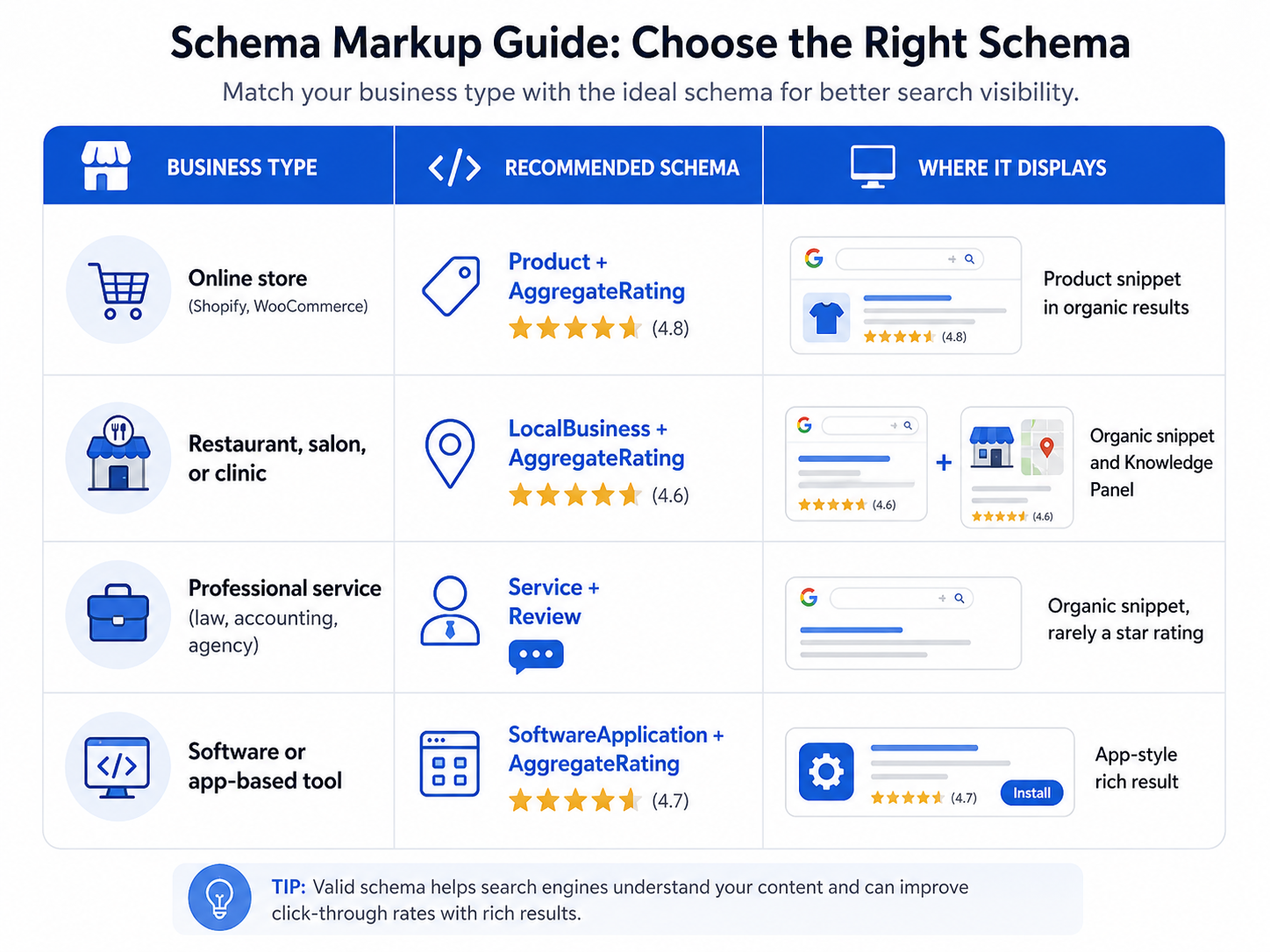
The correct schema type depends entirely on what a Malaysian SME actually sells, and using the wrong one is one of the fastest ways to have a submission rejected.
| Business Type | Recommended Schema |
|---|---|
| Ecommerce product pages | Product with Review or AggregateRating |
| Clinics, salons, restaurants | LocalBusiness, using genuine third-party reviews only |
| Professional service firms | Service, scoped to a specific offering rather than the whole firm |
| Company or corporate homepage | No self-authored review markup; rely on independent review platforms instead |
Common Mistakes That Get Review Schema Rejected
Four errors account for most of the rejected or missing rich results found during technical SEO audits.
| Mistake | Why It Gets Rejected |
|---|---|
| Self-authored ratings on a company page | Falls under Google’s self-serving review restriction |
| Markup references reviews not visible on the page | Structured data must match what a human visitor can actually see |
| Review text copied from a third-party platform without permission | Breaches platform terms and Google’s data accuracy expectations |
| Missing bestRating or worstRating | Breaks the star scale Google needs to render the snippet |
How Newnormz Implements Review Schema Correctly
Newnormz’s SEO service team identifies which pages actually qualify for review schema before writing a single line of markup. The schema is built against Schema.org and Google Search Central guidelines, then tested with Google’s Rich Results Test before it ever goes live. This same process supports the local SEO work behind client results such as Times Parking’s 528,000 impressions and 416 ranking keywords over a six-month campaign, and Sunway Medispa’s 700 percent traffic increase over the same timeframe. Neither result came from schema alone, but clean structured data was part of the technical foundation in both cases.
Is your listing missing its stars?
Find Out If Your Pages Qualify for Review Schema
Newnormz has run SEO campaigns across F&B, healthcare, ecommerce, and local services in Malaysia, backed by a performance guarantee of 70 percent of targeted keywords on Google’s first page.
30 minutes, no obligation, including a check of your review schema eligibility.

Bryan Tan is an SEO Specialist and CEO at Newnormz, helping hundreds of businesses achieve first-page rankings on Google. With a passion for driving organic growth, Bryan blends innovative strategies with hands-on experience to optimize websites for maximum visibility. Always at the forefront of the latest SEO insights and trends, he consistently adapts to the evolving digital landscape.