Your FAQ dropdowns have gone from Google, the plugin is still installed, and someone on LinkedIn says schema is the key to AI search. Here is where FAQ schema SEO stands in 2026. Since August 2023, Google has shown FAQ rich results only for well-known, authoritative government and health websites, so for almost every Malaysian business those dropdowns are gone for good. The markup still has a job. It hands AI engines a clean question and an answer they can quote, but only when the answer visible on your page is worth quoting.
This guide is for Malaysian SME owners, marketers and WordPress managers. It will help you decide whether FAQ schema is worth the effort, which pages should carry it, and whether to fix it yourself or hand it to a specialist.
Key takeaways
- ✓FAQ rich results are limited to authoritative government and health sites, so adding FAQPage markup won’t bring your dropdowns back.
- ✓Google’s own documentation says AI Overviews and AI Mode need no special markup. Ranking and a clear visible answer come first.
- ✓FAQPage structured data still makes your question and answer pairs easier for machines to read, which pays off once you already rank.
- ✓Only mark up a page when the questions are real, the answer is visible word for word, and it includes a price, timeframe or condition.
What Google Actually Changed, and What It Didn’t
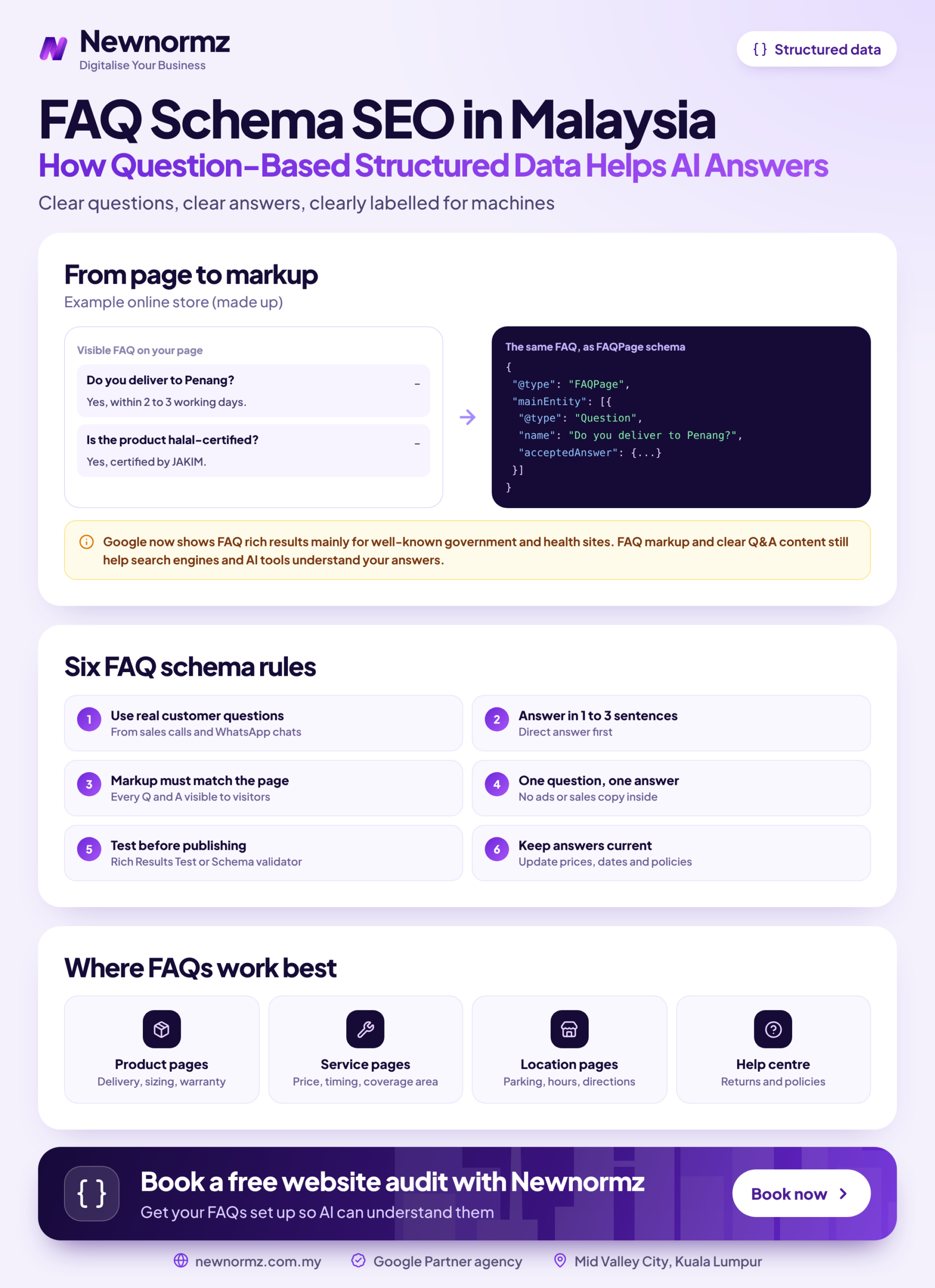
In August 2023, Google Search Central announced that FAQ rich results would only appear for well-known, authoritative government and health websites. Every other site lost the expandable questions under its listing, even with perfectly valid markup. If your FAQ rich results disappeared around then, nothing broke on your side. Google changed who qualifies.
Some things stayed the same. FAQPage is still a valid schema.org type, Google still parses it, and Google’s structured data guidelines still apply: anything you mark up must be visible to visitors on the page. Google’s “AI features and your website” documentation goes further. It says there are no extra technical requirements and no special markup needed to appear in AI Overviews or AI Mode. The page has to be indexed and eligible to show a snippet in normal Search.
So does FAQ schema still work? It no longer works as a visual trick in Google. It still works as a machine-readable label. If you’re deciding which other types are worth the effort, this guide to schema types that matter for AI search covers the wider set.
| Question | FAQ rich results | FAQPage structured data |
|---|---|---|
| Status in 2026 | Limited to well-known government and health sites since August 2023 | Still a valid schema.org type that Google parses |
| What a searcher sees | Expandable questions under the listing, for qualifying sites only | Nothing. It is code that sits in the page |
| Who benefits | A small group of authoritative sites | Any site with real Q&A that visitors can see |
| Value for AI answers | None directly | Labels question and answer pairs so they are easier to parse |
| Rule that still applies | Eligibility is Google’s decision, not yours | Marked-up text must match what visitors can see |
How Question-Based Structured Data Feeds AI Answers
An AI engine building an answer looks for a passage that settles the question cleanly. A question and answer pair is already that kind of passage: the question mirrors the prompt, and the answer sits directly under it. FAQPage markup labels the pair, so a parser doesn’t have to guess where the question ends and the answer starts. That is the honest case for structured data for AI search.
Markup can’t get your page considered in the first place. Industry studies put about 76% of Google AI Overview citations on pages that already rank in the traditional top 10. Schema helps engines read what is already on the page. It doesn’t create rankings, and it can’t make a vague answer worth quoting. Most answer engine optimisation is writing work. Markup is the last step.
The markup is the label on the jar. If the jar is empty, a better label won’t get it picked off the shelf.
Google AI Overviews and AI Mode
Both draw on Google’s own index. To be cited, a page has to be indexed and rank reasonably well for the query or one of the related searches Google runs behind the scenes. Google calls these related searches “query fan-out” in its AI Mode announcements. Normal ranking comes first. FAQ schema for AI Overviews adds clarity on top of a page that is already competitive. To see how this shifts clicks and traffic, read our breakdown of how Google AI Mode changes traffic.
ChatGPT, Perplexity and Other Crawlers
ChatGPT search and Perplexity use their own crawlers. OpenAI documents two of them: OAI-SearchBot, which fetches pages for ChatGPT search, and GPTBot, which collects data for model training. Server log analyses have widely reported that many AI crawlers read raw HTML and don’t run JavaScript. If your FAQ accordion loads its questions with JavaScript, or your JSON-LD is injected through Google Tag Manager, these crawlers may see none of it.
Can ChatGPT read FAQ schema? It can fetch JSON-LD that sits in the raw HTML, but OpenAI hasn’t published how much weight it gives to it. You can rely on the visible text being read, so write that text first.
Malaysia note
Cloudflare began blocking AI crawlers by default for new domains in 2025, as was widely reported. Many Malaysian SME sites sit behind Cloudflare because their host or developer set it up, and the owner has never opened the dashboard. Check the bot settings before you spend a weekend perfecting markup that no AI crawler can reach.
The Visible Answer Test: Which Pages Should Carry FAQ Schema
Most advice still says either “add FAQ schema everywhere” or “FAQ schema is dead”. Neither helps you decide what to do with a specific page. Run each candidate page through three conditions. If a page fails any one of them, leave the markup off.
The test is mostly about the writing, not the code. If your FAQ answers need work, this guide to writing question-based content shows how to build answers around the way people actually phrase their searches.
Pages worth marking up
- Service pages that answer the questions buyers ask before they enquire
- Pricing pages with real ringgit figures and conditions
- Support pages covering delivery, warranty or booking rules
- In-depth guides where the FAQ adds answers the body doesn’t cover
Pages to skip
- Blog posts with filler FAQs added only for the markup
- Sitewide FAQ blocks repeated in every footer or template
- Category pages where the FAQ is mostly keyword stuffing
- Forums or community pages where users write the answers
A JSON-LD FAQ Schema Example With Real Malaysian Numbers
Most JSON-LD FAQ schema examples online use placeholder text like “What is your return policy?” Here is one built from Newnormz’s own published SEO pricing and timeline. You can see the content and the structure together. Swap in your own questions, and keep the same answer pattern.
<script type="application/ld+json">
{
  "@context": "https://schema.org",
  "@type": "FAQPage",
  "inLanguage": "en-MY",
  "mainEntity": [
    {
      "@type": "Question",
      "name": "How much does SEO cost in Malaysia?",
      "acceptedAnswer": {
        "@type": "Answer",
        "text": "Newnormz SEO packages cost RM2,900 a month for Starter (20 target keywords), RM4,500 for Growth (40 keywords plus local SEO) and RM6,800 and above for Enterprise (60+ keywords). All prices exclude SST and run month to month, with no lock-in contract."
      }
    },
    {
      "@type": "Question",
      "name": "How long does SEO take to show results?",
      "acceptedAnswer": {
        "@type": "Answer",
        "text": "Expect the first ranking movement between day 60 and day 90. Technical fixes usually land in weeks 2 to 6, traffic and lead growth tends to follow in months 4 to 8, and authority keeps compounding from month 8 to 12 onwards. Competitive keywords take longer."
      }
    }
  ]
}
</script>
Why these answers are built this way
- ✓The first sentence answers the question on its own. If an engine lifts only that sentence, the reader still gets the price or the timeframe.
- ✓Each answer runs about 40 to 60 words. That is long enough to carry a condition and short enough to quote in full.
- ✓Specific figures (RM2,900, day 60 to 90, excluding SST) give engines something concrete to cite, where “affordable” or “fast results” give them nothing.
- ✓Each answer states its own limits (“Competitive keywords take longer”), so it reads as honest and promises no outcome.
- ✓The same text appears word for word in the visible FAQ on the page. The JSON-LD repeats the page’s content and never replaces it.
FAQ Schema in Bahasa Malaysia and Chinese
Many Malaysian businesses serve customers in three languages, and that is where FAQ schema setups most often break. The rule is simple: one language per page. Put your BM FAQ on the BM version of the page, set the html lang attribute to ms, and set inLanguage in the FAQPage block to match. A Chinese page follows the same pattern with zh-Hans for simplified characters. Don’t mix BM and English questions in one FAQPage block, because it leaves engines unsure which audience the page serves.
Write questions the way people actually type or speak them, not as a direct translation from English. A Malaysian searching in BM is far more likely to type “berapa harga” than a formal textbook phrasing.
| English question | Literal translation (avoid) | Native BM phrasing (use) |
|---|---|---|
| How much does SEO cost? | Berapakah kos perkhidmatan SEO? | Berapa harga SEO sebulan? |
| How long does SEO take? | Berapa lamakah masa yang diambil oleh SEO? | Berapa lama SEO nak nampak hasil? |
This matters more now that Malay-language AI answers exist, including Nur AI, a Malaysian AI engine. A BM page with native phrasing and correct language tags gives those engines a clean source in the language the question was asked in. Newnormz strategists work in English, Bahasa Malaysia and Chinese for this reason. A translation tool can’t tell you which phrasing your customers actually use.
Six FAQ Schema Mistakes We Keep Finding in Malaysian Site Audits
These schema markup mistakes appear again and again, mostly on WordPress sites. Each one either wastes the markup or puts it at risk.
✗ 1. The schema says something the page doesn’t
Someone edits the visible FAQ but not the plugin field, or writes a longer “SEO version” only inside the markup. That breaks Google’s rule that structured data must match visible content, and it can lead to a manual action.
✓ The fix
Use a FAQ block that generates the markup from the visible text, such as the FAQ blocks in Rank Math or Yoast SEO, so there is only one copy of each answer to edit.
✗ 2. Five identical FAQs marked up on every page
A sitewide FAQ block in the footer or template sends the same Q&A on 200 URLs. Engines can’t tell which page is the real source, so none of them stands out.
✓ The fix
Keep each FAQ on the one page it belongs to. If the sitewide block is really customer testimonials dressed up as questions, it isn’t an FAQ at all. Read the rules for star rating review schema first, because Google doesn’t show stars for reviews a business publishes about itself.
✗ 3. Two plugins outputting FAQPage on the same page
Rank Math adds one block, and the theme or page builder accordion adds another. The result is duplicated or conflicting FAQPage data, and it is one of the most common FAQ schema WordPress problems we see.
✓ The fix
View the page source and search for “FAQPage”. If it appears twice, turn off schema output in one tool and keep the other.
✗ 4. Visitor questions marked up as FAQPage
FAQPage is for questions and answers the site owner writes. A product Q&A section or forum thread where users post the answers is a different thing.
✓ The fix
Use QAPage for pages built around one question with answers submitted by users. Keep FAQPage for your own authored answers.
✗ 5. Answers written as sales copy
“Why choose us? We are the leading provider with unmatched quality.” No engine quotes that, because it doesn’t answer anything a searcher asked.
✓ The fix
Replace every “why choose us” question with a buyer question: price, timeframe, coverage area, what’s included, what isn’t. Answer it in the first sentence.
✗ 6. FAQs only AI crawlers can’t see
Questions load through JavaScript after the page renders, or robots.txt or the CDN blocks GPTBot and OAI-SearchBot. Your human visitors see a perfect FAQ while the crawlers see an empty section.
✓ The fix
Render FAQ text and JSON-LD in the server HTML. Then check robots.txt and your CDN’s bot settings. Make sure Google-Extended is set the way you intend: Google says it controls use of your content for Gemini, not whether you appear in Search.
How to Check Your FAQ Markup Is Being Read
Run these checks after any change, and repeat the last step every month.
Google Rich Results Test
Confirms Google can parse your FAQPage block without errors. A pass doesn’t mean the dropdowns will appear, because most sites are no longer eligible.
Schema Markup Validator
validator.schema.org checks the markup against the schema.org vocabulary whatever Google’s eligibility rules say. It catches nesting errors and duplicates that a rich-result tool may not flag.
View source
Press Ctrl+U (Cmd+Option+U on a Mac) and search for a phrase from one of your answers. If it’s missing from the raw HTML, JavaScript is loading it, and many AI crawlers won’t see it.
Search Console URL Inspection
Run a live test and open the rendered HTML to confirm Googlebot sees both the visible FAQ and the JSON-LD. If the property isn’t verified yet, start with setting up Google Search Console properly.
Ask the engines, every month
Type your target questions into ChatGPT, Perplexity and Google (to trigger an AI Overview) in English and BM. Note which sources are cited and whether your answer wording shows up. Keep a simple spreadsheet so you can spot changes over time.
Steps 1 to 4 take an afternoon. Step 5 never ends, and it only means something next to ranking data, crawl health and content updates. If you’d rather have that monthly loop run alongside the rankings work it depends on, that is the job of an experienced SEO agency in Malaysia.
Where FAQ Schema Fits in a Wider AI Visibility Plan
Treat it as a stack. Rankings sit at the bottom, because engines mostly cite pages they already trust. Next comes entity clarity: search engines need to know who your business is, what it does and where. Then come brand mentions on other sites. FAQ markup sits on top of all three. It can’t stand in for any of them.
In the Newnormz RANKED Framework, FAQ schema belongs to two stages. “Knowledge graph” covers entity SEO and schema. “Everywhere answers” covers structuring content for AI search. The first stage is explained in more depth in our guide to entity and knowledge graph SEO.
Client example
Sunway TCM Centre: page 1 rankings and AI Overview appearances
Problem: Crawl and indexing issues were holding back a Traditional Chinese Medicine centre in a competitive Klang Valley market.
What we did: A technical rebuild, crawl and indexing fixes, then AEO structuring so treatment content answered real questions directly.
Result: +150% keywords, 80% of target keywords on page 1 within 4 months, and appearances in Google AI Overview results for treatment searches.
Note the order: the technical fixes came first and the answer structuring came on top of them. Markup alone didn’t produce that result. The same pattern appears elsewhere. Oriental Kopi had full schema implementation as part of a campaign that grew ranked keywords by 350%, and ChatGPT now names it as a top answer for the best kopi brand in Malaysia. Times Parking (TIMES24) reached 416 ranking keywords and 528,000 impressions in a 6-month SEO campaign, and ChatGPT names it in answers for “best LPR parking provider”. You can check both in a new tab.
If you want the full stack handled, including AI-crawler access fixes for GPTBot, OAI-SearchBot, ClaudeBot and Google-Extended, citation-format content and monthly Share of AI Voice tracking, see our AI search optimisation services.
FAQ Schema SEO: Questions Malaysian Site Owners Ask
Does FAQ schema still help SEO in 2026?
Yes, but not in the way it used to. It no longer earns FAQ rich results for most sites. It still labels your questions and answers clearly for search and AI engines, which helps when the page already ranks and the answers are specific.
Why did my FAQ rich results disappear from Google?
Google limited FAQ rich results to well-known, authoritative government and health websites in August 2023. Valid markup on other sites stopped showing dropdowns. It isn’t a penalty and nothing on your site needs fixing because of it.
Does Google need schema to show my page in AI Overviews?
No. Google’s “AI features and your website” documentation says no special markup is required. The page needs to be indexed and eligible for a snippet in normal Search. Schema can make your content clearer, but rankings and answer quality decide whether you’re cited.
What is the difference between FAQPage and QAPage schema?
FAQPage is for questions and answers the site owner writes. QAPage is for a page built around one question where users submit the answers, such as a forum thread. Using the wrong one misdescribes the page to search engines.
Should I add FAQ schema to every page?
No. Add it only to pages that pass the visible answer test: real customer questions, answers visible word for word, and specific details such as a price, timeframe or condition. Sitewide repeated FAQs dilute the signal on every page they appear on.
How long should an FAQ answer be to get quoted by AI?
Aim for about 40 to 60 words, with the direct answer in the first sentence. No AI engine publishes a required length. This is a practical range: long enough to include a condition, short enough to quote in full.
Want to know if AI engines can actually read your FAQs?
Newnormz clients like Oriental Kopi, Times Parking and Sunway TCM Centre are named in ChatGPT answers today, and you can check that yourself in a new tab. GEO packages start from RM2,900/month (excluding SST). Send us a WhatsApp message on +60 17-588 2291 and a strategist will reply within business hours.
Prefer a form? Free AI visibility audit

Bryan Tan is an SEO Specialist and CEO at Newnormz, helping hundreds of businesses achieve first-page rankings on Google. With a passion for driving organic growth, Bryan blends innovative strategies with hands-on experience to optimize websites for maximum visibility. Always at the forefront of the latest SEO insights and trends, he consistently adapts to the evolving digital landscape.