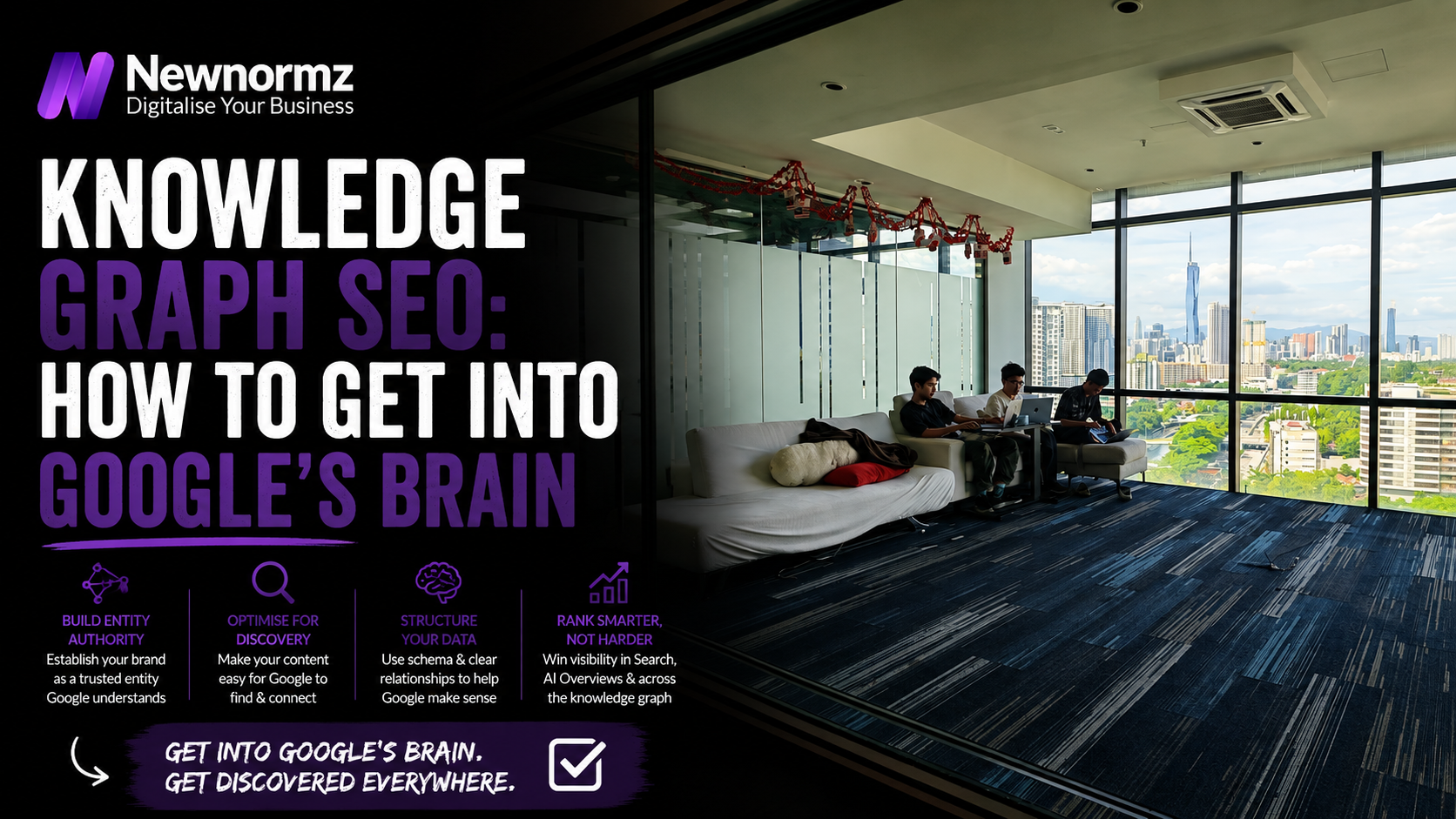
Knowledge graph SEO is the work of getting Google to recognise your business as a specific, verified entity, not just a website that happens to rank for a few keywords. It runs on consistency: the same legal name, address, phone number, logo and services confirmed across your website’s structured data, your Google Business Profile, industry directories and any credible third party mentions. Get that consistency right and Google can build a Knowledge Panel around your business and cite it inside AI Overviews. Leave it inconsistent, and Google, along with tools like ChatGPT and Perplexity that lean on similar entity data, has no reliable answer to give when someone asks about your business directly, so it reaches for a competitor it already trusts instead.
What Is Google’s Knowledge Graph, Exactly?
Google’s Knowledge Graph is a database of real world entities, people, places, organisations and products, along with the facts and relationships that connect them. When Google launched it in May 2012, it already contained over 500 million objects and 3.5 billion facts and relationships between them.
It is a different system from Google’s search index, which stores webpages. The Knowledge Graph exists to help Google understand what a business actually is, then connect that understanding to details like its official name, website, location, services and key people. Google builds this picture from public web content, structured data on your site, licensed databases and information supplied by verified business representatives.
How Knowledge Panels and AI Overviews Use This Data
A Knowledge Panel is the information box that appears beside search results for a recognised entity. Google’s own Search Central documentation confirms these panels are generated automatically from Knowledge Graph facts, they are not something a business can submit or edit directly.
AI Overviews, and tools like ChatGPT and Perplexity, draw on the same type of verified entity data when they summarise a business or answer a buying question. Google holds roughly 93 percent of the search market in Malaysia (Statcounter, May 2026), so when Google’s systems cannot confirm what your business is, you are effectively invisible to almost the entire market, not a small slice of it. If your business has no consistent entity footprint, AI answers simply skip it in favour of a competitor Google already trusts.
Why Entity Trust Matters More Than Keyword Rankings
Traditional SEO chases keyword positions one page at a time. Knowledge graph SEO builds trust once, at the entity level, and that trust supports every page on your site and every AI generated answer about your business afterwards. Schema.org, the structured data vocabulary founded in 2011 by Google, Bing and Yahoo, exists precisely so businesses can hand Google these facts directly in a machine readable format, rather than leaving Google to infer them from scratch.
| Signal | What It Tells Google | Where SMEs Usually Fall Short |
|---|---|---|
| Organisation schema markup | Official name, logo, services, contact details | Missing entirely, or copy pasted from a template site |
| Google Business Profile | Location, category, reviews, hours | Left unclaimed, or inconsistent across branches |
| NAP consistency (name, address, phone) | Same identity across every directory | Different phone numbers or addresses per listing |
| SSM registration match | Legal legitimacy | Trading name on the website differs from the registered entity |
| Authoritative mentions and backlinks | Third party validation | Zero press, directory, or partner mentions |
A Simple Way to Think About It
The Guest List vs the Uninvited Visitor
🚫 Turned Away at the Door
A visitor shows up at a members only building with no ID and a name the guard has never heard before. No matter how well dressed they are, they’re left waiting outside while someone tries to confirm who they even are.
✅ Waved Straight Through
A visitor arrives at the same building, and their name is already on the guest list, matched against ID at the door. The guard doesn’t hesitate. They’re inside before they’ve finished saying their name.
Google runs a version of this check before it will feature a business in a Knowledge Panel or quote it inside an AI Overview. The next section covers exactly what belongs on that guest list.
How Malaysian SMEs Can Start Building Entity Trust
Entry into Google’s Knowledge Graph works as a consistency exercise built over several months, not a one time submission. Four actions move the needle fastest for a Malaysian SME.
Add Organisation schema to your homepage
Include your legal name (matching SSM), logo, services and social profiles as sameAs links, so Google reads the same facts a human visitor would.
Claim and complete your Google Business Profile
Match the category, address and phone number exactly to your website and your SSM record. This is also where local SEO and entity SEO overlap directly, since Google Business Profile feeds both.
Fix every inconsistency across directories
Malaysia Central, Yellow Pages Malaysia and any industry directories your business appears in must all show identical business details, down to the exact spelling of the address.
Earn mentions from sites Google already trusts
A single feature on a recognised Malaysian news outlet or industry association carries more entity weight than ten low quality backlinks.
Most SME owners handle the first two steps alone but stall on directory clean up and earned mentions, which is exactly where a technical SEO audit speeds things up.
How Newnormz Builds Knowledge Graph Visibility for Malaysian Businesses
Malaysian SME owners come to Newnormz with the same problem: their website ranks for a handful of terms but disappears the moment a customer asks Google or ChatGPT a direct question about their industry.
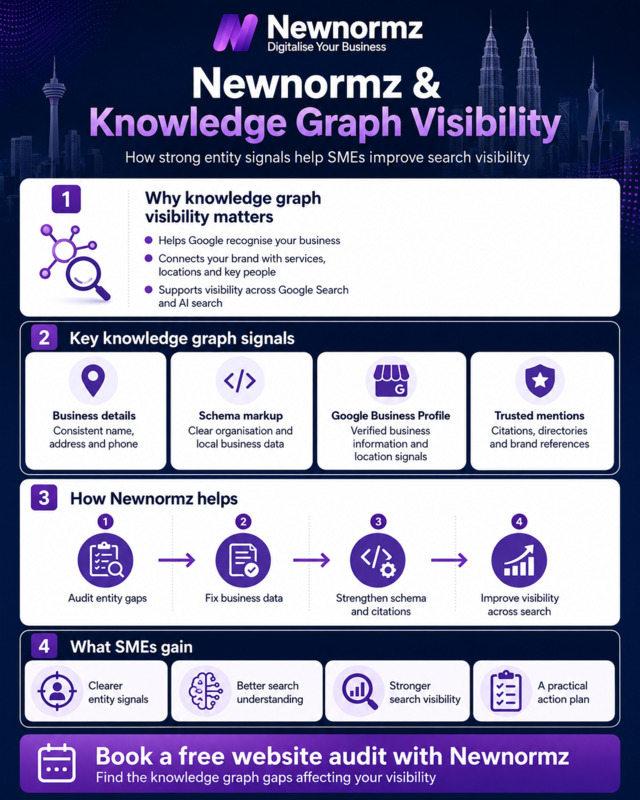
Newnormz’s SEO services team audits your schema, Google Business Profile, SSM business name and directory listings before touching keywords at all. Clients typically have Organisation and LocalBusiness schema implemented within two weeks, followed by a targeted outreach plan to build credible third party mentions.
In one retail case, Newnormz corrected five inconsistent NAP listings for a client, and the business gained a Knowledge Panel within four months of the audit.
Frequently Asked Questions
Why does Google recognise my business listing but still show no Knowledge Panel?
Usually it comes down to conflicting signals. Newnormz checks schema, Google Business Profile data, directory listings and third party mentions for the kind of mismatches that quietly weaken entity recognition.
Which Knowledge Graph issues should a Malaysian SME fix first?
Start with inconsistent business details, missing schema, duplicate listings, weak brand mentions and unclear company relationships. These are the issues Newnormz prioritises in an entity audit.
Can schema markup alone build a stronger Knowledge Graph presence?
No. Schema is necessary but not sufficient. It needs to be combined with accurate listings, credible citations and consistent business information across the web to actually move the needle.
Can Newnormz improve entity recognition without rebuilding my website?
Yes. Most of this work sits on top of your existing pages: schema additions, citation clean up, entity links and clearer company information, rather than a redesign.
Does Knowledge Graph SEO support visibility beyond Google?
Yes. Building clear, consistent entity signals supports how Google, ChatGPT and Perplexity all understand and reference a business, since they draw on overlapping types of entity data.
Does Google even know your business exists?
Find Out What’s Keeping You Out of Google’s Knowledge Graph
Newnormz has run SEO campaigns across F&B, healthcare, ecommerce, and local services in Malaysia, backed by a performance guarantee of 70 percent of targeted keywords on Google’s first page.
30 minutes, no obligation, just a clear look at your entity gaps.

Bryan Tan is an SEO Specialist and CEO at Newnormz, helping hundreds of businesses achieve first-page rankings on Google. With a passion for driving organic growth, Bryan blends innovative strategies with hands-on experience to optimize websites for maximum visibility. Always at the forefront of the latest SEO insights and trends, he consistently adapts to the evolving digital landscape.