For a clinic, social media is a booking system, not an awareness channel. A good social media marketing clinic plan is judged on WhatsApp conversations that turn into kept appointments. Likes and followers don’t count. Below are 8 strategies ranked by how directly each one produces a booked patient. The list starts with your WhatsApp front desk, then Click-to-WhatsApp ads, then clinicians on camera. Each strategy comes with the healthcare advertising limit that changes how you run it in Malaysia: Meta’s personal health rules, Medicine Advertisements Board approval and PDPA.
How to Rank Social Media Marketing Clinic Strategies: By Distance to a Booked Appointment
Most social media marketing for clinics Malaysia-wide starts in the wrong place. The clinic posts more, boosts a promotion and gets 40 likes. Then a WhatsApp enquiry arrives at 9pm and nobody reads it until the next afternoon. More content won’t fix that, because the leak is in the booking path.
At Newnormz we judge social media by one line: turn attention into enquiries, not just views. For a clinic, that means ranking every tactic by how many steps it sits from a kept appointment. Fix the booking path first (WhatsApp, reply speed, the front desk script). Then build trust content. Pay for reach only after that.
1. Make WhatsApp the Front Desk, Not an Afterthought
In Malaysia, most clinic enquiries end up in WhatsApp, whatever platform they started on. A patient sees a Reel, taps the WhatsApp button and asks “how much ah?” What happens in the next ten minutes decides whether that person books with you or with the clinic down the road.
Use the WhatsApp Business App (or the API if you have several branches) with a greeting message, an away message that gives a real reply time, and labels for each enquiry stage. Assign one person per shift to own the chat, not “whoever is free”.
Effort: low. Time to impact: days.
A first-reply script that qualifies the patient without collecting medical details in chat:
“Hi, thanks for messaging [Clinic]. I’m Aina from our front desk. To find you the right slot: 1) Which treatment are you asking about? 2) Which branch suits you? 3) Weekday or weekend, morning or evening? Our doctor will go through your health history in person at the consultation, so there’s no need to share it here.”
That last line matters. Under the PDPA (Personal Data Protection Act 2010), health information is treated as sensitive personal data, which generally means you need explicit consent before you collect and process it. Keep diagnoses, medications and photos of conditions out of chat where you can. Tell patients how their details will be used, and limit chat access to staff who need it. Confirm the specifics with your compliance adviser.
From our audits
Patients message two or three clinics at once. If you reply the next morning, the patient has usually booked with the clinic that answered first. We see this again and again, and it’s the cheapest leak to fix. A same-hour reply rule during clinic hours often adds more bookings than another month of posting.
If you want the chat flow, labels and broadcast lists set up properly, our WhatsApp marketing services cover the full enquiry path.
2. Run Click-to-WhatsApp Ads for Clinics Instead of Boosted Posts
Skip boosted posts if you want bookings. A boost tells Meta to find people who like and comment, and those people are rarely the ones who book. A boost is fine in one case: a post is already doing well organically, with real comments from real patients, and you want more local people to see that social proof.
Click-to-WhatsApp ads open a WhatsApp chat with your clinic straight from the ad. You build them in Meta Ads Manager with a messaging objective and WhatsApp as the destination. Each lead costs more than an Instant Form lead, but you get a live conversation with a patient whose intent you can judge in two messages. That’s why click to WhatsApp ads for clinics usually come out ahead on cost per appointment, as the example below shows.
Instant Forms collect a name and number inside Facebook or Instagram. They’re cheap, partly because people tap through them without thinking. If you use forms, choose the higher-intent form type (it adds a review step before submitting). Add one or two multiple-choice qualifying questions too, such as treatment interest and preferred branch. You’ll get fewer leads, but your front desk wastes far fewer calls.
Effort: medium. Time to impact: 2 to 4 weeks, including a learning period. Medical clinic Facebook ads like these need someone watching cost, chat quality and creative fatigue every week. That’s the work our Facebook ads management team does.
Worked example: cost per lead vs cost per appointment
The numbers below are a hypothetical example to show the maths. They aren’t market rates. A clinic spends RM3,000 a month and tests two setups:
| Example only | A: Instant Form | B: Click-to-WhatsApp |
|---|---|---|
| Monthly spend | RM3,000 | RM3,000 |
| Leads or chats | 300 at RM10 each | 150 at RM20 each |
| Kept appointment rate | 15% (45 patients) | 40% (60 patients) |
| Cost per kept appointment | RM66.67 | RM50.00 |
On cost per lead, setup B looks twice as expensive. On cost per appointment, it’s the better campaign, and the clinic sees 15 more patients from the same budget.
Booking rate swings results more than lead price does, and we see the same thing in paid search. One Newnormz Google Ads client, a chiropractic centre in PJ spending RM4,300 a month, got 224 qualified leads at RM18.74 each, and 60 to 70% of those leads became appointments. That’s a Google Ads search result, not social, so don’t read it as a social benchmark. It shows why a qualified RM18 lead can beat an unqualified RM8 one.
To run your own numbers before you change budgets, plug them into our free social media ROAS calculator.
3. Write Ads That Pass Meta’s Personal Health Rules on the First Try
Healthcare social media marketing has a rulebook most retail brands never deal with. Meta’s personal attributes policy says ad text can’t assert or imply that the viewer has a health condition. Anything that says “you” next to a condition is the usual trigger. Treat the rule as a creative brief: write about the treatment, the process or a situation people recognise, never about the viewer’s body.
✗ “Are you suffering from back pain? Book your chiropractic session today.”
This implies the viewer has back pain, so it’s likely to be rejected or limited. It also reads like every other clinic ad in the feed.
✓ The fix
“Long drives, desk jobs, weekend badminton. Here’s what our chiropractor checks in a first assessment, step by step.” It describes situations and the process, not the viewer’s condition, and it gives a reason to watch.
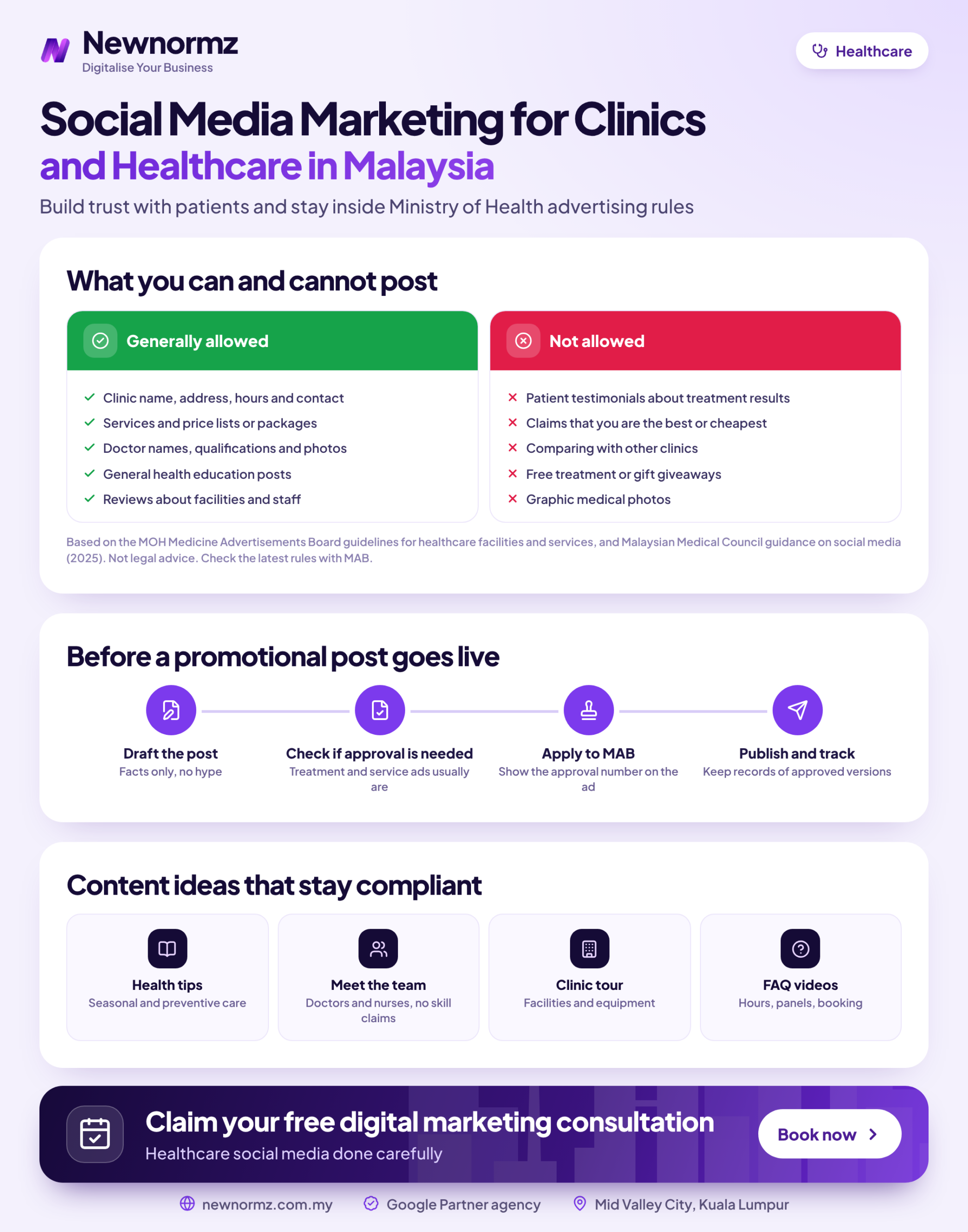
Then come the healthcare advertising rules Malaysia sets on top of Meta’s. Healthcare and medicine-related ads may need approval from the Medicine Advertisements Board (MAB) under the Ministry of Health before they run. Doctors are also bound by Malaysian Medical Council conduct rules on how they present themselves and their services. These rules are detailed and they change. Confirm what applies to your clinic with MAB or your compliance adviser before launch, not after a complaint. Avoid claims like “best”, “guaranteed results” or “painless” unless you have confirmed they are allowed.
Effort: low once you have a template. Time to impact: immediate, because rejected ads and paused campaigns stop costing you weeks.
4. Put Clinicians on Camera with Education-First Short Video
A graphic saying “Book your scaling and polishing now” competes with every other promotion in the feed. A dentist explaining in 40 seconds why their gums bleed after flossing gives a patient a reason to trust a person. Doctor TikTok marketing and Instagram Reels work for clinics because patients choose a practitioner, not a logo.
Native beats polished. Phone footage in the treatment room, good audio from a clip-on mic and captions usually outperform a studio ad. They look like the rest of the feed, and they show the actual clinic the patient will walk into.
Clinic content ideas as hook formulas you can film this week:
- “3 things I check before recommending [treatment].”
- “What actually happens in your first [treatment] session.”
- “Patients always ask me this about [treatment]. Here’s my honest answer.”
- “[Common belief] is a myth. As a [role], here’s why.”
- “Is [treatment] painful? Watch it, then decide.”
Keep the clinician educating, not selling, which also keeps you closer to MMC expectations on self-promotion. Effort: medium. Time to impact: 4 to 8 weeks. A realistic rhythm is two videos a week, batch-filmed in one 90-minute session each fortnight, so the doctor isn’t pulled away from patients every day. If filming and editing in-house keeps slipping, short-form video production is the easiest part to hand off.
5. Build Content Pillars Around Patient Fears, Not Promotions
Patients don’t delay booking because they lack a discount. They delay because they’re unsure. Will it hurt? How long is the downtime? How much will it really cost? Content that answers those three questions converts better than any “20% off this month” post. For dental clinic social media and aesthetic clinic marketing in Malaysia, those fears are the content plan.
Four pillars cover almost every clinic:
- Process and what to expect: the first visit, the room, how long it takes.
- Myths: what patients believe, corrected by a clinician.
- Team and facility: who treats you, sterilisation, the waiting area.
- Patient questions answered: real WhatsApp questions, anonymised.
Sample weekly clinic content calendar
- ✓Monday: clinician Reel or TikTok answering “Is [treatment] painful?”
- ✓Wednesday: carousel busting one myth, written in plain language
- ✓Thursday: second clinician video walking through a first session
- ✓Saturday: team or facility story (new equipment, a therapist’s background)
- ✓Daily: Stories with clinic hours, open slots and a WhatsApp link
Effort: medium. Time to impact: 1 to 3 months, as the posts build up into a library the front desk can send to hesitant patients.
6. Speak to Each Language Segment Separately, Including Xiaohongshu
A single English ad translated into BM and Chinese usually underperforms. The worries, the words and even the decision-maker differ by segment. Write creative per language: a BM video from a Malay-speaking therapist, a Chinese video using the terms patients actually search, an English version for the urban mixed audience. Newnormz strategists work in English, Bahasa Malaysia and Chinese for exactly this reason.
From our experience running campaigns, Facebook still matters for older and family decision-makers. That makes it relevant for confinement centres (where parents and in-laws often weigh in), paediatrics and elderly care. Younger aesthetic and wellness patients are more often found on Instagram and TikTok.
For aesthetic clinic marketing Malaysia has one channel many competitors overlook: Xiaohongshu. It deserves a look if you’re an aesthetic, skin or wellness clinic with Chinese-Malaysian patients, because many use it to research treatments and read others’ experiences before they book. It rewards detailed, honest posts more than ads, so treat it as a research channel and point readers to WhatsApp.
Effort: medium to high. Time to impact: 1 to 2 months per new segment.
7. Turn Patient Reviews into Social Proof Without Breaking Confidentiality
Patient reviews on social media are your strongest proof, and the easiest place to get compliance wrong. Get written consent before you share any patient’s words, face or story. Never confirm in a public comment that someone is your patient, even when they post first. “Thanks for the kind words, we’re glad you had a good experience with us” works. “Glad your root canal went well, Mr Lim” doesn’t.
Negative comments need the same discipline. Acknowledge them publicly in one calm line, then move the conversation to WhatsApp or a phone call, and keep clinical details out of the thread. Reply speed and tone are part of performance, because new patients read the comments before they book. Our guide to handling patient comments and DMs covers reply templates.
Before-and-after content is a special case. Check MAB requirements and Meta’s ad policies first, and get specific approval before you use it in ads. Effort: low to medium. Time to impact: ongoing.
8. Track Appointments Back to Ads, Not Just Leads
Meta will tell you how many chats an ad started. It won’t tell you who turned up. Good social media management for clinics closes that gap. Install the Meta Pixel plus the Conversions API so Meta gets reliable data. Then label every WhatsApp chat by source: UTM tags on links, a different pre-filled greeting per Click-to-WhatsApp campaign, or a separate number for a major campaign.
One health-data caution: don’t send event names, URLs or parameters that reveal a condition or treatment to Meta (for example, an event called “Botox_Booking” or a page URL like /hair-loss-consult). Use neutral events such as Lead or Schedule. Meta’s own health data restrictions and the PDPA both point that way.
A weekly reporting table the front desk can fill in, in 10 minutes:
| Week | Spend | Chats | Qualified chats | Booked | Kept | Cost per kept appointment |
|---|---|---|---|---|---|---|
| Example week | RM750 | 38 | 24 | 18 | 15 | RM50 |
| Your week |
The example row uses illustrative numbers. If qualified chats are high but kept appointments are low, look at reminders and the front desk, not the ads. For the full formula and what to include beyond clinic metrics, see our walkthrough on measuring social media ROI properly. Effort: medium to set up, low weekly. Time to impact: every decision after week one.
That’s eight systems running alongside a full patient list. If that’s more than your team can carry, a social media marketing agency in Malaysia that judges its work on enquiries can run the ads, content and tracking while your front desk handles the patients.
Not sure where your clinic’s enquiries drop off? We’ll review your social accounts, ads and WhatsApp flow and show you where they leak.
Which Clinic Strategies to Start With: Effort vs Time to Impact
| Strategy | Effort | Time to impact | Best for |
|---|---|---|---|
| 1. WhatsApp as front desk | Low | Days | Every clinic, including GP |
| 2. Click-to-WhatsApp ads | Medium | 2 to 4 weeks | Dental, aesthetic, physio and chiro, confinement |
| 3. Policy-safe ad copy | Low | Immediate | Any clinic running ads |
| 4. Clinicians on camera | Medium | 4 to 8 weeks | Aesthetic, TCM, physio and chiro, dental |
| 5. Fear-based content pillars | Medium | 1 to 3 months | Dental, aesthetic |
| 6. Language segments and Xiaohongshu | Medium to high | 1 to 2 months | Aesthetic, TCM, confinement |
| 7. Reviews as social proof | Low to medium | Ongoing | Every clinic |
| 8. Appointment tracking | Medium, then low | From week one | Any clinic spending on ads |
Social works best when search is also doing its job, because many patients see a clinician’s Reel and then Google the clinic before they message. That’s why Newnormz runs social alongside SEO for clinics and Google Ads, so a WhatsApp enquiry can be traced back to whichever channel started it.
Clinic Social Media FAQs
Can clinics in Malaysia advertise on Facebook and Instagram?
Yes, clinics can advertise on Facebook and Instagram, within both Meta’s ad policies and Malaysian healthcare advertising rules. On Meta’s side, the main limit is the personal attributes policy, which bans copy that implies the viewer has a condition. On the Malaysian side, check MAB and Malaysian Medical Council requirements before you launch.
Do clinic ads need approval from the Medicine Advertisements Board?
Some do. Whether you need Medicine Advertisements Board approval depends on what the ad says and what it promotes. Treatment, medicine and health-claim content is the most likely to need it. Confirm with MAB or your compliance adviser for each campaign, especially before using claims or before-and-after images.
Which social media platform is best for a clinic in Malaysia?
For most clinics, Facebook and Instagram with Click-to-WhatsApp ads are the best starting point, because they connect straight to WhatsApp, where Malaysian patients book. Add TikTok when you have a clinician comfortable on camera. Consider Xiaohongshu if you’re an aesthetic or wellness clinic with Chinese-Malaysian patients.
How much should a clinic spend on social media ads per month?
Work it out from the number of kept appointments you need and your cost per kept appointment, not from a fixed number. For example, if testing shows about RM50 per kept appointment and you want 20 more patients a month, plan for about RM1,000 plus room to test. Treatment value, competition in your area and festive periods all move the cost. Our social media budgeting guide for Malaysia breaks down what drives it.
How do you measure if social media is bringing patients to your clinic?
Track kept appointments by source, not likes or leads. Label each WhatsApp chat by campaign, record booked and kept appointments weekly, and divide ad spend by kept appointments. Pair this with the Meta Pixel and Conversions API, using neutral event names that don’t reveal health information.
Find out where your clinic’s social enquiries go missing
Newnormz plans, creates and runs social media and paid social for Malaysian brands, and judges every campaign on enquiries, not just views. 5.0 rating from 214+ Google reviews.
We review your social accounts and WhatsApp enquiry flow. No obligation.

Bryan Tan is an SEO Specialist and CEO at Newnormz, helping hundreds of businesses achieve first-page rankings on Google. With a passion for driving organic growth, Bryan blends innovative strategies with hands-on experience to optimize websites for maximum visibility. Always at the forefront of the latest SEO insights and trends, he consistently adapts to the evolving digital landscape.