Organic vs paid social media is a false choice. Organic social is where you find out which messages and creative actually work, and where you collect proof: comments, saves, reviews and creator posts. Paid social buys reach for the winners, so more of the right people see content you already know works. Most Malaysian businesses need both, so the real question is how to balance organic and paid social. The right balance depends on your stage, your sales cycle and how quickly someone answers your WhatsApp. A fixed 70/30 rule won’t tell you. Below you’ll find a social media budget split for each stage and a worked ringgit example that judges both on cost per qualified enquiry.
Organic vs Paid Social Media: What Each One Actually Does for Your Business
Organic social media marketing and paid social media advertising are bought with different currencies. Organic costs team time and production. Paid costs ad spend. They also do different jobs, which is why judging them with the same yardstick causes so much confusion in marketing meetings.
| Organic social | Paid social | |
|---|---|---|
| What it buys you | Trust, proof and data on which messages land | Reach and frequency in front of people you choose |
| Who sees it | Mostly followers, plus non-followers when short-form video gets picked up | Anyone who fits your targeting, including people who have never heard of you |
| Speed | Slow, compounds over months | Fast, live within a day of approval |
| Cost type | Team time, content production, replying to comments | Ad spend paid to the platform, plus creative |
| Good at | Testing hooks and angles, social proof, customer service, repeat buyers | Lead generation, retargeting, launches, promotions, scaling proven creative |
| What it can’t do | Deliver predictable reach or enquiry volume on demand | Make people trust a brand with an empty or stale profile |
| Judge it on | Saves, shares, comments, DMs and WhatsApp enquiries per post | Cost per qualified lead, cost per customer, ROAS |
If you haven’t written down your goals, audiences and content pillars yet, start with a practical social media strategy. The organic vs paid social question is much easier to answer once you know what each post is supposed to do.
Why Organic Reach Alone Rarely Carries a New Brand in 2026
The organic reach decline on Facebook has been going on for years, and the reason is simple. Every feed ranks posts by how likely each person is to care. A brand Page’s promotional post competes with friends, family, creators and ads. Static promos and posts with outbound links tend to reach a fraction of your own followers and almost nobody else.
Organic isn’t dead, though. Short-form video (Instagram Reels, TikTok, YouTube Shorts) is still shown to non-followers when people watch it through. So treat organic as a cheap testing ground: a way to find out which hooks and angles hold attention before you pay to show them to anyone.
Why Paid Without Organic Burns Money
Most people who see an ad tap through to your profile before they message. If they find three posts from 2024 and no comments, many leave. Paid traffic converts against whatever proof is sitting on your page.
There’s a second problem. On Meta and TikTok, the creative now does most of the targeting. With broad audiences and Advantage+ campaigns, the algorithm reads your video and decides who should see it. That means paid social needs a steady supply of tested creative, and learning why some hooks stop the scroll matters more than any interest setting.
Without that supply you run into creative fatigue: the same people see the same ad too often, and results drop. Watch frequency (how many times the average person has seen your ad). When frequency rises and click-through rate (CTR, the share of viewers who click) falls, the ad is tired. Organic posting is the cheapest way to keep fresh, proven replacements ready.
Boosted Posts vs Ads Manager: Not the Same Thing
Boosting a post is a shortcut. You click Boost in Meta Business Suite and pick an audience and a budget. Running an ad in Meta Ads Manager lets you choose the campaign objective, the optimisation event, placements, exclusions and Custom Audiences. It also lets you test several creatives against each other.
Our opinion: skip boosting if you want leads. A boost usually finds people who react cheaply, and people who like posts are not the same as people who book. Boosting is fine when a post is already earning comments organically and you want more eyes on that social proof. For anything measured in enquiries, use Ads Manager with a messaging or leads objective.
Organic tells you what to say. Paid decides how many people hear it.
The Test-Then-Scale Loop: How Organic and Paid Social Work Together
This is the organic and paid social strategy we use. It also matches how the Newnormz team works: strategy, content creation, campaign execution and engagement, then performance tracking and optimisation, with constant testing. The steps are the same whether it’s a Facebook campaign like the ones we’ve run for Taiwan Excellence or a TikTok campaign like Hot & Roll’s.
Post organically across 3 to 4 content pillars
Content pillars are the recurring themes you post about. For a home services business, they might be before-and-after jobs, common problems explained, behind the scenes and customer stories. Try different hooks within each pillar so you learn something from every post.
Shortlist winners by intent signals, not likes
Every two weeks, rank posts by saves, shares, comments with questions, and DMs or WhatsApp enquiries. For video, also check hook rate: the share of viewers who get past the first three seconds. A post with 40 likes and 6 price questions beats one with 400 likes and none.
Put ad budget behind the winners
Run proven posts as ads in Meta Ads Manager, keeping the original post ID so the comments carry over. On TikTok, use Spark Ads in TikTok Ads Manager to promote the organic post itself. For creator content, Meta partnership ads run the creator’s post with their handle on it. If you’d rather have specialists run this part, see our Facebook ads management.
Retarget engaged people with Click-to-WhatsApp ads
Build Custom Audiences of people who watched most of your videos, engaged with your Page or visited your Instagram profile. Then show them click to WhatsApp ads with a specific offer. These people already know you, so the chats they start are usually warmer.
Feed paid learnings back into organic
Ad comments and WhatsApp questions are free research. If ten people ask whether you cover Cheras, your next organic video answers that, and the loop starts again.
Tracking Both Without Fooling Yourself
Social media ROI falls apart when you can’t tell which side produced the customer. Install the Meta Pixel together with the Conversions API (CAPI). The Conversions API sends events from your server, so fewer get lost to browser blockers and the algorithm optimises on cleaner data. Add UTM parameters to your bio links and ad URLs so GA4 can separate organic social from paid social traffic.
WhatsApp needs its own tagging. Give each campaign a different pre-filled message (“Hi, I saw your aircond servicing video”). Ask every new chat “how did you find us?” and record the answer with labels in WhatsApp Business. It’s manual, but it’s the only way to know where most Malaysian enquiries actually came from.
What a Balanced Organic and Paid Social Budget Looks Like in Malaysia (Worked Example)
Here’s a hypothetical KL home services business with a RM6,000 monthly social budget. In both scenarios its social media budget split is RM2,000 for content production and team time (filming, editing, replying) and RM4,000 for ad spend. Every number below is an example to show the maths, not a market rate.
Approach A, boost everything: the RM4,000 is spread across boosts of every post. Engagement-style delivery is cheap. Say the CPM (cost per 1,000 impressions) is RM8, which gives 500,000 impressions and 200 WhatsApp chats at RM20 each. Most chats are “how much?” and then silence, so only 15% qualify.
Approach B, test organic, scale winners: the same RM4,000 goes only behind posts that earned enquiries organically, run as Click-to-WhatsApp ads. Say your CPM is RM15. That’s about 266,700 impressions. At a 1% CTR you get about 2,670 clicks, and if 6% start a chat, 160 chats at RM25 each. Because the creative already answers the obvious questions, say 40% qualify.
| Example figures (RM4,000 ad spend) | A: Boost everything | B: Test, then scale with CTWA |
|---|---|---|
| WhatsApp chats | 200 (RM20 each) | 160 (RM25 each) |
| Qualified leads | 30 (15%) | 64 (40%) |
| Cost per qualified lead | RM133 | RM62.50 |
| Customers (20% close rate) | 6 | About 13 |
| Cost per customer (full RM6,000) | RM1,000 | About RM460 |
Approach A wins on cost per chat and loses on everything that pays the bills. That’s why social media lead generation should be judged on cost per qualified lead. To run your own numbers, plug them into our free social media ROAS calculator.
The Malaysian Factor Most Budget Splits Ignore: Who Answers the WhatsApp
Malaysia note
Most Malaysian enquiries end up in WhatsApp, so a slow or unstaffed chat wastes paid spend faster than a weak ad. A lead who waits until tomorrow has often already messaged two competitors. Our rule: don’t scale paid until someone can reply within business hours, with prices and availability ready to send.
Language is the other factor. English, Bahasa Malaysia and Chinese-speaking audiences respond to different hooks, references and humour. Make creative and captions for each language segment, and test them as separate ads. One translated ad rarely works as well.
What Changes the Right Split for Your Business
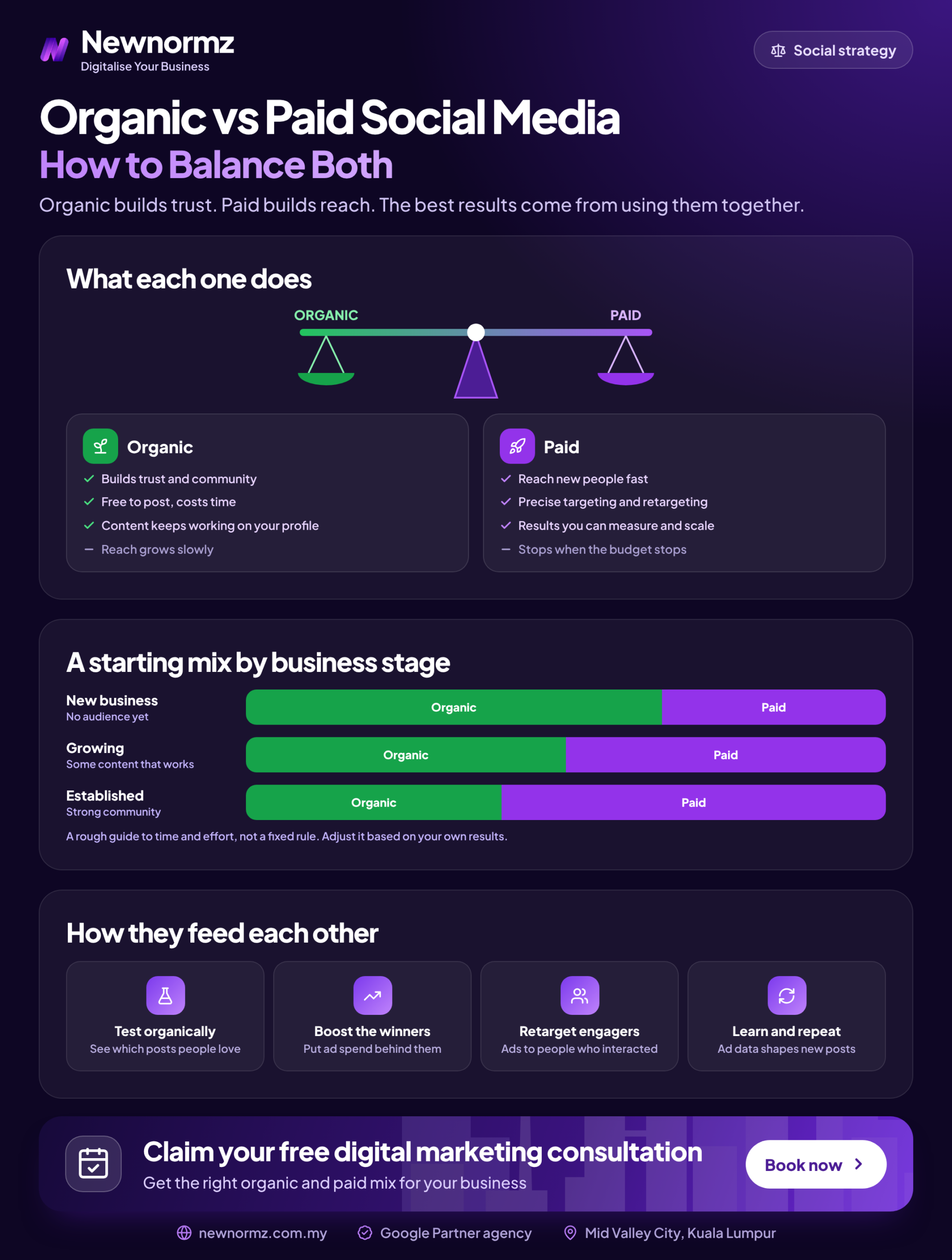
Here’s a rough starting point, not a rule. At launch, put most effort into organic testing with a small paid test budget. Once some posts are consistently earning enquiries, shift most new money into paid behind them. At scale, keep organic running mainly to feed paid with fresh creative and proof. The rules below adjust that for your situation in social media marketing in Malaysia:
Weighing up the same question for Google search? The logic is similar, but search has a different timeline and cost structure.
The Mistake We See Most in Social Audits
✗ Judging organic and paid on vanity numbers, run by teams that never talk
The content team reports reach and likes. The ads person reports CPM and clicks. Nobody connects either to enquiries, so winning organic posts never get budget, and paid keeps running tired creative.
✓ The fix
Use one scorecard. Put cost per qualified enquiry and cost per customer for paid next to saves, shares, DMs and WhatsApp enquiries per organic post. Review it together every two weeks. Use our guide to social media KPIs that track revenue to choose the columns.
Your Next 30 Days: Setting Up an Organic and Paid Social Plan
30-day setup checklist
- ✓Pick 3 to 4 content pillars tied to the questions buyers actually ask.
- ✓Set a posting rhythm your team can keep up for three months, and schedule it in Meta Business Suite.
- ✓Install the Meta Pixel and Conversions API, and add UTMs to every bio link and ad URL.
- ✓Set up Click-to-WhatsApp ads with a different pre-filled message for each campaign.
- ✓Name who answers WhatsApp, and when, before any paid budget goes live.
- ✓Set aside a small monthly test budget for running organic winners as ads.
- ✓Review winners every two weeks, and retire ads when frequency rises and CTR falls.
- ✓Send one combined organic and paid report, built around cost per qualified enquiry.
None of this is hard on its own. The hard part is keeping it all going every week: new creative, constant testing, tracking and fast replies. If you’d rather hand that over, our social media marketing agency in Malaysia runs organic and paid social together and judges both on enquiries and leads, not views or likes. Because we also run SEO and Google Ads, we can link social activity to search and WhatsApp enquiries in one view.
FAQ
How much of my social media budget should go to paid ads?
It depends on your stage, so no fixed percentage is right for everyone. At launch, most of your effort should go into organic testing with a small paid budget. Once posts are reliably producing enquiries, shift most new money into ads behind those posts and keep enough production budget to replace tired creative.
Can a business grow on social media without paid ads?
Yes, but growth is usually slow and hard to predict. Businesses with strong short-form video, a creator-friendly product or an existing customer base can grow organically. Most SMEs need some paid reach to turn proven content into a steady flow of enquiries.
Is boosting a Facebook post the same as running paid ads?
No. A boost is a simplified ad with fewer controls. Meta Ads Manager lets you choose the objective, optimisation event, placements, Custom Audiences and creative tests. Use boosts to add reach to posts that already work, and use Ads Manager for leads and sales.
How long should I post organically before starting paid social?
Around 4 to 6 weeks of consistent posting is usually enough to find your first winners. Run a small paid test alongside that period rather than waiting. A fresh profile with recent posts and some comments also makes paid traffic convert better.
Should I measure organic and paid social with the same KPIs?
No, but put both in one report. Judge paid on cost per qualified lead and cost per customer. Judge organic on intent signals like saves, shares, DMs and WhatsApp enquiries, which show you which content deserves ad budget next.
Free social media audit
Find out where your organic and paid social budget is leaking
Newnormz plans, creates and runs social media and paid social for Malaysian brands, and judges every campaign on enquiries, not just views. 5.0 rating from 214+ Google reviews.
- ✓Which of your organic posts deserve ad budget, and which ads are fatigued
- ✓A check of your Pixel, Conversions API, UTMs and WhatsApp source tracking
- ✓A recommended organic and paid split for your stage, judged on cost per qualified enquiry

Bryan Tan is an SEO Specialist and CEO at Newnormz, helping hundreds of businesses achieve first-page rankings on Google. With a passion for driving organic growth, Bryan blends innovative strategies with hands-on experience to optimize websites for maximum visibility. Always at the forefront of the latest SEO insights and trends, he consistently adapts to the evolving digital landscape.