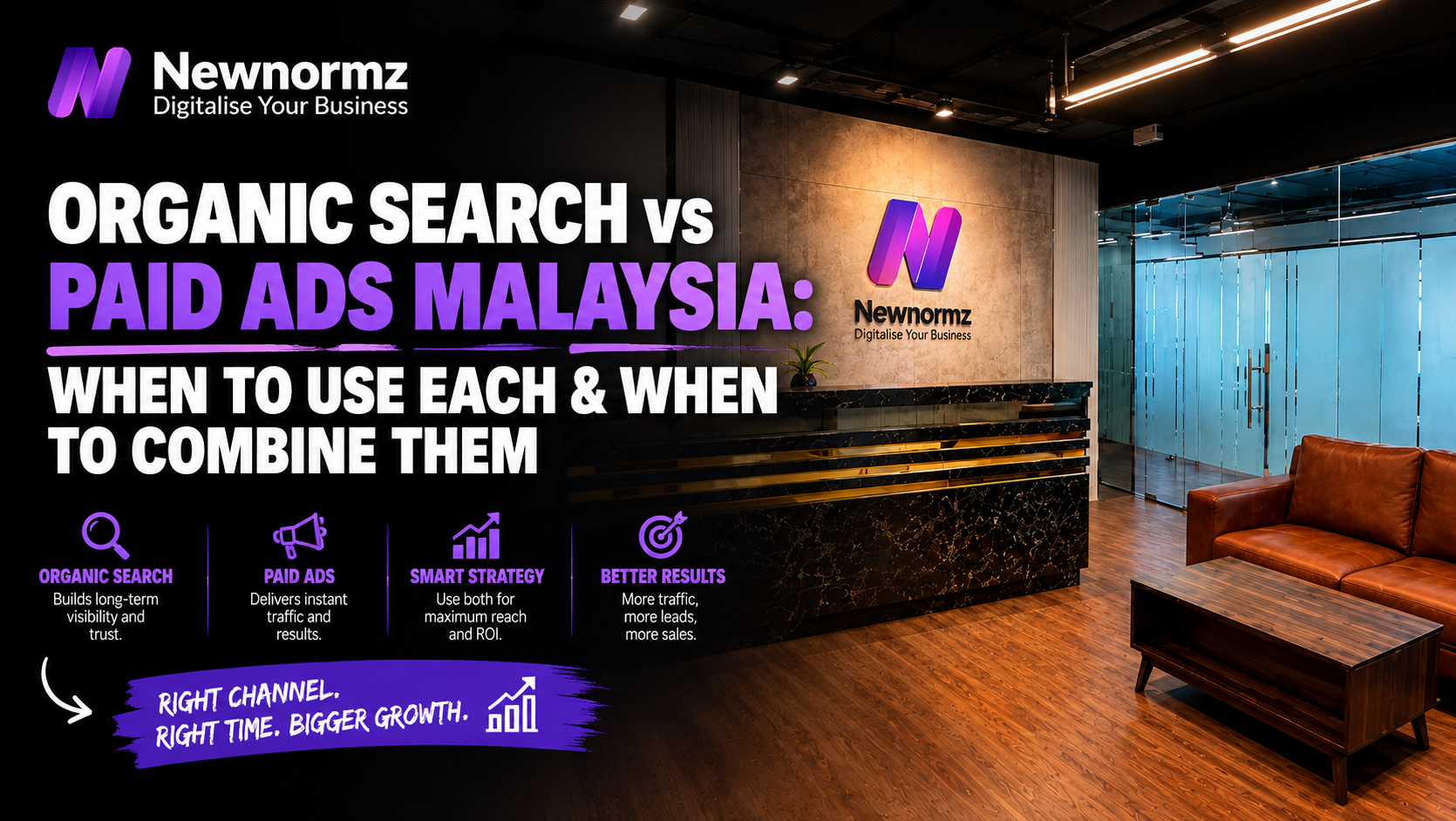
Use paid ads when you need customers this week and can afford to pay for every click. Use organic search when you’re building a business that still needs to show up on Google a year from now without a daily ad spend. Most businesses in Malaysia that grow steadily end up running both, just not on day one, and not with the same budget split forever. The right mix depends on your cash flow, your timeline, and how competitive your keywords already are.
A Simple Way to Think About It
Renting a Shoplot vs Buying One
🏪 The rented shoplot
You open for business the day you sign the lease. The foot traffic is steady, but the moment you stop paying rent, the doors close and the customers go somewhere else.
🌱 The shop you own
Renovating it takes months and the first customers trickle in slowly. But once the location is established, people keep walking in whether or not you spent anything that month.
Paid ads are the rented shoplot. Organic search is the one you own. The section below breaks down exactly what each one buys you, and when smart Malaysian businesses use both at once.
What Organic Search Actually Does
Organic search, the unpaid results Google shows for a query, is built through SEO: fixing technical issues on your site, writing content that answers what people are actually searching, and earning the signals Google uses to trust your pages. Nobody can promise you a specific position for a specific keyword. Google itself has said publicly, more than once, that no one can guarantee a ranking spot, and any agency that promises “#1 in 30 days” is telling you something they can’t back up.
What SEO reliably does is compound. A page that ranks well keeps bringing in visitors every day without an extra ringgit spent per click. Oriental Kopi’s two-year campaign with Newnormz is a good illustration of that curve: traffic grew by 43,300 visitors, impressions reached 6.31 million, and the site ended up ranking for 24,500 more keywords than when it started, generating 468,000 clicks along the way. That kind of growth doesn’t happen in the first month. It happens because the work from month three is still paying off in month twenty.
What Paid Ads Actually Do
Paid ads (Google Ads being the dominant channel, since Google holds roughly 93 percent of the search market in Malaysia as of May 2026 per Statcounter) put you at the top of the results page immediately, for whichever keywords you’re willing to pay for. There’s no waiting for Google to trust your site. You bid, you write the ad, it runs.
The tradeoff is that the visibility is rented, not owned. Stop the campaign and your listing disappears the same day. That’s not a flaw, it’s just what the channel is for: a lever you can pull when you need leads on a specific timeline, for a specific offer, without waiting for organic rankings to build up.
The Real Differences, Side by Side
| Factor | Organic Search (SEO) | Paid Ads (Google Ads) |
|---|---|---|
| Time to see results | Typically 3 to 6 months before meaningful movement | Same day the campaign goes live |
| Cost per click | No direct cost once a page ranks | Paid every time, for every click |
| What happens if you stop | Rankings usually hold for a while, then fade slowly | Traffic stops immediately |
| Best suited for | Long-term brand visibility, high-intent evergreen keywords | Launches, promotions, testing new offers, filling pipeline gaps |
| Trust with searchers | Often perceived as more credible, since it isn’t a paid placement | Clearly marked “Sponsored,” which some searchers skip past |
When to Lean on Organic Search
SEO makes the most sense when you have some runway (at least six months before you need the growth to pay off) and when your category has search terms people look up repeatedly, not just once. Sunway Medispa’s six-month campaign with Newnormz produced a 700 percent increase in traffic, 54,000 impressions, and 70 percent more keywords ranking, in a category where people research treatments repeatedly before booking. That’s the kind of repeat-search behaviour where organic visibility keeps paying you back.
It also makes sense if your margins can’t absorb an ongoing cost per click. A parking management company, for instance, isn’t selling a high-ticket item where a few expensive ad clicks are easy to justify. Times Parking’s six-month SEO campaign with Newnormz brought in 528,000 impressions, 416 ranking keywords, and 31.5K clicks, all without paying per click.
When to Lean on Paid Ads
Paid ads are the better call when you need customers now: a new outlet opening next month, a seasonal promotion, or a business that’s too new for Google to trust its content yet. If your website was registered last week, no amount of good content will out-rank a competitor’s decade-old domain within days. Ads let you show up regardless of how old your site is.
They’re also useful as a testing tool. Before you invest months into content for a keyword, running that same keyword through Google Ads for a few weeks tells you whether it actually converts, before you commit SEO effort to it.
When to Run Both Together

The combination usually makes sense for new or seasonal businesses that can’t wait out SEO’s timeline but still want to build something that outlasts the ad budget. A Kuala Lumpur confinement centre worked with Newnormz on exactly this setup: a Google Ads budget of RM2,550 a month paired with local SEO, and the business had qualified leads within 30 days. The ads covered the gap while the SEO work built up in the background, so that when the ad budget eventually gets trimmed, the site doesn’t go back to zero.
If Malaysia’s search market is where your customers are (35.4 million internet users, 98 percent penetration as of the end of 2025 per DataReportal), the goal isn’t picking one channel forever. It’s sequencing them: paid ads for the leads you need immediately, local SEO for the visibility that keeps working after the campaign ends.
How to Decide Your Split
| Your situation | Where to put your budget |
|---|---|
| Brand new business, need leads this month | Mostly paid ads, start SEO in parallel |
| Established business, stable cash flow | Mostly SEO, small ad spend to test new offers |
| Seasonal spikes (festive periods, promotions) | Paid ads around the spike, SEO year round |
| Tight margins, low tolerance for per-click cost | SEO first, ads only for high-value offers |
FAQ
How long does SEO take to show results in Malaysia?
Most campaigns need three to six months before rankings move meaningfully, and longer for competitive keywords. Sunway Medispa’s results at six months and Oriental Kopi’s growth over two years both reflect that SEO is a compounding effort, not a one-time fix.
If I already rank well organically, do I still need Google Ads?
Not necessarily. If your organic rankings already cover your key terms and generate enough leads, ads become optional, useful mainly for testing new keywords or covering seasonal spikes rather than a permanent requirement.
Can I run both with a limited budget?
Yes. The KL confinement centre case ran on RM2,550 a month for ads, paired with local SEO, and saw qualified leads within 30 days. The key is keeping the ad spend focused on your highest-intent keywords while SEO builds in the background.
Does running paid ads help my SEO rankings?
Ads and organic rankings run on separate systems within Google, so paid clicks don’t directly move your organic position. What ads can do is get your business in front of people sooner while your SEO work is still building up.
Not sure which channel fits your business?
Get a Clear Read on SEO vs Paid Ads for Your Business
Newnormz has run SEO campaigns across F&B, healthcare, ecommerce, and local services in Malaysia, backed by a performance guarantee of 70 percent of targeted keywords on Google’s first page.
30 minutes, no obligation, just an honest read on where your budget should go.

Bryan Tan is an SEO Specialist and CEO at Newnormz, helping hundreds of businesses achieve first-page rankings on Google. With a passion for driving organic growth, Bryan blends innovative strategies with hands-on experience to optimize websites for maximum visibility. Always at the forefront of the latest SEO insights and trends, he consistently adapts to the evolving digital landscape.