Short verdict
A keyword difficulty score is a rough backlink estimate. It does not tell you whether you can win a Malaysian search result. Ahrefs, Semrush and Moz mostly measure how strong the links are behind the pages already ranking, and they use largely global data to do it. When a Malaysian page one is full of marketplace listings, forum threads and thin directories, the score means something different, so check the real results before you trust the colour.
Keyword Difficulty SEO Malaysia: What the Score Actually Measures (and What It Ignores)
So what is keyword difficulty? It is a 0 to 100 estimate of how hard it would be to reach Google’s top 10 for a search term. The estimate is based mainly on how many quality backlinks, counted as referring domains, point to the pages ranking there now. A higher number means you will probably need more links to compete.
Everything else that decides rankings gets ignored: search intent, content quality, locality, language, and whether the pages ranking now actually answer the query well. That gap matters more here than in most markets. Statcounter puts Google at roughly 93 to 96% of Malaysian search, so the keywords you pick decide whether your SEO budget compounds or gets wasted on fights you can’t win.
How Ahrefs, Semrush and Moz Each Calculate a Keyword Difficulty Score
Each tool builds its keyword difficulty score in its own way, and none of them publishes the full formula. In general terms, this is what drives each one and where each one goes wrong.
| Tool | What drives the score | Scale | Main blind spot |
|---|---|---|---|
| Ahrefs Keyword Difficulty | Referring domains pointing to the top 10 ranking pages | 0 to 100 | Counts links only. A Shopee category page with few links of its own but huge brand strength can make a term look easy. |
| Semrush KD% | Several signals, including referring domains, the authority of ranking domains and SERP features | 0 to 100% | Blends everything into one number, so you can’t see which factor is pushing it up. Small Malaysian long-tail terms often show no data. |
| Moz Keyword Difficulty | Authority of the ranking pages and domains (Moz’s Page Authority and Domain Authority) | 100-point scale | Domain Authority is Moz’s own metric, not something Google uses. |
| Google Keyword Planner | How many advertisers bid on the term | Low / Medium / High, plus an indexed value | It isn’t an organic ranking metric at all. |
This is why the Ahrefs keyword difficulty vs Semrush KD question causes so much confusion. The same keyword can easily score 12 in one tool and 35 in the other. Neither number is wrong. They measure different things. Choose one tool, stick with it, and use its scores to rank keywords against each other rather than as absolute truth. If you’re still choosing a tool, our comparison of AI-powered keyword research tools covers the workflow side.
The Keyword Planner Trap: “High Competition” Is About Advertisers, Not Rankings
Google’s own Keyword Planner help explains that the Competition column shows how competitive ad placement is, based on how many advertisers bid on the keyword. It says nothing about how hard the keyword is to rank for organically.
✗ Dropping every keyword Keyword Planner marks “High”
We see this in audits all the time. A business filters out the “High” keywords and ends up with an SEO list of informational terms nobody pays for. A “High” label usually means advertisers make money from that search, which makes it exactly the kind of keyword worth ranking for organically.
✓ The fix
The real Keyword Planner competition meaning is commercial value, so read the column that way. Get organic difficulty from an SEO tool’s KD score, then confirm it with the manual SERP check below.
Why Malaysian SERPs Often Break the Tool’s Number
KD scores come from backlink indexes built mostly on global data. A lot of Malaysian page ones aren’t won on links at all. They’re won on relevance, brand strength and Google’s preference for certain result types. A proper SERP analysis often shows a very different picture from the number in the tool.
- Thin directory listings and aggregator pages rank for service queries with almost no links of their own.
- Shopee and Lazada product and category pages fill ecommerce results because of domain strength, not page-level links.
- Lowyat.NET forum threads and Facebook posts rank for comparison and “which one is better” queries because they match how people actually ask.
- The Google Maps local pack and Google AI Overviews push organic results further down for local queries, so position 3 can sit well below the fold on mobile.
- Bahasa Malaysia or Chinese versions of a term often have a weaker page one than the English version.
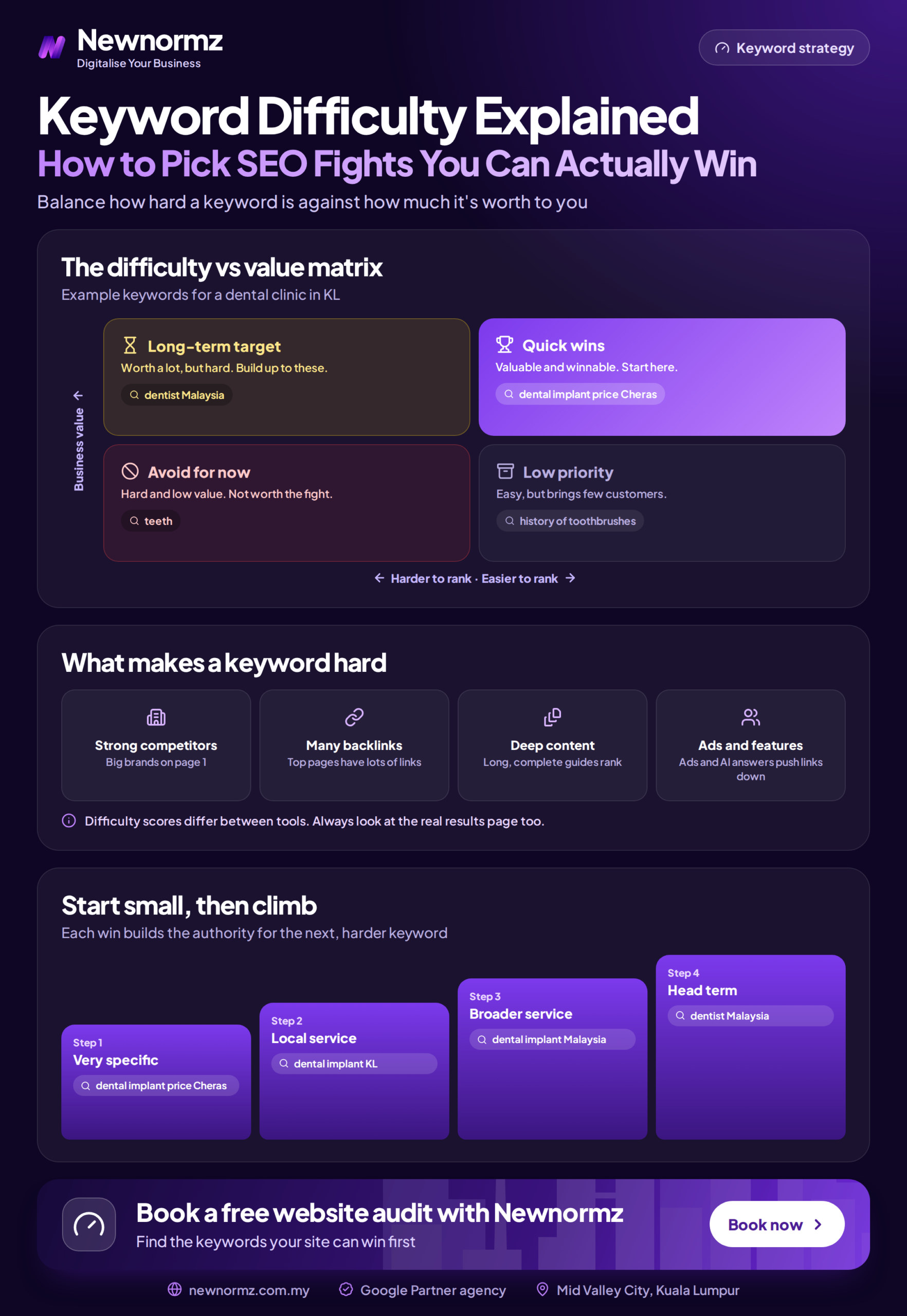
This works in both directions. A low KD can hide a page one that a marketplace has locked up, and a high KD can hide a page one of off-topic pages that an exact, local answer could beat. That’s why the low competition keywords Malaysia businesses actually win usually come from looking at the results page, not from filtering a spreadsheet. Knowing the different types of SEO keywords also helps you see which ones are realistic for which page.
For product searches, the question is usually whether to rank alongside the marketplaces or go around them. Our guide to competing with Shopee and Lazada listings covers both options.
The 10-Minute SERP Check That Beats Any KD Score
This is how to check keyword difficulty by hand, and it’s the core of any useful keyword competition analysis. It takes about ten minutes per keyword and catches most of what the tools get wrong.
Search in incognito with Malaysia as your location
Use a private window on google.com.my so your own history doesn’t skew the results. For local terms, also search from a phone, because that’s where most of your buyers will see the result.
Note the result types
Write down what shows up before the first ordinary organic result: a map pack, an AI Overview, Shopee or Lazada listings, forum threads, People Also Ask. If the map pack dominates, the real fight is your Google Business Profile, not a blog post.
Open the top 5 and sort real competitors from weak fits
A real competitor is a dedicated page that answers this exact query for a Malaysian audience. A weak fit is a general homepage, a foreign site, a directory or an old thread. Three or more weak fits is a strong buy signal.
Check each page’s referring domains
Put each URL into Ahrefs, Semrush or a free backlink checker. Look at the page, not the domain. A strong domain with an unlinked, thin page is far easier to beat than the domain score suggests.
Compare them with your own site
If the weakest real competitor has 5 referring domains and your site has 15, you can compete. If the weakest has 80 and you have 8, park the keyword for now.
Check whether the pages match the search intent
If someone searching “price” is getting guides, or a buying query is getting definitions, Google is settling for what it has. A page built for the actual intent can overtake stronger sites.
Weak Spots That Signal a Winnable Keyword
- Forum or Q&A threads in the top 5, which means no business has written a proper answer yet.
- Outdated posts from 2022 or earlier, with old prices or discontinued products.
- National pages ranking for a city query, such as a general “Malaysia” page showing up for a Penang or Shah Alam search.
- Page titles that don’t contain the query at all, a sign Google is guessing.
- An English result filling the slot for a BM search because no proper BM page exists.
A KD score tells you how strong the ranking pages are. It can’t tell you how badly they answer the question.
A Decision Rule: Matching Keyword Difficulty to Your Site’s Authority
The question of domain authority vs keyword difficulty is really about you versus them. Domain Authority (Moz), Domain Rating (Ahrefs) and Authority Score (Semrush) are all third-party estimates, and none of them is a Google metric. Referring domains are a more honest yardstick. The bands below use Ahrefs-style KD and are rough starting points, not rules.
| Your site | Starting KD band | Keywords to target | Realistic timeline |
|---|---|---|---|
| New site (under 20 referring domains) | 0 to 10 | Service + area, specific questions, BM variants, “price Malaysia” terms | First ranking movement around day 60 to 90; traffic and leads from months 4 to 8 |
| Established SME site (roughly 20 to 150 referring domains) | 10 to 30 | Core service terms by city, comparisons, category pages | Movement in 60 to 90 days; lead growth months 4 to 8 |
| Strong authority site (150+ referring domains) | 30 and above | National head terms, broad categories | Compounding gains from months 8 to 12+ |
So what counts as a good keyword difficulty score for new website owners? Under 10, as long as the SERP check confirms it. Sunway TCM Centre shows how fast well-chosen specific terms can move: after a technical rebuild, 80% of its target keywords reached page 1 within 4 months, including local terms like “Acupuncture KL” and “Best TCM in Klang Valley”.
Worked Example: Two Keywords, One Budget
A hypothetical Klang Valley physio clinic is choosing between a broad term and a specific one. All figures below are illustrative assumptions, not client data. Each new patient is worth RM600 (six sessions at RM100), and half of all enquiries book.
| Assumption | “physiotherapy Malaysia” | “slipped disc physiotherapy PJ” |
|---|---|---|
| Monthly searches / KD | 2,400 / 45 | 140 / 6 |
| Likely position and click share | Position 5, 5% = 120 visits | Top 3, 20% = 28 visits |
| Enquiry rate | 1.5% (many visitors are out of area or just researching) = 1.8 | 10% (local, problem-specific) = 2.8 |
| Monthly value at 50% booking | 0.9 patients = about RM540 | 1.4 patients = about RM840 |
| When it starts paying | Month 12 or later, if ever | Months 3 to 5 |
The keyword with 17 times less volume earns more each month and starts paying most of a year sooner. Repeat it across ten treatment and area pairs (sciatica in Subang Jaya, frozen shoulder in Puchong) and the clinic builds a lead base that the broad term would have taken years to match.
Where “Easy Keywords to Rank For” Actually Come From
The easiest keywords to rank for are rarely found by filtering KD under 10. They come from these sources:
- Google Search Console queries at positions 8 to 30. Google already sees you as relevant for these, so improving the page is the fastest win you have.
- Long-tail modifiers such as a symptom, a material, a size or a use case added to the core term.
- Comparisons and “price Malaysia” searches, which carry buying intent and are often answered by weak forum threads.
- Area variants for every town you actually serve, from Kajang to Johor Bahru.
- People Also Ask questions, which tell you the exact wording people use.
Times Parking shows how these add up in a niche. A 6-month campaign built 416 ranking keywords and 31.5K clicks around LPR parking, a topic most tools would show with little volume. Our long-tail keyword strategy guide covers how to build these lists.
If your business serves walk-in or local customers, start with these quick wins for local rankings before you write anything new.
When a High-Difficulty Keyword Is Still Worth Fighting For
Don’t avoid hard keywords completely. Avoid hard keywords you can’t commit to. Go after a high-KD term only when it is core revenue for you and you can keep building content, technical quality and E-E-A-T signals for 8 to 12 months or longer. Anything shorter and you’ll spend a year on page three.
Client example
Oriental Kopi: +350% ranked keywords on broad category terms
Problem: A national F&B brand needed visibility for the hardest terms in its category: “kopi”, “white coffee” and “3 in 1 coffee”.
What we did: Content built around those head terms, full schema markup and ecommerce technical fixes, sustained over a multi-year engagement.
Result: +350% ranked keywords. Over a 2-year campaign: 24,500 more ranking keywords, 6.31M impressions and 468,000 clicks. A client for 4 years.
Head terms like these are won by covering the whole topic, not by publishing one page. That’s why building topical authority matters more for a hard keyword than any single backlink.
There’s no single answer to how long to rank for a keyword. For specific terms, think months. For head terms, think a year or more. Google has said publicly that no one can guarantee a specific ranking position. Newnormz’s written guarantee is a work clause, not a promised position: if the agreed target keywords are not on page 1 within 12 months, the team keeps working free until they are. That only works because the keywords are agreed realistically at the start. If you’d rather have that list built and checked for you, our SEO agency in Malaysia team does it on month-to-month terms.
Keyword Difficulty FAQs
What is a good keyword difficulty score for a new website in Malaysia?
Aim for 0 to 10 in Ahrefs (or the lowest band in your tool) and confirm it with a manual SERP check. Many Malaysian service and area keywords score low because few local pages have links, which gives new sites a real opening.
Is Ahrefs KD the same as Semrush KD?
No. Ahrefs relies mainly on referring domains to the top 10 pages, while Semrush combines several signals. The same keyword can score very differently in each, so compare keywords within one tool only.
Does the “Competition” column in Google Keyword Planner mean SEO difficulty?
No. Google’s help documentation says it measures how many advertisers bid on the keyword. “High” usually means the term is commercially valuable, which can make it worth ranking for organically.
Why does a keyword with a low KD score still not rank?
Usually because the page doesn’t match search intent, or because the results are held by result types links can’t beat, such as the map pack, marketplaces or AI Overviews. Weak content, poor internal linking and thin E-E-A-T signals are the other common causes.
How do I find low competition keywords in Malaysia?
Start with Search Console queries at positions 8 to 30, then add area, BM and “price Malaysia” variants of your core terms. Check each one against the real SERP for forum threads, outdated posts and off-topic pages.
How long does it take to rank for a low difficulty keyword?
Expect first movement around day 60 to 90, with traffic and leads building from months 4 to 8. Pages already ranking on page two or three can move sooner once they’re improved.
Should I avoid high keyword difficulty keywords completely?
No, but only target them if they’re core revenue and you can commit 8 to 12+ months. Build easier, related wins first so your site has the authority to compete when you get there.
Keyword lists built to be won
Get a target keyword list that weighs difficulty against revenue
Newnormz runs SEO for 200+ Malaysian businesses on month-to-month terms, with a written page 1 guarantee and a 5.0 rating from 214+ Google reviews. If the agreed target keywords are not on page 1 within 12 months, the team keeps working free until they are.
No obligation. A strategist reviews your current keywords and real Malaysian SERPs.

Bryan Tan is an SEO Specialist and CEO at Newnormz, helping hundreds of businesses achieve first-page rankings on Google. With a passion for driving organic growth, Bryan blends innovative strategies with hands-on experience to optimize websites for maximum visibility. Always at the forefront of the latest SEO insights and trends, he consistently adapts to the evolving digital landscape.