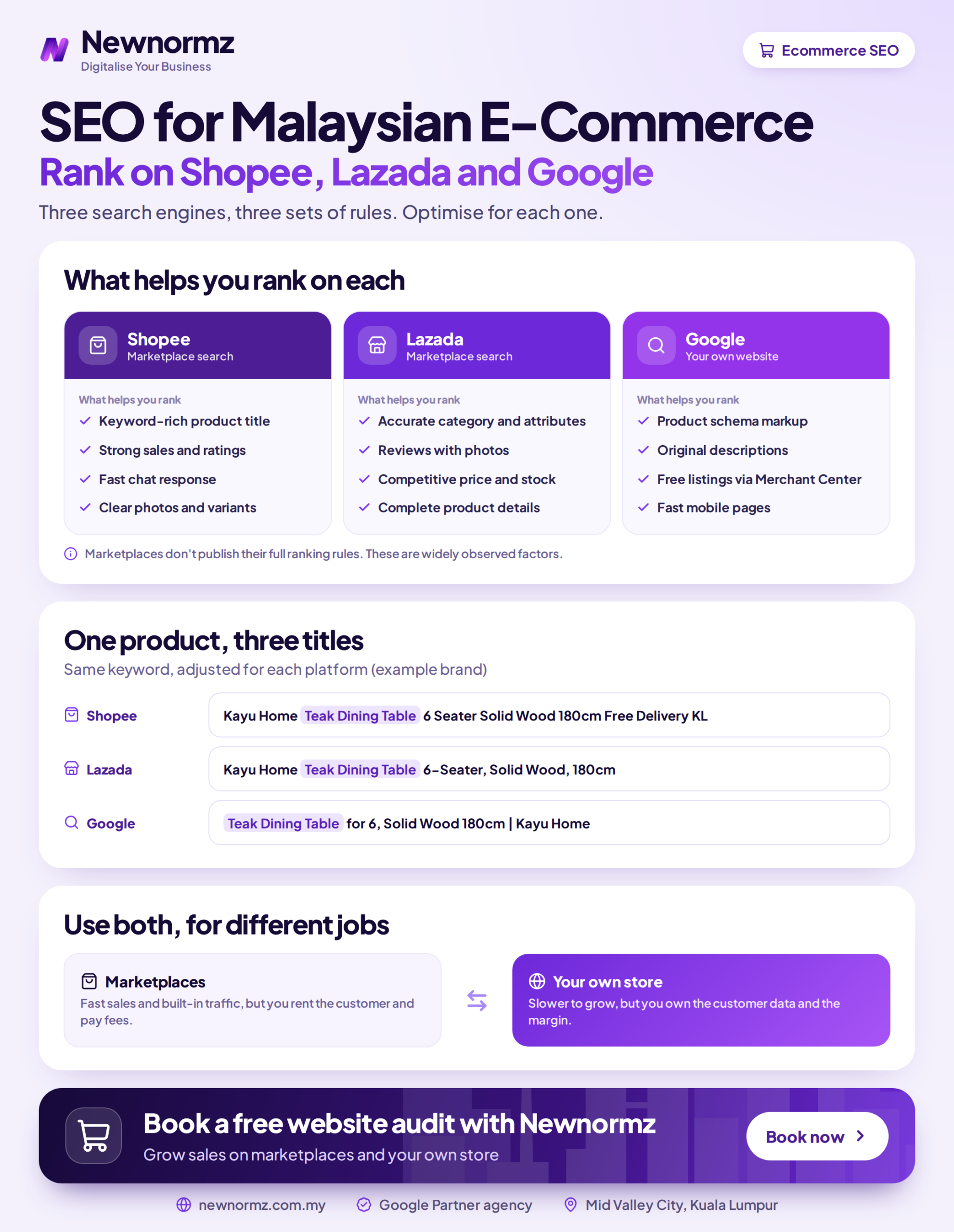
Shopee, Lazada, and Google are three separate search engines, and each one rewards something different. Shopee and Lazada mostly reward products that already sell: relevant titles and attributes get you into the results, then sales, conversion, ratings, and seller performance decide how high you go. Google rewards useful, well-structured pages on a website you own, and it takes months rather than weeks to build. The sellers who do well in Malaysia don’t pick one. They use the marketplaces for sales they can get now, and build Google traffic on their own store so they aren’t completely dependent on a platform that sets its own rules and fees. Be wary of anyone who promises a guaranteed number one spot on any of the three. No outside agency controls those algorithms.
A Simple Way to Think About It
The Mall Kiosk and the Shoplot
🏬 A kiosk in a busy mall
Thousands of people walk past every day. But the mall decides the rent, the rules, and which competitor gets the kiosk right next to yours.
🏠 Your own shoplot on a main road
Fewer people walk in during the first few months. But the signboard, the regulars, and the address all belong to you.
Most Malaysian online sellers need both. The sections below cover how ranking actually works in each place, and how to split your effort between them.
Three search engines, three different jobs
A lot of sellers say “SEO” and mean one thing. In Malaysian e-commerce it means three different things, because a shopper can start their search in three different places. Someone who already knows they want a specific air fryer usually opens Shopee or Lazada and compares prices. Someone who is still working out which air fryer suits a small kitchen is far more likely to type that question into Google.
That second group is bigger than many sellers think. Malaysia had 35.4 million internet users at the end of 2025, about 98% of the population (DataReportal, Digital 2026 Malaysia), and Google handles roughly 93% of search in the country (Statcounter, May 2026). Marketplaces own the moment someone is ready to buy. Google owns most of the research that comes before it.
| Shopee | Lazada | Google (your own store) | |
|---|---|---|---|
| Shopper’s mindset | Ready to buy, comparing price and vouchers | Ready to buy, often brand or LazMall focused | Researching, comparing, asking questions |
| What mostly drives ranking | Relevance plus sales, conversion, ratings, seller performance | Relevance plus sales, ratings, content quality, seller performance | Page relevance, content quality, site health, links |
| How fast results show | Days to weeks, faster with ads | Days to weeks, faster with ads | Usually months |
| Who owns the customer | The platform | The platform | You |
How Shopee search actually decides who ranks
Shopee doesn’t publish its ranking formula, and anyone who claims to know the exact weightings is guessing. What you can see from running listings, though, is consistent. Ranking works in two stages.
Stage one: getting into the results at all
This is about relevance. Your product title, category, and attributes (brand, size, colour, material) tell Shopee what the product is. If a shopper filters by “cotton” and you never filled in the material field, you don’t show up, however good the product is. Most sellers lose more sales to empty attribute fields than to anything else on this list.
Write titles for how people actually search, not for how your supplier labels the item. Put the core product term first, then the details that matter: “Tudung Bawal Cotton Voile Bidang 45 Plain” works. “NEW ARRIVAL!!! Premium Best Quality Hijab Hot Sale” does not. Keyword stuffing and unrelated keywords can get a listing demoted, and it makes the title harder for a human to read on a phone screen.
Stage two: how high you go
Once you’re in the results, performance takes over. Products that get clicked, bought, and rated well get pushed up, which earns them more clicks. That’s the flywheel, and it’s also why a brand new listing with zero sales struggles to compete with an old one that has thousands. Signals that matter here:
- Click-through rate: your main image and price are what earn the click. A clean, clear main photo often beats a cluttered one full of text banners.
- Conversion rate: good images, a clear description, honest sizing, and sensible variations turn clicks into orders.
- Ratings and reviews: both the score and the number of reviews.
- Seller performance: chat response rate, shipping speed, and low cancellation rates. Late shipments and slow replies quietly drag every listing down.
Shopee Ads are the way to break the cold-start problem. Paid placement gets a new listing its first clicks and orders, and those orders then help its organic position. Treat ads as the starter for the flywheel, not a permanent crutch. If a product only sells while ads are running, the real problem is usually price, images, or reviews.
Lazada: same logic, different emphasis
Lazada’s search follows the same two-stage pattern: relevance first, then performance. A few things are worth doing differently.
- Fill in every attribute and specification field. Lazada leans heavily on structured product data for filters, so missing fields cost you visibility in exactly the same way.
- Use the full product description space. Proper description sections with images and clear specs help conversion, and Lazada shoppers tend to read them.
- Know where you stand on LazMall. If you qualify as a brand or authorised seller, LazMall placement carries real trust with shoppers who are wary of counterfeits. If you don’t qualify, compete on reviews, service, and value instead of trying to look like a mall brand.
- Sponsored Solutions play the same role as Shopee Ads: get early sales moving, then let organic performance carry the listing.
One practical point: don’t paste the exact same title across both platforms without checking. Search the term on each platform first and see what the top listings call the product. Shoppers on the two apps sometimes phrase the same thing differently.
Keyword research for Malaysian shoppers (in three languages)
This is where most generic e-commerce SEO advice falls apart in Malaysia. Your customers search in English, Bahasa Malaysia, Chinese, and very often a mix of all three. “Baju raya budak”, “kids raya outfit”, and a Chinese-language search can all be after the same product, and each one is a separate keyword with its own competition.
You don’t need expensive tools to start:
- Type into the search bar on Shopee and Lazada and write down the autocomplete suggestions. These come from real shopper searches on that platform.
- Check Google’s autocomplete and “People also ask” for the research-stage questions that come before the purchase.
- Look at what top-ranking competitors put in their titles, especially the local terms they use.
- Read your own customer chats and reviews. The words customers use to describe your product are often better keywords than the ones you’d pick yourself.
Put the main term in the title, then work the language alternatives into attributes, descriptions, and (on Google) separate pages where the search volume justifies one. Cramming three languages into a single title usually just makes it unreadable.
Ranking your own store on Google
Here’s an uncomfortable fact: if you search for a specific product name, Shopee and Lazada listings often outrank the brand’s own website. Marketplaces are huge, trusted domains. Fighting them head-on for “[product name] price Malaysia” is usually a losing battle, and you don’t need to win it.
The opportunity for your own store is everywhere the marketplaces are weak:
Category pages that actually say something
Most online store category pages are a grid of products with no text. A category page with a short, genuinely helpful intro (who the range is for, how to choose, sizing notes) gives Google something to rank for broader searches like “school shoes for wide feet” or “kasut sekolah murah”.
Product pages with your own descriptions
If your product description is the same supplier text used by fifty other sellers, Google has no reason to pick your page. Rewrite it. Add what only you know: how it fits, what customers ask, what it pairs with, how long delivery to East Malaysia takes.
Content for the research stage
Buying guides and comparison articles catch shoppers before they’ve opened Shopee. “Best baby car seat for a Myvi” is a question a marketplace listing can’t answer well. Your article can, and it can link straight to the product on your store.
The technical basics
Fast mobile pages, product structured data (price, availability, reviews) so Google can show rich results, and a free Google Merchant Center feed so your products can appear in Shopping results without paying per click. These aren’t glamorous, but a store that skips them is fighting with one hand tied.
Google SEO compounds over time, which is exactly why it’s worth starting early. Our 2-year campaign for Oriental Kopi grew traffic by 43,300 and added 24,500 more ranking keywords, with 6.31M impressions and 468,000 clicks along the way. That kind of result comes from consistent work, not a one-off fix. If you’d rather have specialists handle it, that’s what our SEO service is built for.
How to split your effort by stage
There’s no single right split. It depends on where your business is right now.
| Your stage | Where to focus | What to avoid |
|---|---|---|
| Just starting, no sales history | Marketplace listings done properly, small ad budget to get first reviews | Spending big on a website before you know what sells |
| Selling steadily on marketplaces | Launch your own store, start category pages and Merchant Center | Copying marketplace descriptions word for word onto your site |
| Established brand with repeat buyers | Serious Google SEO, research-stage content, building direct customer relationships | Letting platform fees and ad costs eat your margin unchecked |
| Need sales from Google this month | Paid Shopping campaigns while organic SEO builds underneath | Expecting organic SEO to deliver in weeks |
That last row matters. Organic Google results take time, and when you need sales from Google sooner, Google Ads Shopping campaigns can fill the gap while SEO catches up. Paid and organic work best side by side, not as a choice between them.
The honest limits
A few things nobody can promise you, including us.
No one can guarantee a specific position. Google has said this publicly and repeatedly, and the same logic applies to Shopee and Lazada: their algorithms belong to them. Marketplaces also change their rules, fees, and voucher programmes whenever they choose, and a change in commission or a new campaign mechanic can shift your margins overnight. That isn’t a reason to leave the platforms. It’s a reason not to build your whole business on land you’re renting.
SEO also can’t fix a product people don’t want, a price that’s well above the market, or a run of one-star reviews about slow delivery. Ranking gets you seen. The product, the price, and the service still have to close the sale.
Frequently asked questions
Do my Shopee and Lazada listings show up on Google?
Often, yes. Marketplace product pages get indexed and frequently rank for product name searches. That’s useful, but the traffic still lands on the platform, not on your store. Your own site is how you rank for the broader and research-stage searches that marketplaces don’t cover well.
Can I use the same product description everywhere?
You can on the marketplaces, but write a unique, more detailed version for your own website. If your site has the same text as your listings and dozens of other sellers, Google has little reason to rank your page over theirs.
How long does Google SEO take for an online store?
Expect months, not weeks. For a sense of what a focused 6-month campaign can do, our work with Times Parking reached 528,000 impressions, 416 ranking keywords, and 31.5K clicks in that period. Results vary with your niche, competition, and starting point.
Do I have to pay for Shopee Ads or Lazada Sponsored Solutions to rank?
Not forever, but for new listings it’s usually the fastest way past the zero-sales stage. Use ads to build early orders and reviews, then pull back gradually and watch whether organic sales hold up.
Should I move off the marketplaces once my website ranks?
Usually not. Many Malaysian shoppers prefer buying on Shopee or Lazada because of vouchers, free shipping, and buyer protection. The goal is balance: marketplaces for volume, your own store for margin, data, and customers you can reach again.
Too dependent on Shopee and Lazada?
Build Google traffic your online store actually owns.
Newnormz has run SEO campaigns across F&B, healthcare, ecommerce, and local services in Malaysia, backed by a performance guarantee of 70 percent of targeted keywords on Google’s first page.
30 minutes, no obligation, with a clear look at where your store can win on Google.

Bryan Tan is an SEO Specialist and CEO at Newnormz, helping hundreds of businesses achieve first-page rankings on Google. With a passion for driving organic growth, Bryan blends innovative strategies with hands-on experience to optimize websites for maximum visibility. Always at the forefront of the latest SEO insights and trends, he consistently adapts to the evolving digital landscape.