
Long-tail keywords are longer, more specific searches like “affordable SEO agency for ecommerce Malaysia” instead of just “SEO”. They get fewer searches, but the people typing them are close to buying, and far fewer established sites are competing for them. For most Malaysian SMEs, that makes them the most realistic place to start winning on Google. They are not a shortcut, and nobody can promise a specific ranking, but they are usually where a smaller site gets its first real traction.
A Simple Way to Think About It
The Busy Junction vs. the Right Doorway
🚦 Handing out flyers at the busiest junction
Thousands of people walk past every hour. Almost none of them stop, and every big brand is standing on the same corner.
🚪 Standing where people are already looking
Far fewer people pass by, but each one came looking for exactly what you sell. Most of them walk in.
The rest of this article covers how to find those doorways for your own business, and why so many agencies keep sending clients to the junction.
What Long-Tail Keywords Actually Are
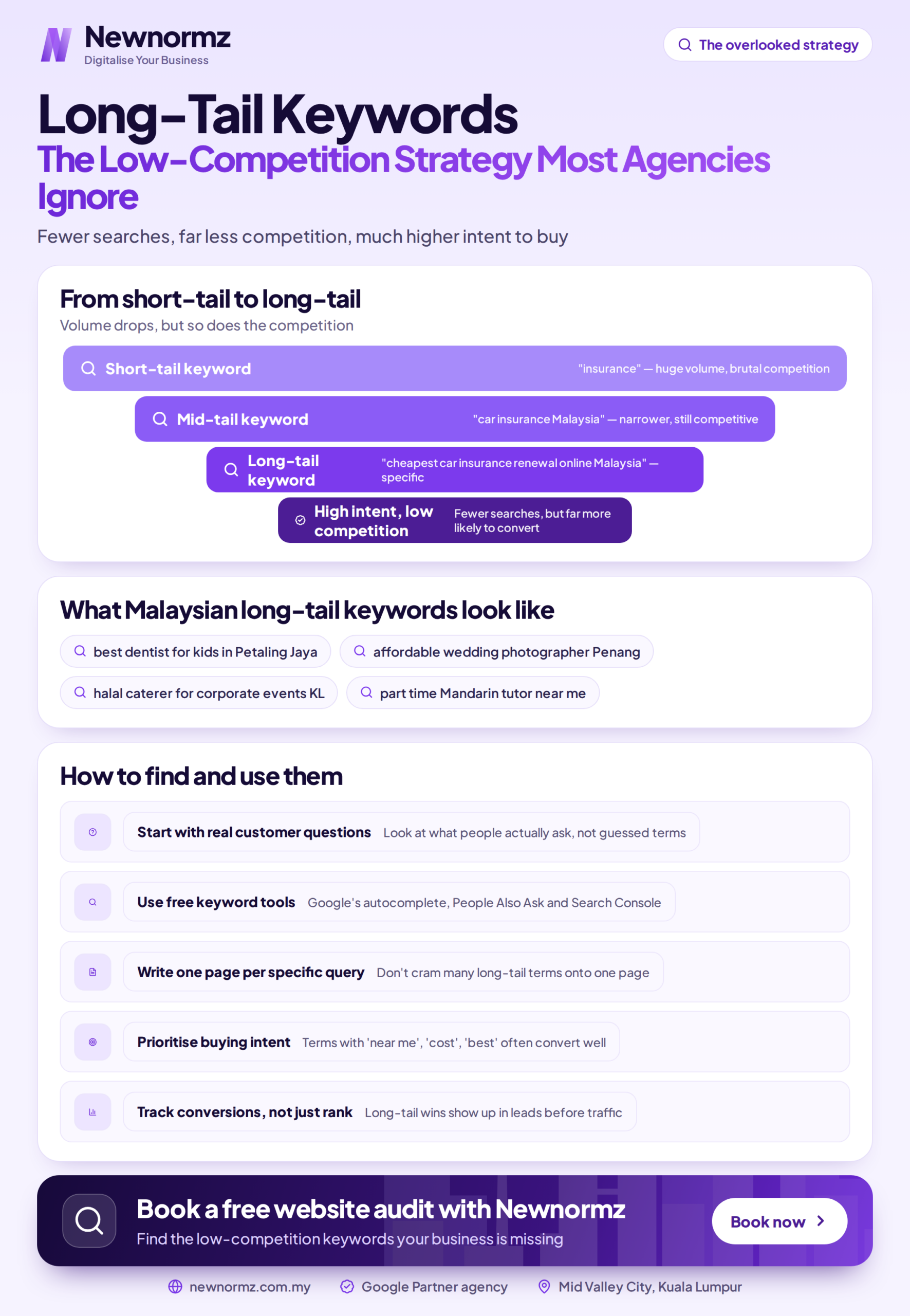
A long-tail keyword is a specific search phrase, usually three words or more. The name comes from the shape of search demand: a few broad terms get huge volume (the “head”), and a very long list of specific phrases each get a small amount (the “tail”). Add up the tail and it is often the bigger share of all searches.
The difference is intent. Someone searching “SEO” could be a student, a journalist or a curious business owner. Someone searching “affordable SEO agency for ecommerce Malaysia” already knows what they need, where they are and roughly what they want to spend. The second person is a buyer.
| Keyword type | Example | Search volume | Competition | Buyer intent |
|---|---|---|---|---|
| Broad | SEO Malaysia | High | Very high | Low |
| Mid-tail | SEO services Malaysia | Medium | High | Medium |
| Long-tail | affordable SEO for SME in KL | Low | Low to medium | High |
Why Broad Keywords Are a Bad Fit for Most SMEs
Terms like “SEO Malaysia” or “digital marketing” are owned by agencies with years of domain authority, huge content libraries and full-time SEO teams. Google does not care that your business is good. It ranks the pages it has the most evidence for, and a young or small site rarely has that evidence yet.
Many SMEs come to us after months of targeting exactly these terms. The effort was real. The keyword choice was the problem.
Why Most Agencies Skip Long-Tail Keywords
It is not that agencies do not know about them. Long-tail work is simply harder to sell and harder to scale. Three reasons come up again and again:
- Reporting optics. A ranking for a big, recognisable keyword looks great on a slide. A ranking for “halal catering for corporate events in Shah Alam” does not, even if it brings in the enquiry that pays the bills.
- Template strategies. Running the same keyword list for every client is cheaper than researching each business properly. SMEs end up in the same crowded spaces as big brands.
- Underrating the cumulative effect. One long-tail page brings a trickle. A few hundred, each answering a real question, add up to steady traffic that keeps compounding.
You can see that compounding effect in our own campaigns. Oriental Kopi’s two-year SEO campaign ended with 24,500 more ranking keywords and 6.31M impressions. Sunway Medispa saw 70% more keywords ranking within six months. Growth in the number of ranking keywords is what a broad, specific footprint looks like in a report, and it is where a lot of the traffic comes from.
How Long-Tail Search Works in Malaysia
Google holds roughly 93% of the Malaysian search market (Statcounter, May 2026), and Malaysians search in ways that generic, imported keyword lists tend to miss.
Location is built into the search
People add the area to almost everything: “digital marketing agency Penang”, “SEO for restaurant Johor Bahru”, “web design company Petaling Jaya”. Each of these is a long-tail keyword, and each is far easier to compete for than the generic version. If you serve specific areas, this is where local SEO and long-tail work overlap.
Language switches mid-search
Searches happen in English, Bahasa Malaysia, Chinese and often a mix. A food delivery business in Subang may need to show up for “hantar makanan Subang” as well as “food delivery Subang”. Agencies working from one English keyword list never see the first phrase.
SME buyers search with price and trust in mind
Phrases like “trusted SEO company for small business Malaysia” or “low budget digital marketing KL” show real intent. Few agencies build pages for them, so the demand often goes unanswered.
How We Build a Long-Tail Keyword Strategy
The method matters more than the keyword list. Here is the process, and what each stage is for.
| Stage | What we do | Why it matters |
|---|---|---|
| 1. Intent mapping | List what customers search at each stage: questions, comparisons, ready-to-buy phrases, by location and language. | Stops you writing for searches that never turn into enquiries. |
| 2. Competitor gap analysis | Check what competitors rank for and, more usefully, what they have not covered. | Gaps are usually your quickest route to visible rankings. |
| 3. Content per keyword cluster | Each page targets one cluster and one real question or decision. | Specific pages beat generic articles that could fit any business. |
| 4. Measure what matters | Track rankings, but also which pages produce enquiries and where visitors drop off. | Rankings are a means. Enquiries are the point. |
This work sits inside a wider SEO service, because long-tail pages also need sound technical foundations and internal linking to perform.
What Results to Realistically Expect
Long-tail SEO is methodical, not instant. Be wary of anyone who promises a fixed ranking or a fixed timeline, because Google has repeatedly said no one can guarantee a position. What usually happens when it is done well:
- Earlier movement. Lower competition means specific pages can start ranking sooner than broad ones. Early movement often shows in 4 to 8 weeks, with stronger growth typically taking 3 to 6 months of consistent content and optimisation. It depends on your site’s starting point.
- Better-quality enquiries. Visitors arriving on a specific phrase know what they want, so more of them contact you.
- Less reliance on paid ads over time. As organic pages build up, some of the traffic you were paying for arrives free.
- Stronger topical authority. A cluster of useful pages on one subject signals to Google that your site is a real resource in that niche, which can help the rest of your site too.
Long-tail SEO also pairs well with paid search. Google Ads can capture the same specific searches immediately while the organic pages mature, and your ad data shows which phrases actually convert.
Frequently Asked Questions
How long does long-tail SEO take to show results in Malaysia?
Early movement often appears within 4 to 8 weeks, and stronger traffic growth usually takes 3 to 6 months. Your site’s age, authority and content quality all affect the pace.
Is long-tail keyword SEO suitable for every business?
It suits most SMEs, service providers, ecommerce brands and B2B companies, because they all serve customers who search for specific products, problems or locations. A business with almost no search demand for what it sells is the exception.
How do you find the right long-tail keywords?
We start with your industry, competitors, customer questions, location and existing website data. Then we pick phrases with real conversion potential, not just the ones with pleasing search numbers.
Do long-tail keywords improve lead quality?
Usually, yes. The searcher has already described what they need, so the enquiries that come through tend to be more relevant than those from broad traffic.
Can I use long-tail keywords with Google Ads?
Yes. Specific phrases are often cheaper to bid on than broad ones, and they give you quick data on what converts while your organic pages build up.
Still fighting for keywords you cannot win?
Find the specific searches your competitors have missed
Newnormz has run SEO campaigns across F&B, healthcare, ecommerce, and local services in Malaysia, backed by a performance guarantee of 70 percent of targeted keywords on Google’s first page.
30 minutes, no obligation, and we will show you your best long-tail opportunities.

Bryan Tan is an SEO Specialist and CEO at Newnormz, helping hundreds of businesses achieve first-page rankings on Google. With a passion for driving organic growth, Bryan blends innovative strategies with hands-on experience to optimize websites for maximum visibility. Always at the forefront of the latest SEO insights and trends, he consistently adapts to the evolving digital landscape.