Malaysian business owners should start with five free keyword research tools: Google Search Console, Google Keyword Planner, Google Trends, Ubersuggest and Keyword Tool. Use them in roughly that order. Search Console shows what people already type to find you. Keyword Planner adds Malaysian volume and commercial value, Trends shows timing and the last two fill the gaps. Google’s own tools come first because, according to Statcounter, Google handles roughly 93 to 96% of Malaysian searches. Set every tool to Malaysia before you trust a single number.
The 5 Free Keyword Research Tools Malaysia Businesses Should Start With (At a Glance)
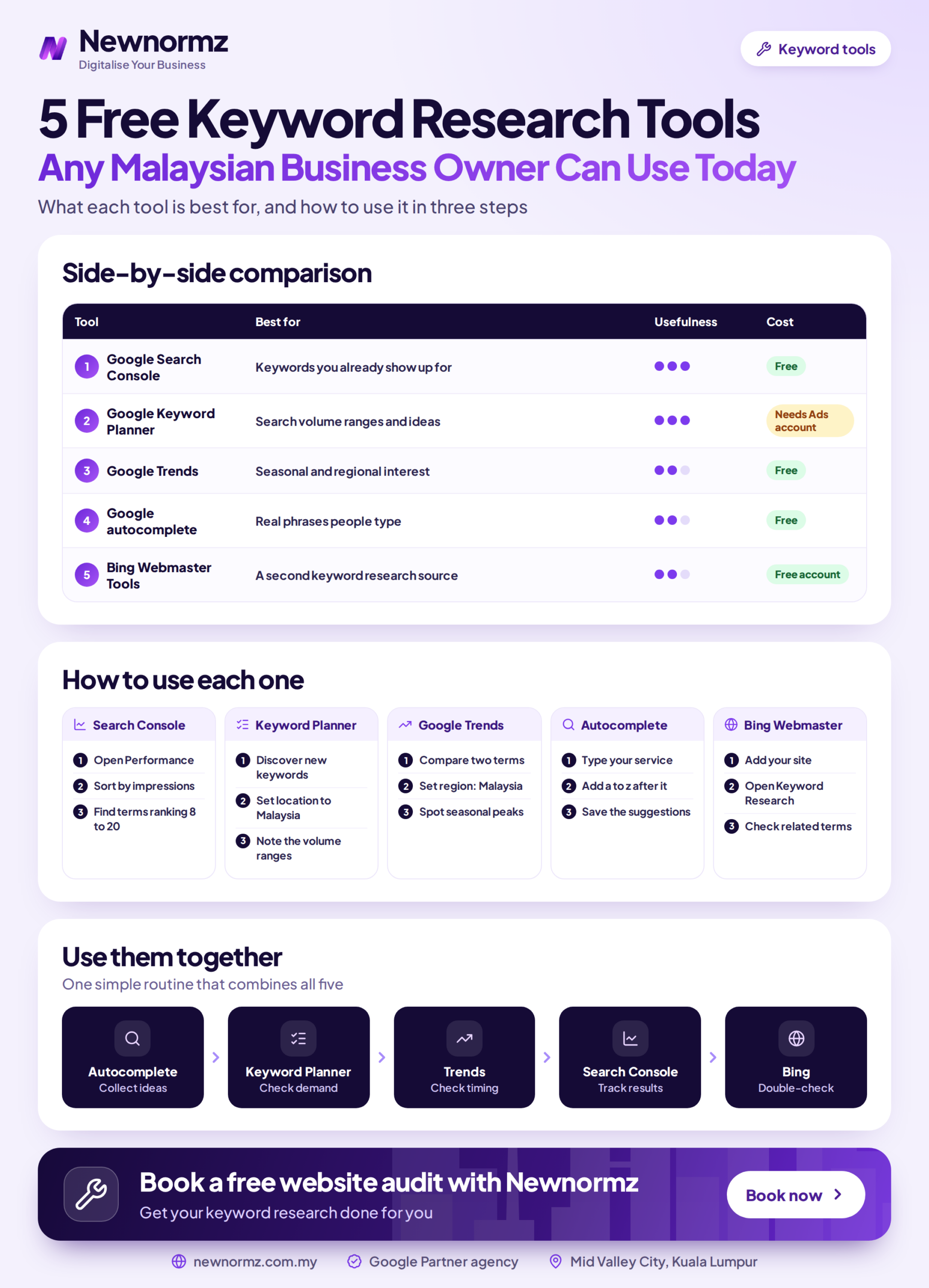
Every tool below is free, and every one of them hides something. The table shows what you get, how good the Malaysian data is and what each tool won’t tell you, so you know which numbers to trust. If you want the full process from first list to page plan, our guide to keyword research for Malaysian audiences covers it end to end.
| Tool | What it’s free for | Malaysia data quality | Blind spot | Best for |
|---|---|---|---|---|
| Google Search Console | Real query data for your own verified site, up to 16 months back | Excellent once filtered to Malaysia: actual clicks and impressions | Only shows searches you already appear for | Quick wins on existing pages |
| Google Keyword Planner | Keyword ideas, volume and top-of-page bids inside any Google Ads account | Good, straight from Google, with location set to Malaysia | Wide volume ranges until the account has active ad spend | Volume and commercial value |
| Google Trends | Interest over time and by state, comparing up to five terms | Good for popular terms. Niche terms often show “not enough data” | No search volumes, only a 0 to 100 index | Seasonality and regional demand |
| Ubersuggest | A limited number of daily searches, including competitor domain lookups | Thinner than for the US or UK, especially for niche terms | Volumes need checking against Keyword Planner | Seeing which keywords a competitor ranks for |
| Keyword Tool (keywordtool.io) | Autocomplete suggestions from google.com.my, YouTube, Amazon and more | Good for phrasing, since suggestions come from real local searches | The free version hides search volume | Long-tail ideas in English, BM and Chinese |
1. Google Search Console: The Keywords You Already Rank For
Every other tool on this list estimates what people search for. Search Console reports what they actually searched before they saw your site in Google. That makes Google Search Console keyword data the most reliable starting point you have, and it costs nothing beyond verifying your domain.
Open the Performance report, choose Search results and add a filter for Country: Malaysia. Without that filter, impressions from Singapore, Indonesia and elsewhere get mixed into your numbers. In the Queries tab, switch on Average position. You will also see the Bahasa Malaysia, Chinese and Manglish phrasings your customers really use, which no keyword tool predicts well.
The queries worth acting on sit between positions 8 and 20 and have high impressions. Google already considers your page relevant for them. Often a better heading, a new section or an FAQ is enough to move them onto page 1. Effort: low. You can get your first useful insight in about 10 minutes.
Newnormz take
If your site has 3 or more months of Search Console data, start here before you open any other tool. Google has already told you which searches it links to your business. Ignoring that and building a list from scratch means guessing when you already have the answer.
The “Page 2 Goldmine” Filter
Set the date range and country
In Performance, set the date range to the last 3 months and add the filter Country: Malaysia.
Sort queries by impressions
Tick Average position, open the Queries tab and sort by Impressions from highest to lowest.
Filter to page 2
Click the filter icon above the table and set Position greater than 10. Ignore anything much past position 20 for now, because those pages need more than a tweak.
Export the list
Use Export (top right) to send the filtered queries to Google Sheets or a CSV file.
Match each query to a page
Click a query, then the Pages tab, to see which URL ranks for it. Add that URL in a new column. Then write one note per row: does the page answer this query directly, or does it need a section, an H2 or an FAQ added?
2. Google Keyword Planner Malaysia: Free Volume and Price Signals
Keyword Planner is Google’s own tool for advertisers, and it is free inside any Google Ads account. Because the numbers come from Google itself, it is the closest thing you have to official keyword search volume Malaysia data. You can use Google Keyword Planner without running ads. Sign up at Google Ads, and when it pushes you to create a campaign, choose Switch to Expert Mode, then create an account without a campaign. The planner sits under Tools, then Planning.
There is a catch. Accounts with no active ad spend see volumes as ranges such as “100 to 1K” or “1K to 10K”, not exact figures. The ranges are still useful for ranking keywords against each other. Just don’t treat them as forecasts.
Before you search, set the location to Malaysia, or to a specific state or city if you only serve one area. Change the language setting when you check Bahasa Malaysia or Chinese terms, because the default English setting can underreport them. Effort: low to medium, mostly in the one-time setup.
Read the Top-of-Page Bid as a Value Signal, Not Just a Cost
The top-of-page bid columns show roughly what advertisers pay per click to appear above the organic results. Advertisers only keep paying for clicks that turn into customers. So when the top of page bid Malaysia advertisers pay for a keyword is high, that keyword makes money, and that matters as much as its volume.
Here is how to turn that into a number you can compare. The figures below are illustrative assumptions, not a forecast: the 10% click share is a round figure for a page ranking well, and the bids are invented examples.
| Keyword | Monthly searches | Top-of-page bid | Clicks at 10% | Monthly traffic value |
|---|---|---|---|---|
| Keyword A (buyer intent) | 1,000 | RM4.00 | 100 | About RM400 |
| Keyword B (broad, informational) | 5,000 | RM0.50 | 500 | About RM250 |
Keyword A gets a fifth of the searches yet brings in more value, because it costs advertisers more to buy that traffic. Add this column to your sheet (volume × 10% × bid) and sort by it. Your priority list will look very different from one sorted by volume.
Why “10 to 100” Isn’t Zero in a Market of 35 Million
According to DataReportal’s Digital 2026 report, Malaysia has over 35 million internet users, about 98% of the population. That is a large online audience. Search volume per keyword, though, is small next to the US, so many useful terms show only “10 to 100” as their Keyword Planner search volume range.
Don’t skip them. Someone searching “aircond service puchong” wants a technician this week and will probably WhatsApp the first credible result. A broad term like “aircond” draws price checkers, brand research and Shopee shoppers. Five enquiries a month from a low-range keyword can be worth more than thousands of visits that never convert. Our guide to finding long-tail keywords that convert goes further on this.
A simple rule: if a low-range keyword has a top-of-page bid well above the others in your list, treat it as a target, not as noise.
3. Google Trends Malaysia: Timing and State-Level Demand
Trends doesn’t give search volumes. It shows when demand rises and where. Set the location to Malaysia, compare up to five terms and scroll to Interest by subregion. You will see whether a term is searched more in Selangor, Penang or Johor, which helps if you are deciding where to open a branch or which state to target first.
Seasonal peaks matter more in Malaysia than many businesses expect. Searches for catering, hampers, travel and tuition all move around Hari Raya, Chinese New Year and the school holidays. Check last year’s curve and publish or update pages several weeks before the rise, not during it. Google Trends Malaysia data gets patchy for very niche terms, so use it on your main category words. For a full method, see our guide to using Google Trends for keyword planning. Effort: low.
4. Ubersuggest Malaysia: Competitor Peeking on a Free Plan
The free tier of Ubersuggest gives you a limited number of searches per day. That is enough for a focused session, not a full audit. Set the language and location to English and Malaysia first. The most useful free feature is entering a competitor’s domain and seeing which keywords and pages bring them traffic.
The honest limit: Ubersuggest’s data for Malaysia is thinner than for larger markets like the US or UK. Volumes for niche Malaysian terms can be inflated, deflated or missing. Use it to find keyword ideas you hadn’t thought of, then check every number in Keyword Planner before you build a page around it. Effort: low.
5. Keyword Tool (Free Version): Autocomplete Ideas in English, BM and Chinese
Keyword Tool pulls Google’s autocomplete suggestions at scale. You type a seed word and it returns the phrases real people start typing. Choose google.com.my as the Google domain, pick the language and you get local phrasing you won’t find in a US-trained database. It also has tabs for YouTube, Amazon, Bing and other sources, which helps if you sell products or make video content.
As a free SEO keyword tool it has one big gap: the free version hides search volume. Copy the best suggestions into Keyword Planner to check demand and bids. Of every keyword tool free Malaysia users can open without an account, this one gives the most local phrasing per minute, and that two-step routine covers its blind spot.
It is especially good at language variants. A bakery might find “kedai kek”, “kek hari jadi” and “cake shop near me” are all live searches, plus Manglish blends that mix both. Note them here. Turning them into a proper BM strategy is a separate job.
Bonus Free Sources Nobody Charges For
- Google’s autocomplete itself: type your service into Google on your phone, letter by letter, and note what it suggests. Most of your customers search on mobile too.
- People Also Ask boxes give you ready-made FAQ questions. Click a few and more appear.
- For online stores, the Shopee and Lazada search bars show what shoppers type when they are ready to buy. Many Malaysian product searches start there, not on Google. Our page on SEO for online stores explains how to use those terms on your own site.
- Related searches at the bottom of Google’s results page often surface location and price modifiers.
The Audit Mistake We See Most: Keyword Lists Built on Global Defaults
✗ Keyword lists built on “All locations” or US data, then picked on volume alone
Most tools default to worldwide or US data. The resulting list is full of terms Malaysians rarely search and volumes that look far bigger than any local business will ever see. Then the highest-volume terms get chosen whether or not the searcher wants to buy.
✓ The fix
Set Malaysia as the location in every tool before exporting anything. Google each shortlisted keyword yourself and look at what ranks: if page 1 is all Shopee listings or government sites, a blog post will struggle. Then map one keyword cluster to one page, not one keyword to one page.
Checking the results page by hand is the quickest way to judge intent. If you want a framework for it, our guide to the four types of keyword intent explains what each type means for the page you should build.
The one-cluster-per-page rule matters because writing separate pages for “TCM clinic KL” and “TCM centre Kuala Lumpur” makes them compete with each other. Read more about pages competing for the same keyword and how to fix it.
Not sure your keyword list is set to Malaysia or matched to the right pages? We’ll check it against your Search Console data.
A Free Keyword Stack for a Small Malaysian Business (30 Minutes a Month)
Keyword research for small business Malaysia owners can actually keep up has to be quick, so you don’t need all five tools every time. Pick the stack that fits where your site is today.
Spend about 30 minutes a month on it: 10 on the Page 2 filter, 10 checking new ideas in Keyword Planner and 10 noting which pages need a section added. Done every month, that beats one big spreadsheet that nobody opens again.
The variants these tools surface are often where the results come from. Oriental Kopi’s content was built around close variants like “kopi”, “white coffee” and “3 in 1 coffee”, not a single head term, and its ranked keywords grew 350%. Sunway TCM Centre ranks for location-modified searches such as “Acupuncture KL” and “Best TCM in Klang Valley”. Autocomplete and Keyword Planner surface exactly these modifiers if you set them to Malaysia.
When Free Keyword Tools Stop Being Enough
Free tools are good for a first list and monthly upkeep. They start to fall short in a few predictable situations.
Signs you have outgrown free tools
- ✓You are planning or maintaining 50+ target pages and the spreadsheet is unmanageable.
- ✓Your niche is competitive (legal, aesthetics, property, finance) and you need keyword difficulty scores you can trust.
- ✓You need backlink data and SERP-feature tracking, which is where Semrush and Ahrefs earn their fees.
- ✓You know what to do but don’t have the hours to do it every month.
If the first three apply, a paid subscription or one of the newer AI-powered keyword research tools can save hours of manual cross-checking. Paid tools still estimate Malaysian volumes, so keep Keyword Planner and Search Console as your reality check.
If time is the problem, a tool won’t fix it. That is when SEO services in Malaysia become worth comparing. For reference, the Newnormz SEO Starter plan covers 20 target keywords at RM2,900/month (excluding SST), month to month with no lock-in. Whether that beats doing it yourself depends on what an extra customer is worth to you.
FAQ: Free Keyword Research Tools in Malaysia
Is Google Keyword Planner free to use in Malaysia?
Yes, Google Keyword Planner is free for anyone with a Google Ads account, and you don’t need to run a campaign. Create the account in Expert Mode without a campaign, then set the location to Malaysia before searching.
Why does Keyword Planner show volume ranges instead of exact numbers?
Google shows ranges such as “100 to 1K” to accounts without active ad spend. More precise figures appear once an account is running campaigns. The ranges are still good enough to compare keywords against each other and to spot which ones have commercial value.
Is Ubersuggest accurate for Malaysian keywords?
Ubersuggest is useful for ideas and competitor research in Malaysia, but its volumes are less reliable than for bigger markets. Treat its numbers as rough and confirm any keyword you plan to build a page around in Google Keyword Planner.
What is the best free keyword tool for a small business in Malaysia?
Google Search Console is the best free keyword tool for small business owners whose site already has a few months of data. A new site should start with Google Keyword Planner instead. Both use Google’s own data, and Google handles the large majority of Malaysian searches.
Can I find keyword ideas in Bahasa Malaysia with free tools?
Yes. Keyword Tool set to google.com.my and Malay, Google autocomplete, and Keyword Planner with its language setting changed will all surface BM keywords. Search Console also shows the BM and Manglish queries people already use to find you.
How many keywords should a small Malaysian business target at the start?
Start with a small set of buyer-intent keywords, grouped into one cluster per page, rather than a long list. A handful of well-matched service and location pages usually beats dozens of thin ones. Expand once those pages start ranking.
Send us your keyword list. We’ll check it against your Search Console data.
Newnormz runs SEO for 200+ Malaysian businesses on month-to-month terms, with a written page 1 guarantee and a 5.0 rating from 214+ Google reviews.
No obligation. Strategists work in English, BM and Chinese. Or WhatsApp +60 17-588 2291.

Bryan Tan is an SEO Specialist and CEO at Newnormz, helping hundreds of businesses achieve first-page rankings on Google. With a passion for driving organic growth, Bryan blends innovative strategies with hands-on experience to optimize websites for maximum visibility. Always at the forefront of the latest SEO insights and trends, he consistently adapts to the evolving digital landscape.