Key takeaways
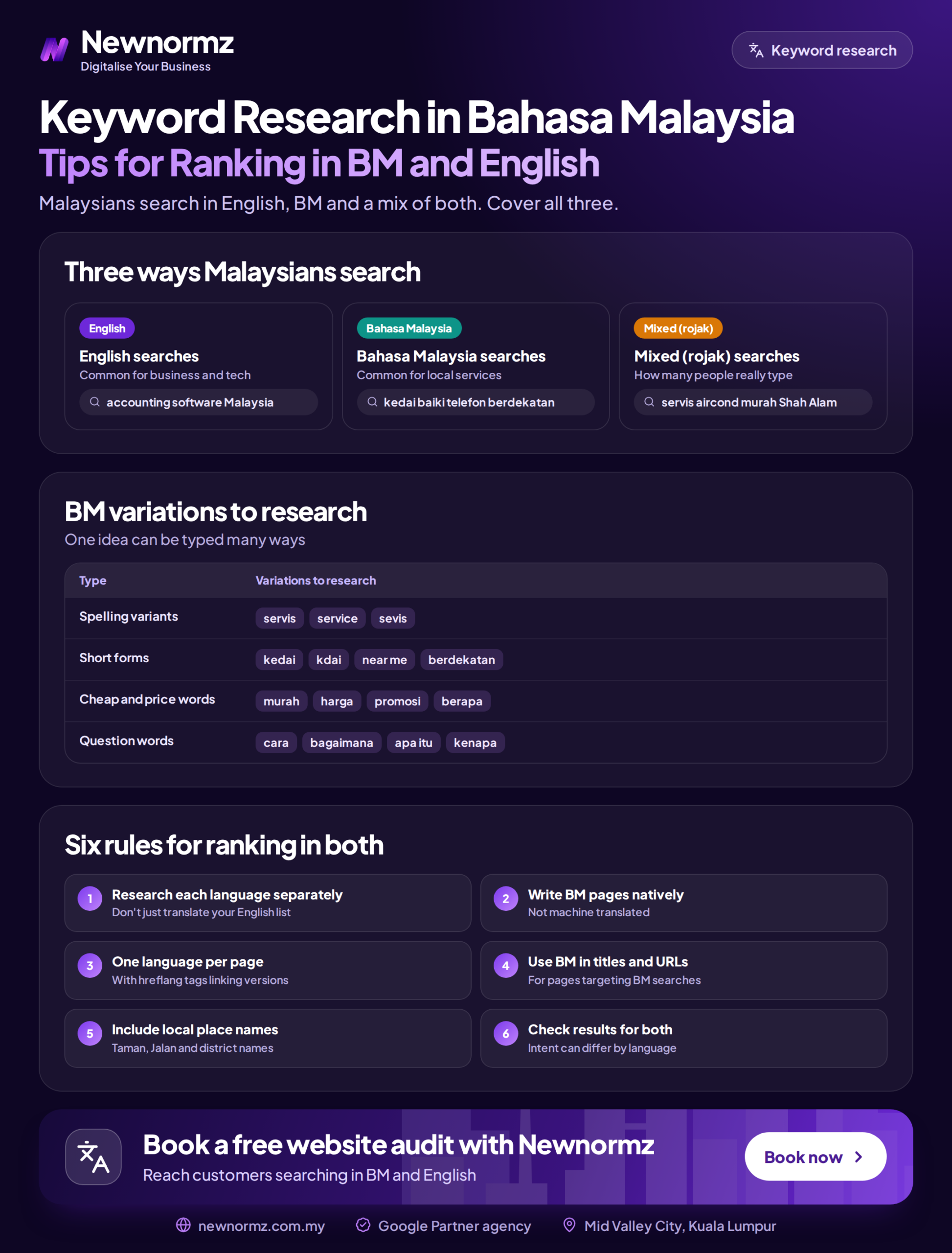
- ✓Good Bahasa Malaysia SEO keywords come from translating the searcher’s intent. Word-for-word translations of English keywords miss.
- ✓Keyword tools and machine translation mix in Indonesian words like mobil, gratis and toko, so filter those out before you plan any pages.
- ✓A lot of real Malaysian demand is rojak: mixed BM and English with casual spellings such as “servis aircond”.
- ✓Compare the BM and English results pages. If they share few URLs, the BM keyword needs its own page. If they share many, one page can rank for both.
This guide gives you a 7-step process for finding the Bahasa Malaysia SEO keywords your customers actually type, then a simple test to decide whether each one needs a separate BM page or just BM phrasing added to the English page you already have. You can do all of it with free Google tools in an afternoon. If your site ranks in English but enquiries have levelled off, BM search is often where the missing demand is.
Why Bahasa Malaysia SEO Keywords Get Missed by Most Malaysian Sites
Your audience is on Google. Statcounter puts Google at roughly 93 to 96% of search in Malaysia, and DataReportal’s Digital 2026: Malaysia report counts more than 35 million internet users, about 98% of the population. Many of those people search in Bahasa Malaysia, or in a mix of BM and English, especially on mobile.
Most Malaysian business sites are written in English, though, and their keyword lists come from English tools. If the team adds BM at all, it usually means running the top English keywords through a translator. What comes out is formal Malay that hardly anyone types into a search bar.
The BM vs English keywords gap is easy to see for yourself. Pick your main service keyword, search it in English, then search the way a customer in Klang or Kota Bharu would say it in BM. Look at who ranks on the BM page. You will often find directories, forum threads, Facebook pages and small competitors with thin pages, and that tells you the BM results are there for the taking. I’m not going to quote general volume or competition figures for BM, because they vary too much by niche to be useful. Your own two results pages will tell you more.
Before You Start: Work Out Which Language Your Buyers Search In
Your BM SEO strategy depends on who your buyers are. Use these as rules of thumb, then check them against your real query data in Step 1. For how BM, English and Chinese searchers behave differently, see our guide on how BM, English and Chinese SEO differ.
How to Find Bahasa Malaysia SEO Keywords: A 7-Step Process
The process starts with demand you already have, widens it with tools, cleans out Indonesian terms, then decides which pages to build. If you are new to keyword research for Malaysian audiences, read that first for the basics. This section covers the BM-specific layer.
Mine Search Console
Use a regex filter to pull the BM queries that already bring you impressions.
Translate intent
Rewrite each English seed the way a Malaysian would type it, then check it in Google Autocomplete.
Expand and filter
Run Keyword Planner set to Malaysia and Malay, and delete the Indonesian vocabulary.
Add rojak and casual spellings
Collect the mixed-language queries and spellings that standard Malay leaves out.
Run the SERP overlap test
Count how many top-10 URLs the BM and English searches share to decide between one page and two.
Map keywords and set hreflang
Give every keyword one page, and connect the language versions with ms-MY and en-MY.
Check Malay AI answers
Ask AI Overviews, ChatGPT and Nur AI your top BM queries and see whether you get mentioned.
Step 1: Pull the BM Queries You Already Get from Search Console
Start with your own data. These are Malay keywords Google already connects to your site, so the demand is proven before you spend anything.
In Google Search Console, open Performance, then Search results. Click + Add filter, choose Query, switch the dropdown to Custom (regex) and pick “Matches regex”. Paste in common BM words:
harga|murah|terbaik|kedai|berdekatan|cara|apa itu|servis
Set the date range to the last 12 months so you catch seasonal queries, then export. You will get some noise (for example, “cara” also matches “caravan”), so clean the list by hand. Look for queries with high impressions and a low average position. Those are BM searches where you already show up but sit too far down to get clicks.
Step 2: Translate the Intent, Not the Words
This is where keyword research in Bahasa Malaysia usually goes wrong. A translator gives you the dictionary version. Customers type the short, spoken version. Before you add any kata kunci SEO to your list, type the first few words into Google on your phone and see what Autocomplete suggests.
| English seed | Literal translation | What Malaysians actually type |
|---|---|---|
| aircon servicing | perkhidmatan penghawa dingin | servis aircond |
| cheap car rental | penyewaan kereta murah | sewa kereta murah |
| [service] near me | [servis] berdekatan dengan saya | [servis] near me / [servis] berdekatan |
Make a row like this for each of your top 10 English seeds. If Autocomplete won’t complete the literal version but finishes the casual one straight away, keep the casual one.
Step 3: Set Keyword Planner to Malaysia and Malay, Then Remove the Indonesian Terms
Google Keyword Planner’s Malay language setting is the most useful free Malay keyword research tool, but only if you set it up properly. In Discover new keywords, set the location to Malaysia only and the language to Malay. Enter the typed forms from Step 2 as seeds, not the literal translations.
Even with those settings, Indonesian vocabulary gets in, because the two languages share so much and the tools draw on a shared pool of data. This is the core Malay vs Indonesian keywords problem. Delete or swap anything in the left column:
| Indonesian term (remove) | Malaysian term (keep) |
|---|---|
| mobil | kereta |
| gratis | percuma |
| toko | kedai |
| jasa | perkhidmatan, or servis in casual queries |
| uang | wang |
| rental mobil | sewa kereta |
The same caveat applies to Ahrefs and Semrush. Set the database to Malaysia and run the same filter, because their keyword suggestions mix the two languages as well. Then put your shortlist into Google Trends with the region set to Malaysia. BM searches often jump around Ramadan, Hari Raya and the school holidays, and you want those pages live before the jump. Our guide to using Google Trends for seasonal demand shows how to read those patterns.
Step 4: Capture Rojak Queries and Colloquial Spellings
Rojak search queries are where a lot of buying intent sits, and standard keyword tools tend to under-report them. Look for three patterns:
- Code-switched product terms: “kedai baby stroller”, “harga [product] murah”, where the product name stays in English.
- English modifiers in BM queries: “near me”, “best” or “promo” added to an otherwise Malay search.
- Shorthand and casual spellings: “aircond” instead of “aircon”, dropped vowels, and spellings that differ from the Dewan Bahasa dan Pustaka standard.
Check the standard spelling in Pusat Rujukan Persuratan Melayu (PRPM), then compare it with what Autocomplete suggests. Our rule for SEO in Bahasa Melayu is to put the typed form in headings and FAQ questions, because that is what gets matched, and keep the standard spelling in body copy where it reads naturally. Many of these phrases have low competition, which makes them good low-competition long-tail phrases for a newer site.
Step 5: Run the SERP Overlap Test to Decide One Page or Two
This is the step most guides leave vague. Open an incognito window with Google set to Malaysia. Search the English keyword and write down the top 10 URLs. Search the BM equivalent and do the same. Then count how many URLs appear on both lists.
If Google ranks the same pages for both searches, it treats them as one intent. If the lists are different, it treats them as separate needs. This is the most practical part of bilingual keyword research in Malaysia, because it uses Google’s own results rather than a guess.
These are rules of thumb, not fixed limits. Run the test again every few months, because results pages change.
Step 6: Map Keywords to Pages and Set hreflang Properly
Give every keyword exactly one page so your BM and English pages don’t compete with each other. A simple map looks like this:
| Keyword | Language | Page | Intent |
|---|---|---|---|
| aircon servicing kl | en-MY | /aircon-servicing/ | Book a service |
| servis aircond murah | ms-MY | /ms/servis-aircond/ | Compare prices, book |
| cara cuci aircond sendiri | ms-MY | /ms/blog/cara-cuci-aircond/ | Learn (DIY) |
For pages that exist in both languages, Google Search Central’s documentation on localised versions of a page explains how to use hreflang. Each version lists itself and the other, for example <link rel="alternate" hreflang="ms-MY" href="https://example.com/ms/servis-aircond/" /> on both pages, with a matching en-MY line pointing to the English URL. hreflang ms-MY means Malay for users in Malaysia. Pages with no counterpart in the other language don’t need a tag. If you plan to expand beyond two languages or into other countries, our multilingual SEO setup page covers the wider structure.
✗ Publishing machine-translated BM pages
Auto-translation plugins pick up Indonesian vocabulary and stiff phrasing. Malaysian readers notice straight away, trust drops, and the page ends up targeting words like “jasa” and “gratis” that your buyers don’t search for.
✓ The fix
Have a native BM writer write or review every BM page, checking it against the Step 3 table and the typed forms from Steps 2 and 4.
Want a strategist to run the SERP overlap test on your top keywords and tell you which ones need a BM page?
Step 7: Check Whether Malay AI Answers Mention You
Type the BM versions of your top five queries into Google AI Overviews, ChatGPT and Nur AI, the Malaysian AI engine. Note who gets named and which pages are cited. A growing share of Bahasa Malaysia searches now get an AI-written answer before any normal results.
Don’t treat this as a separate project. Industry studies find that about 76% of Google AI Overview citations come from pages already in the traditional top 10, so getting the BM page ranking comes first. After that, clear FAQ answers and schema make the page easier to quote. Newnormz’s AI search optimisation work covers Malay-language AI answers, including Nur AI, if you want this tracked monthly.
Is a BM Keyword Worth Its Own Page? The Ringgit Maths
The overlap test tells you whether a BM keyword needs its own page. This calculation tells you whether that page is worth paying for. The numbers below are illustrative only. Replace them with your own Keyword Planner volume, conversion rate and job value.
- BM keyword with 900 monthly searches
- × an assumed 8% click share in a top-3 position = 72 visits
- × a 3% enquiry rate = about 2 enquiries
- × a 50% close rate = 1 job a month
- × RM400 average job value = about RM400 a month, or RM4,800 a year
Compare that with the one-off cost of a native-written BM page. If writing it costs you around RM600 to RM1,000, the page pays for itself five to eight times over in a year, and it keeps working after that. If your numbers come out at RM50 a month, add BM phrasing to the existing page instead.
Newnormz take
Build a separate BM page only when both tests agree: the SERP overlap test says the intents are separate, and the yearly value is several times the writing cost. If only one test passes, add BM phrasing to the English page and measure it first.
The work doesn’t end at launch. Two language versions mean two sets of pages to update, check for hreflang errors and track in Search Console. For a site with dozens of bilingual pages, that ongoing maintenance is where most of the effort goes. If you would rather hand it to an SEO agency in Malaysia, our strategists work in English, Bahasa Malaysia and Chinese, and multilingual EN/BM/CN SEO is part of the Enterprise package (RM6,800+/month, excluding SST).
Bahasa Malaysia Keyword Research FAQs
Is it better to do SEO in Bahasa Malaysia or English?
Most Malaysian businesses need both, weighted by who their buyers are. Mass-market B2C usually leans BM, while corporate B2B leans English. Your Search Console query data is the most reliable guide.
Does Google treat Malay and Indonesian as the same language?
No. hreflang uses separate codes for the two (ms for Malay, id for Indonesian), and Google Keyword Planner lists them as separate languages. The vocabulary overlaps a lot, though, so keyword tools and translation tools still mix them, which is why you need the filter in Step 3.
Can one page rank for both BM and English keywords?
Yes, when Google treats the two searches as the same intent. If the BM and English results share five or more of their top 10 URLs, add BM phrasing to H3s and FAQs on the English page. If they share three or fewer, build a separate BM page.
Which keyword research tools support Bahasa Malaysia?
Google Keyword Planner, Ahrefs and Semrush all support Malay with a Malaysia location setting. Google Search Console, Google Trends and Google Autocomplete fill in what those tools miss. Whichever tool you use, filter out the Indonesian terms before you trust the list.
Should I translate my English website into BM for SEO?
Not the whole site, and not with machine translation. Build BM pages only for keywords that pass the SERP overlap test and the ringgit maths, and have a native BM writer write or review them.
How do I set up hreflang for Malay pages in Malaysia?
Use hreflang=”ms-MY” for the Malay page and hreflang=”en-MY” for the English version, and put both tags on both pages. Each page must point to itself and to its counterpart, or Google may ignore the tags.
Do Bahasa Malaysia keywords have lower competition than English keywords?
Often, but it depends on the niche, so check rather than assume. Search the BM version of your keyword and look at who ranks. Directories, forums and thin pages mean an opening. Strong, dedicated BM pages mean real competition.
Free SEO audit
Find out which of your keywords are missing BM demand
- ✓A review of the BM and rojak queries already in your Search Console
- ✓SERP overlap results for your top keywords, showing which ones need a separate BM page
- ✓An hreflang and translation check by strategists who work in English, Bahasa Malaysia and Chinese
Newnormz runs SEO for 200+ Malaysian businesses on month-to-month terms, with a written page 1 guarantee and a 5.0 rating from 214+ Google reviews.

Bryan Tan is an SEO Specialist and CEO at Newnormz, helping hundreds of businesses achieve first-page rankings on Google. With a passion for driving organic growth, Bryan blends innovative strategies with hands-on experience to optimize websites for maximum visibility. Always at the forefront of the latest SEO insights and trends, he consistently adapts to the evolving digital landscape.