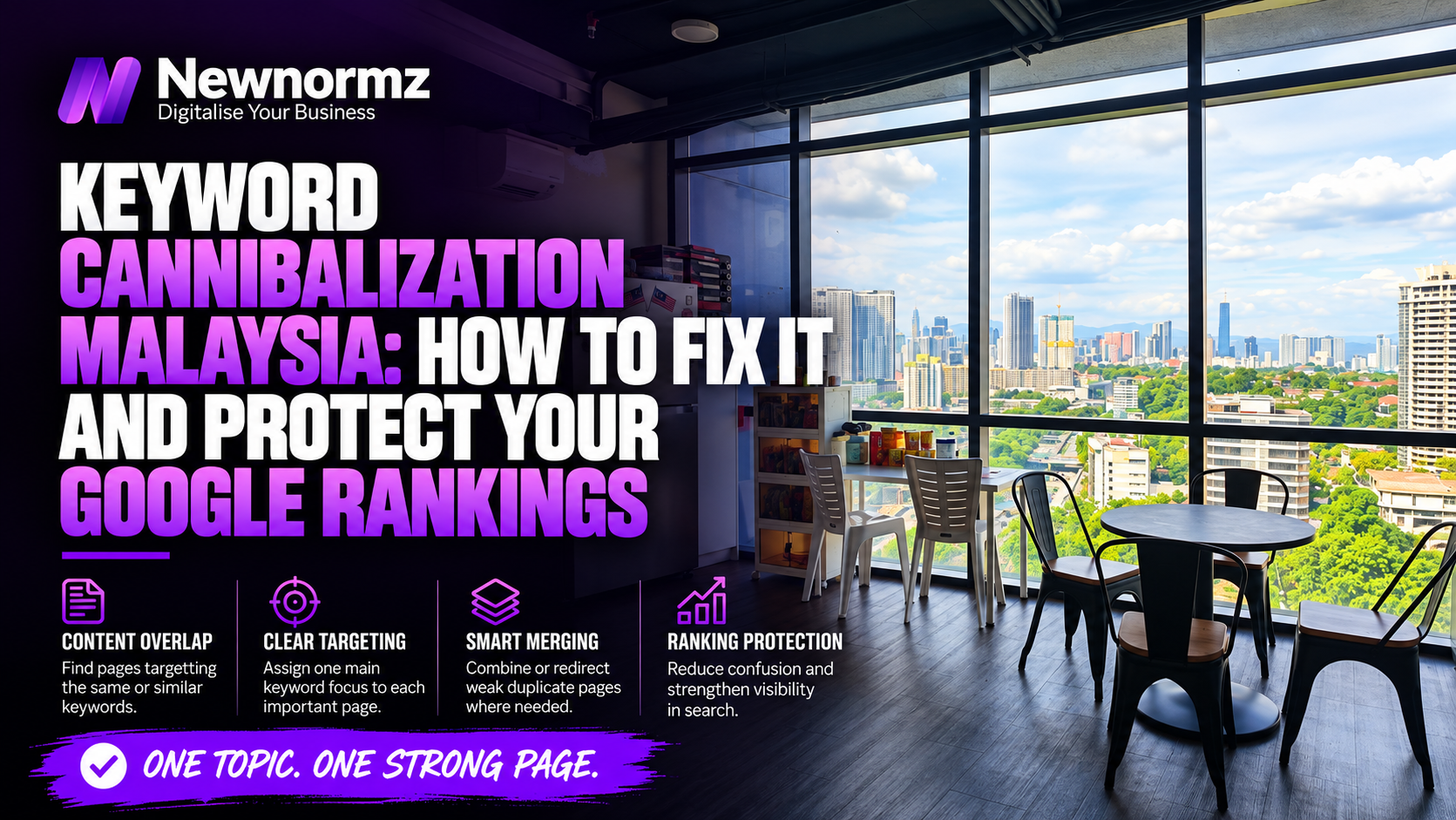
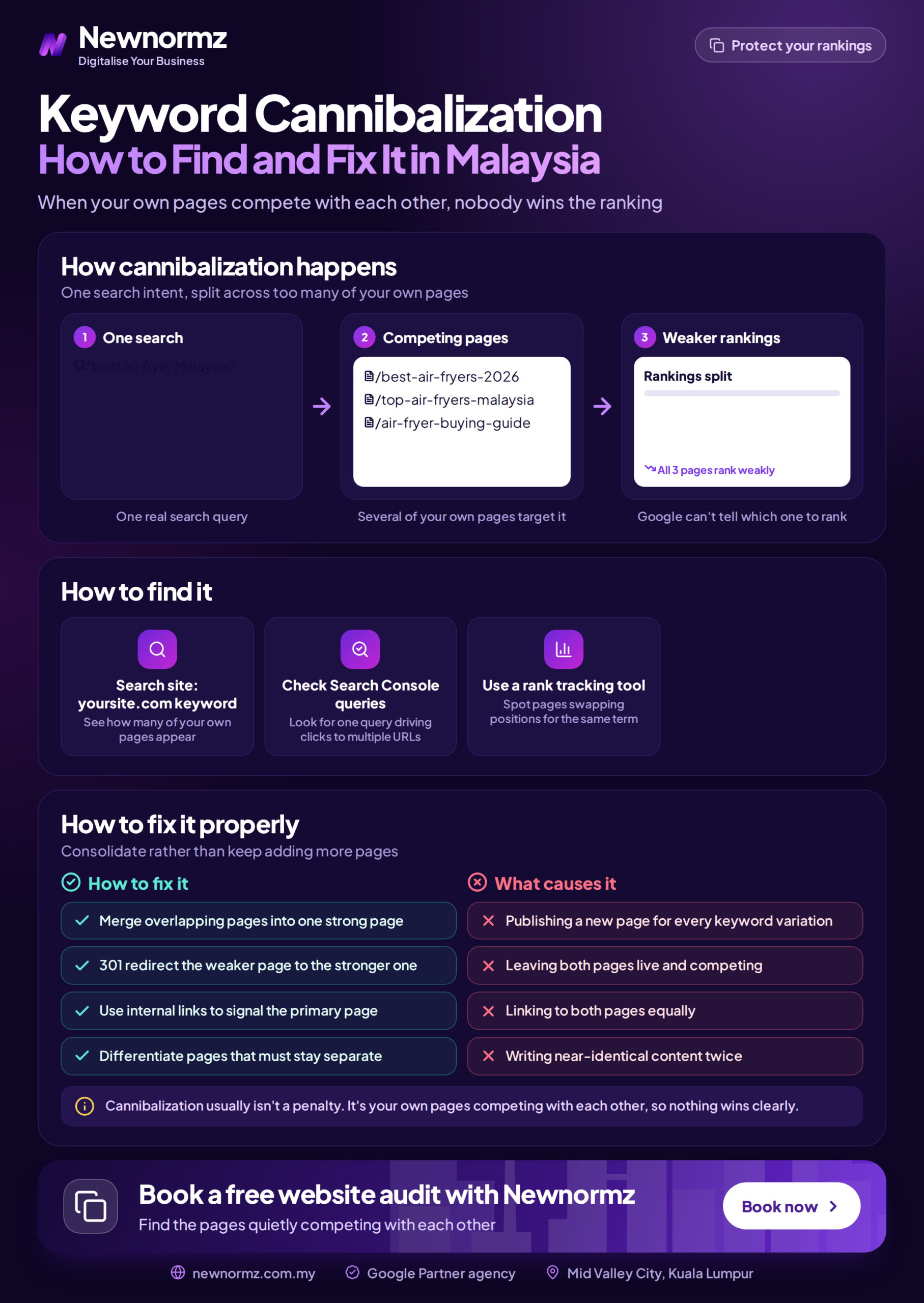
Keyword cannibalization happens when two or more pages on your site target the same search intent, so Google has to guess which one to show. It rarely triggers a penalty. What it does is split your links, clicks and relevance across several weak pages instead of building one strong one. You find it by checking which URLs appear for the same query in Google Search Console, and you fix it by merging, redirecting or clearly separating the pages. No one can promise a specific ranking from this, but a site where every page has one job gives Google far less to be confused about.
A Simple Way to Think About It
Two Salespeople, One Customer
😕 Two people, same customer
Two salespeople step forward to greet the same customer at the door. They hesitate, talk over each other, and the customer walks out.
✅ One person, one job
One salesperson greets everyone at the door and knows exactly which counter to send each customer to.
Your website works the same way. Below, we look at how the pile-up happens on Malaysian sites and how to give every page its own role.
What Keyword Cannibalization Actually Is
Cannibalization is not about using the same word twice. It is about two pages answering the same question for the same searcher. If you run an agency in Kuala Lumpur and have a service page, a blog post and a homepage section all aimed at “SEO services Malaysia”, Google has to pick one. Often it keeps switching between them, and none of them gets the stability it needs to hold a strong position.
Two pages sharing a keyword is fine if the intent differs. A blog post explaining “what is SEO” and a service page selling SEO are not in conflict, even though both mention SEO. The problem starts when both pages are trying to satisfy the same person at the same stage of their search.
Why It Happens So Often on Malaysian Websites
Most SME sites grow one page at a time, with no keyword plan behind them. A homepage targets “digital marketing Malaysia”, then a blog post gets written on the same phrase, then a service page borrows the same language. Nobody planned the conflict. It just built up over time.
Four patterns show up again and again locally:
- Content added without keyword mapping. Pages are written reactively, and no one checks whether an existing page already covers the topic.
- Overlapping English and Bahasa Malaysia pages. Where both versions target the same broad term with the same intent, they can end up competing.
- Ecommerce categories, tags and products sharing keywords. Common in Malaysian online retail, where a tag page and a category page can describe the same thing.
- Near-identical location pages. A business serving KL, Penang and Johor sometimes clones one page three times and swaps the city name. If you do run location pages, they need real local substance. Our local SEO approach covers how to build them so each one earns its place.
How to Find Cannibalization on Your Site
You do not need paid tools to start. Three checks cover most cases.
1. The site: search
Search Google for site:yourdomain.com.my "target keyword". If several of your pages show up for the same phrase, that is a lead worth investigating. It is a rough check, not proof, because it shows what is indexed rather than what ranks.
2. Google Search Console
Open the Performance report, click a query, then switch to the Pages tab. If two or more URLs share impressions for one query, and the ranking URL keeps changing from week to week, you have a strong signal. A keyword that bounces between the bottom of page one and page two without settling is a typical example.
3. A keyword mapping audit
List every page on your site next to the one keyword and intent it is meant to own. Duplicates become obvious the moment they sit in the same column. This is also the first thing we build in a full audit, before touching any content.
Cannibalization vs Duplicate Content
People mix these up, but the fixes differ. Duplicate content is about copied text. Cannibalization is about competing intent, and the pages can be completely different in wording.
| Keyword cannibalization | Duplicate content | |
|---|---|---|
| What it is | Different pages targeting the same search intent | Identical or near-identical text on more than one URL |
| Usual cause | No keyword plan for the site | Copied text, URL variations, product page cloning |
| What Google does | Rotates between your pages, or ranks the wrong one | Usually picks one version and filters out the rest |
| Typical fix | Merge, redirect or differentiate | Canonical tags, noindex or rewrite |
| Where we see it in Malaysia | Blog posts and service pages fighting over one phrase | Ecommerce products with near-identical descriptions |
What It Costs You If You Ignore It
Cannibalization does not usually crash a site. It quietly caps it. Here is what to expect:
- Unstable rankings. The URL Google shows keeps changing, so traffic for that keyword is hard to predict.
- Split link value. Backlinks and internal links pointing at different pages divide your authority instead of concentrating it.
- The wrong page ranking. A visitor ready to enquire lands on an informational blog post instead of your service page, and leaves.
- Wasted crawling on large sites. For a small business site this is minor. On a large ecommerce catalogue, Google spending time on overlapping pages can slow how quickly new pages are picked up.
How to Fix It: Four Steps
The right fix depends on what each page is for. Do not delete anything until you have decided its role.
Step 1: Choose the page that should win
Compare the competing pages in Search Console and your analytics. Which has more clicks, stronger backlinks, and a better fit for the intent behind the query? That page becomes the one you want Google to rank.
Step 2: Merge pages that cover the same ground
If two pages say nearly the same thing, fold the useful parts of the weaker one into the stronger one, then 301 redirect the old URL to the new one. This consolidates link value on one URL. A typical Malaysian case is a blog post and a service page both aimed at “SEO agency Malaysia”. One page that serves both the researcher and the buyer often performs better than two half-strength ones. If that is the position you are in, our SEO service starts with exactly this kind of audit.
Step 3: Separate pages that need to stay separate
Sometimes both pages have a real purpose. Then rewrite each around a distinct intent:
- A broad page for “digital marketing Malaysia” aimed at people still learning.
- A specific page for “SEO services Kuala Lumpur” aimed at people ready to hire.
- A unique title tag, meta description and primary keyword on each, with no overlap.
- Internal links that point to the page you want to rank, using clear anchor text.
Step 4: Use canonical tags where pages must coexist
For near-identical pages that have to remain live, such as similar ecommerce category pages, add a rel="canonical" tag pointing to the preferred version. It is a hint to Google, not a command, so pair it with sensible internal linking.
How Long Before You See a Change?
Google needs time to recrawl and reprocess the new structure, usually a few weeks. More stable rankings tend to follow after that, and they build with monitoring and small refinements rather than arriving overnight. Anyone promising a fixed position or a fixed date is guessing, because Google has said repeatedly that no one can guarantee rankings.
The bigger lesson from our own campaigns is that structure supports growth. Sunway Medispa saw a 700% traffic increase and 70% more keywords ranking over six months, and Times Parking reached 416 ranking keywords in six months. Those numbers came from campaigns where each page had a clear purpose, not from a single cannibalization fix, so treat them as evidence of what clean structure allows, not as a promised outcome.
Frequently Asked Questions
Does keyword cannibalization cause a Google penalty?
No. It is a strategy problem, not a rule violation. Your pages simply split signals that would be stronger on one URL.
Is it a problem if two pages rank for the same keyword?
Not always. If both pages serve different intents and both hold good positions, leave them alone. Act when rankings are unstable or the wrong page keeps appearing.
Should I delete, merge or redirect the weaker page?
It depends on its traffic, backlinks and role. If it has value, merge it. If it has none, redirect it. Delete outright only when it has no links, no traffic and no purpose.
Can cannibalization hurt my enquiries?
Yes. If Google shows an informational post for a buying query, the visitor may never reach your service page or contact form.
Are English and Bahasa Malaysia pages a risk?
Only when both target the same broad term with the same intent. Use hreflang and distinct, language-appropriate keywords so each version has its own role.
Is this only a technical fix?
No. Redirects and canonicals help, but the lasting fix is content direction: one keyword, one intent, one page, with internal links that reinforce it.
Are your own pages competing with each other?
Find out which pages are holding your rankings back
Newnormz has run SEO campaigns across F&B, healthcare, ecommerce, and local services in Malaysia, backed by a performance guarantee of 70 percent of targeted keywords on Google’s first page.
30 minutes, no obligation, and we will check your site for keyword conflicts.

Bryan Tan is an SEO Specialist and CEO at Newnormz, helping hundreds of businesses achieve first-page rankings on Google. With a passion for driving organic growth, Bryan blends innovative strategies with hands-on experience to optimize websites for maximum visibility. Always at the forefront of the latest SEO insights and trends, he consistently adapts to the evolving digital landscape.