If you searched “how to write SEO content Malaysia” because your pages aren’t ranking, the answer is four steps, done in order. First, match the page type Google already shows for your query. Second, answer the question in the first 100 words. Third, add one thing the current top results are missing. For most Malaysian businesses that means real RM prices, Bahasa Malaysia or Chinese search terms and proof from your own work. Fourth, make the page easy to act on, usually with a WhatsApp button. Keyword density and word count matter far less than most beginners think.
We see the same pattern again and again. A KL business publishes 20 blog posts in six months, opens Google Search Console and finds a few hundred impressions and almost no clicks. The writing itself is fine. The trouble is that each post answers a question nobody in Malaysia is typing, in a format Google isn’t showing, and says nothing a competitor’s page doesn’t already say.
This guide is for owners and marketers writing their own pages for the first time. The formula works for service pages and product pages as well as blog posts.
Why Most Beginner SEO Content Never Ranks (and It Isn’t the Keywords)
Most SEO content writing tips still start with keywords: pick one, repeat it at 2% density, hit 2,000 words. For SEO writing in Malaysia today, that advice is years out of date. Google’s systems judge whether a page satisfies the person searching. They don’t count how often a phrase appears.
According to Statcounter, Google holds roughly 93 to 96% of Malaysian search, so writing for Google first makes sense. These days, though, writing for Google means writing for the person searching. Three ideas explain why.
Google Ranks the Answer, Not the Article Length
Google’s guidance on creating helpful, reliable, people-first content asks whether a reader leaves feeling they’ve learnt enough to reach their goal. It also warns against writing to a particular word count because you’ve heard Google prefers it. Google has no preferred length.
So how long should SEO content be? As long as the answer needs, and no longer. A Subang Jaya homeowner wants the price range, the timeline and the next step. A 900-word page that gives them that will beat a 3,000-word page that spends its first 600 words on industry history. Padding also hurts on mobile, where most Malaysian searchers read. If the answer is three screens down, they leave before they reach it.
Content Writing for Google Means Writing for the Page Google Already Shows
Search intent is the job the searcher wants done. Google tells you what it thinks that job is through the type of page it ranks. If you search “aircon service Petaling Jaya”, the top results are service pages and Google Maps listings, not blog posts. If you search “how often should I service my aircon”, you get articles and People Also Ask boxes.
Content writing for Google starts with that check. When the top 10 are all service pages, a blog post won’t win however good it is, because it’s the wrong format for the job. Match the page type first, then write.
What “Experience” Looks Like on a Malaysian Page
E-E-A-T stands for experience, expertise, authoritativeness and trust. The term comes from Google’s Search Quality Rater Guidelines, which human reviewers use to judge the quality of search results. It isn’t a single ranking factor, but it describes what Google’s systems try to reward.
On a Malaysian page, experience looks like this: photos of your own team and jobs instead of stock images, real RM prices or price ranges, the areas you actually serve, and the name of the person who does the work. Our guide to showing E-E-A-T on your pages covers authorship and trust signals in more depth.
From our audits
Many of the Malaysian service pages we audit could belong to any company. Swap the logo and the text still works: “We provide quality service at affordable prices with experienced professionals.” Fifty other pages say the same thing, so Google has no reason to pick yours. The fix is to add details only you can write: your prices, your areas, your process and your photos.
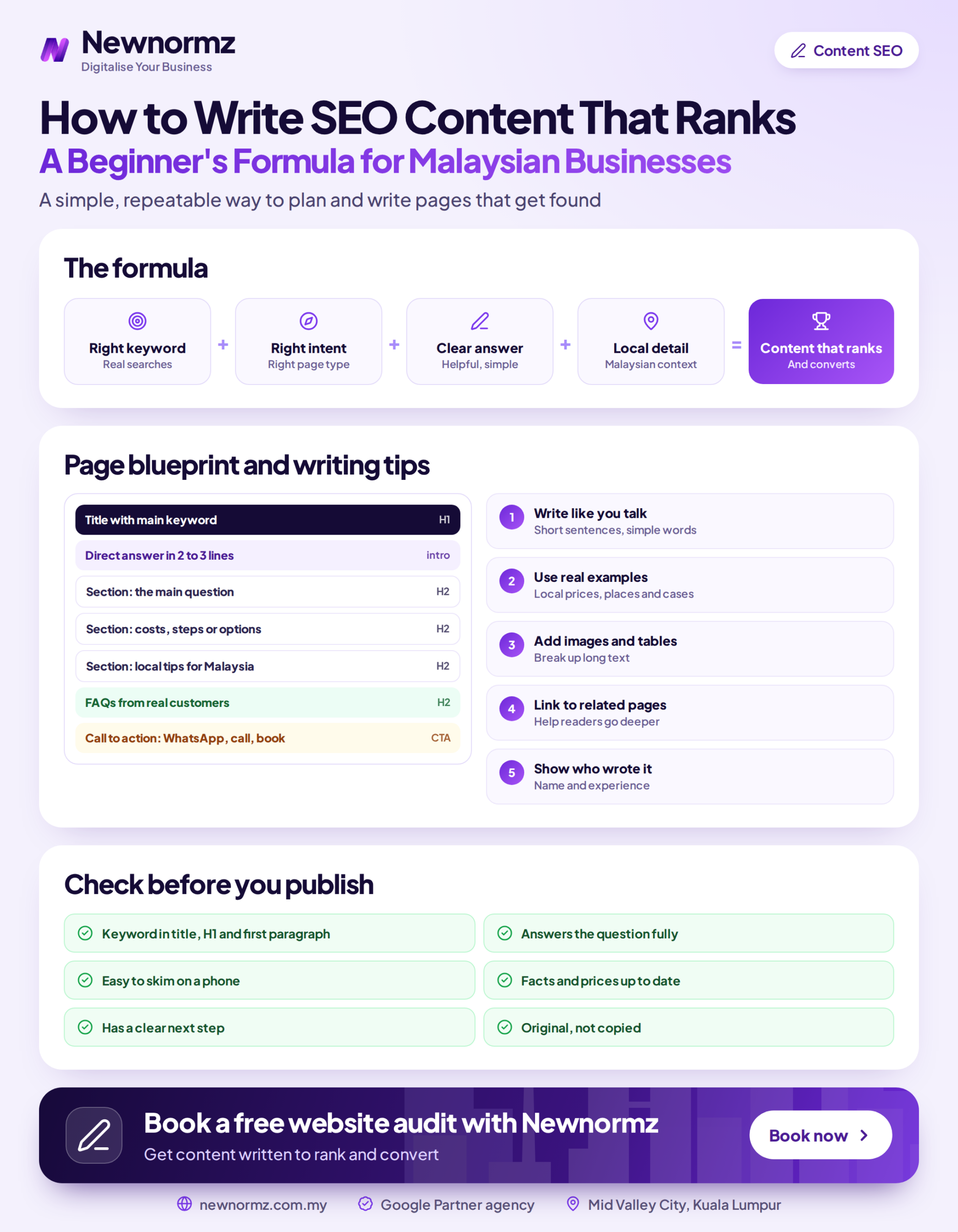
How to Write SEO Content in Malaysia: The Four-Part Formula
Here is the short version of how to write content that ranks on Google. Use it on any page: a blog post, a service page or a product page. Each part depends on the one before it, so don’t skip ahead.
Part 1: Check the SERP Before You Write a Word
Do this on your phone, because that’s how most of your customers search.
Search the exact query on mobile
Note what type of page holds each of the top 5 spots: service page, blog post, product listing, Maps pack or video. Whichever type dominates is the format you should write.
Copy the People Also Ask questions
Write down 4 to 6 of them. They show the follow-up doubts searchers have, and they make good H2s, H3s or FAQ questions.
Check whether an AI Overview appears
If Google shows one, your answer has to be quotable: a clear, direct sentence near the top that a summary can lift as it stands.
Find the BM, Chinese and mixed-language variants
Type your query into Google autocomplete with words like “kedai”, “murah”, “terdekat” or “harga”. Try mixing languages the way people really type, such as “servis aircon PJ murah”. If the BM results show the same page types as the English ones, one page with a BM section may be enough. If the results are completely different, the intent is different and a separate language page is justified.
Part 2: Answer in the First 100 Words
Lead with the answer, then give the reason. If someone searches “aircon chemical wash price”, the first line of your page should give the price range, not a paragraph about Malaysia’s hot weather. Readers decide in seconds whether to stay. AI Overviews and People Also Ask boxes also pull from pages that state the answer cleanly.
Sunway TCM Centre shows how this works. Alongside a technical rebuild, the work included AEO structuring, which means organising pages so each question gets a direct, quotable answer. The centre reached page 1 for 80% of its target keywords within 4 months and now appears in Google AI Overviews for treatment searches. The same structure helps you get picked by ChatGPT, which we cover in writing content that AI engines quote.
Headings, meta descriptions, URLs and schema all support the page, but each is a separate job. Get the opening right first.
Part 3: Add One Thing the Top Results Don’t Have
This is the step most Malaysian content skips, and it’s usually why that content doesn’t rank. If your page says the same thing as the top 10, Google has no reason to replace one of them with yours.
Open the top 3 results and list what they cover. Ahrefs or Semrush will show you which keywords and subtopics each competing page ranks for, so you can find the gaps instead of guessing. Then add at least one of these:
- A price range in RM, plus what makes the price go up or down.
- A decision rule from your own work, such as when you’d recommend the cheaper option over the expensive one.
- Photos or a short step-by-step process from a real job.
- Answers to the BM or Chinese questions customers send you on WhatsApp.
Covering the related topics and entities around your subject also helps Google understand what your page is about. Our guide on how Google reads topics and entities explains how.
Part 4: Make It Easy to Act On
SEO friendly content is content a busy reader can scan on a phone and act on with one tap. Keep paragraphs to 2 to 4 lines, use specific subheadings, and add a table wherever people compare options or prices.
In Malaysia, enquiries usually come through WhatsApp rather than a contact form. Add a WhatsApp Business click-to-chat button near the top and again at the end, with a pre-filled message so the customer doesn’t have to think about what to type.
Keyword placement in content is simpler than most tutorials suggest. Put the primary keyword in the title, the first paragraph and at least one H2. After that, write naturally and use variations. If you find yourself forcing a phrase into a sentence, take it out.
The Formula in Practice: An Illustrative Service Page Rewrite in RM
The example below is illustrative, not a client case. The numbers are there to show the maths.
A PJ aircon servicing business has one page called “Services”. It’s a bullet list (general service, chemical wash, gas top-up, repair) with no prices, no areas and no photos. It ranks for nothing. Here is how the formula changes it:
| Element | Before | After |
|---|---|---|
| Page type | Generic “Services” page | Dedicated “aircon service PJ” page, matching the service pages in the top results |
| Opening | Company history | Starting prices for a general service and a chemical wash in the first two lines |
| Local detail | None | Areas covered (SS2, Damansara Utama, Kelana Jaya) plus a BM section for “servis aircon PJ” |
| Proof | Stock photo | Photos from real jobs and the technicians’ names |
| Action | Contact form at the bottom | WhatsApp button at the top and bottom |
The next question is whether the effort pays off. Say the average job is RM180. If the rewritten page brings in 10 extra WhatsApp enquiries a month and 4 of them book, that’s RM720 a month, or RM8,640 over a year. The rewrite takes roughly 8 hours: 2 for the SERP check, 4 to write and 2 for photos and setup. Even if you value your time at RM150 an hour, that’s RM1,200 of effort for a page that keeps working.
There are two honest caveats. The enquiries won’t arrive in the first week, so expect first movement after about 60 to 90 days. And nobody can promise those 10 enquiries, because Google itself states that no one can guarantee a ranking. Still, the maths shows you which pages to fix first: the ones tied to your highest-value jobs. The same formula works for ecommerce too. Our guide to writing product listings that rank applies it to product pages.
Client example
Oriental Kopi: content built on real search terms, compounding over time
Problem: A national F&B and retail brand competing for broad, high-volume product searches.
What we did: Optimised content around the terms customers actually type, such as “kopi”, “white coffee” and “3 in 1 coffee”, and added full schema and ecommerce technical fixes.
Result: +350% ranked keywords. Over a 2-year campaign: 24,500 more ranking keywords, 6.31M impressions and 468,000 clicks. Still a client after 4 years.
When the Formula Isn’t Enough on Its Own
The formula fixes the page. It doesn’t fix everything around the page. These are the situations where you’ll need more.
Even with all of this in place, be realistic about timing. Newnormz tells clients to expect first ranking movement around day 60 to 90, with traffic and lead growth in months 4 to 8.
Can You Use ChatGPT to Write SEO Content?
Yes, as a drafting aid. Google’s guidance on AI-generated content says it rewards quality however the content is produced. Using automation mainly to manipulate rankings, though, breaks its spam policies.
The real risk with AI written content for SEO isn’t a penalty. It’s that ChatGPT can’t know your prices, your service areas, the questions customers send on WhatsApp or the photos from last week’s job, and those are exactly what make Part 3 work. Use it to outline, tidy grammar or suggest FAQs, then add what only you know. For the detail, read what Google says about AI content.
Your Pre-Publish Check for SEO Friendly Content
Before you hit publish
- ✓The page type matches what Google shows in the top 5 on mobile.
- ✓A direct answer appears in the first 100 words.
- ✓At least one element the top results lack: a price range, a decision rule, a process or a real photo.
- ✓A real RM figure or local detail (areas, landmarks, BM or Chinese terms) is on the page.
- ✓The primary keyword sits in the title, the intro and one H2, and nowhere does it sound forced.
- ✓People Also Ask questions are answered in headings or the FAQ.
- ✓3 to 5 internal links point to related pages, with descriptive anchor text.
- ✓A WhatsApp button sits near the top and at the end.
- ✓Your meta title and description are written by hand and within length limits.
- ✓A preview on your phone shows no walls of text, tables that scroll and buttons that are easy to tap.
Writing blog posts specifically? Our step-by-step blog post framework picks up where this checklist ends.
FAQ
How long should an SEO article be to rank in Malaysia?
There’s no fixed length, so write as long as the answer needs. A focused service page might run 600 to 1,000 words and a full guide 1,500 to 2,000. Use the top results for your query as a rough guide, then cut anything that doesn’t help the reader.
Should I write SEO content in Bahasa Malaysia, English or Chinese?
Write in the languages your customers actually search in, which you can see from autocomplete and your Search Console queries. Many Malaysian businesses start with English, then add SEO content in Bahasa Malaysia or Chinese where those searches show different results or real demand. Write each version for how that audience searches, not as a direct translation.
How many keywords should one page target?
Target one primary keyword plus a handful of close variations and related questions. If two keywords bring up the same pages in Google, one page can target both. If they bring up different pages, each needs its own page.
How long does new content take to rank on Google?
First movement usually shows around day 60 to 90, with traffic and leads building over months 4 to 8. It depends on your site’s existing authority, the competition and whether Google can crawl the page. Google itself states that no one can guarantee a specific position.
Is it worth hiring an SEO content writer in Malaysia?
It’s worth it when your time is better spent running the business, or when you need steady output in more than one language. If you can publish one strong page a month and Search Console shows impressions rising, keep going in-house. If pages still aren’t moving after 3 months, a writer alone may not fix it, so check for technical and authority issues too.
Pages not ranking?
Send us one page. We’ll show you what’s stopping it from ranking.
Newnormz runs SEO for 200+ Malaysian businesses on month-to-month terms, with a written page 1 guarantee and a 5.0 rating from 214+ Google reviews.
No obligation. Our strategists review content in English, Bahasa Malaysia and Chinese.

Bryan Tan is an SEO Specialist and CEO at Newnormz, helping hundreds of businesses achieve first-page rankings on Google. With a passion for driving organic growth, Bryan blends innovative strategies with hands-on experience to optimize websites for maximum visibility. Always at the forefront of the latest SEO insights and trends, he consistently adapts to the evolving digital landscape.