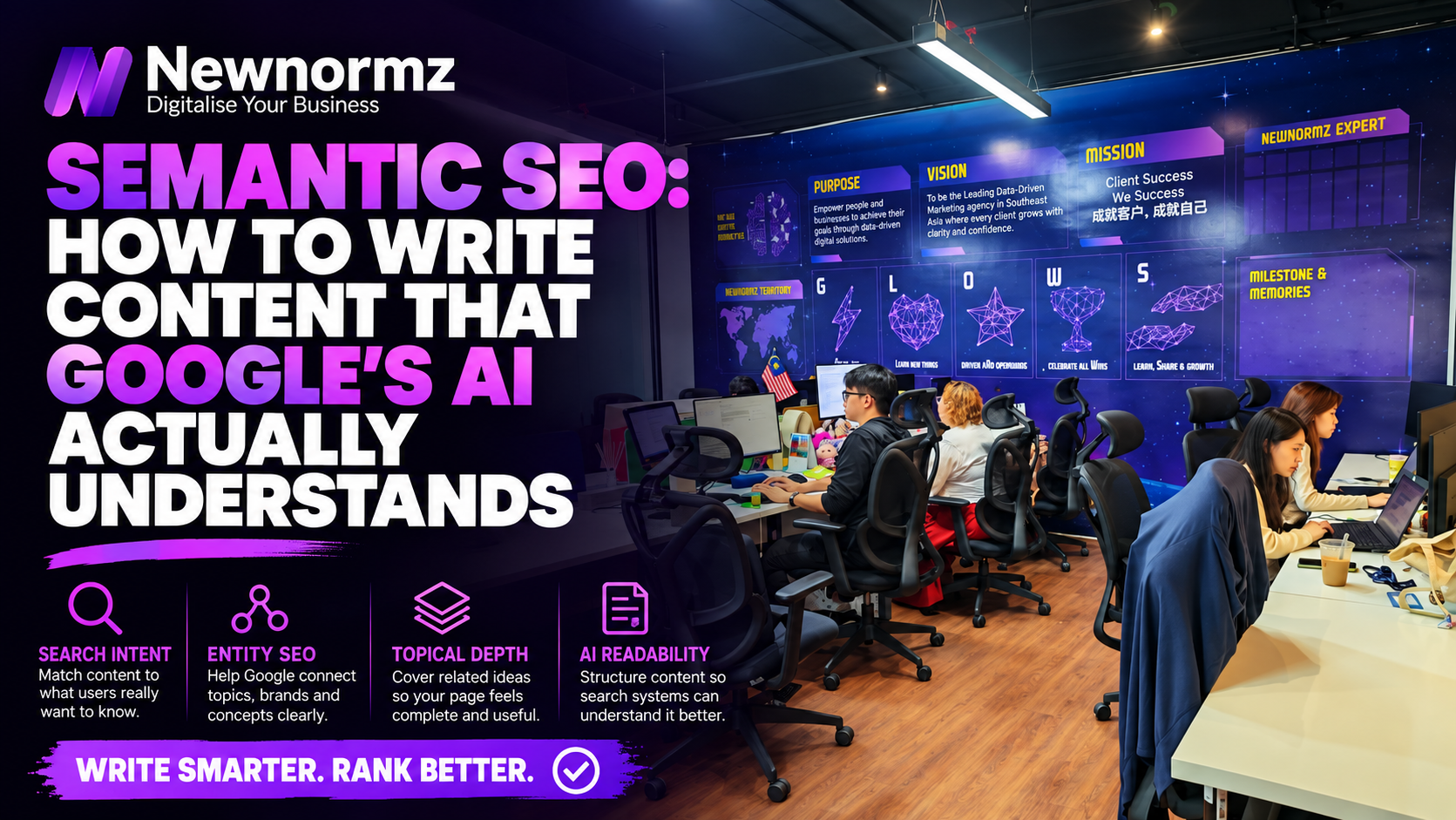
Semantic SEO is writing content around a topic and the intent behind a search, not around a single keyword repeated on the page. Google’s systems read whole sentences and whole pages to work out what you mean, so a page that covers a subject fully, uses the words real customers use, and is laid out clearly will usually beat a page that just repeats a phrase. No one can guarantee a ranking position, but this is the approach that gives your content the best chance of being understood, and cited, by Google’s AI.
A Simple Way to Think About It
Two Waiters, One Order
🍽️ The waiter who matches words
You say “something light for lunch” and he points at the word “lunch” on the menu. You get a set meal you did not want.
🍜 The waiter who listens
He asks what you feel like, hears “light”, and suggests the right dish. You order it and come back next week.
Google has spent years training itself to be the second waiter. The rest of this article covers how to write so it can serve your pages the same way.
What Semantic SEO Actually Means
Old-style SEO asked, “Which keyword does Google want to see on this page?” Semantic SEO asks, “What does the person searching actually need to know?”
Google uses natural language systems, including BERT and MUM, to analyse full queries and full pages. It looks at context, the entities mentioned (people, places, products, concepts) and how they relate to each other. A page that covers a topic thoroughly, in clear language, gives those systems far more to work with than a page built around one repeated phrase.
That matters in Malaysia, where people search in English, Bahasa Malaysia, Chinese, or a mix of all three, often as full questions. Google has to interpret meaning, not just match strings, and your content needs to make that easy.
Keyword SEO vs Semantic SEO
| Factor | Keyword-first SEO | Semantic SEO |
|---|---|---|
| Starting point | One target keyword | A topic and the questions around it |
| Writing approach | Repeat the phrase, hit a density target | Cover the subject fully, in natural language |
| What Google reads | Exact-match terms | Context, entities and how they connect |
| Fit for AI answers | Weak: thin, repetitive text is hard to quote | Stronger: clear, complete answers are easy to extract |
| Long-term value | Fades as competitors copy the tactic | Builds as more pages support each other |
Five Ways to Apply It to Your Content
1. Build around a topic, not a phrase
Start with what your customer is trying to solve, then list every question that sits around it. A page on accounting software for Malaysian SMEs should naturally deal with cost, payroll integration, and LHDN e-invoicing requirements. Those are the related ideas a knowledgeable reader expects to see.
If a page skips them, Google has little reason to treat it as a complete source.
2. Write the way customers talk
Semantic SEO is not stuffing every keyword variant onto the page. It is using the vocabulary that naturally belongs to the subject. A page about SEO should mention search rankings, organic traffic, and Google’s algorithm because a real explanation of SEO would.
Google’s People Also Ask boxes and autocomplete suggestions are free, reliable places to find the phrasing your customers use. For Malaysian audiences, check the Bahasa Malaysia and Chinese versions too where they matter to your market.
3. Structure the page so it can be read quickly
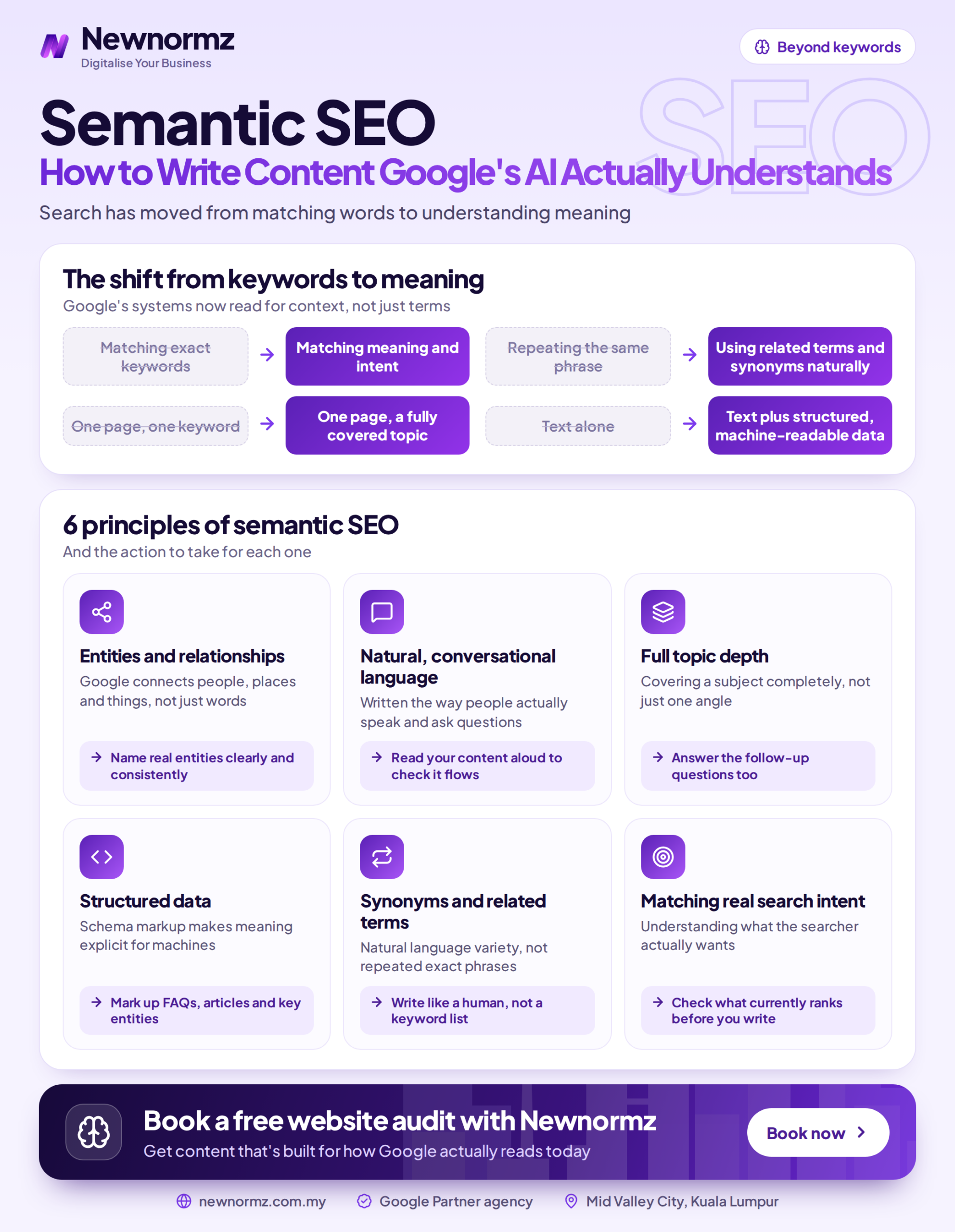
Google’s systems and AI answer engines both favour pages that are easy to parse. Use clear headings that say what each section covers, keep paragraphs to two to four sentences, and use tables or lists when you are comparing things.
Structure is not just a readability matter. It changes how easily a passage can be lifted out and used as an answer.
4. Answer the question early
Put the direct answer in the first paragraph or two, then spend the rest of the page backing it up. If your page targets “what is semantic SEO”, the definition belongs at the top, not after three paragraphs of warm-up.
This helps readers who want a fast answer, and it gives Google a clean passage to consider for featured snippets and AI-generated overviews. It does not guarantee either.
5. Link your pages into a cluster
Internal links show Google which pages belong together. When a blog post on a subject links to the related service page, and related guides link to each other, your site reads as one connected body of knowledge instead of a pile of separate pages.
Many Malaysian business sites have decent individual pages and almost no internal linking. Fixing that is often one of the cheapest improvements available. It is also a core part of a proper SEO service, and it matters just as much for local SEO when your service pages target different areas.
What Results Should You Expect?
Semantic SEO builds over time, so be sceptical of anyone promising a fast jump. Newnormz campaigns show the pattern. Sunway Medispa saw a 700% traffic increase and 70% more keywords ranking over a 6-month campaign. Times Parking gained 416 ranking keywords and 31.5K clicks in 6 months. Oriental Kopi, over 2 years, added 24,500 more ranking keywords and 468,000 clicks. Those results came from full campaigns, not from content tweaks alone.
What semantic SEO adds is durability. Pages that cover a topic well tend to hold their positions better than pages built on a single tactic, and they give you more chances to show up for the many ways customers phrase the same need.
Frequently Asked Questions
How is semantic SEO different from traditional SEO?
Traditional SEO centres on individual keywords. Semantic SEO centres on topic depth, search intent, page structure, and how your pages link to each other.
Will semantic SEO get me into AI search results?
It improves your chances, because clear, complete, well-structured content is easier for AI systems to understand and quote. Nobody can guarantee a citation, though.
How long does it take to see results?
It depends on your site’s age, competition, and how much content needs fixing. Expect it to be measured in months rather than weeks, with gains compounding as more of your pages support each other.
What does a semantic SEO audit look at?
Keyword coverage, content gaps, search intent match, internal links, page structure, and how your topics are grouped into clusters.
Is Your Content Written for Google’s AI?
Find the semantic gaps holding your pages back
Newnormz has run SEO campaigns across F&B, healthcare, ecommerce, and local services in Malaysia, backed by a performance guarantee of 70 percent of targeted keywords on Google’s first page.
30 minutes, no obligation, with a review of your content structure and topic coverage.

Bryan Tan is an SEO Specialist and CEO at Newnormz, helping hundreds of businesses achieve first-page rankings on Google. With a passion for driving organic growth, Bryan blends innovative strategies with hands-on experience to optimize websites for maximum visibility. Always at the forefront of the latest SEO insights and trends, he consistently adapts to the evolving digital landscape.