Most Malaysian product pages fail for two reasons. They use the same supplier description as every other seller, and they read like a spec sheet instead of a sales conversation. A page that ranks and converts does three things well. It uses the exact words Malaysians type when they are ready to buy, in English, Bahasa Malaysia, and sometimes Chinese. It answers the questions that stop someone from checking out, like delivery, returns, and warranty. And it gives Google clean, structured facts about price and stock. None of this guarantees a ranking position, and Google has said publicly that no one can promise one. But it is the difference between a page Google has a reason to show and a page it has no reason to pick over anyone else’s.
A Simple Way to Think About It
Two Durian Stalls on the Same Street
😐 The stall with the same sign as everyone else
A pile of durians and a cardboard sign that says “Musang King, RM50/kg,” just like the ten stalls beside it. People walk past because nothing gives them a reason to stop here.
🛒 The stall that tells you what you’re buying
The seller has one open already and tells you which orchard it came from and when it fell. You stop, you taste, you buy a second one for home.
Your product page has the same choice to make. The sections below cover how to become the second stall, both for Google and for the person holding their phone.
Why most product pages in Malaysia never get seen
Here is the usual pattern. A shop launches 200 products in a week. To move fast, it pastes in the supplier’s description, adds a price and a photo, and hits publish. Six months later, those pages get almost no search traffic.
There are three reasons this happens.
The content is duplicated. If five other Malaysian retailers use the same supplier text, Google sees five copies of one page. It usually picks one to show, and it’s rarely the newest store with the fewest links.
The content is thin. A two-line blurb, a price, and an add-to-cart button don’t give Google much to work with. It can’t tell who the product is for, what problem it solves, or which searches it should appear for.
The language is wrong for the market. Malaysians don’t just search “office chair.” They search “office chair Malaysia price,” “kerusi pejabat murah,” “ergonomic chair delivery Penang,” and sometimes “人体工学椅 马来西亚.” A page written only in generic English misses most of these.
There’s a fourth problem you can’t fix with copy alone: Shopee and Lazada listings often take up page one for product searches. You won’t outrank them on every query, and that’s fine. What you can do is win the searches where a proper, detailed page does better than a marketplace listing. That’s more of them than most sellers think.
Start with the words buyers actually type
Before you write a single sentence, figure out which searches each page should win. Google handles about 93% of search in Malaysia (Statcounter, May 2026), so its results are where you need to show up. Product pages mostly target people who are close to buying, but the questions they ask before buying are just as useful to cover.
| Search type | Example | Where it belongs on the page |
|---|---|---|
| Ready to buy | “ergonomic office chair price Malaysia” | Title tag, H1, first paragraph |
| Bahasa Malaysia | “kerusi pejabat ergonomik murah” | Description body, image alt text, FAQ |
| Delivery and location | “office chair delivery Johor Bahru” | Shipping section, FAQ |
| Comparison | “tilam latex atau spring” | FAQ, a short “who this is for” section |
| Brand and model | “[brand] [model] Malaysia” | Title tag, spec table, URL |
One warning. Don’t build a separate copy of the same product page for every city (“office chair KL,” “office chair Penang,” and so on). Google treats near-identical pages like that as low quality, and they compete with each other. Keep one strong page per product and cover delivery areas inside it.
The same goes for language. You don’t need a full Bahasa Malaysia version of every page to pick up BM searches. A few natural BM phrases in the description, alt text, and FAQ often do the job. If a big share of your buyers search in BM or Chinese, that’s when a properly translated, hreflang-tagged version is worth the effort. Machine-translated copy isn’t.
The anatomy of a product page that ranks and converts
Title tag and meta description
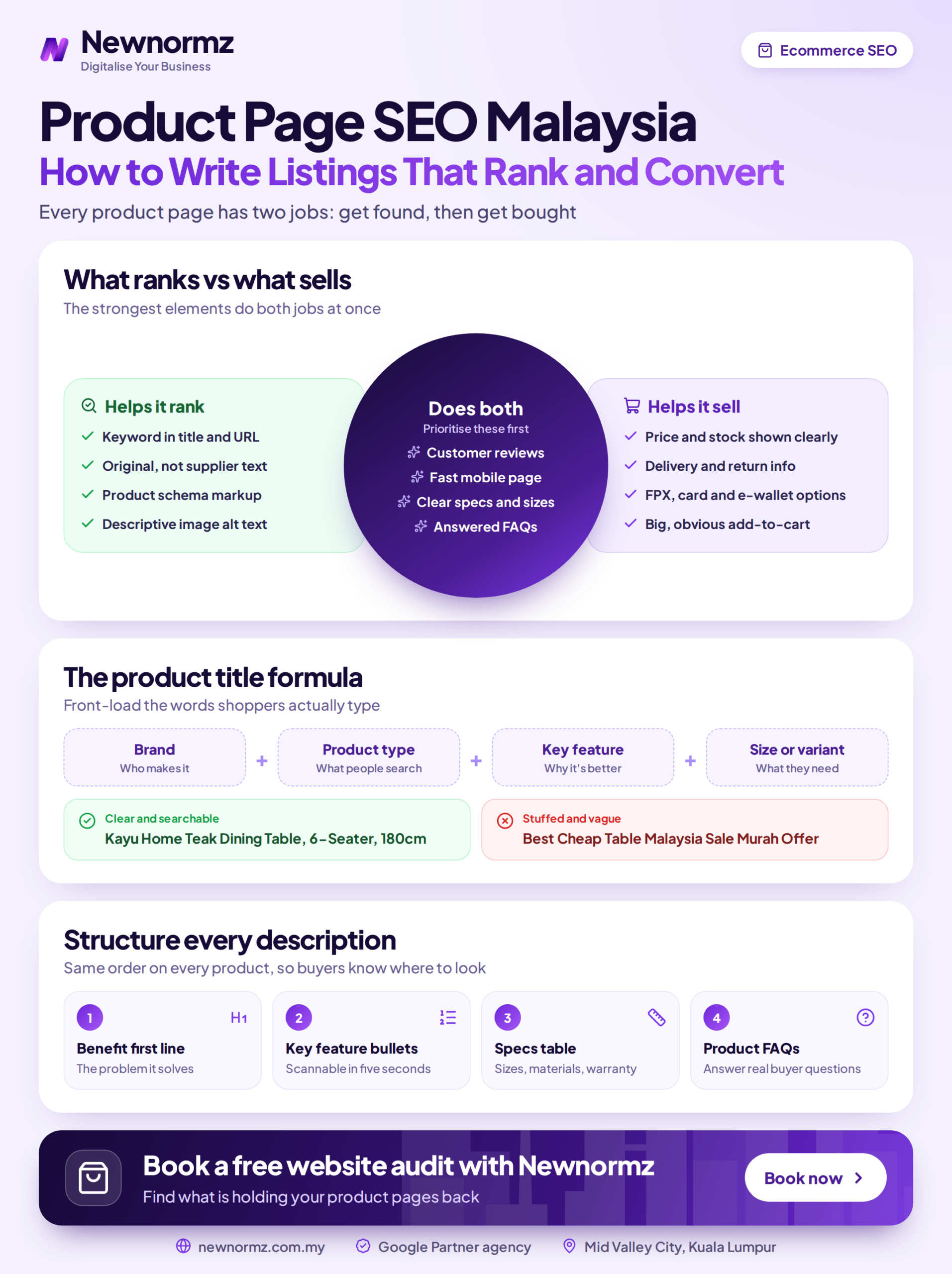
Your title tag is one of the strongest on-page signals you control. Put the product name first, then the modifier buyers use: “Malaysia,” “price,” a model number, or a key feature. Keep it under 60 characters so it doesn’t get cut off.
The meta description doesn’t directly affect rankings, but it decides whether someone clicks. Aim for 150 to 160 characters. Include the main keyword, one concrete reason to buy (free West Malaysia delivery, a two-year local warranty, whatever is actually true), and a soft call to action.
H1 and the first 100 words
The H1 should match the intent of the title tag without copying it word for word. The first paragraph matters most, both for Google working out what the page is about and for a shopper deciding whether to scroll. Say what the product is, who it’s for, and why it’s better than the obvious alternative, in plain words.
The description itself
Specs tell people what the product is. Benefits tell them why it matters to them. You need both, in that order. A good structure:
- A short benefit-led opening
- Use cases (“for home offices under 10 square metres,” “for people who sit more than six hours a day”)
- A clean spec table
- What’s in the box, warranty terms, and care instructions
Social proof helps, but only when it’s real. “Trusted by 500 offices” is powerful if you can back it up and a liability if you can’t. Use your actual review count and your actual rating, or leave it out.
URL
Short, readable, keyword-based. yoursite.com/ergonomic-office-chair beats yoursite.com/product?id=2847&cat=12 every time. Set it right at launch, because changing URLs later means managing redirects.
Images and alt text
Use your own photos where you can: multiple angles, the product in use, and something that shows scale. Supplier photos have the same problem as supplier copy. Write alt text that describes what the image shows (“black mesh ergonomic chair with adjustable headrest, side view”), not a list of keywords.
Write for the buyer’s hesitation, not the spec sheet
Most people who leave a product page haven’t decided against the product. They left because a question went unanswered and it was easier to check Shopee. In Malaysia, those questions are very predictable:
- How much is shipping to Sabah or Sarawak? East Malaysian buyers often assume the worst unless you tell them.
- How long will delivery take? Give a real range, not “fast shipping.”
- Is the warranty local? Buyers have learned to ask whether it’s a Malaysian set or an import.
- What if it doesn’t fit or doesn’t work? Put a one-line summary of your returns policy on the page and link to the full version.
- How can I pay? FPX, e-wallets, instalments, and COD if you offer them.
Answering these on the page does double duty. It removes friction for the buyer, and it adds unique, relevant text that picks up long-tail searches you would never have targeted on purpose. A short FAQ block under the description is the easiest place to put this.
Reviews work the same way. Every genuine buyer review adds fresh, original wording to the page. A simple post-purchase email asking for a review is one of the highest-return things a small store can set up.
Structured data: give Google the facts in its own format
Schema markup is code that tells Google, in a format it reads reliably, what the page is selling, how much it costs, and whether it’s in stock. It makes your page eligible for richer search results that show price, availability, and star ratings. Eligible is the key word. Google decides whether to show them, and there’s no switch that forces it.
At minimum, a product page should have:
- Product schema: name, description, image, SKU, brand
- Offer: price, currency set to MYR, availability
- AggregateRating: only if genuine reviews are actually shown on the page
- BreadcrumbList: so Google understands where the product sits in your catalogue
On WooCommerce, Rank Math generates most of this automatically once it’s configured. Many Shopify themes include basic product schema, though it’s often incomplete. Either way, run the page through Google’s Rich Results Test before you assume it’s working. A common problem is the schema showing one price while the page shows another after a promotion, and Google notices mismatches like that.
Technical traps that quietly sink product pages
Great copy can’t save a page Google struggles to crawl or keeps confusing with other pages. These come up again and again in Malaysian ecommerce audits:
| Problem | What goes wrong | Fix |
|---|---|---|
| Each colour or size has its own URL | Near-duplicate pages split ranking signals between them | Canonical tags pointing to the main product URL, or variants handled on one page |
| Out-of-stock pages get deleted | A page that already ranks disappears and its traffic goes with it | Keep temporary stockouts live with a restock note. 301 redirect only products that are gone for good |
| Filter and sort URLs get indexed | Thousands of thin URLs waste crawl attention | Noindex or canonicalise parameter URLs |
| Heavy, uncompressed images | Slow loading on mobile data, which is how most Malaysians shop | Serve compressed WebP images at the size they’re displayed |
| Orphan products | No category or related-product links lead to the page, so Google rarely finds it | Link every product from its category page and from related products |
Your own store vs Shopee and Lazada
Being honest about this matters. Marketplaces have huge domain strength, and for broad searches like “air fryer” they will often outrank a standalone store. Trying to beat them head-on for those terms is usually a waste of budget.
What a well-built product page on your own site does better is depth. It wins specific searches, comparison questions, BM and Chinese phrasing, and branded searches where a buyer who found you on Shopee now wants to buy direct. And every sale on your own site means better margin, your own customer data, and no marketplace fees.
Most healthy Malaysian ecommerce businesses do both: marketplaces for reach, their own site for margin and loyalty. SEO takes months to build up. If you need sales from your own site sooner, Google Ads (Shopping campaigns in particular) can drive product traffic while your organic rankings catch up.
What this looks like in practice: Ecolite
One product page we reworked was Ecolite’s Collagen Bird’s Nest Drink with Lychee Rose Syrup. The page already had product information, but it didn’t tell a shopper quickly what made the drink different, and it wasn’t built around how Malaysians actually search for this kind of product.
The work was straightforward, and that’s the point:
- Rewrote the copy around the four things buyers care about: collagen, bird’s nest, lychee, and rose
- Made the flavour profile and wellness appeal clear within the first few lines
- Restructured the page with clear headings so both shoppers and Google could scan it
- Aligned the content with real local searches such as “bird’s nest drink Malaysia,” “collagen drink,” and “wellness drink online”
The result was a page that’s easier for Google to understand and easier for a customer to judge and buy from. None of it needed a redesign. It needed someone to think about what the buyer was actually asking. If you’d like an SEO agency in Malaysia to do the same across your catalogue, the steps above are exactly where we start.
Frequently asked questions
How long should a product description be?
There’s no magic word count. A simple, low-cost item might need 150 words. A high-consideration product like a mattress or an office chair might need 600 or more, plus an FAQ. Write until the buyer’s real questions are answered, then stop.
Do I have to rewrite every supplier description?
Start with your best sellers and your highest-margin products. Rewriting a whole 2,000-product catalogue at once is rarely realistic. Rewriting the 50 pages that drive most of your revenue usually is, and that’s where the payoff is.
How long before an optimised product page starts ranking?
Think in months, not weeks. It depends on how competitive the product is, how established your domain is, and how many pages you’re improving. Anyone who promises a specific position by a specific date is promising something Google itself says can’t be guaranteed.
Should I write product pages in Bahasa Malaysia too?
Work in natural BM phrases first and see what traffic they bring. If a large share of your buyers search in BM or Chinese, a properly translated version with hreflang tags is worth the investment. Avoid raw machine translation. It reads badly and converts badly.
Do customer reviews help SEO?
They help in two ways. They add unique, keyword-rich text to the page, and they make the page eligible for star ratings in search results when paired with the right schema. They also convert, which is reason enough to collect them.
What should I do with discontinued products?
If the page has rankings or backlinks, 301 redirect it to the closest replacement or its category page. Don’t just let it return a 404. If it never got any traffic, removing it is fine.
Getting traffic but not sales?
Find out exactly what’s holding your product pages back.
Newnormz has run SEO campaigns across F&B, healthcare, ecommerce, and local services in Malaysia, backed by a performance guarantee of 70 percent of targeted keywords on Google’s first page.
30 minutes, no obligation, with a page-by-page look at your top product listings.

Bryan Tan is an SEO Specialist and CEO at Newnormz, helping hundreds of businesses achieve first-page rankings on Google. With a passion for driving organic growth, Bryan blends innovative strategies with hands-on experience to optimize websites for maximum visibility. Always at the forefront of the latest SEO insights and trends, he consistently adapts to the evolving digital landscape.