No, Google does not penalise a page for using AI to write it. Google penalises content that fails to help the person searching, and that judgement applies the same way whether a human, a tool, or a mix of both produced the page. If your rankings dropped after you started using AI, the cause is almost never the AI itself, it is what got published without enough checking, local relevance, or editorial ownership behind it.
A Simple Way to Think About It
Two Ways to Use the Same Ghostwriter
📥 The stack nobody reads
A ghostwriter hands you fifty articles overnight, and you publish every single one before you have read a single page.
✅ The stack someone stands behind
The same ghostwriter hands you the same fifty articles, but you read each one, correct what is wrong, and put your name on it before it goes out.
The tool is identical in both cases. What Google actually rewards or punishes is what happens between the draft and the publish button, which is exactly what the sections below cover.
What Google Actually Says About AI Content
Google stated in 2023 that appropriate use of AI does not break its guidelines. The risk it flagged was using automation to manipulate rankings or to publish large volumes of low-value content, not the act of using AI at all. That guidance has not changed since.
Google’s Search Quality Rater Guidelines describe generative AI as a useful tool that can also be misused. A page with little effort, little originality, or little added value gets marked down by human raters, regardless of how it was written.
The data backs this up. Ahrefs analysed 600,000 top-20 ranking pages in 2025 and found almost no relationship between estimated AI usage and ranking position. Its detector classified 86.5% of those pages as containing some degree of AI-assisted writing, which tells you AI-assisted content is now the norm in search results, not the exception.
Where AI Content Actually Loses Rankings
AI content fails for the same reasons weak human-written content fails. Google’s March 2024 core update targeted low-value pages produced at scale to manipulate rankings, and after the rollout Google reported 45% less low-quality, unoriginal content showing up in search results.
Three patterns show up consistently in the sites that lost visibility:
Mass publishing without review. Businesses that push out dozens of unedited AI articles a week to chase keyword volume risk both a ranking drop and a manual action.
Missing local relevance. Generic AI output rarely mentions Malaysian regulations, ringgit pricing, or local business conditions, which weakens topical authority for anyone searching with Malaysia in mind. This is the same gap that shows up in weak local SEO generally, AI or not.
Thin E-E-A-T signals. Google’s quality raters look for first-hand experience and named expertise. AI cannot supply either of those on its own, no matter how well it writes a sentence.
| Factor | AI Content That Ranks | AI Content That Gets Penalised |
|---|---|---|
| Editing process | Reviewed and fact-checked by a named expert | Published directly with no human review |
| Local relevance | References Malaysian market conditions and regulations | Generic, could describe any country |
| Publishing volume | Matched to genuine audience demand | Scaled to hundreds of thin pages a month |
| Author signals | Named author with real credentials | No byline, or a generic “admin” author |
What This Actually Costs a Malaysian SME
An SME does not have the marketing budget to absorb a ranking collapse the way an enterprise site can. A drop in organic visibility can erase months of leads, and paid ads rarely fill that gap at the same cost per lead you were getting from search.
Google’s AI Overviews add another layer of pressure on top of this. Pew Research found that users clicked through to a traditional result in only 8% of visits where an AI summary appeared, compared with 15% when no summary was shown. Fewer clicks reach your site even when you rank, which makes the quality of the page you do get visitors to more important, not less.
Google has said its AI features rely on Search’s core ranking and quality systems, and that helpful, reliable, expert-led content is what supports visibility inside them. Originality.ai separately found that 19.1% of Google’s top 20 results were classified as AI-generated in January 2025, which confirms AI-assisted content is common in results generally. It does not tell you anything about how competitive AI Overview citations specifically are, so treat that number as context, not a benchmark to chase.
How to Use AI Content Without Hurting Your SEO
Five habits keep AI-assisted content accurate, useful, and safe for rankings.
1. Use AI for drafts, not final copy
Let AI handle research and structure, then have someone with real subject knowledge add genuine examples and correct anything it got wrong.
2. Name a real author
Attach the article to a person with relevant credentials, not a generic “team” or “admin” byline.
3. Verify every statistic
Cross-check every number against its original source before publishing. A fabricated statistic is one of the fastest ways to lose both reader trust and algorithmic trust.
4. Localise every page
Reference Malaysian regulations, ringgit pricing, and local business context so the page cannot be mistaken for generic global output.
5. Cap your publishing volume
Match your output to what your team can genuinely review, not to what the tool can generate in a day.
How Newnormz Helps Malaysian SMEs Get AI Content Right
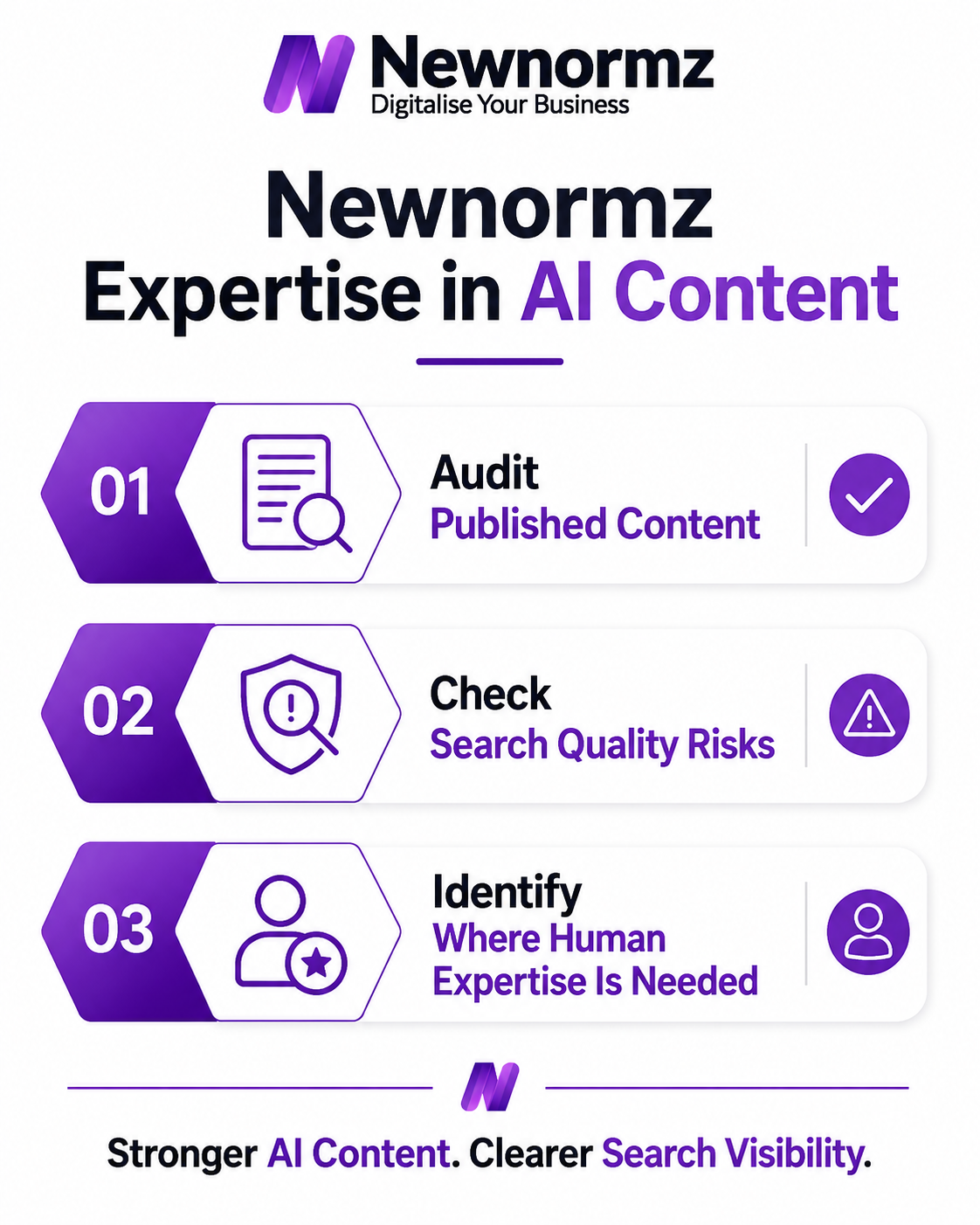
Most SME owners cannot tell on their own whether their content is helping or quietly working against their rankings. Newnormz’s SEO service team audits published pages against Google’s Search Quality Rater Guidelines, flags scaled-content risk, and identifies where genuine human expertise needs to be added.
That audit also checks authorship, local relevance, and publishing pace, and comes back with a prioritised list of what to fix first rather than a generic report to file away.
Not sure if your AI content is helping or hurting?
Find Out Exactly Where Your Content Stands With Google
Newnormz has run SEO campaigns across F&B, healthcare, ecommerce, and local services in Malaysia, backed by a performance guarantee of 70 percent of targeted keywords on Google’s first page.
30 minutes, no obligation, and no pressure to sign anything.
Why did my rankings fall after I started publishing AI-generated pages?
It is almost never the AI itself. Look first at thin content, factual errors, repeated ideas across pages, and weak local relevance, since those are what Google’s quality systems actually penalise.
What actually helps AI-assisted content rank in Malaysian search results?
Human review, real Malaysian context, credible sourcing, and a clear match to what the searcher is actually looking for. Skip any one of those and the page is exposed.
How do I know if I am publishing AI content too quickly?
If your publishing volume has outpaced your team’s ability to fact-check and edit every page before it goes live, you are already publishing too fast.
Should AI-assisted articles always carry a named author?
Yes. A named author with real credentials strengthens the accountability and expertise signals Google’s raters are specifically trained to look for.
Which pages on my site are most likely already hurting my SEO?
Start with declining-traffic pages, duplicate ideas covered across multiple posts, outdated facts, and anything published with no clear author or local context.

Bryan Tan is an SEO Specialist and CEO at Newnormz, helping hundreds of businesses achieve first-page rankings on Google. With a passion for driving organic growth, Bryan blends innovative strategies with hands-on experience to optimize websites for maximum visibility. Always at the forefront of the latest SEO insights and trends, he consistently adapts to the evolving digital landscape.