Most B2B plans start with a list of channels and end with a budget nobody can defend in a board meeting. A B2B digital marketing strategy that holds up works the other way round. Start with the revenue you need, work out how many deals, meetings and leads that takes, and only then choose channels, judging each one by what it costs to produce a qualified meeting. This guide gives you that one-page B2B digital marketing template. If you collect four numbers from your sales team first, you can fill it in within about half a day.
This guide is for marketing managers, sales directors and founders at Malaysian B2B firms with long sales cycles. By the end you will have a lead target, a channel mix, a budget and the one metric worth reporting: cost per qualified meeting.
Before You Fill In the Template: Four Numbers to Get From Your Sales Team
A B2B marketing plan built on guesses falls apart the first time finance asks a question. Get these four numbers before you open the template. Use the last 12 months if you have them, or the last two quarters if you don’t.
The four inputs
- ✓Average contract value: first-year revenue from a new customer, not lifetime value.
- ✓Close rate from first meeting: of the prospects who sat down with sales, how many signed.
- ✓Sales cycle length: the typical number of weeks from first contact to signed purchase order.
- ✓Current lead sources: taken from the CRM, or from a spreadsheet if you don’t have one, broken down by referral, trade show, website, ads and so on.
One Malaysian complication: a large share of B2B enquiries never reach the CRM. They arrive on WhatsApp, on a salesperson’s personal phone or through a WeChat contact from a trade fair. Ask each salesperson to go back through their chats for the last quarter and count them. Otherwise your website and ads will look weaker than they really are.
How to Build a B2B Digital Marketing Strategy in 7 Steps
Do the steps in order. Each one feeds a number into the next, so if you skip Step 1, your budget in Step 5 is just a guess.
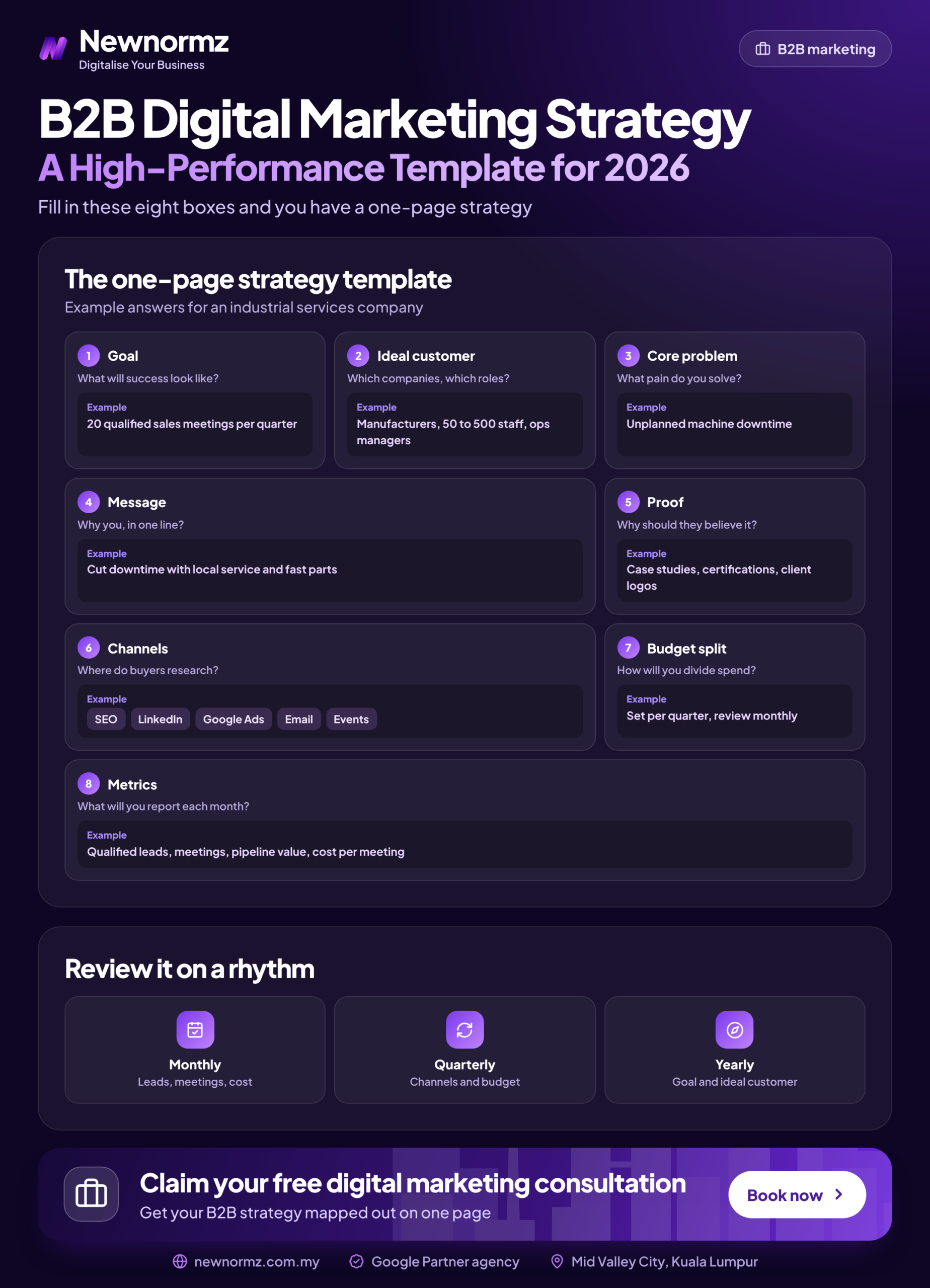
Step 1: Turn the Revenue Target Into a Lead Number
Here is the reverse funnel with hypothetical figures. Replace them with your own four numbers.
Revenue target to deals
The goal is 6 new contracts a quarter at RM60,000 each, which is RM360,000 of new business.
Deals to qualified meetings
At a 20% close rate from first meeting, 6 deals need 30 qualified meetings a quarter.
Meetings to leads
If 30% of leads turn into a meeting, 30 meetings need 100 leads a quarter, or about 33 a month.
Leads to allowable cost
Set a target customer acquisition cost. If marketing may spend RM7,500 to win a RM60,000 contract, then 6 deals allow RM45,000 a quarter. That works out at RM450 per lead, or a cost per qualified lead meeting of RM1,500.
Those last two figures become your ceiling. Any channel that delivers qualified meetings below RM1,500 earns more budget, and any channel above it has to justify itself. The CAC here covers marketing only. Sales salaries sit on a separate line in the board’s version.
Step 2: Write an Ideal Customer Profile Narrow Enough to Exclude People
If no one fails your ideal customer profile (ICP), it isn’t doing its job. Write down five things: industry, company size (headcount or revenue), location, the job titles that sign off and the people who influence them, and the trigger events that start a purchase.
In Malaysia, location usually matters more than templates suggest. A supplier of industrial components might target the Klang Valley, Penang’s manufacturing base and Johor’s industrial zones, and leave out East Malaysia because delivery costs make deals there unprofitable. Trigger events are where the precision comes from: a new factory, an expansion, a failed audit, a supplier contract up for renewal, or a new procurement head.
Once your target list drops below about 200 named companies, consider account-based marketing. Instead of buying traffic, you pick the accounts and then reach them directly with LinkedIn company-list targeting, case pages written for their industry, and outreach from sales that is timed to match the ads.
Step 3: Map How Malaysian B2B Buyers Actually Research Suppliers
A workable B2B marketing strategy Malaysian buyers respond to follows the path they actually take, which usually has four stops.
Google Search first. Statcounter puts Google at roughly 93 to 96% of Malaysian search, so this is where most supplier research starts. SME owners and purchasing staff don’t all search in English. Queries like “pembekal pallet plastik Selangor” or “塑料托盘供应商” (plastic pallet supplier) are common and often less contested, so build keyword lists in all three languages.
LinkedIn vetting next. Before replying, a buyer checks your company page and the profiles of the people they’d deal with. An empty page with 40 followers makes them doubt you, even if your website is strong. That is why LinkedIn marketing for B2B starts with a credible company page and active staff profiles, not with ads.
AI shortlists. More buyers now ask ChatGPT or read a Google AI Overview to get a list of three to five suppliers. Industry studies find that about 76% of AI Overview citations come from pages already ranking in the traditional top 10, so ranking in search and getting cited in AI search are largely the same work.
First contact on WhatsApp. The enquiry form is often skipped. The buyer taps the WhatsApp button, which is fast for them but invisible to your reporting unless you set up tracking (see Step 7).
Step 4: Score Each Channel on Cost per Qualified Meeting, Not Cost per Click
A RM2 click that produces no meetings costs more than a RM25 click that books one. Use this table to shortlist channels, then test them against your RM1,500 ceiling from Step 1.
| Channel | Intent level | Time to first lead | Cost behaviour | Best use in B2B |
|---|---|---|---|---|
| B2B SEO | High: the buyer is searching for the solution | First ranking movement around day 60 to 90 | Fixed monthly; cost per meeting falls as rankings build | Category, “supplier + location” and specification searches |
| Google Ads | High on exact product terms, mixed on broad ones | Days, once tracking is live | You pay for every click; leads stop when spend stops | Capturing existing demand and finding which terms book meetings |
| LinkedIn Ads | Low to medium: right job title, not actively buying | Weeks | Premium click costs; only pays with a tight ICP filter | Account-based marketing and reaching the buying committee |
| Content and email | Medium: people who already know you | Months; mostly supports other channels | Mainly staff time; email is cheap once you have a consented list | Keeping prospects warm through long sales cycles |
| AI search visibility | High: the buyer is asking for a shortlist | Months; builds on SEO | Fixed monthly; overlaps heavily with SEO work | Being named when ChatGPT or AI Overviews list suppliers |
Then apply these rules to pick your starting mix:
Google Ads for B2B works best on exact product, specification and “supplier + location” terms, where the searcher is already a buyer. If search is your first channel, these Google Ads tactics for B2B prospects show how to set up campaigns that screen out retail buyers before they click.
Step 5: Set the B2B Marketing Budget From the Maths, Then Split It
Your B2B marketing budget is already set by Step 1: RM45,000 a quarter, or RM15,000 a month. Here is one way a “search plus LinkedIn” mix could divide it, using Newnormz’s published prices (all excluding SST):
- Google Ads spend: RM5,000, paid directly to Google with no mark-up.
- Google Ads management: RM1,500 a month on the Starter plan, which covers ad budgets up to RM5,000, plus a one-time RM1,000 campaign build in month one. You keep ownership of the ad account.
- SEO: RM2,900 a month on the Starter plan (20 target keywords), month to month.
- LinkedIn Ads spend: RM3,000, aimed only at the ICP job titles.
- Content and tools: RM2,600 for case pages, spec sheets and your CRM subscription.
To check that against the market, Newnormz’s published ranges are RM800 to RM2,500 a month for freelancers, RM1,500 to RM8,000 for SME-focused agencies, and RM10,000 to RM30,000+ for enterprise agencies. Organic search is the most labour-heavy line here: technical fixes, pages in three languages, schema and authority building, all before rankings move. If you’d rather not staff that in-house, SEO services in Malaysia run on the same framework Newnormz uses for B2B and professional-services clients such as Edwin Lee & Partners, Ng Kim Heng Advisory Services and ESPING Corporation.
Step 6: Plan Content That Answers Procurement Questions
B2B content marketing isn’t about publishing blog posts every week. It means answering the questions that a buying committee passes between engineering, finance and procurement. For a digital marketing strategy 2026 buying committees will actually respond to, the shortlist looks like this:
- Spec sheets as indexable HTML pages, not locked inside PDFs.
- Pricing-range pages. You don’t need exact quotes, just honest bands and what moves a price up or down.
- Comparison pages: your approach against the alternatives, including when the alternative is the better choice.
- Case pages organised by industry, so a buyer finds a client that looks like them.
- “How to choose a supplier” guides, which tend to get forwarded inside buying committees.
Structure each page so AI tools can quote it. Put a direct answer in the first two sentences, use clear H2s phrased as questions, use tables for specifications, and add schema markup. For the LinkedIn half of the plan, use this B2B content plan for LinkedIn to turn the same material into posts your salespeople can share.
Step 7: Wire Up Attribution Before You Spend a Ringgit
This is the step most firms skip. If it’s missing, the board review in month four turns into an argument about opinions. Set up the following before any ad goes live:
- Conversions in Google Analytics 4 for form submissions, WhatsApp button clicks and click-to-call taps.
- A required “lead source” field in the CRM (HubSpot or similar), filled in for every enquiry, including WhatsApp Business chats.
- Offline conversion uploads, so that closed deals go back into Google Ads and the bidding learns which clicks turned into revenue rather than just form fills.
This is the Data loop in Newnormz’s RANKED Framework: call, WhatsApp and form attribution tied back to the keyword. For the reporting side, this guide to measuring ad ROI properly covers the dashboard. Keep the PDPA in mind as well. Under the Personal Data Protection Act 2010, get clear consent before you add anyone to an email or WhatsApp broadcast list, and record when and how they gave it.
From our audits
We often find B2B accounts where the WhatsApp button on the website has no tracking at all. The form shows a handful of leads, the board decides digital “doesn’t work”, and meanwhile the sales team is answering chats from that same traffic every day. Tracking the button click takes an hour to set up and changes what the report says.
Your First 90 Days: A Week-by-Week Rollout
| When | Focus | Done looks like |
|---|---|---|
| Weeks 1 to 2 | Tracking, CRM lead-source field, ICP written and signed off by sales | A test WhatsApp click and a test form both show up in GA4 and the CRM |
| Weeks 3 to 6 | Google Ads Search live on exact product terms; technical SEO fixes | First qualified meetings booked; negative keyword list growing weekly |
| Weeks 7 to 12 | Procurement content published; LinkedIn campaigns to ICP titles | Spec, pricing-range and case pages live; first SEO ranking movement |
| Every month | Review with sales: cost per qualified meeting by channel | Budget moved towards channels below the RM1,500 ceiling |
Set expectations honestly. Newnormz’s published SEO timeline is technical fixes in weeks 2 to 6, first ranking movement around day 60 to 90, and traffic and lead growth in months 4 to 8. Google has said publicly that no one can guarantee a ranking position, so treat any agency promising one with suspicion. In the first quarter, paid search carries the meeting target. SEO starts to carry it later.
Want a second opinion on your 90-day rollout before you commit budget? We’ll check the tracking and the channel order.
How to Check Your Strategy Is Working When Deals Take Six Months to Close
Closed revenue and customer acquisition cost are lagging indicators. With a six-month sales cycle, they tell you about decisions made two quarters ago. To judge marketing ROI month by month, report three leading indicators alongside them:
- Qualified meetings booked, by channel, against the target of 10 a month from Step 1.
- Pipeline value created: the total of the proposals marketing-sourced meetings turned into.
- ICP match rate: the share of new leads that fit the profile. A falling match rate shows up before falling revenue does.
If meetings and pipeline are on target but revenue isn’t, look at the sales process. If the leads don’t match the ICP, look at targeting. This split keeps the monthly review about facts. For more on B2B lead generation Malaysian sales teams can actually close, see this guide to turning search traffic into qualified leads.
Client example
Times Parking (TIMES24): found in search and named by ChatGPT
Problem: A parking management provider whose buyers research and compare suppliers carefully before making contact.
What we did: A six-month SEO campaign targeting the searches buyers make when comparing parking providers.
Result: 528,000 impressions, 416 ranking keywords and 31.5K clicks in six months. TIMES24 is also named in ChatGPT answers for “best LPR parking provider”, which is the AI shortlist from Step 3.
Where B2B Plans Go Wrong (and the Fix for Each)
✗ Optimising for lead volume
Cheap leads look good in a report until sales are buried in enquiries from students, job seekers and retail buyers. The team stops trusting marketing leads at all.
✓ The fix
Add negative keywords (“jobs”, “kerja”, “internship”, “free”, “DIY”) and qualifying form fields such as company name and expected order quantity. Expect fewer leads and more meetings.
✗ LinkedIn spend with no ICP filter
Targeting just “Malaysia, Manufacturing” pays premium click costs to reach interns and competitors.
✓ The fix
Target by job title, seniority and company size from Step 2, or upload your named-account list. Turn off audience expansion.
✗ WhatsApp leads never logged
The channel that brings most enquiries shows zero in the report, so its budget gets cut.
✓ The fix
Track WhatsApp clicks in GA4, use a shared WhatsApp Business number instead of personal phones, and log every chat in the CRM with its source. Done properly, WhatsApp marketing becomes a channel you can measure.
B2B Digital Marketing Strategy FAQs
What should a B2B digital marketing strategy include?
It should include a lead target worked backwards from revenue, an ideal customer profile, a channel mix scored on cost per qualified meeting, a budget, a content plan and attribution tracking. If any of these is missing, the plan can’t be checked against results.
How much should a Malaysian B2B company spend on digital marketing?
Spend what your target customer acquisition cost allows, multiplied by the number of deals you need. In this guide’s example, that is RM15,000 a month. Using a percentage of revenue ignores your deal size and close rate, which are the numbers that actually set the ceiling.
Which channel works best for B2B lead generation in Malaysia: LinkedIn, Google Ads or SEO?
If buyers already search for your category, Google Ads and SEO usually produce qualified meetings most cheaply. LinkedIn is the better fit when the product is new to buyers or you are targeting a short list of named accounts.
How long does a B2B digital marketing strategy take to show results?
Google Ads can book meetings within weeks of going live, while SEO typically shows first ranking movement around day 60 to 90, with lead growth in months 4 to 8. Closed revenue then follows after your normal sales cycle.
Is LinkedIn worth it for B2B companies in Malaysia?
Yes, if your buyers can be defined by job title and company and your contract value can absorb premium click costs. For low-value or high-volume products, search usually delivers qualified meetings for less.
Newnormz is a digital marketing agency in Malaysia that runs SEO, Google Ads and social media under one roof for 200+ Malaysian businesses, with a 5.0 rating from 214+ Google reviews. If you’ve filled in the template and want someone to check the numbers, send it over.
Free marketing audit
Send us your filled-in template. We’ll check the maths and the channel mix.
- ✓A check of your reverse-funnel numbers and your allowable cost per qualified meeting
- ✓A channel-by-channel view of where your budget should go first
- ✓A tracking check covering GA4, WhatsApp clicks and CRM lead sources

Bryan Tan is an SEO Specialist and CEO at Newnormz, helping hundreds of businesses achieve first-page rankings on Google. With a passion for driving organic growth, Bryan blends innovative strategies with hands-on experience to optimize websites for maximum visibility. Always at the forefront of the latest SEO insights and trends, he consistently adapts to the evolving digital landscape.