There is no single ROAS number that counts as good digital advertising ROI in Malaysia. A good return is whatever pays for your product cost, your ad spend and your overheads and still leaves profit. For most businesses, that means working out a break-even ROAS from your gross margin first, then measuring every campaign against it. Ad platform dashboards report clicks and revenue. They don’t report profit. In 2026, the Malaysian businesses getting real returns from Google Ads, Meta and SEO track every lead through to a closed sale (WhatsApp and phone enquiries included), cut spend that doesn’t convert, and give each channel the time it needs before judging it.
A Simple Way to Think About It
Two Stalls at the Same Pasar Malam
🔥 The stall with the longest queue
It sells out every night and the owner goes home proud. Then they count the takings against what the stock cost, and almost nothing is left.
💰 The stall with the shorter queue
It has fewer customers, but every plate is priced to make money. By the end of the year, this owner is the one opening a second stall.
Most ad reports only show you the queue. The framework below is about counting what’s left at the end of the night.
Why “Good ROI” Has No Universal Number
Most Malaysian marketing budgets now go to digital. MAGNA reported that digital media made up 77% of Malaysia’s total advertising spend in 2024 and projects it will reach 85% by 2029. Digital media spend hit USD 2.97 billion in 2025. That is a lot of businesses bidding for the attention of the same 35.4 million internet users.
More competition pushes click costs up, and the effect is strongest in high-value categories like property and insurance. So the question isn’t whether to advertise online. It’s whether each Ringgit you spend comes back with profit attached.
This is where most ROI conversations go wrong. You’ll often hear that a 4:1 ROAS is a healthy benchmark. That number means nothing until you know your margins. A 4:1 return is excellent for a business with 60% margins and a slow way to go broke for one with 15% margins.
The Number That Matters: Your Break-Even ROAS
Before you judge any campaign, work out the return you need just to cover your costs. The formula is simple:
Break-even ROAS = 1 ÷ gross margin
Anything above that line is profit. Anything below it costs you money on every sale, however busy the dashboard looks.
| Gross margin | Break-even ROAS | What it means in practice |
|---|---|---|
| 60% | 1.67x | Plenty of room to scale and test new channels |
| 40% | 2.5x | Workable, but weak landing pages will hurt |
| 30% | 3.33x | You need tight targeting and good conversion rates |
| 20% | 5x | Paid ads only work with repeat purchases or high order values |
| 10% | 10x | Very hard to profit from paid clicks alone. Organic channels matter more. |
A worked example
Say you spend RM10,000 on ads and they bring in RM50,000 in revenue. That’s a 5x ROAS, and many reports will call it a “400% ROI”. It looks great.
Now apply your margin. At 40%, the RM50,000 leaves RM20,000 in gross profit. Take off the RM10,000 ad spend and you keep RM10,000, a real return of 100% on the ad money. At 20% margin, the same RM50,000 leaves RM10,000 in gross profit, which the ad spend uses up completely. You made zero.
The dashboard is identical in both cases, but one business is growing and the other is working for free. That’s why every framework below starts with your margin, not the platform’s numbers.
A Five-Step ROI Framework for 2026
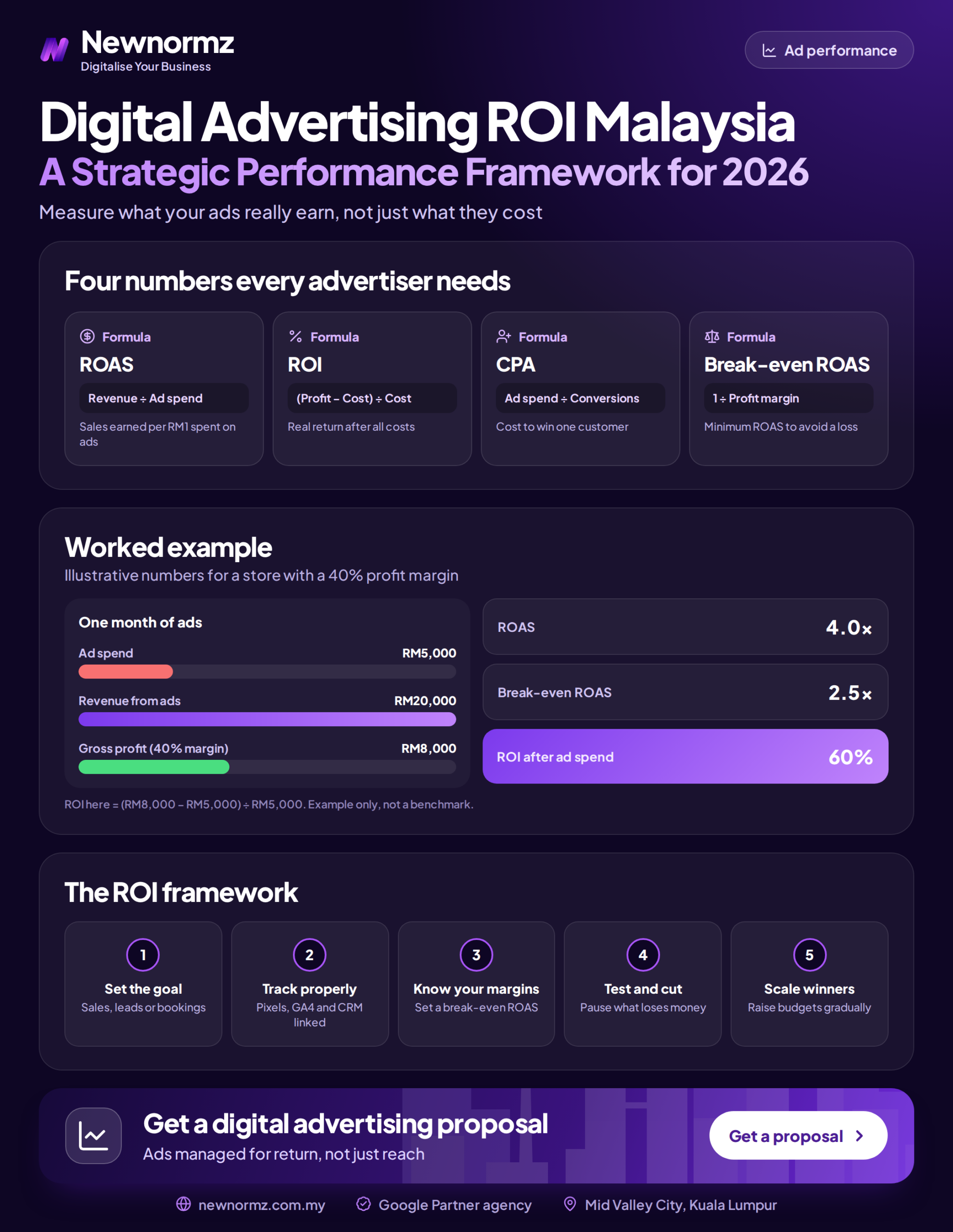
1. Set a ceiling on what a lead is worth
If you sell through enquiries instead of a checkout, turn break-even ROAS into a maximum cost per lead. Here’s an example. If an average customer brings in RM3,000 of gross profit and you close one lead in five, each lead is worth at most RM600 to you. Pay more than that and you lose money. Pay well under it and you have room to scale. Use your own numbers, not an industry average.
2. Price customers on lifetime value, not the first sale
A café customer who comes back every week is worth far more than one coffee. A confinement centre client might buy only once but refer three friends. If you judge acquisition cost against the first transaction alone, you’ll cut campaigns that are actually profitable. Keep customer acquisition cost below lifetime value, and be honest about how much repeat business you really get.
3. Track to the sale, not the form
This is where most Malaysian campaigns lose sight of their real ROI. A large share of enquiries here come through WhatsApp click-to-chat and phone calls, and many setups count a tap on the WhatsApp button as a “conversion”. A tap isn’t a customer.
Close the loop. Tag every lead by source in your CRM, or even a shared spreadsheet. Use dedicated phone numbers or campaign-specific codes for offline sales. Import closed deals back into your ad platforms as offline conversions. Use data-driven attribution instead of first-click or last-click models, which give all the credit to one touchpoint on a journey that usually has several.
4. Match each channel to the buyer’s mindset
Every channel reaches people in a different state of mind, so judging them all on the same number gives misleading answers. Someone searching on Google is already looking for a solution. Someone scrolling Instagram isn’t. With Google holding roughly 93% of Malaysian search market share, Google Ads is usually the fastest route to high-intent demand. It isn’t the whole picture, though.
| Channel | Buyer mindset | Judge it by | Common ROI trap |
|---|---|---|---|
| Google Search Ads | Actively looking for a solution right now | Cost per qualified lead or sale against your break-even | Broad keywords with no negative keyword list |
| Meta (Facebook, Instagram) | Browsing, not searching | Cost per sale over a longer window, plus assisted conversions | Treating likes and engagement as results |
| LinkedIn Ads | Professional, B2B decision-making | Cost per qualified sales opportunity, not per form fill | Expecting quick closes on long sales cycles |
| SEO | Searching and trusting organic results | Leads and revenue over 6 to 12 months | Cutting it at month three, before results compound |
5. Judge each channel on its own timeline
Paid search starts producing data within days, but automated bidding usually needs several weeks of conversion data to settle. A month of results tells you more than a week. SEO runs on a slower clock: expect six to twelve months before it pays back properly. Reviewing both on the same monthly report leads to bad decisions, usually cutting the channel that was about to pay off.
Where Malaysian Ad Budgets Usually Leak
When an account has low ROI, the cause is rarely one big mistake. It’s usually several small leaks that add up. These are the ones we see most often:
Missing negative keywords in every language. Most advertisers block “free”, “jobs” and “meaning” in English but forget “percuma”, “kerja”, “jawatan kosong”, “maksud” and the Chinese-language equivalents. Malaysians search in all three languages, so your exclusions need to cover all three as well.
Sending paid traffic to the homepage. A homepage is built for everyone, so it converts nobody in particular. Each campaign should send people to a page with one offer, one clear next step and as few distractions as possible.
Slow mobile pages. Most Malaysian searches happen on a phone. A slow page loses visitors you’ve already paid for and can also lower your Google Ads Quality Score, which raises what you pay per click.
Targeting areas you don’t serve. A clinic in Petaling Jaya doesn’t need clicks from Kota Kinabalu. Put your budget where your customers are, and exclude areas that historically send poor leads.
Creative fatigue. On Meta especially, people tire of the same ad and performance drops without much warning. Refresh your creative on a schedule instead of waiting for results to fall.
Can AI Bidding Fix a Low-ROI Account?
It can help a lot, but only if you feed it the right goal. Google’s Smart Bidding and Meta’s automated delivery optimise toward whatever you tell them counts as a conversion. If you count WhatsApp button taps, they’ll find people who tap buttons. If you count closed sales, they’ll find buyers.
So AI doesn’t fix bad tracking. It scales whatever you give it, mistakes included. Get step three of the framework right first, then let automation do what it’s good at: adjusting bids faster than any person could.
Paid Ads vs SEO: Different Returns on Different Clocks
Paid advertising is like renting. Leads come quickly, and they stop the day you stop paying. SEO is more like owning. It’s slow to build, but it keeps bringing in traffic without a fee on every click. The highest ROI usually comes from running both, with each one covering the other’s weakness.
One KL confinement centre we work with ran Google Ads alongside SEO on a budget of RM2,550 a month and had qualified leads within 30 days. Paid search brought in revenue while the organic side was still building. At the longer end, Oriental Kopi’s two-year SEO campaign produced 468,000 clicks and 24,500 more ranking keywords, traffic they would otherwise have paid for click by click. Sunway Medispa saw a 700% traffic increase in six months.
A word of caution: Google has said publicly, more than once, that no one can guarantee a specific ranking position. A good SEO service should be honest about what it can and can’t promise and still show you progress you can measure. Organic visibility also counts for more now that AI summaries sit above the regular results, and the brands those summaries cite are usually ones that already have strong, well-organised content.
Frequently Asked Questions
What is a good ROAS for a Malaysian business?
It depends on your gross margin. Divide 1 by your margin to get break-even ROAS. At 40% margin that’s 2.5x. A good ROAS is anything comfortably above that line after your overheads. Treat benchmark figures you read online as a rough reference, not a target.
How much should a Malaysian SME spend on digital advertising?
Enough to produce data you can make decisions with, on one or two channels, rather than a little spread across five. A smaller budget focused on high-intent search usually teaches you more than the same money split between Google, Meta, TikTok and LinkedIn. Increase spend once you’ve confirmed that cost per sale is under your break-even.
Is Google Ads or Facebook Ads better for ROI in Malaysia?
They do different jobs. Google Ads reaches people who are already searching, so it usually shows a direct return faster. Facebook and Instagram create demand among people who weren’t looking yet, and that pays off over a longer window. Many profitable accounts use both, judged on different metrics.
How long until digital advertising shows positive ROI?
Paid campaigns produce data within days, but a stable, optimised return usually takes a few months of testing and bid learning. SEO takes longer, typically six to twelve months, but tends to lower your overall cost per customer once it’s established.
How do I track ROI if most of my sales happen offline?
Give each campaign its own phone number, WhatsApp link, QR code or promo code. Record the source of every lead in a CRM, then match those leads to closed sales. Import those sales back into Google Ads and Meta as offline conversions so their bidding optimises for actual revenue, not just enquiries.
My agency reports a strong ROAS, so why isn’t my profit growing?
Usually it’s one of three reasons. The reported ROAS is below your break-even once you account for margin. The “conversions” being counted aren’t real sales. Or revenue from customers who would have bought anyway is being credited to the ads. Ask for numbers tied to closed sales and compare them with your margin.
Not sure what your ads are really earning?
Find out which Ringgit in your marketing budget is actually making you money.
Newnormz has run SEO campaigns across F&B, healthcare, ecommerce, and local services in Malaysia, backed by a performance guarantee of 70 percent of targeted keywords on Google’s first page.
30 minutes, no obligation, with a clear look at where your ad spend and organic traffic are leaking.

Bryan Tan is an SEO Specialist and CEO at Newnormz, helping hundreds of businesses achieve first-page rankings on Google. With a passion for driving organic growth, Bryan blends innovative strategies with hands-on experience to optimize websites for maximum visibility. Always at the forefront of the latest SEO insights and trends, he consistently adapts to the evolving digital landscape.