Source context is what your website is for: who runs it, what it sells or offers, and why it has the right to talk about a subject. In SEO, it decides which topics belong on your site, which angle you should take on each one, and which topics you should leave to other sites. If you get it wrong, you end up with dozens of articles that pull in visitors who will never buy from you, and a site that looks unfocused to search engines and to people. If you get it right, every page you publish adds to one clear picture of what you’re an authority on. It won’t make you rank by itself. It does decide whether your content effort adds up to something or just piles up.
A Simple Way to Think About It
The Tailor and the Tyres
🛞 A tailor with tyres by the door
You walk past a tailor’s shop with a stack of car tyres outside. You stop asking what else they sell and start wondering whether they’re actually any good at suits.
🧵 A tailor whose window is all tailoring
Fabric, fittings, finished jackets on display. Before you even step inside, you know what this shop is for and why you’d trust it with your wedding suit.
Your website sends the same signal. The sections below explain how that plays out in search and how to work out what belongs in your window.
What source context actually means
Every website has an identity, whether you’ve written it down or not. A dental clinic in Petaling Jaya, an online store selling dental supplies, and a consumer health blog can all write about teeth whitening. They shouldn’t write the same article, and they shouldn’t cover the same set of surrounding topics either.
Source context is the answer to three questions:
- Who is behind this site? A clinic, a retailer, a publisher, a software company, a government body.
- How does the site create value or make money? Appointments, product sales, leads, subscriptions, advertising.
- What does the visitor need from this specific source? To book, to buy, to compare, to learn.
Put those together and you have a lens. Every topic you consider gets looked at through it. Does this topic connect to what we do? From which angle? How deep should we go?
Where the term comes from (and what Google does and doesn’t say)
Let’s be clear about this, because a lot of SEO content isn’t. “Source context” is not an official Google ranking factor, and Google doesn’t use the phrase in its documentation. It’s a framework from the semantic SEO community, and it’s mostly linked to Koray Tuğberk Gübür’s work on topical maps and topical authority. In that model, a topical map is built from a central entity (what the site is about), a source context (why this site exists and how it monetises), and the search intents the site serves.
What Google does say publicly lines up closely with the idea. Its guidance on helpful content asks whether your site has a primary purpose or focus, and whether your content is made mainly to attract search visits rather than to serve an existing audience. Its site reputation abuse policy, announced in March 2024, targets third-party pages published on a host site mainly to borrow that site’s ranking signals, which is pretty much a page with no source context of its own.
So treat source context as a practical planning tool that fits how Google says it evaluates sites. Don’t treat it as a secret signal you can switch on.
Why it matters for topical coverage
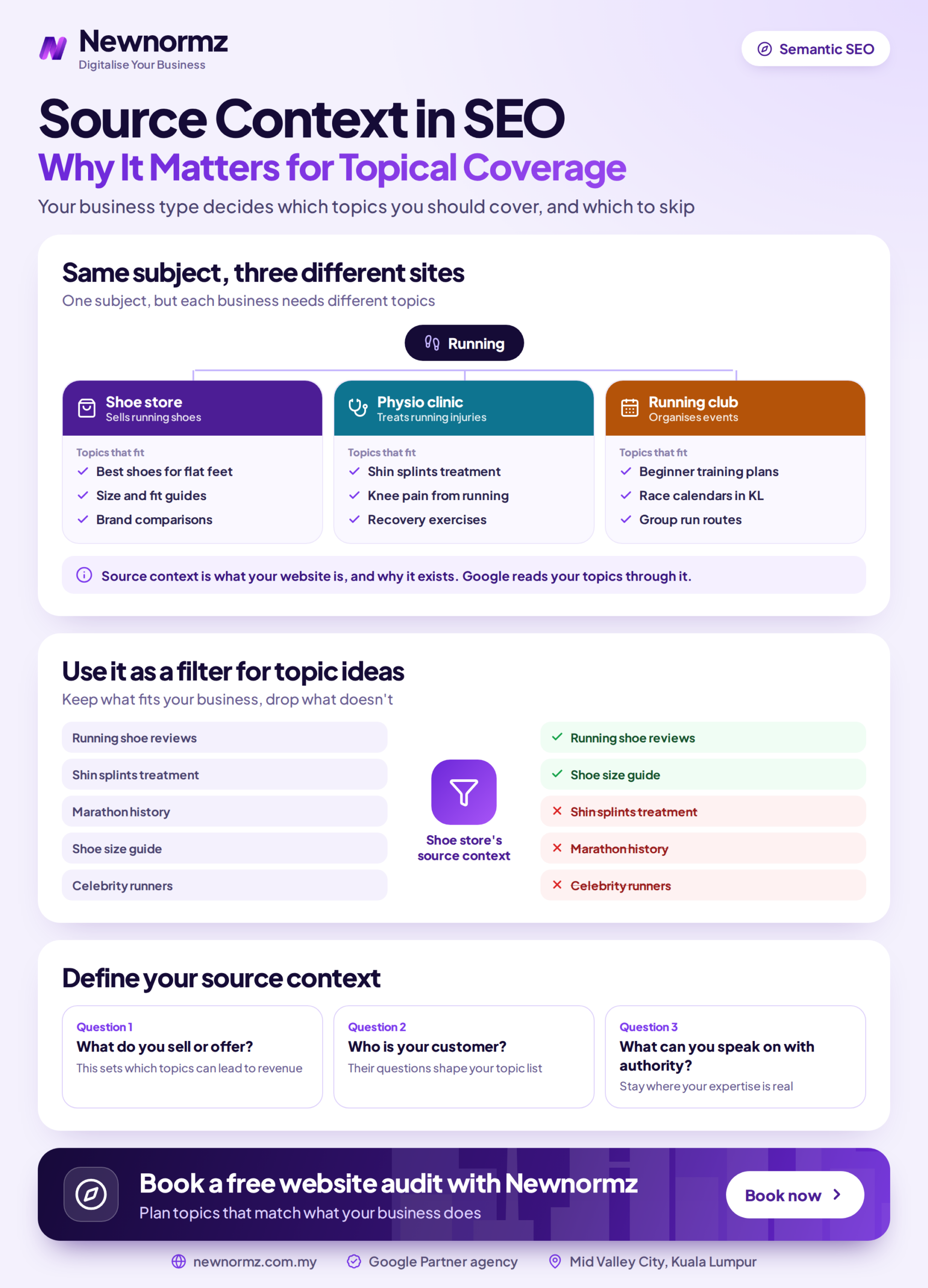
Topical coverage is how completely your site covers the subjects it wants to be known for. Most businesses try to build it by brainstorming keywords and writing whatever has search volume. Source context is the filter that stops that from becoming a random content dump.
It decides what’s in scope
A B2B logistics company in Shah Alam doesn’t need an article on “Hari Raya cookie recipes,” even if it gets thousands of searches every Ramadan. It does need content on customs clearance, warehousing costs, and last-mile delivery in the Klang Valley. The test is simple: would a reasonable person expect this business to be a credible source on this topic? If not, it’s out of scope, however tempting the volume.
It decides the angle
Two sites can cover the same topic and both be right, because they come at it from different places. Your source context tells you which attributes of a topic to put first. A clinic writing about Invisalign leads with suitability, the consultation process, and treatment time. A price comparison site leads with cost ranges across providers. Both are useful. Copying the other’s angle makes your page weaker.
It decides depth and internal linking
Topics that sit closest to how you make money deserve the most depth and the strongest internal links. Topics further out are supporting content: they’re there to answer related questions and pass relevance back to your core pages, not to compete with them. Without a defined source context, every article gets the same weight and your most commercially important pages get diluted.
Same topic, different source context
Here’s how one topic, teeth whitening, should change depending on who’s publishing it.
| Site type | Source context | How it should cover the topic |
|---|---|---|
| Dental clinic in PJ | Books in-clinic treatments, serves a local area | Professional vs at-home results, who is a suitable candidate, what happens in the appointment, local pricing in RM, aftercare |
| Dental supplies ecommerce store | Sells whitening kits and products nationwide | Product comparisons, how to use kits safely, ingredient explainers, which product suits which situation |
| Consumer health publisher | Earns from readership and advertising | Broad explainers, myths vs facts, side effects, neutral overview of all options |
| Car workshop blog | Sells car servicing and repairs | Shouldn’t cover it at all. No connection to the business, and no reason a reader would trust it here |
That last row is the one most businesses get wrong. They don’t publish teeth whitening posts on a car workshop site, obviously. But they do publish loosely related “lifestyle” or seasonal content because a keyword tool showed volume, and it does the same quiet damage.
How to define your source context
You don’t need a 20-page brand document. You need a few honest answers that you’ll actually use when you plan content.
- Write one sentence on what the business does and for whom. “We’re a confinement centre in Kuala Lumpur serving new mothers who want professional postnatal care.” If you can’t write that sentence, fix that before you write any content.
- List how you make money. Bookings, product sales, enquiries, retainers. These are the topics that get your deepest pages.
- Map what your customers ask before they buy. Pre-purchase questions, comparisons, worries, costs. Include the Bahasa Malaysia and Chinese phrasing your customers actually type, such as “harga” queries or Mandarin searches for the same service, since they often reveal different intent from the English versions.
- Draw the boundary. Write down the topics you’ll deliberately not cover, even if they’re popular. This list matters as much as the list of what you will cover.
- Check every new content idea against it. Before anything goes into the backlog, ask whether it fits the sentence from step one. If it doesn’t, drop it.
Common mistakes we see on Malaysian sites
Chasing seasonal traffic that doesn’t fit
Every festive season, plenty of business blogs publish “Chinese New Year greeting ideas” or “Raya open house tips” with no link to what they sell. The posts might pull visits for a couple of weeks. They almost never convert, and they water down what the site is about.
Copying a competitor’s content plan wholesale
If a competitor is a publisher and you’re a service provider, their topic list isn’t yours. Same keywords, different source context, different articles. Using a competitor’s sitemap as your content plan is one of the fastest ways to lose your own angle.
Treating every article the same
A core service page and a supporting FAQ-style article shouldn’t get the same treatment. When your SEO service plan treats them the same, the pages that should rank for buying-intent searches end up competing with your own blog posts.
Ignoring location when location is the business
For clinics, centres, workshops, and F&B outlets, where you are is part of your source context. Content that ignores the areas you actually serve misses what makes you relevant. That’s why topical coverage for these businesses usually needs to work hand in hand with local SEO.
What source context won’t do for you
Honesty matters here. A clear source context doesn’t override weak content, a slow site, or no backlinks at all. It doesn’t guarantee rankings, and as Google has said publicly more than once, nobody can guarantee a specific ranking position. What it does is make sure the effort you put into content builds in one direction. Over months, that’s usually the difference between a site that grows into a recognised authority in its niche and one with 200 blog posts and no real identity.
Frequently asked questions
Is source context the same as topical authority?
No. Topical authority is the result: search engines and users seeing your site as a reliable source on a subject. Source context is one of the inputs that decides which subject that should be and how you approach it.
Should I delete old blog posts that don’t fit my source context?
Not automatically. Check each one first. If a post gets relevant traffic or has backlinks, think about refreshing it with an angle that fits your business. If it gets no traffic, has no links, and has nothing to do with what you sell, removing it or merging it into a better page is usually reasonable. Set up redirects where they make sense.
Can a site have more than one source context?
A business can have several services, but the site still needs one clear identity tying them together. A group running both an aesthetic clinic and a skincare product line can make it work if the connection is obvious to a visitor. Two unrelated businesses on one domain usually can’t.
Does source context matter for small businesses with only a few pages?
Yes, maybe more than for anyone else. With only a handful of pages, every one has to pull its weight. Knowing exactly what you’re about helps you pick the few topics that will actually bring in customers instead of spreading a small budget thin.
Not sure what your content should cover?
Get a content plan built around what your business actually does
Newnormz has run SEO campaigns across F&B, healthcare, ecommerce, and local services in Malaysia, backed by a performance guarantee of 70 percent of targeted keywords on Google’s first page.
30 minutes, no obligation, and a clear view of which topics your site should own and which ones to drop.

Bryan Tan is an SEO Specialist and CEO at Newnormz, helping hundreds of businesses achieve first-page rankings on Google. With a passion for driving organic growth, Bryan blends innovative strategies with hands-on experience to optimize websites for maximum visibility. Always at the forefront of the latest SEO insights and trends, he consistently adapts to the evolving digital landscape.