A high-performance e-commerce site in Kuala Lumpur is not the one with the most features or the fanciest design. It’s one that loads fast on a mid-range phone over mobile data, takes payment the way Malaysians actually pay (FPX, DuitNow, e-wallets, cards), and is structured so Google can understand every category and product page. Get those three right and the platform matters less than most agencies tell you. Get them wrong and no amount of ad spend or SEO will fix a store that loses buyers at checkout.
A Simple Way to Think About It
The Beautiful Shop vs the Open Till
🛍️ The beautiful shop
Lovely interior, great lighting, and one slow cashier with a queue out the door. Half the people in line quietly put their baskets down and walk out.
💳 The open till
A plainer shop where the till is free the moment you walk up. People pay for what they came for and come back next week.
Most online stores we audit are the first shop. The sections below show what turns a store into the second one.
What “High Performance” Actually Means for an Online Store
Agencies use “high performance” loosely. For an online store, it comes down to three measurable things.
Speed on real devices. Your customers aren’t browsing on a fibre-connected MacBook. They’re on a mid-range Android phone in a Grab car on the Federal Highway. Google measures this with Core Web Vitals and publishes the targets openly: the main content should load within 2.5 seconds (Largest Contentful Paint), the page should react to a tap within 200 milliseconds (Interaction to Next Paint), and the layout shouldn’t jump around while it loads (Cumulative Layout Shift under 0.1). These are the numbers worth holding a developer to, not a vague promise that the site will be “fast”.
A checkout that doesn’t leak. Every extra form field, forced account signup, or redirect to a payment page that looks unfamiliar is a point where buyers leave. In our experience, checkout is where most revenue disappears, not the homepage.
A structure search engines can read. Clean category hierarchies, unique product pages, and no thousands of near-duplicate filter URLs. This decides whether your products can be found without paying for every click.
An honest point here: speed is one of many signals Google uses, not a ranking switch. A fast site with thin product pages won’t outrank a slower competitor with genuinely better content. Speed mostly pays off in conversion rate, and it removes a handicap on the search side.
Where Malaysian Checkouts Usually Break
Malaysia had 35.4 million internet users and 98% internet penetration at the end of 2025 (DataReportal, Digital 2026 Malaysia). Industry data from 2025 puts smartphones at around 72.67% of the local e-commerce market. In practice your store is a mobile store first, with a desktop version on the side.
Payments
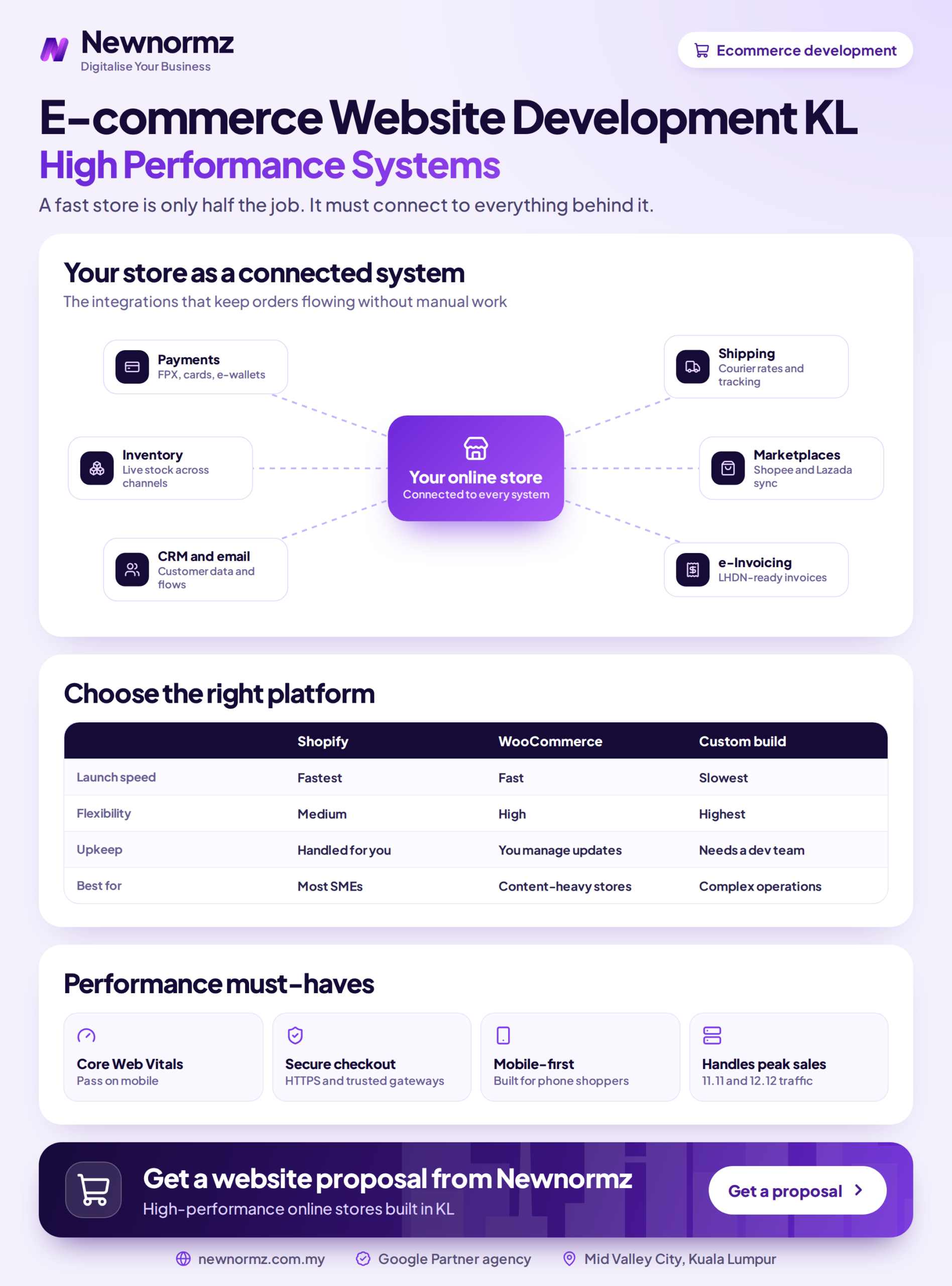
A store that only takes credit cards is turning away a large share of KL buyers. At a minimum you want FPX online banking, DuitNow QR, the major e-wallets (Touch ‘n Go eWallet, GrabPay, ShopeePay), and cards. Local gateways like Fiuu and SenangPay cover most of this in one integration. Stripe is a solid option if you also sell overseas. Whichever you pick, the payment step should look and feel like part of your store, not a jump to a page that makes people wonder if they’re being scammed.
Shipping and delivery expectations
Shoppers here are used to marketplace convenience: clear shipping fees shown before checkout, tracking numbers, and couriers they recognise. Connecting your store to providers like Pos Laju, J&T Express, or Ninja Van so orders and tracking sync automatically saves your team hours each week and cuts down on “where is my parcel” WhatsApp messages.
Language and trust
Depending on who you sell to, Bahasa Malaysia or Chinese-language versions of key pages can be worth more than any design upgrade, because many shoppers search in those languages. Add visible trust signals (an SSR registration number, a real address, a WhatsApp contact button, a clear refund policy) and you remove the hesitation that stops first-time buyers from buying from a brand they don’t know yet.
Template, Platform, or Custom Build?
This is usually the first question business owners ask, and the answer depends on your catalogue size, integrations, and how much control you need. There is no single correct platform.
| Option | Best for | Strength | Watch out for |
|---|---|---|---|
| Hosted platform (e.g. Shopify) | Small to mid catalogues, teams without in-house developers | Fast to launch, hosting and security handled for you | Monthly app fees add up; heavy themes and too many apps slow the site down |
| WooCommerce | Brands that want full ownership and strong content marketing | Flexible, huge plugin ecosystem, content and store in one place | Performance depends entirely on hosting and build quality; needs ongoing maintenance |
| Enterprise platform (e.g. Adobe Commerce) | Large catalogues, B2B pricing, multiple stores or currencies | Handles complexity that smaller platforms can’t | Significantly higher build and running costs; overkill for most SMEs |
| Fully custom build | Unusual business logic, deep ERP or inventory integrations | Total control over speed, structure, and features | You depend on the developer who built it; ask who maintains it in three years |
Our honest view: most KL SMEs don’t need a fully custom build. A well-built store on a mainstream platform, with a lean theme, a handful of carefully chosen plugins, and good hosting, will outperform a bloated “custom” site nine times out of ten. Custom work makes sense when the business logic genuinely can’t fit a standard platform, not as a status symbol.
Build for Search From Day One, Not After Launch
The most expensive SEO problems we see are baked in during development. Fixing them after launch means redoing work you already paid for. Get these settled before the first line of code:
- Category structure that matches how people search. If buyers search “baju kurung moden” or “office chair ergonomic Malaysia”, those phrases should map to real category pages, not just filter options.
- Control over filter and sort URLs. Size, colour, and price filters can generate thousands of near-identical URLs. Without canonical tags and sensible crawl rules, Google wastes its time on junk pages instead of your products.
- Product structured data. Price, availability, and review markup help your listings show richer results in search.
- Unique product descriptions. Copying the manufacturer’s text means your page is identical to every other reseller’s. Google has little reason to rank yours.
- A redirect plan if you’re migrating. Every old URL that earned traffic needs a 301 redirect to its new equivalent. Skipping this is the fastest way to lose rankings you spent years building.
A well-built site is the foundation, not the finish line. Rankings come from what you do on top of it over months. Oriental Kopi’s two-year SEO campaign with us grew traffic by 43,300 and added 24,500 more ranking keywords, and that kind of compounding only works when the site underneath can handle it. If you want help with that side, our SEO service picks up where the build ends. While organic rankings take time to build, Google Ads (Shopping campaigns especially) can bring in buyers from launch week. And remember Google has said publicly that no one can guarantee a specific ranking position, so be wary of any developer who promises one.
Security and Customer Data
The basics aren’t optional: an SSL certificate on every page, a payment gateway that handles card data on its side so your server never stores it, regular platform and plugin updates, and automated off-site backups. Malaysia’s Personal Data Protection Act applies to the names, addresses, and phone numbers you collect, so your store needs a clear privacy notice and sensible access controls on who in your team can see customer records. Most store breaches we hear about don’t come from sophisticated attacks. They come from an outdated plugin nobody remembered to update.
Questions to Ask Before You Sign With a Developer
| Question | Why it matters | Red flag answer |
|---|---|---|
| What Core Web Vitals scores will the site hit on mobile? | Gives you a measurable speed target instead of a vague promise | “Don’t worry, it’ll be fast.” |
| Which local payment methods are included? | Missing FPX or e-wallets directly costs you sales | “We can add those later as an extra.” |
| How will you handle redirects from my current site? | Protects the rankings and traffic you already have | “Google will figure it out.” |
| Who owns the code, domain, and hosting account? | You should be able to switch providers without starting over | “It’s all under our account for convenience.” |
| What does maintenance look like after launch? | Unpatched plugins and themes are the most common security hole | No clear answer, or no maintenance plan at all |
Frequently Asked Questions
How long does it take to build an e-commerce website in Kuala Lumpur?
A straightforward store usually takes around six weeks. More complex builds with custom integrations often take twelve weeks or more. The biggest delays almost never come from the coding. They come from product photos, descriptions, and pricing data that aren’t ready, so prepare your content early.
Does a custom-built site rank better than Shopify or WooCommerce?
Not automatically. Google doesn’t reward a site for being custom. It rewards pages that load well, are easy to crawl, and answer what the searcher wants. A clean WooCommerce or Shopify store can rank just as well as a custom build. A poorly built custom site can rank worse.
Can I start on a simple platform and move later?
Yes, and for many new brands that’s the sensible path. Just plan the migration properly when the time comes: map every old URL to a new one with 301 redirects, keep your product data clean, and expect a short period of ranking fluctuation while Google re-crawls.
Should I sell on my own site or just on Shopee and Lazada?
Most brands do both. Marketplaces bring volume, but you pay commission, compete on price next to rivals, and don’t own the customer relationship. Your own store is where you build repeat customers, collect data, and keep the margin. Think of marketplaces as a channel and your site as the asset.
Will a new website bring in sales on its own?
No. A well-built store converts the traffic it gets, but you still need to send traffic to it through SEO, ads, social, or email. Be suspicious of anyone who sells you a website as if it markets itself.
Is your online store losing buyers before they pay?
Find out exactly where your store is slow, hard to crawl, or leaking sales at checkout.
Newnormz has run SEO campaigns across F&B, healthcare, ecommerce, and local services in Malaysia, backed by a performance guarantee of 70 percent of targeted keywords on Google’s first page.
30 minutes, no obligation, with a clear look at your store’s speed, structure, and checkout.

Bryan Tan is an SEO Specialist and CEO at Newnormz, helping hundreds of businesses achieve first-page rankings on Google. With a passion for driving organic growth, Bryan blends innovative strategies with hands-on experience to optimize websites for maximum visibility. Always at the forefront of the latest SEO insights and trends, he consistently adapts to the evolving digital landscape.