Leadership sees thousands of views and a healthy enquiry count. Admissions sees a WhatsApp inbox full of “how much ar?” messages that nobody answered on Saturday night. The intake still comes in short. Social media for education works when you treat it as an enrolment funnel rather than a posting schedule. It has two audiences (the student scrolls, the parent pays), it runs to a fixed intake calendar, and it nearly always ends in a WhatsApp chat with a counsellor. This guide sets up that system in seven steps and measures it on one number: cost per enrolled student.
For marketing managers, admissions heads and owners at Malaysian colleges, universities, international schools, tuition centres and training providers who want to plan the next intake campaign and report it in enrolments, not likes.
What you’ll set up in 7 steps
- ✓An audience map that separates who scrolls, who decides and who pays
- ✓A campaign plan worked backwards from your real intake dates
- ✓Content pillars built on enrolment objections, plus a trilingual hook bank
- ✓A platform mix chosen by programme type
- ✓Intake ads in Meta and TikTok Ads Manager with clean tracking
- ✓A WhatsApp hand-off from ad to counsellor that doesn’t leak students
- ✓A reporting sheet that tracks cost per enrolled student
Step 1: Map Who Scrolls, Who Decides and Who Pays
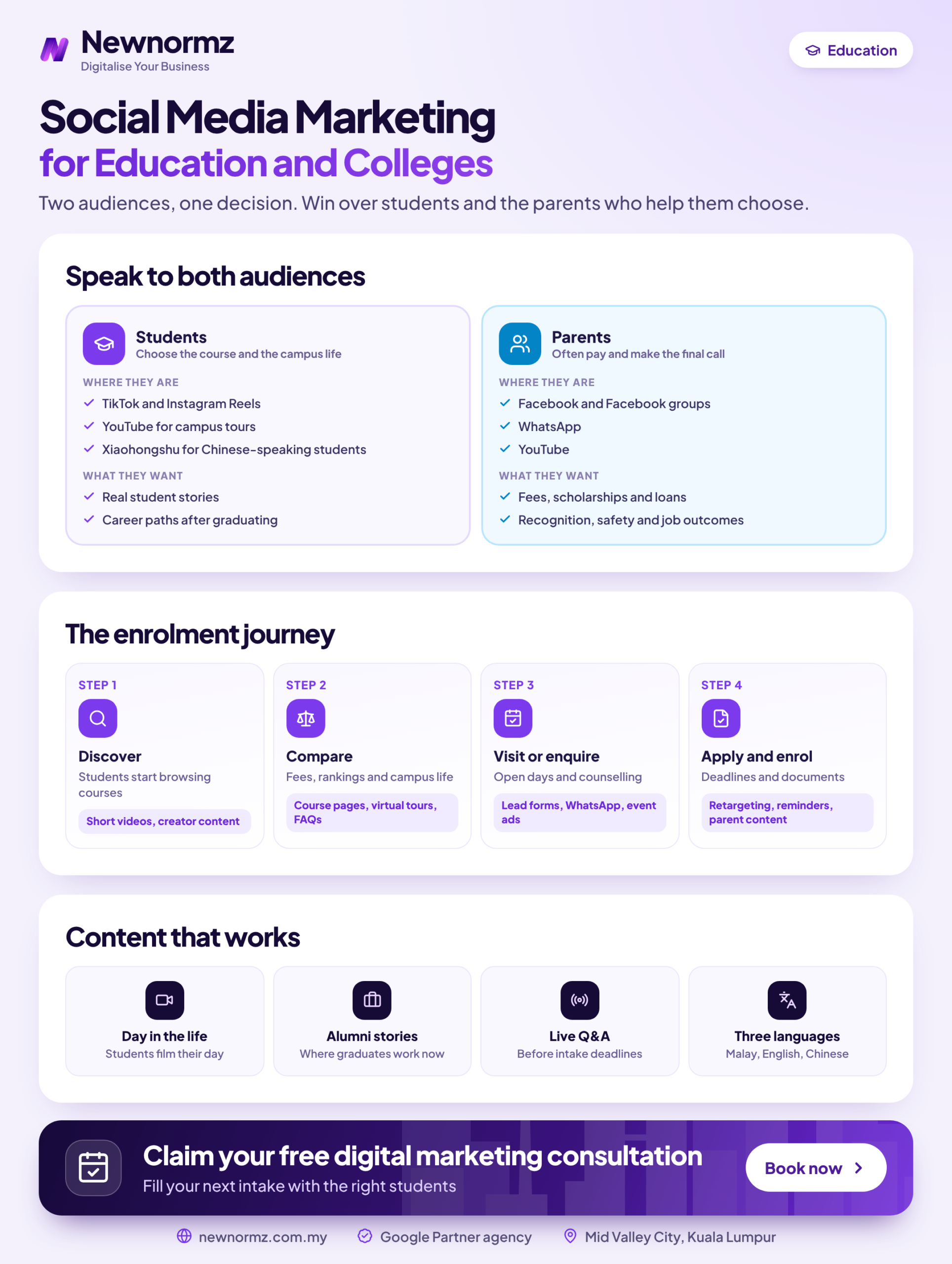
Student recruitment social media campaigns fail most often because one ad tries to speak to a 17-year-old and their father at the same time. They want different things, they worry about different things, and they spend their time on different apps. Split them before you write a single caption.
For foundation, diploma and degree programmes there are usually two audiences. Postgraduate, executive and professional courses add a third: the working adult, and sometimes the employer who sponsors them. The table below reflects what we see running social for Malaysian brands. Treat it as practitioner experience, not survey data, and check it against your own enquiry records.
| Audience | What they need to see | Where they usually are |
|---|---|---|
| School leavers (SPM, STPM, UEC, A-Level) | Real campus life, friends, what classes feel like, where the course leads | TikTok, Instagram Reels, YouTube Shorts |
| Parents and guardians | Total cost, payment options, safety, accommodation, accreditation, career outcomes | Facebook, WhatsApp, YouTube; Xiaohongshu for many Chinese-speaking families |
| Working adults and employers | Flexible schedule, career payoff, employer recognition, time to complete | LinkedIn, Facebook, Instagram |
Social media for colleges and universities is really two campaigns sharing one budget. The student builds the shortlist. The parent approves it and pays the deposit. Your content plan, ad sets and WhatsApp scripts should all reflect that split.
Step 2: Build Your Plan Around the Intake Calendar, Not the Posting Calendar
A posting calendar asks “what do we post on Tuesday?” An intake campaign asks “how many students need to pay a deposit by the deadline, and what has to happen in each week before then?” Start from the intake date and work backwards.
Mark your own key dates first: each intake month, application and scholarship deadlines, open days, and the national moments your audience reacts to. Anyone doing education marketing Malaysia-wide plans around the same two: SPM and STPM results season, and UPU decisions, when families who don’t get the public university place they hoped for start comparing private options. Use the officially announced dates each year rather than last year’s guesses.
| Weeks before intake | Goal | Content | Paid activity |
|---|---|---|---|
| 16 to 12 | Get on the shortlist | Student life, day-in-the-life videos, programme teasers | Video views and reach on TikTok and Reels to build retargeting pools |
| 12 to 8 | Answer objections | Fees explained, careers, lecturer explainers, parent FAQs | Click-to-WhatsApp and lead ads to parents; retarget video viewers |
| 8 to 3 | Get families on campus | Open day and campus tour invites, scholarship deadlines | Event-registration ads; heaviest spend of the cycle |
| 3 to 0 | Convert to deposits | Last-call reminders, “what to bring on day one”, testimonials | Retargeting to chats, tour attendees and form leads only |
| Intake week onwards | Stock the next cycle | Film orientation, first classes and new-student reactions | Low spend; save the footage for the next intake |
The decision rule: start building creative at least one full intake cycle ahead. The footage that sells the next intake is shot during the current one. If you start filming eight weeks before the deadline, you’ll be paying for ads with stock photos.
Malaysia note
Hari Raya, Chinese New Year and Deepavali push retail advertisers into the same auctions you’re bidding in, and families are busy with balik kampung, not brochures. If an intake deadline falls just after a festive period, move your heaviest push earlier and use the festive weeks for warm, low-pressure content instead of hard enrolment ads.
If you also need the wider annual plan your intake campaigns sit inside, see our guide to building a full social media strategy. A social media strategy for higher education is that annual plan with intakes as fixed points.
Step 3: Set Content Pillars That Answer Enrolment Objections
Content pillars for schools should come from the questions your counsellors hear every week, not from a list of “post ideas”. Pull the last 100 WhatsApp enquiries, group the questions, and you’ll usually land on these five:
- Student life: proof the place is real. Unscripted campus footage, clubs, the canteen, the hostel corridor.
- Outcomes and careers: where graduates work, internships, industry partners. Only use figures your institution can verify.
- Fees and financing: the full cost of a year, and the ways to pay, such as PTPTN loans, scholarships and instalment plans. Explain eligibility in general terms and send the specifics to a counsellor.
- Programme explainers: a lecturer explaining in 60 seconds what Year 1 of a course actually covers.
- Parent reassurance: safety, accommodation, transport, pastoral care and accreditation.
The same method holds for social media marketing for schools and tuition centres. The objections shift towards class sizes, teachers and exam results, but you still build pillars from what parents actually ask.
A warning on that last pillar. Don’t put “MQA accredited” or “95% employed” in an ad unless you have checked it. Accreditation status can differ by programme (provisional versus full accreditation), so check each programme’s listing on the Malaysian Qualifications Register and copy the exact wording. One wrong claim in a parent’s comment section costs more trust than a month of ads can build.
Hook Formulas That Work for School Leavers and Parents
The hook is the first one to three seconds of a video, the part that decides whether someone stops scrolling. Ads Manager calls this the thumb-stop. Hook rate is the share of people who watched at least three seconds out of everyone the video was shown to. Here are hooks you can adapt, written per language rather than translated:
| Audience and language | Hook line |
|---|---|
| School leaver, English | “SPM done. Here’s what week one of a diploma actually looks like.” |
| School leaver, BM | “Lepas SPM nak sambung apa? 3 benda saya tak tahu sebelum masuk diploma.” |
| School leaver, Manglish (TikTok) | “Okay lah, honest review of our campus food. I’m a student here, not paid one.” |
| Parent, English | “What happens if your child wants to switch courses after semester one?” |
| Parent, BM | “Berapa sebenarnya kos setahun? Kami pecahkan satu per satu.” |
| Parent, Chinese | “孩子SPM成绩出来了,下一步怎么选?” (Your child’s SPM results are out. How do you choose the next step?) |
| Working adult, English | “Doing a master’s while working full time: my actual weekly schedule.” |
Turn Students and Lecturers Into Your Content Team
Native beats polished on TikTok and Reels. A second-year student filming their morning on a phone usually holds attention better than a studio campus video, and costs far less to make. A small ambassador programme can keep your pillars stocked all year:
- Recruit 5 to 10 student ambassadors across programmes and language groups, and add two or three lecturers who are comfortable on camera.
- Give each a monthly brief: one pillar, one hook from the bank above, 30 to 60 seconds, filmed vertically.
- Get written consent covering where and how long you’ll use their content, including as paid ads. Running Spark Ads on TikTok (ads that use a creator’s own post) needs the creator’s authorisation code as well.
- Treat their personal data under the PDPA, and get parental consent for anyone under 18 before you feature or advertise with them.
Ambassadors with a real following behave like micro-creators, so the same rules apply as when working with student influencers: clear deliverables, disclosure, and agreed usage rights.
Step 4: Choose Your Platform Mix by Programme, Not by Trend
The right platform depends on who decides for that programme. A school leaver’s diploma and an executive MBA should not share a channel plan.
| Programme | Primary platform | Support platform | Why |
|---|---|---|---|
| Foundation, diploma, first degree | TikTok and Instagram Reels | Facebook (parent retargeting) | Students shortlist on short video; parents approve on Facebook and WhatsApp |
| Postgraduate and executive | Facebook and Instagram | Job title and industry targeting on LinkedIn; Meta for cheaper retargeting | |
| International school | Facebook and Instagram | Xiaohongshu | Parents are the whole audience; many Chinese-speaking parents research schools on Xiaohongshu |
| Tuition centre, short courses | Facebook with click-to-WhatsApp | Instagram, Xiaohongshu | Local, fast decisions made over chat; radius targeting around the centre |
Newnormz take on TikTok for universities
TikTok is worth it when your intake is school leavers and you can feed it with two or three native videos a week from students and lecturers. It isn’t worth it for executive programmes, international school admissions, or any team that can only manage polished monthly posts. A TikTok account with four corporate videos does less than one strong Facebook campaign aimed at parents.
Pick one primary and one support platform per programme and do them properly. Our guide to running several platforms without burning out covers how to reuse one shoot across channels.
Step 5: Run Intake Ads in Meta and TikTok Ads Manager
Facebook ads for education fail more often on tracking and setup than on budget. Follow these steps in order.
Install tracking before you spend
Set up the Meta Pixel plus the Conversions API (a server-side connection that recovers events browsers block), and the TikTok Pixel plus Events API. Fire events for open-day registration, application form submission and brochure download, and test them in Events Manager before launch.
Pick the optimisation event that makes money
The algorithm finds more of whatever you tell it to optimise for. Choose conversations for click-to-WhatsApp, or leads for forms, rather than clicks or reach. Meta’s Business Help Centre describes the learning phase as needing roughly 50 optimisation events a week per ad set, so if applications are rarer than that, optimise for open-day registrations or conversations first.
Go broad and let creative do the targeting
Use location and broad age ranges, then run 4 to 6 different creatives per ad set: a student vlog, a fee explainer, a lecturer clip, a parent FAQ. Meta restricts targeting options for audiences under 18, so check what’s available in your Ads Manager and let parent-facing creative attract parents rather than relying on interest stacks.
Split ad sets by language
Run separate English, BM and Chinese ad sets, each with creative made in that language and a WhatsApp greeting in the same language. A translated subtitle on an English video is not a Chinese ad.
Plan the creative refresh rhythm
Across a 6 to 10 week intake push, plan new creative every two to three weeks. Watch frequency (how many times the same person sees your ad) and click-through rate together: when frequency climbs and CTR falls, that’s creative fatigue, and it’s time to swap in fresh videos.
Keep boosted posts for proof, not leads
Boosting a graduation post that’s already getting warm comments is fine for social proof. For enquiries, build proper campaigns in Ads Manager, where you control the objective, the event and the placements.
Instant Forms vs Click-to-WhatsApp for Education Enquiries
Instant Forms (Meta lead ads) let someone submit details without leaving Facebook. Click to WhatsApp ads open a chat with your admissions number. Both work, but they attract different leads.
| Factor | Instant Forms | Click-to-WhatsApp ads |
|---|---|---|
| Cost per lead | Usually lower, especially on the default form | Usually higher per conversation |
| Lead quality | Mixed: one tap fills in a pre-filled form, and many never answer a call | Higher: the person typed a question and is waiting for a reply |
| Fit with Malaysian parents | Feels like signing up for a sales call | Matches how parents already ask: “Fees how much? Got hostel?” |
| How to raise quality | Higher-intent form type plus questions on programme, intake and SPM status | Pre-set greeting and quick-reply buttons for programme and language |
| Best for | Open-day registrations, brochure requests, high volumes | Fee and entry questions, parents, tuition centres |
Adding qualifying questions raises your cost per lead, and that’s the point. You pay more per lead and less per enrolment, because the people who can’t be bothered to answer three questions were never going to pay a deposit. So don’t judge a campaign against a cost per lead education benchmark you found online. Judge it on what each enrolled student costs, which is what Step 7 sets up.
Step 6: Fix the WhatsApp Hand-Off Where Most Enrolments Die
Most institutions don’t lose students in the content. They lose them in the 12 hours after a parent sends a WhatsApp message. Ads run around the clock, and the admissions phone doesn’t.
✗ Ads generate chats that nobody answers properly
This is the most common leak we see in accounts running click-to-WhatsApp ads. A parent messages at 10pm on a Saturday and gets a reply on Monday, by which time they’ve chatted with two other colleges. Or a Chinese-speaking parent gets an English-only reply from whoever is free. Nobody records which ad the chat came from, so marketing can’t tell which campaign produced the enrolments.
✓ The fix
Treat WhatsApp as part of the campaign, not as admissions’ problem. Set reply-time targets, route chats by language, and tag every chat by source and programme from the first message.
WhatsApp hand-off checklist
- ✓Reply-time target written down, for example under 5 minutes in office hours and before 9am for overnight chats
- ✓After-hours auto-reply that answers the top three questions (fees range, intakes, entry requirements) and promises a callback time
- ✓Language routing: quick-reply buttons send EN, BM and Chinese chats to counsellors who speak them
- ✓Source and programme labels on every chat (WhatsApp Business app labels, or CRM tags if you use the WhatsApp Business Platform API)
- ✓Approved message templates for fee breakdowns, open-day invites and document lists
- ✓A follow-up sequence: day 1, day 3, a week before open day, and the day before
- ✓A PDPA consent line before you add anyone to broadcast lists
The comment section is part of the hand-off too. Fee questions left unanswered under an ad look like hidden costs, and a complaint left in public for two days reaches more parents than your best video. Reply publicly with a short, factual answer and move the detail to WhatsApp. Our guide to handling enquiries and complaints on social covers tone and escalation.
By now the workload is clear: trilingual creative, two ad platforms, tracking, and an inbox that needs answering at night. Many institutions keep strategy and student content in-house and bring in a social media marketing agency in Malaysia for paid campaigns, community management and the reporting that connects ads to admissions.
Step 7: Measure Social Media for Education on Cost per Enrolled Student
Likes and views tell you whether content is being seen. Social media marketing for education is only working if it fills seats, so social media ROI for an institution comes down to one question: how much did each enrolled student cost, and is that worth it against what they pay? Here’s a worked example. All numbers are illustrative, not market rates.
| Example: RM10,000 intake budget | Click-to-WhatsApp route | Instant Form route |
|---|---|---|
| Cost per lead (example) | RM20 per conversation | RM8 per form lead |
| Leads | 500 | 1,250 |
| Qualified (right programme, intake, results) | 30% = 150 | 10% = 125 |
| Attend open day or campus tour | 20% = 30 | 16% = 20 |
| Enrol (deposit paid) | 40% = 12 | 30% = 6 |
| Cost per enrolled student | About RM833 | About RM1,667 |
Now set that against the value of a student. If first-year fees in this example were RM18,000, both routes are profitable, but the cheap-lead route produced half the students for the same spend. A report showing “1,250 leads at RM8” would have looked like the better campaign.
The cheapest lead is the one that enrols. Everything else is a cost you’re paying to look busy.
To run this maths on your own numbers, plug your budget, fee value and conversion rates into our free social media ROAS calculator.
None of this works unless the data joins up. Add UTM parameters to every ad link so GA4 shows which campaign drove open-day registrations. Then add a “lead source” field to your CRM or admissions spreadsheet that counsellors fill in for every chat, and make it compulsory before a lead can be marked enrolled. Agree who owns each number:
| Metric | Who owns it | Target to set |
|---|---|---|
| Cost per conversation or lead | Marketing | Baseline from the first two weeks, per language and platform |
| First reply time | Admissions lead | Minutes in office hours; next morning for overnight chats |
| Qualified lead rate | Counsellors (tag every chat) | Agreed definition: programme, intake and entry results fit |
| Open day or tour attendance | Admissions and events | Share of qualified leads who attend |
| Cost per enrolled student | Marketing with finance | A ceiling set as a share of first-year fee value |
Report these monthly and per intake, next to spend. If you need a layout leadership will actually read, start from our monthly social media report template and replace the engagement section with the funnel above.
Lead-to-appointment tracking is standard practice in other lead-driven sectors. In a Google Ads (paid search, not social) campaign for a chiropractic centre in PJ, Newnormz tracked leads through to bookings and saw 60 to 70% of leads become appointments. Student enrolment marketing Malaysia-wide needs the same discipline: count the enrolments, not just the enquiries.
FAQ
Which social media platform is best for student recruitment in Malaysia?
It depends on who decides for the programme. For school leavers, TikTok and Instagram Reels usually build the shortlist while Facebook and WhatsApp reach the parents who approve it. Postgraduate and executive programmes do better on LinkedIn with Meta for retargeting.
Should education ads target students or parents?
Both, with separate creative and ad sets. Students respond to campus life and career stories, while parents need fees, safety, accommodation and accreditation answered. Running one ad for both usually serves neither.
How much should a college spend on social media ads per intake?
Work backwards from your enrolment target and the cost per enrolled student you can afford. For example, 20 students at a ceiling of RM800 each points to about RM16,000 in ad spend. Your first intake gives you the real conversion rates to refine it, and our social media budgeting guide covers what drives the cost.
Is TikTok worth it for universities and colleges?
Yes, if you recruit school leavers and can post native student and lecturer videos every week. It’s a poor fit for executive programmes or for teams that only produce polished monthly content.
When should colleges start their intake campaigns on social media?
Start paid activity around 12 to 16 weeks before the intake, and start filming creative one full intake cycle earlier. Line up your heaviest push with SPM or STPM results, UPU decisions and your open days, and plan around festive periods when ad costs rise.
Free social media audit
Find out where your intake funnel loses students, from first ad to deposit
- ✓A review of your ads and content for students and parents, in each language you recruit in
- ✓A check of your WhatsApp hand-off: reply times, language routing and source tagging
- ✓A tracking plan that connects social, Google search and WhatsApp enquiries to cost per enrolled student

Bryan Tan is an SEO Specialist and CEO at Newnormz, helping hundreds of businesses achieve first-page rankings on Google. With a passion for driving organic growth, Bryan blends innovative strategies with hands-on experience to optimize websites for maximum visibility. Always at the forefront of the latest SEO insights and trends, he consistently adapts to the evolving digital landscape.