Short verdict
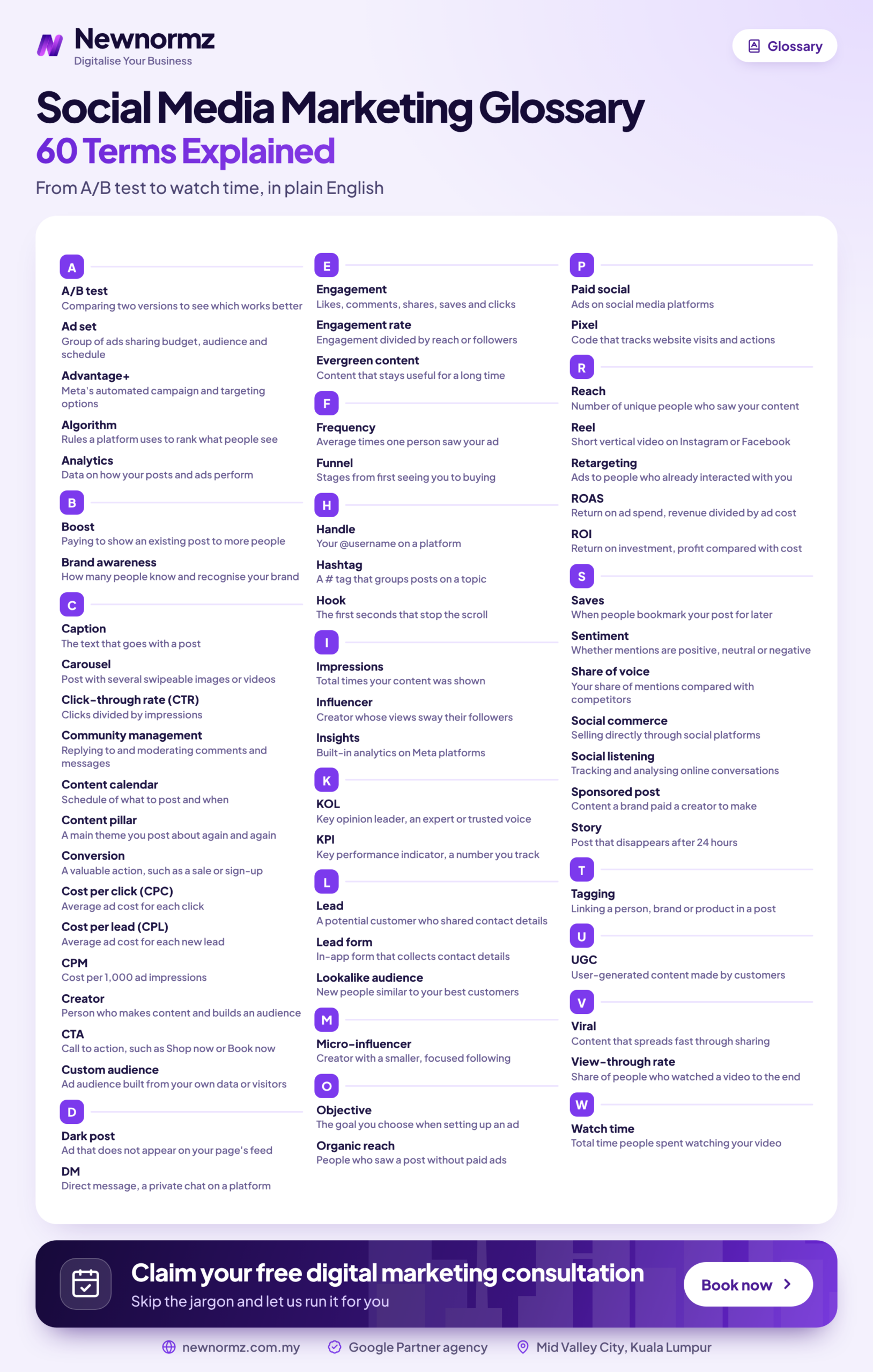
Only about a dozen social media marketing terms tell you whether your ads made money. The rest explain why. This social media marketing glossary covers 60 terms in eight groups, from strategy to KOLs. Each one is tagged Money (ties straight to revenue), Diagnostic (explains why the money numbers moved) or Vanity on its own (useful only next to other numbers). At Newnormz we judge social media on enquiries and leads, not views, and every tag follows from that. If you only need to know what belongs in your monthly report, jump to the shortlist near the end.
How to Read This Glossary: Money Terms, Diagnostic Terms and Vanity Terms
Money terms connect directly to ringgit going out or coming in per result. ROAS (return on ad spend) is the clearest one: revenue divided by ad spend. If your report doesn’t have at least one Money term, it can’t tell you whether the month worked.
Diagnostic terms explain why a Money number moved. CTR (click-through rate) won’t pay anyone’s salary. But a falling CTR is usually the first sign that a creative has worn out, weeks before your cost per lead starts climbing.
Vanity on its own terms look good on a slide and prove nothing by themselves. Likes are the classic example. A post with 4,000 likes and zero enquiries tells you people liked the content. It doesn’t tell you anyone bought anything.
A metric is only vanity when it’s reported alone.
Strategy and Planning Terms (1 to 8)
This is the social media marketing terminology you’ll see in an agency proposal before any money is spent. These terms aren’t metrics, so the tag shows how closely each one should connect to revenue.
| Term | What it means | Tag | Where people get it wrong |
|---|---|---|---|
| 1. Social media strategy | The written plan for which platforms, audiences, content and budget will move a business goal, and how you’ll measure it. | Money | It’s a list of platforms and posting days with no revenue or lead target attached. |
| 2. Content pillars | Three to five recurring themes your posts rotate through, such as education, proof, behind the scenes and offers. | Diagnostic | Pillars get picked for being easy to post, not for answering what customers ask before they buy. |
| 3. Content calendar | The dated schedule of posts, campaigns and festive moments. | Diagnostic | It commits the team to a rhythm it can’t keep, or leaves Raya, CNY and 11.11 creative until two weeks before. |
| 4. Organic vs paid social | Organic is unpaid posting. Paid is ads. Organic builds proof (comments, reviews, creator content) and paid buys reach. Most businesses need both. | Money | People expect organic reach alone to grow a new brand, or they send paid traffic to a page with no posts. |
| 5. Brand voice | How your brand sounds in captions, replies and videos, written down so different people sound like one brand. | Diagnostic | The English copy gets translated word for word into BM and Chinese instead of being written for each language. |
| 6. Social listening | Tracking what people say about your brand, competitors and category, beyond the comments on your own posts. | Diagnostic | Mentions get counted but never read for complaints, objections and content ideas. |
| 7. Community management | Replying to comments and DMs, moderating, and handling negative feedback in public. | Money | It’s treated as an afterthought, so a “how much?” comment left unanswered for two days becomes a lost sale. |
| 8. Social media audit | A structured review of your accounts, ads, tracking and results against your goals. | Diagnostic | The audit checks follower count and posting frequency but skips tracking setup and lead quality. |
If you’re still working out where these pieces fit together, start with this overview of what social media marketing covers across Facebook, Instagram and TikTok.
Reach and Engagement: Social Media Metrics Explained (9 to 18)
These are the numbers that fill most monthly reports. Almost all of them are Diagnostic or Vanity on its own. They’re useful for explaining results, and dangerous when they’re presented as the results.
| Term | What it means | Tag | Where people get it wrong |
|---|---|---|---|
| 9. Impressions | How many times your content was shown, including repeat views by the same person. | Vanity on its own | Reports present it as “people reached”. |
| 10. Reach | How many unique accounts saw your content at least once. | Vanity on its own | Reach from several posts gets added together, so the same person is counted several times. |
| 11. Frequency | Impressions divided by reach: the average number of times each person saw your ad. | Diagnostic | Nobody looks at it. Frequency going up while CTR goes down is the classic sign of creative fatigue. |
| 12. Engagement rate | Engagements (reactions, comments, shares, saves) divided by either reach or followers, times 100. | Vanity on its own | The report doesn’t say which denominator it used, and the two give very different numbers. |
| 13. Hook rate | Three-second video plays divided by impressions. It shows whether your opening stopped the scroll. | Diagnostic | Videos get judged on total views instead of how well the first seconds worked. |
| 14. Thumb-stop ratio | Often used as another name for hook rate: how well the first frame stops a scrolling thumb. | Diagnostic | Teams calculate it differently. Agree on one formula before you compare numbers. |
| 15. ThruPlay and watch time | ThruPlay is Meta’s count of video plays to 15 seconds (or to the end if the video is shorter). Watch time is total or average time viewed. | Diagnostic | Campaigns optimise for ThruPlays when the real goal is leads. |
| 16. Audience retention | The curve that shows what share of viewers are still watching at each second of a video. | Diagnostic | Nobody checks where viewers drop off, so the same weak moment shows up in the next video. |
| 17. Saves and shares | People bookmarking your post or sending it to someone. Both signal stronger intent than a like. | Diagnostic | They get folded into one engagement number, so you can’t see them. |
| 18. Follower growth rate | New followers in a period divided by the followers you started with. | Vanity on its own | Growth from giveaways gets celebrated, even though it brought in people who were never going to buy. |
From our audits
Two problems come up again and again in the reports we review. Impressions get labelled as “reach”, which can make an audience look several times bigger than it is. And engagement rate is reported with no denominator, so nobody knows whether it was divided by reach or by followers. Ask which one it is. Then compare the number with your own past months rather than an industry “benchmark”, because your content mix, audience and spend make outside averages close to meaningless.
To turn these numbers into decisions instead of screenshots, read our guide to reading your social media analytics.
Paid Social Terms That Decide Whether You Make Money (19 to 28)
This is where most of the Money terms are. If an agency report skips this group, ask why. And if the CPM CPC CTR meaning is what tripped you up in your last report, here it is in one line: CPM is what you pay per 1,000 views, CPC is what you pay per click, and CTR is the share of viewers who click.
| Term | What it means | Tag | Where people get it wrong |
|---|---|---|---|
| 19. CPM | Cost per 1,000 impressions: what you pay for your ad to be shown 1,000 times. | Diagnostic | Teams chase the lowest CPM, but cheap impressions often reach people who don’t buy. CPMs also rise around festive and 11.11 periods. |
| 20. CPC | Cost per click: ad spend divided by clicks. | Diagnostic | Reports don’t say whether it means link clicks or all clicks. All clicks include profile taps and “see more”. |
| 21. CTR | Click-through rate: clicks divided by impressions, times 100. | Diagnostic | Reports show CTR (all), which flatters the number, instead of link CTR. |
| 22. Cost per lead (CPL) | Ad spend divided by the number of leads (form fills, WhatsApp chats, calls). | Money | The campaign with the cheapest CPL gets called the best one. The worked example below shows why it often isn’t. |
| 23. Cost per qualified lead | Ad spend divided by the leads that meet your agreed criteria: reachable, in your area, with a real need and budget. | Money | Nobody writes down what “qualified” means, so the definition shifts from month to month. |
| 24. CPA and cost per customer | CPA is cost per chosen action, often a purchase. Cost per customer is ad spend divided by new paying customers. | Money | The “action” behind CPA quietly turns out to be an add-to-cart or a landing page view. |
| 25. ROAS | Return on ad spend: revenue from ads divided by ad spend. RM12,000 in revenue from RM3,000 in spend is a 4x ROAS. | Money | The platform-reported ROAS gets read as profit. It ignores product cost, fees and returns. |
| 26. Ad auction | The instant process that decides which ad a person sees. Meta weighs your bid, how likely the person is to take the action, and ad quality. | Diagnostic | People assume the highest bid always wins. A more relevant ad can win with a lower bid. |
| 27. Learning phase | The period after you launch or make a big edit, while delivery is still working out who to show the ad to, so results swing. Meta’s Business Help Centre says an ad set generally needs about 50 optimisation events within a week to exit it. | Diagnostic | Ad sets get edited every day, which keeps resetting learning, or the budget is split so thin that no ad set ever exits it. |
| 28. Advantage campaign budget | Meta’s setting (formerly called CBO) that spreads one campaign budget across ad sets automatically. | Diagnostic | People expect each ad set to get equal spend, then wonder why one ad set took 80% of the budget. |
Once the ROAS meaning is clear (revenue divided by ad spend), the next question is whether your number is actually profitable. To see what ROAS your current numbers point to, enter your spend, conversion rate and order value into our free social media ROAS calculator.
Worked Example: How RM3,000 in Ad Spend Turns Into Customers
The numbers below are hypothetical. They show the maths, not the market rate. Both campaigns get the same budget, CPM and CTR. Campaign A uses an Instant Form set for more volume. Campaign B uses a higher-intent form with qualifying questions.
| Step (example numbers) | Campaign A: cheap leads | Campaign B: higher-intent leads |
|---|---|---|
| Ad spend | RM3,000 | RM3,000 |
| Example CPM | RM15 | RM15 |
| Impressions (spend ÷ CPM × 1,000) | 200,000 | 200,000 |
| Clicks at 1% CTR | 2,000 | 2,000 |
| Lead rate from clicks | 12.5% | 6% |
| Leads | 250 | 120 |
| CPL | RM12 | RM25 |
| Share of leads that qualify | 20% (50 leads) | 50% (60 leads) |
| Cost per qualified lead | RM60 | RM50 |
| Customers (10% of qualified leads close) | 5 | 6 |
| Cost per customer | RM600 | RM500 |
A report that stops at CPL would call Campaign A the winner by a wide margin. Follow the same budget to the end and the RM25 lead turns out to be the cheaper way to get a customer. Your sales team also spends less time calling 200 people who never meant to buy. That’s why cost per qualified lead and cost per customer are Money terms, and CPL on its own can mislead you.
For reference, here’s what “per qualified lead” reporting looks like on a real account. One of our Google Ads clients, a confinement centre in KL, got 266 qualified leads in its first 30 days at RM9.58 per lead, with an average CPC of RM0.73. That’s paid search, not paid social, but the reporting principle is the same: count leads that meet the definition, not every form fill.
To take the same maths further, with product margins and repeat purchases included, see our guide to measuring social media ROI properly.
Audience and Targeting Terms (29 to 35)
| Term | What it means | Tag | Where people get it wrong |
|---|---|---|---|
| 29. Broad targeting | Setting only the basics (location, age, language) and letting the algorithm find buyers from your creative and conversion data. | Diagnostic | Going broad with one creative and broken tracking leaves the algorithm nothing to learn from. |
| 30. Advantage+ audience | Meta’s AI targeting option. The audience details you enter act as suggestions, and Meta can go beyond them. | Diagnostic | People treat the suggestions as hard limits, then can’t explain who actually saw the ads. |
| 31. Custom audience | An audience built from your own data: website visitors, customer lists, video viewers or page engagers. | Diagnostic | Customer lists get uploaded without checking that you have PDPA consent to use the data this way. |
| 32. Lookalike audience | People who resemble a source audience you provide. | Diagnostic | The source is every lead, junk included. Use paying customers as the source where you can. |
| 33. Retargeting | Showing ads to people who have already visited, watched or engaged. | Money | Retargeting takes credit for sales that would have happened anyway, which makes its ROAS look better than it is. |
| 34. Audience exclusions | Removing groups such as existing customers or recent leads from a campaign. | Diagnostic | You end up paying to show a “first order” discount to last week’s buyers. |
| 35. Special ad categories | Meta’s label for ads in sensitive areas such as financial products, employment, housing and social issues. These ads get fewer targeting options. | Diagnostic | The plan relies on narrow age or location targeting that turns out not to be available. |
Creative and Content Format Terms (36 to 44)
| Term | What it means | Tag | Where people get it wrong |
|---|---|---|---|
| 36. Hook | The first one to three seconds of a video, or the first line of a caption. | Diagnostic | Videos open with a logo animation or a slow introduction. |
| 37. Creative fatigue | Performance falls because the same people have seen the same ad too often. Frequency rises, CTR drops and CPL climbs. | Diagnostic | The targeting or “the algorithm” gets blamed instead of refreshing the creative. |
| 38. UGC | User-generated content: real customers or creators filming in a natural, unpolished phone style. | Diagnostic | Customer videos end up in ads without written permission. |
| 39. Reels | Short vertical videos on Instagram and Facebook. | Vanity on its own (views) | TikToks get reposted with the watermark still on them. |
| 40. Stories | Full-screen posts that disappear after 24 hours. Stories is also an ad placement. | Diagnostic | A square feed ad gets squeezed into Stories, with key text hidden under the buttons. |
| 41. YouTube Shorts | YouTube’s vertical short-video format. | Vanity on its own (views) | Shorts get judged on views alone instead of the subscribers and site visits they bring. |
| 42. Carousel | A swipeable post or ad with several images or videos. | Diagnostic | The strongest card goes last, where few people swipe to see it. |
| 43. Spark Ads | A TikTok ad format that runs an organic post (yours, or a creator’s with their authorisation) as an ad, keeping its likes and comments. | Diagnostic | A weak organic post gets promoted in the hope that money will fix it. |
| 44. Meta partnership ads | Ads that show both a creator’s handle and your brand, run with the creator’s permission. | Diagnostic | They’re never tested against your own brand ads, so you can’t tell whether the creator added anything. |
Because the hook decides whether anything else in the video gets watched, here are three formulas you can brief to a creator or film yourself this week.
Three hook formulas to test
- ✓The call-out: “Stop doing [common mistake] if you run a [type of business].” Example: “Stop paying for likes if you run a renovation company.”
- ✓The visible result: the before and after appear in the very first frame (a stained sofa next to the clean one, a leaking roof next to the dry one), with the explanation coming afterwards.
- ✓The local voice: a Manglish or BM opening line that sounds like a friend, not a brand. Example: “Weh, your aircon also like this ah?” Write a separate version for each language segment instead of subtitling one ad.
Tracking and Attribution Terms Most Accounts Get Wrong (45 to 51)
Tracking decides what the algorithm optimises for. If the data is wrong here, every Money term in your report is wrong too.
| Term | What it means | Tag | Where people get it wrong |
|---|---|---|---|
| 45. Meta Pixel | Code on your website that reports visits and actions (leads, purchases) back to Meta. | Diagnostic | It gets installed twice, once by a plugin and once by hand, so every purchase is counted twice. |
| 46. Conversions API (CAPI) | Sends the same events from your server or CRM straight to Meta, so data isn’t lost to ad blockers and browser privacy limits. | Diagnostic | CAPI runs alongside the Pixel without deduplication (a shared event ID), which inflates conversions. |
| 47. TikTok Events API | TikTok’s server-side equivalent of CAPI. | Diagnostic | Accounts rely on the TikTok Pixel alone and lose conversions that should have been tracked. |
| 48. Event Match Quality | A score in Meta Events Manager showing how well the customer details sent with your events (email, phone) match people’s Meta accounts. | Diagnostic | A low score gets ignored, and hashed phone numbers never get passed through. |
| 49. UTM parameters | Tags added to a link (utm_source, utm_medium, utm_campaign) so analytics tools know where a visit came from. | Diagnostic | Inconsistent naming (“facebook”, “FB”, “fb_ads”) splits one source into three. |
| 50. GA4 | Google Analytics 4: tracks what visitors from every channel do on your website. | Diagnostic | People expect GA4 and Ads Manager to agree. They use different attribution rules, so they won’t. |
| 51. Attribution window | How long after a click or view a conversion still gets credited to the ad, for example 7-day click or 1-day view. | Diagnostic | Months reported with different windows get compared as if they were the same, or view-through conversions pad the results. |
✗ Optimising for landing page views or link clicks because the lead or purchase event was never set up
This happens when the Pixel goes in but nobody configures the event that fires on the thank-you page or checkout. The campaign gets optimised for clicks instead. Meta then finds exactly what you asked for: people who click a lot and rarely buy. CPC looks great and sales don’t move.
✓ The fix
In Events Manager, check that your Lead or Purchase event fires once per real conversion. Add CAPI with deduplication and test it with the Test Events tool. Then switch the campaign’s optimisation to that event. If you have too few conversions for the ad set to exit learning, optimise for the nearest higher-volume event (such as initiated checkout) for a while, then move to the real one.
Setting up pixels, CAPI and clean events is where many businesses decide to hand social to a specialist team. Our social media marketing agency in Malaysia runs social alongside SEO and Google Ads, so we can connect what happens in Ads Manager with search traffic and the WhatsApp enquiries that follow.
Malaysia-Specific Lead and Social Commerce Terms (52 to 57)
Most international glossaries leave these out, yet anyone doing social media marketing Malaysia-wide meets them within the first month, and they’re often where the money is made or lost.
| Term | What it means | Tag | Where people get it wrong |
|---|---|---|---|
| 52. Click-to-WhatsApp ads | Facebook or Instagram ads whose button opens a WhatsApp chat with your business. | Money | Every “conversation started” gets counted as a lead, without checking how many people replied or qualified. |
| 53. WhatsApp Business Platform (API) and BSP | The version of WhatsApp built for businesses at scale: multiple agents, CRM connection and automation. You usually access it through a Business Solution Provider (BSP), a Meta-approved vendor. | Diagnostic | Businesses pay for the API before fixing the real bottleneck, which is how fast someone replies. |
| 54. Instant Forms | Meta lead forms that open inside Facebook or Instagram with details pre-filled. “More volume” makes submitting easy. “Higher intent” adds a review step before submitting. | Money | The default “more volume” setting stays on, then nobody answers when sales calls. |
| 55. TikTok Shop | TikTok’s in-app store. Viewers buy from videos, lives and the shop tab without leaving TikTok. | Money | Reports show views on shoppable videos instead of orders and revenue. |
| 56. Live selling | Selling during a livestream, with products pinned on screen and time-limited offers. | Money | Lives get judged on peak viewers instead of orders per hour. |
| 57. GMV Max | TikTok’s automated campaign type for TikTok Shop, which optimises for gross merchandise value (GMV). Check whether it’s available in your Seller Center or TikTok Ads Manager. | Money | GMV gets treated as revenue. It’s counted before returns, vouchers and platform fees. |
Malaysia note
Most Malaysian enquiries end up on WhatsApp, whatever ad started them. That makes reply speed, and who answers the chat, just as important as the ad itself. A strong ad followed by a three-hour wait for a reply will lose to an average ad followed by a reply in three minutes. Lead data collected through forms and chats also falls under the PDPA, so store it securely and use it only for the purpose the person agreed to.
If your click to WhatsApp ads already bring in chats but too few become customers, the fix is usually in the follow-up process. Our WhatsApp marketing services work on exactly that part of the funnel.
Influencer and KOL Terms (58 to 60)
| Term | What it means | Tag | Where people get it wrong |
|---|---|---|---|
| 58. KOL | Key opinion leader: an influencer or expert with a large following, paid for reach and credibility. | Vanity on its own (follower count) | KOLs get booked on follower count without checking where the audience lives or whether the comments are real. |
| 59. KOC | Key opinion consumer: an everyday customer or micro-creator whose reviews feel like advice from a peer. In our experience, Xiaohongshu (RedNote) is a major KOC channel for Chinese-Malaysian lifestyle and beauty discovery. | Diagnostic | People expect one KOC post to perform like a KOL post. KOCs work in volume. |
| 60. Usage rights and whitelisting | Usage rights are your contracted permission to reuse a creator’s content (where and for how long). Whitelisting means running ads from the creator’s handle, through partnership ads or Spark Ads. | Money | Usage rights get left out of the contract, so you pay again to use the video that performed best. |
To decide whether creators belong in your plan at all, read why brands hire influencers and what they should expect in return.
Social Media Terms People Confuse (and the Difference That Matters)
| Pair | The difference | Why it changes your decision |
|---|---|---|
| Reach vs impressions | Reach counts people. Impressions count views. | A huge impression count on a small reach means you’ve shown the same ad to the same people too many times. |
| CPL vs cost per qualified lead | CPL counts every lead. Cost per qualified lead counts only the leads your sales team can use. | As the worked example showed, the “cheap” campaign can be the expensive one. |
| Boosted post vs ad from Ads Manager | Boosting is the quick button on a post. Ads Manager gives you full control over objective, optimisation event and placements. | A boost is fine for adding social proof to a post that already works organically. It’s rarely the right tool for leads or sales. |
| Engagement rate by reach vs by followers | By reach measures how people who saw the post responded. By followers measures the response against your audience size. | Switching denominators between months can make a bad month look like a good one. |
| ROAS vs ROI | ROAS is revenue divided by ad spend. ROI also subtracts product cost, fees and agency costs. | A 3x ROAS can lose money on a low-margin product. Work out your break-even ROAS first. |
| KOL vs KOC | A KOL brings reach and authority. A KOC brings relatable, peer-level trust. | Pick a KOL for a launch that needs attention fast, and a group of KOCs for proof that keeps working over months. |
Which Social Media Marketing Terms Belong in Your Monthly Report
Good social media reporting is built around your goal, not around whatever the platform dashboard shows first. Here’s the shortlist for each goal.
Likes and follower count can appear in the report, but only next to one of these numbers, never as the headline. If an agency leads with them, ask what happened to cost per qualified lead.
For a ready-made layout that puts these numbers in the right order, use our monthly social media report template.
Frequently Asked Questions
What does CPM mean in social media marketing?
CPM means cost per mille: what you pay for your ad to be shown 1,000 times. It’s a Diagnostic number. A rising CPM explains why your cost per lead went up, but a low CPM on its own doesn’t mean the campaign is working.
What is the difference between reach and impressions?
Reach is the number of unique people who saw your content, and impressions are the total number of times it was shown. Divide impressions by reach and you get frequency, which tells you how often each person saw the ad.
What is ROAS and how do you calculate it?
ROAS (return on ad spend) is revenue from ads divided by ad spend. RM12,000 in sales from RM3,000 in spend is a 4x ROAS. It doesn’t include product cost or fees, so compare it with your break-even ROAS before calling a campaign profitable.
What is the Conversions API and does a small business need it?
The Conversions API sends conversion events from your server or CRM directly to Meta, so you don’t lose data to ad blockers and browser privacy limits. If you run ads optimised for leads or purchases, it’s worth setting up whatever your size. Many website platforms offer a built-in connection, so it doesn’t always need a developer.
What is the difference between a KOL and a KOC?
A KOL (key opinion leader) is an influencer with a large following, and a KOC (key opinion consumer) is an everyday user whose reviews feel like advice from a peer. KOLs bring reach quickly. KOCs bring trust and work best in volume.
Free social media audit
Want a report built on the terms that actually show money?
Newnormz plans, creates and runs social media and paid social for Malaysian brands, and judges every campaign on enquiries, not just views. 5.0 rating from 214+ Google reviews.
Get Your Free Social Media Audit →
No obligation. Prefer to chat? WhatsApp us on +60 17-588 2291.

Bryan Tan is an SEO Specialist and CEO at Newnormz, helping hundreds of businesses achieve first-page rankings on Google. With a passion for driving organic growth, Bryan blends innovative strategies with hands-on experience to optimize websites for maximum visibility. Always at the forefront of the latest SEO insights and trends, he consistently adapts to the evolving digital landscape.