Yes, SEO works for logistics and supply chain companies in Malaysia, but not the way it works for a café or an online shop. Your buyers are procurement managers, importers, and operations heads searching for a specific service in a specific place, like a freight forwarder near Port Klang or a cold chain warehouse in Shah Alam. They don’t search often, but when they do, one contract can be worth more than a year of retail sales. Logistics SEO in Malaysia comes down to building a page for every service and location you can actually deliver, earning trust signals that a cautious B2B buyer looks for, and measuring success by quote requests, not traffic. Expect the first meaningful movement in 3 to 6 months. Be wary of anyone who promises you the number one position, because Google itself has said publicly that no one can guarantee that.
A Simple Way to Think About It
The Warehouse Nobody Can Find
🚧 Down an unmarked side road
The drivers who already know the way keep turning up. A new client looking for space drives straight past and signs with the depot they could actually see.
🛣️ A clear sign at the highway exit
Same warehouse, same rates. But the person who needs space this month sees your name at the exact moment they’re looking for it.
Most Malaysian logistics firms are the first warehouse: good at the work, invisible online. The sections below show how to put up the sign.
Why Logistics Companies Can’t Rely on Referrals Alone Anymore
A lot of freight forwarders, transporters, and 3PL providers in Malaysia built their business on relationships. That still matters. But the person who decides who handles their shipments has changed. Younger procurement teams, regional managers who just relocated to KL, and overseas companies setting up in Malaysia for the first time all start with the same step: a Google search.
The audience is there. Malaysia had 35.4 million internet users at the end of 2025, about 98 percent of the population (DataReportal, Digital 2026 Malaysia). Google holds roughly 93 percent of the search market here (Statcounter, May 2026). If a shipper is looking online for a logistics partner, they are almost certainly doing it on Google.
The catch is that logistics search volume is small compared with consumer topics. “Freight forwarder Penang” will never be searched as often as “nasi lemak near me”. That’s fine. You don’t need thousands of visitors. You need the right twenty people a month who are actually looking for a partner, and one of them signing a 12-month contract.
How Shippers Actually Search for Logistics Services
B2B logistics searches are specific. People rarely type just “logistics company”. They combine a service, a location, and often a cargo type or an industry. Good keyword research for this sector maps those combinations to what you can genuinely deliver.
| Search type | Example searches | What the searcher wants |
|---|---|---|
| Service + location | “freight forwarder Port Klang”, “warehouse for rent Pasir Gudang” | A shortlist of providers to contact now. Highest buying intent. |
| Service + cargo or industry | “cold chain logistics Malaysia”, “halal logistics provider”, “pharmaceutical warehousing” | Proof you handle their specific goods and compliance needs. |
| Problem or process | “how to import goods into Malaysia”, “customs clearance documents needed” | An explanation first, a provider second. Good for building trust early. |
| Local language | “syarikat penghantaran barang”, “sewa gudang”, “货运代理 马来西亚” | The same intent from SME owners and Chinese-speaking traders who search in their own language. |
Notice what’s missing: broad terms like “logistics” or “supply chain”. They attract students, job seekers, and people reading the news. Ranking for them looks good in a report and fills nobody’s pipeline.
What a Logistics SEO Strategy Should Include
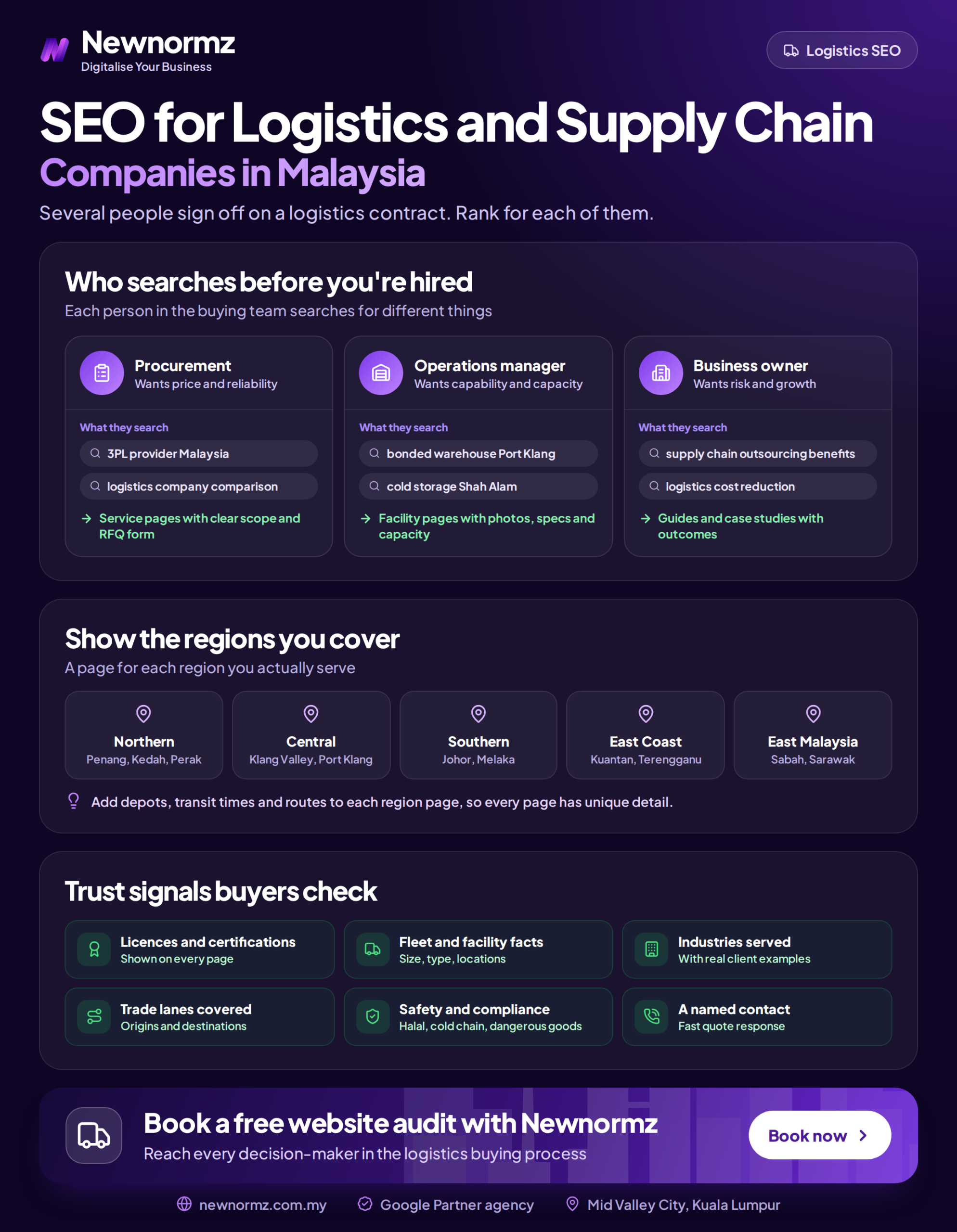
One page per service, not one page for everything
The most common problem we see on logistics websites is a single “Our Services” page that lists sea freight, air freight, trucking, warehousing, and customs brokerage as bullet points. Google can’t rank one thin page for five different intents. Give each core service its own page that explains what you handle, which routes or lanes, which cargo types, and what the process looks like from booking to delivery.
Location pages tied to real operations
If you have a depot in Port Klang, a warehouse in Senai, and a branch in Bayan Lepas, each one deserves its own page with the address, what operates from that site, and which ports, airports, or industrial zones it serves. Only build pages for places where you actually operate. A “logistics company in Kuching” page with no Kuching presence gets found out by the first client who asks, and it tends to perform poorly anyway because there’s nothing real to say.
Google Business Profile for every physical site
When someone searches “warehouse Shah Alam”, the map results often appear above the regular listings. Each depot or warehouse you operate should have a verified Google Business Profile with accurate hours, photos of the actual facility, and reviews from real clients. This is where local SEO does most of its work for logistics firms, because so many searches are anchored to a specific industrial area.
Trust signals a procurement team checks
Handing your cargo to a new provider is a risk, and B2B buyers act like it. Before they fill in a quote form, they look for evidence. Put it where they can see it:
- Certifications and licences you genuinely hold, such as ISO standards, halal logistics certification, or customs-related approvals.
- Your fleet size, warehouse capacity, and equipment, stated plainly.
- Industries you already serve, with client logos or case studies if you have permission to use them.
- Real photos of your facilities and trucks. Stock images of a generic container ship tell the buyer nothing.
These signals help conversions directly, and they also give Google more specific, original content to understand what you do.
Content that answers operational questions
Importers and SME owners have a lot of practical questions: which documents customs needs, how long clearance usually takes, the difference between FCL and LCL, what Incoterms mean for who pays. A logistics firm that answers these clearly earns visits from people early in the buying process. When they’re ready to pick a provider, you’re already the name they recognise. Write these from your operations team’s real experience, not generic summaries copied from elsewhere.
A quote form that doesn’t scare people off
Rankings are pointless if the next step is painful. Keep the first enquiry short: origin, destination, cargo type, rough volume, contact details. You can collect the rest on the call. Add a WhatsApp button too, because many Malaysian SME owners would much rather message than fill in a form.
What Results to Expect, and When
Logistics is a lower-competition niche online than sectors like property or aesthetics, which helps. But B2B sales cycles are long, so leads from SEO can take a while to show up as signed contracts. Here’s a realistic timeline:
| Period | What’s happening | What you should see |
|---|---|---|
| Months 1 to 2 | Technical fixes, keyword mapping, service and location pages built, Google Business Profiles cleaned up | Pages indexed, map listings appearing for nearby searches |
| Months 3 to 6 | Content published, links earned, pages refined based on early data | Service + location keywords moving onto page one, first enquiries from organic search |
| Months 6 to 12 | Expanding into more cargo types, industries, and language versions | Steady flow of quote requests, some converting into contracts as sales cycles complete |
For a sense of what a focused six-month campaign can do in a B2B service niche: our campaign for Times Parking, a parking management company, produced 528,000 impressions, 416 ranking keywords, and 31.5K clicks in six months. Parking management isn’t logistics, but it has the same profile: a specialist service, bought by businesses, with a clear location element to every search.
The metric that matters most for you is not traffic. It’s the number of qualified quote requests per month, and how many turn into signed accounts. Ask any agency to report on that, not just rankings.
Where Google Ads Fits In
Some logistics needs are urgent. A shipper whose usual transporter dropped out this week isn’t going to wait for you to climb the organic rankings. For these time-sensitive searches, Google Ads can put you in front of buyers from day one while SEO builds up in the background.
The sensible split for most logistics firms: run Ads on a tight list of high-intent service + location keywords for immediate enquiries, and use SEO to build the long-term position that eventually lowers how much you depend on paid clicks. Ads stop the moment you stop paying. Organic rankings keep working.
Frequently Asked Questions
Is SEO worth it if we only need a handful of new clients a year?
Often, yes. In logistics, a single contract can be worth a lot over its lifetime. If SEO brings in even two or three long-term accounts a year that you wouldn’t have reached otherwise, it usually pays for itself. The key is targeting high-intent searches, not chasing traffic.
Do we need Bahasa Malaysia or Chinese pages?
It depends on who you sell to. If your clients are multinationals and regional managers, English pages will carry most of the weight. If you serve local SMEs, traders, or manufacturers, Bahasa Malaysia and Chinese versions of your key service pages can reach searchers your competitors ignore. Have them written properly, not machine-translated.
We operate across several states. Should we target all of Malaysia?
Target the locations where you really operate and can deliver well. A strong page for each real branch or depot, plus a national page for services you run nationwide, works much better than trying to rank everywhere with nothing local to back it up.
Can an agency guarantee we’ll rank first for “logistics company Malaysia”?
No. Google has stated publicly that no one can guarantee a specific ranking position. A credible agency commits to what it can control, like how many of your target keywords reach page one, and reports honestly on the leads that come in.
Are shippers finding your competitors instead of you?
Find out which logistics searches you’re missing, and what it takes to win them.
Newnormz has run SEO campaigns across F&B, healthcare, ecommerce, and local services in Malaysia, backed by a performance guarantee of 70 percent of targeted keywords on Google’s first page.
30 minutes, no obligation, with a clear look at your service and location keywords.

Bryan Tan is an SEO Specialist and CEO at Newnormz, helping hundreds of businesses achieve first-page rankings on Google. With a passion for driving organic growth, Bryan blends innovative strategies with hands-on experience to optimize websites for maximum visibility. Always at the forefront of the latest SEO insights and trends, he consistently adapts to the evolving digital landscape.