AEO (answer engine optimisation) for healthcare means setting up your clinic’s content so Google AI Overviews, ChatGPT, Gemini, and Perplexity can understand it, trust it, and cite it when a patient asks a health question. Nobody can guarantee your clinic gets named in an AI answer, in the same way Google has said publicly that nobody can guarantee a ranking. What you do control is the stuff AI tools check before they quote anyone: whether your treatment pages answer real patient questions clearly, whether your doctors’ credentials are visible and verifiable, whether your clinic details match everywhere they appear, and whether your site already does well enough in normal search to be considered at all. Get those right and you give AI tools far fewer reasons to pass you over for the clinic down the road.
A Simple Way to Think About It
The Referral You Never Hear About
🤷 The specialist nobody can describe
A friend asks their GP who to see about a bad knee. The GP has heard of you but can’t remember what you actually do, so they give out another doctor’s name.
🩺 The specialist everyone can explain
Another GP knows exactly who you are, what you treat, and where your clinic is. Your name comes out of their mouth before the question is even finished.
AI tools now give out a lot of those referrals. The sections below cover what makes a clinic easy for them to recommend.
What AEO Actually Means for a Clinic
A patient in Malaysia doesn’t just type “orthopaedic clinic KL” anymore. They ask full questions. “Is surgery the only option for a torn meniscus?” “How much does a health screening cost in Petaling Jaya?” “Which fertility doctor in KL speaks Mandarin?” More and more, the first thing they read is an AI-written summary, not a list of ten blue links.
AEO is the work of making your website the source those summaries pull from. It is not a separate discipline that replaces SEO. AI tools mostly draw on pages that search engines have already crawled and judged trustworthy. With Google holding around 93% of Malaysian search market share (Statcounter, May 2026), a clinic that is invisible in regular Google results is rarely the one an AI Overview quotes.
So treat AEO as a layer on top of solid SEO. SEO gets your pages considered. AEO makes them easy to quote.
Why Healthcare Is Harder Than Other Industries
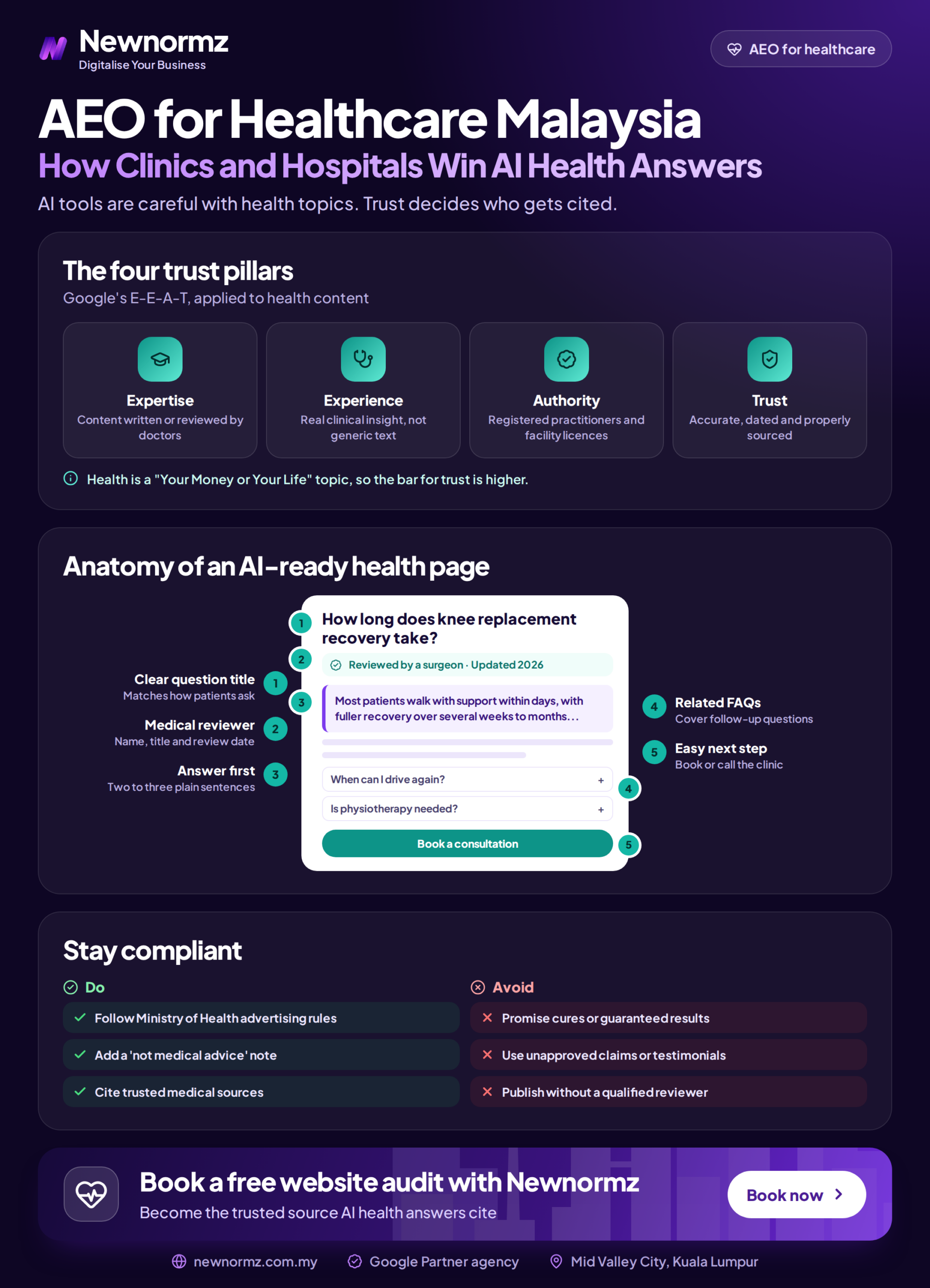
Google puts health content in its “Your Money or Your Life” category: topics where bad information can actually hurt someone. Its public Search Quality Rater Guidelines ask raters to hold these pages to a higher standard of experience, expertise, authoritativeness, and trust (E-E-A-T). AI tools are cautious with health questions for the same reason. They lean towards sources that look accountable.
In practice, a nicely written page with no named doctor, no credentials, and no sign of medical review is at a disadvantage, however good the copy is. An AI tool has no way of telling whether a marketing intern or a consultant surgeon wrote it.
Malaysian clinics also have a compliance layer. The Medicine Advertisements Board approval process and the Malaysian Medical Council’s guidelines still cover what you publish. Putting a claim in a blog post instead of an ad doesn’t make it safe. That works in your favour, though. Measured, factual language is exactly what AI tools are comfortable quoting. “Painless results guaranteed” helps neither your compliance team nor your citations.
Start With the Questions Your Patients Actually Ask
Most clinic websites are organised around what the clinic sells: a services page, a doctors page, a contact page. Patients don’t search that way. They search around a worry, a cost, or a decision, and they do it in English, Bahasa Malaysia, and Chinese. Mapping those questions to specific pages is the most useful thing you can do first.
| Patient question | Page that should answer it | What the answer needs |
|---|---|---|
| “How much does knee replacement cost in KL?” | Treatment page | A realistic RM range, what it includes, what changes the price, and a clear note that the final cost depends on assessment |
| “Should I get this mole checked?” | Condition guide | Warning signs that mean “see a doctor”, reviewed by a named dermatologist, with no diagnosis promises |
| “Klinik pergigian buka hari Ahad Shah Alam” | Location page and Google Business Profile | Correct opening hours, address, and phone number that match on every platform |
| “Which fertility specialist in KL speaks Mandarin?” | Doctor profile | Qualifications, MMC registration, National Specialist Register status, areas of focus, languages spoken |
| “八打灵再也儿科诊所” (paediatric clinic in Petaling Jaya) | Chinese-language location or service page | Properly written Chinese content, not a machine translation of the English page |
| “What is recovery like after LASIK?” | Procedure FAQ | A typical timeline, what’s normal, and which symptoms mean the patient should call the clinic |
Not every clinic gets the same return from this. Walk-in GP clinics win most of their patients on location and opening hours, so local SEO and an accurate Google Business Profile do most of the work for them. AEO pays off most where patients research for days or weeks before booking: aesthetics, dental work like aligners and implants, fertility, orthopaedics, eye surgery, health screening packages, and elective procedures at hospitals. In those categories, the clinic that answered a patient’s question during their research is often the one they end up calling.
What to Build So AI Tools Can Quote You
Answer first, then explain
Open every treatment or condition page with a two-to-four sentence direct answer to the main question. Then go into the details. AI tools pull out short, self-contained passages. If your answer is spread across six paragraphs of brand story, there is nothing clean for them to lift.
Put a real doctor’s name on medical content
Every clinical page should show who wrote or reviewed it, their qualifications, and when it was last reviewed. Link that name to a full doctor profile. On health topics, this is the clearest trust signal you can give, and plenty of Malaysian clinic sites still leave it out completely.
Use schema markup that matches the page
Structured data such as MedicalClinic, Physician, and FAQPage tells machines what a page is about, who the doctor is, and where the clinic is located. It helps, but it isn’t magic. Markup only works when it describes content that is actually on the page. Adding FAQ schema to a page with no visible FAQ does nothing, and misleading markup goes against Google’s guidelines.
Keep your clinic details identical everywhere
Your clinic name, address, phone number, and hours need to match across your website, Google Business Profile, Facebook, Waze, and health directories. When AI tools find conflicting information, they either repeat the wrong version to patients or skip you and quote a source they find more consistent.
Write in the languages your patients use
Malaysia had 35.4 million internet users and 98% penetration at the end of 2025 (DataReportal Digital 2026 Malaysia). Those users don’t all search in English. If a large share of your patients are more comfortable in Bahasa Malaysia or Chinese, your most important treatment pages should exist in those languages too, written by someone fluent.
The Mistakes We See Most on Malaysian Clinic Websites
These come up again and again in audits. None of them are hard to fix. They just tend to get missed when a website is built to look good rather than to answer questions.
| Mistake | What it costs you | The fix |
|---|---|---|
| Treatment pages that are just a service name and a “Book Now” button | Nothing for an AI tool to quote, so it quotes a competitor | An answer-first paragraph, then cost, process, recovery, and risks |
| Medical content with no named author or reviewer | Weak trust signals on exactly the topics where trust matters most | A doctor byline, credentials, and a “last reviewed” date |
| Different addresses or phone numbers across platforms | AI answers give patients wrong details, or leave you out | Audit every listing and bring them in line with one master version |
| English-only content for a multilingual patient base | Every Bahasa Malaysia and Chinese query goes to someone else | Properly localised versions of your highest-value pages |
| Schema added by a plugin with no matching content on the page | No benefit, and a possible guideline violation | Markup that describes only what visitors can actually see |
| Overstated claims like “painless” or “guaranteed results” | Regulatory risk, and the kind of language AI tools tend to avoid repeating | Factual, measured wording your compliance team can approve |
How to Measure AEO Without Fooling Yourself
AI answers aren’t fixed rankings. Ask ChatGPT the same question twice and you can get different sources. Anyone showing you a screenshot of your clinic “ranking number one in ChatGPT” is showing you one moment, not a position you hold.
A more honest approach looks like this:
- Keep a list of 20 to 30 real patient questions. Each month, ask them in Google, ChatGPT, Gemini, and Perplexity and note how often your clinic is cited. Watch the trend, not any single result.
- Track question-style queries in Google Search Console. AI Overview appearances are counted inside the normal web search data, though Google doesn’t report them separately.
- Add “AI assistant (ChatGPT, Gemini, etc.)” as an option on your “How did you hear about us?” field. Your front desk will often learn more than your analytics will.
Where the Evidence Actually Comes From
When we ran a six-month SEO campaign for Sunway Medispa, traffic grew 700%, impressions reached 54,000, and 70% more keywords ranked. That was an SEO campaign, not an AI citation campaign, and we won’t dress it up as anything else. But it is the foundation AEO sits on. A healthcare site that Google already trusts for hundreds of patient queries is in a far stronger position to be quoted by AI tools than one starting from nothing.
That’s why we start healthcare AEO with an audit of the basics: whether your pages rank, whether they answer real questions, whether your doctors are visible, and whether your clinic details hold up. The AI-specific work only pays off once those are in place.
Frequently Asked Questions
Is AEO different from SEO for a clinic?
They overlap a lot. SEO gets your pages ranked and considered. AEO makes those pages easy to pull out and quote in an AI answer. In practice, a clinic with weak SEO rarely does well in AEO, so the two work best as one plan.
Can you guarantee my clinic will appear in ChatGPT or AI Overviews?
No, and nobody honestly can. AI answers change from one query to the next, and the platforms don’t publish how they pick sources. What can be done is to remove the reasons they might skip you and then track your citation rate over time.
Should we publish treatment prices on our website?
Cost is one of the most common questions patients ask, so a realistic RM range with clear conditions usually helps. Explain what affects the final price, say that an assessment decides the actual fee, and run the wording through your usual compliance check.
Do we need content in Bahasa Malaysia and Chinese?
If a meaningful share of your patients search in those languages, yes. Start with your highest-value treatment and location pages rather than translating the whole site, and have fluent writers do it instead of relying on machine translation.
How long before we see results?
There’s no fixed timeline. Once search engines recrawl them, improved pages can start appearing in answers fairly quickly, but trust on health topics builds over months. Expect to judge progress on a quarterly trend, not a weekly one.
Is your clinic showing up when patients ask AI?
Find out what’s keeping your clinic out of AI health answers
Newnormz has run SEO campaigns across F&B, healthcare, ecommerce, and local services in Malaysia, backed by a performance guarantee of 70 percent of targeted keywords on Google’s first page.
30 minutes, no obligation, and a clear look at how your treatment pages, doctor profiles, and clinic listings hold up in Google and AI search.
Bryan Tan is an SEO Specialist and CEO at Newnormz, helping hundreds of businesses achieve first-page rankings on Google. With a passion for driving organic growth, Bryan blends innovative strategies with hands-on experience to optimize websites for maximum visibility. Always at the forefront of the latest SEO insights and trends, he consistently adapts to the evolving digital landscape.