Event searches in Malaysia come in waves. Annual dinners, Chinese New Year functions, Hari Raya open houses and year-end team building all get searched heavily for a few weeks, then go quiet. The problem is that Google usually takes months to trust a new page, so if you publish your “annual dinner planner KL” page when the enquiries start, you are already too late for this season. The event companies that win build their pages on permanent URLs four to six months before each peak, refresh them every year instead of starting over, and back them with real portfolio pages and a properly set up Google Business Profile. Nobody can guarantee you a specific position on Google (Google itself says so publicly), but getting the timing right is the biggest advantage you can control.
A Simple Way to Think About It
The Pasar Malam Spot
🌙 Turning up on the night
A trader who only arrives once the crowd shows up. Every good spot near the entrance is already taken, so they set up at the far end where few people walk.
🏮 Holding the same lot for years
A trader who has kept the same corner lot every week for years. Regulars walk straight to them without looking around.
Below is how to become the second trader on Google: when to publish, which pages to build, and how to keep the ground you win from one season to the next.
Why event keywords behave differently from most industries
Most businesses get a fairly steady flow of searches all year. A dental clinic or a law firm will see some ups and downs, but people need them every month. Event companies don’t work like that. Demand is tied to the calendar, and in Malaysia that calendar is crowded: year-end corporate dinners, Chinese New Year, Hari Raya, Deepavali, Merdeka and Malaysia Day, plus product launches and conferences that cluster around the start and end of financial years.
That creates two problems.
First, the search window is short. When an HR manager types “annual dinner event planner KL” into Google, they usually have a date, a budget and a shortlist deadline. They will call whoever is on page one that week.
Second, Google doesn’t reward pages that just appeared. A new page needs time to be crawled, indexed, tested against what searchers actually click, and linked to from elsewhere. That process takes months, not days. So the ranking you see in November is mostly the result of work done in the middle of the year.
If you want to see the pattern for your own services, open Google Trends, set the region to Malaysia, and look up your main event types over the last five years. You will see the same spikes repeating at the same points each year. That repeat is what makes event SEO plannable.
Plan backwards from the peak, not forwards from today
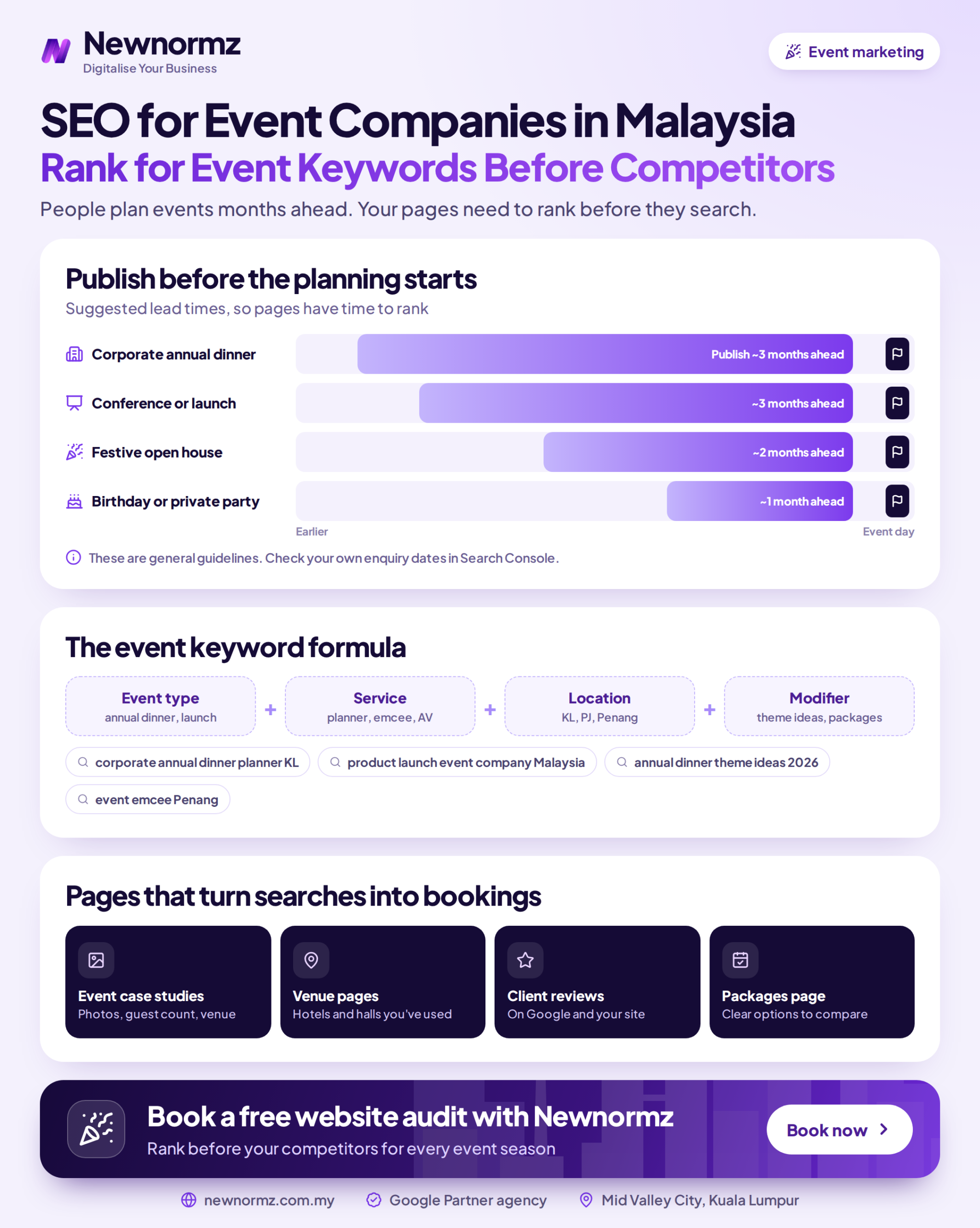
The most useful change an event company can make is to stop thinking “what should we post this month?” and start thinking “what peak is coming in six months, and is our page ready for it?” Here is a working schedule for the main Malaysian event seasons.
| Event season | When people search and book | Have the page live and indexed by |
|---|---|---|
| Corporate annual dinners | Planning from around September, events November to January | May to June |
| Chinese New Year functions | Booking from Q4, events January to February | July to August |
| Hari Raya open houses | Date follows the Islamic calendar and moves earlier each year, so check the date first | Five to six months before that year’s Raya |
| Merdeka and Malaysia Day events | Planning from mid-year, events August to September | February to March |
| Team building and corporate retreats | All year, with more activity once annual budgets are approved | Any time, but treat it as a permanent page, not a campaign |
These are planning windows, not promises. A page published in June won’t automatically rank in November. But a page published in October almost never has enough time, and that is the mistake most event companies make every year.
Use one permanent URL per event type, not one per year
This is where a lot of event companies waste their own effort. Every year they publish a fresh page: “Annual Dinner Packages 2025”, then “Annual Dinner Packages 2026”, each on a new URL. Every time, the new page starts from zero. The old one, which had built up some trust and maybe a few links, gets abandoned.
Do this instead:
- Build one page per event type on a permanent URL, such as
/annual-dinner-planner-kl/, with no year in it. - Update the year in the title, the packages, the photos and the venue list each season.
- Add the latest events to the page instead of replacing everything.
Over three or four seasons, that one page builds up history no new competitor can copy quickly. That’s the corner lot from the analogy above.
Target the keywords your buyers actually type
“Event company Malaysia” is a broad, very competitive term, and the people searching it are often still just browsing. The searches that turn into bookings are usually more specific. Build your pages around these angles:
Event type plus location
“Annual dinner planner Petaling Jaya”, “corporate event management Penang”, “team building Johor Bahru”. If you really serve several cities, each one can justify its own page, as long as each page shows real local work (venues you’ve used, events you’ve run there) and isn’t just the same text with the city name swapped.
Event type plus theme or format
Theme searches like “Great Gatsby annual dinner” or “retro annual dinner ideas” come in early, while people are still planning. A good ideas page reaches them before they have picked a vendor.
Bahasa Malaysia and Chinese searches
Plenty of decision makers search in Bahasa Malaysia (“pengurus acara korporat”, “majlis makan malam tahunan”) or Chinese, especially for CNY and family functions. Fewer competitors write proper pages in these languages, so the competition is often lighter. Have them written by a native speaker. A machine-translated page reads badly to buyers and rarely ranks well.
Turn your portfolio into pages that can rank
Most event companies have a gallery of beautiful photos and almost no words. Google can’t rank photos it doesn’t understand. Each major past event can be its own short page: the event type, the venue, roughly how many guests, the theme, what you handled, and what went wrong on the day and how you fixed it.
That last part is where your expertise shows. A buyer comparing three vendors wants to see that you’ve dealt with a sound system failing at a hotel ballroom, not just that you can hang fairy lights. Get the client’s permission before naming them. If they would rather stay anonymous, “a Klang Valley logistics company, 400 guests” still works.
Link each portfolio page back to the matching service page. That internal link tells Google your annual dinner page is backed by real annual dinners.
Don’t neglect the map results
A lot of event searches trigger Google’s map pack, especially “near me” searches and anything with a city name. That spot is decided mostly by your Google Business Profile, not your website. Choose the right primary category, list every service you offer, upload recent event photos regularly, and ask happy clients for reviews within a week of the event, while they still remember the night. If you run events across several states, a proper local SEO setup stops you from showing up in one area and disappearing everywhere else.
What a realistic timeline looks like
SEO takes longer than most event owners expect, so here’s a real benchmark. In a six-month campaign for Times Parking, a parking management company, Newnormz grew the site to 416 ranking keywords, 528,000 impressions and 31.5K clicks. Over a two-year campaign for Oriental Kopi, the gains kept compounding: 6.31M impressions, 468,000 clicks and 24,500 more ranking keywords. Neither is an event business, but the pattern is the same one you’re up against. The first six months build the base, and the bigger results come from staying with it.
For an event company, that means a page you start working on this month is really an investment in next year’s peak season, and the season after.
If you are already late for this season
If the peak is weeks away and your pages aren’t ranking, SEO won’t fix this season. Be honest with yourself about that. The practical move is to run Google Ads on your most valuable event keywords to catch this season’s demand, while you build the permanent pages that will rank for the next one. We took this approach with a KL confinement centre: on a RM2,550 monthly budget, paired with Google Ads, they were getting qualified leads within 30 days. Ads pay for leads now. SEO is what makes next year cheaper.
Then put the next peak date in your calendar and count back six months. That date is your real deadline.
Frequently asked questions
How far ahead should an event company start SEO for a specific season?
Aim to have the page live and indexed four to six months before people start booking. For annual dinners, that means working on it around the middle of the year. Earlier is better, because a page that has already been through one full season usually does better in the next.
Can we rank for “event company Malaysia”?
Possibly over time, but it’s one of the hardest terms to win and many of the people searching it are still just browsing. Specific searches that combine an event type with a location usually bring better enquiries sooner. Ranking for a lot of those also helps your site’s overall authority for the broad term.
Should we delete last year’s event pages?
Usually not. If they’re on dated URLs, redirect them to the permanent version of that page so you keep any trust and links they’ve built. Portfolio pages about past events should stay up, because they’re proof of your experience.
Does Instagram or TikTok replace SEO for event companies?
No. They do a different job. Social media is good for inspiration and staying top of mind. When a corporate buyer has a date and a budget, they usually go to Google to build a shortlist. With Google holding around 93% of search market share in Malaysia (Statcounter, May 2026), that’s where vendor decisions get made.
Can an agency guarantee we will be number one before peak season?
No, and Google has publicly said nobody can guarantee a specific ranking position. What an honest agency can commit to is a clear plan, a realistic timeline, and measurable goals across a set of targeted keywords.
Is your next peak season already being won by someone else?
Get your event pages ranking before the enquiries start, not after.
Newnormz has run SEO campaigns across F&B, healthcare, ecommerce, and local services in Malaysia, backed by a performance guarantee of 70 percent of targeted keywords on Google’s first page.
30 minutes, no obligation, with a season-by-season plan for your event keywords.

Bryan Tan is an SEO Specialist and CEO at Newnormz, helping hundreds of businesses achieve first-page rankings on Google. With a passion for driving organic growth, Bryan blends innovative strategies with hands-on experience to optimize websites for maximum visibility. Always at the forefront of the latest SEO insights and trends, he consistently adapts to the evolving digital landscape.