
Most small businesses that give up on SEO in year one didn’t buy bad SEO. They used the wrong scorecard. They expected page 1 for their biggest keyword in month one, looked at traffic charts that showed no WhatsApp leads, and judged month 3 by month 10 standards. The right SEO goals small business Malaysia owners should set follow the stages a campaign goes through. Technical fixes and indexation come first, then long-tail rankings, then leads you can measure. On the timeline Newnormz gives clients, the first ranking movement usually appears around day 60 to 90, and traffic and lead growth around months 4 to 8.
This guide is for SME owners and one-person marketing teams spending about RM1,500 to RM4,500 a month on SEO. By the end you’ll be able to set a clear, measurable target for month 3, month 6 and month 12, and tell whether your SEO is working before you spend more.
SEO Goals for a Small Business in Malaysia: What Year One Can Realistically Deliver
Google handles roughly 93 to 96% of Malaysian searches, according to Statcounter, so organic Google results are where your customers already look. What you can’t do is order a ranking position. Google’s own Search Central guidance says nobody can guarantee a ranking on Google. Any goal that promises a position on a fixed date is a guess.
What you can set are targets for progress at each stage. Here is the timeline Newnormz gives clients. Technical fixes happen in weeks 2 to 6. The first ranking movement usually shows between day 60 and 90. Traffic and leads grow between months 4 and 8. Authority starts to compound from month 8 onwards. Each of the six mistakes below breaks that sequence in some way, and each comes with a fix.
Mistake 1: Setting a Page 1 Target for Your Biggest Keyword in Month One
A two-year-old accounting firm website that targets “accounting firm KL” is up against directories, large firms with ten years of backlinks, and listicle pages that already rank. A young domain can’t win that term in 30 days, and probably not in 6 months. When month 3 comes and the term is still on page 4, the owner decides SEO doesn’t work.
✗ Making one competitive head term the only measure of success
One keyword gives you only two outcomes, ranked or not ranked. It hides the progress that is actually happening across dozens of smaller searches, and it pushes owners to quit right before the work starts to pay off.
✓ The fix
Pick 10 to 20 long-tail and location keyword ranking targets, such as “audit firm Puchong”, “akauntan syarikat sdn bhd Shah Alam” or “吉隆坡 会计公司”. Searches in Bahasa Malaysia and Chinese often have fewer well-optimised pages competing for them, so they make realistic early targets. Keep the head term on a year-two list and track its position each month.
Long-tail terms aren’t a consolation prize. Each one is a small ranking that drives enquiries and builds the topical relevance you’ll need for the head term later. That is the basic mechanism behind how small businesses compete with big brands on Google, and it gives you the kind of SEO targets Malaysia SMEs can actually hit in the first two quarters.
Mistake 2: Measuring Traffic but Not WhatsApp Clicks and Calls
Traffic tells you something is starting to happen. It isn’t the goal. Most Malaysian customers enquire by tapping a WhatsApp button or a phone number on their mobile, and Google Analytics 4 doesn’t record either of those by default. If those taps aren’t tracked, the organic leads Malaysia customers send through WhatsApp can come in every week while your reports show none.
From our audits
This is the gap we find most often. Every “Chat with us” button on the site is a wa.me link, and GA4 has no event for any of them. Organic traffic is going up, yet the owner says SEO brings no leads. Going by the data they have, both statements are true. The cause is missing tracking, not poor SEO.
That’s why the single most useful SEO KPI Malaysia SMEs can track is organic WhatsApp clicks. Set this up in week one, before any SEO work begins, so you have a baseline:
Install Google Tag Manager and connect GA4
Add the Tag Manager container to every page, then add your GA4 configuration tag inside it. From then on, every tracking change can be made in Tag Manager without asking your developer.
Track WhatsApp clicks
Turn on the built-in Click URL variable. Create a link click trigger that fires when the Click URL contains “wa.me” or “api.whatsapp.com”, and use it to send a GA4 event named something like whatsapp_click.
Track phone taps and form submissions
Do the same for links whose Click URL starts with “tel:” (phone_click). For forms, fire an event when the thank-you page loads or when the form submits successfully (generate_lead).
Mark them as key events and filter to organic
In GA4, mark all three events as key events (GA4’s current name for conversions). Then filter your acquisition report to google / organic. The number left over is your organic lead count.
Log Google Business Profile actions every month
Calls, direction requests and website clicks from your Google Business Profile never reach GA4. Copy them from the profile’s Performance view into the same monthly sheet so local search results get counted too.
The Five SEO KPIs Worth Tracking (and Two to Ignore)
These are the SEO KPIs to track during year one, and the two worth ignoring:
| KPI | Where to find it | Verdict |
|---|---|---|
| Indexed pages | Google Search Console, Pages report | Track. Every service page should be indexed by the end of Q1. |
| Impressions | Search Console, Performance report | Track. These usually go up months before clicks do. |
| Target keywords in positions 11 to 30 | Search Console, filtered by query | Track. Terms in this range are next in line for page 1. |
| Organic WhatsApp, call and form conversions | GA4 key events, google / organic | Track. This is the number your business actually cares about. |
| Google Business Profile actions | GBP Performance view | Track. Calls and direction requests from Google Maps. |
| Domain authority scores | Third-party SEO tools | Ignore. These are tool estimates. Google doesn’t use them. |
| Total keyword count without intent | Third-party SEO tools | Ignore. 500 informational terms can bring fewer enquiries than 5 buying terms. |
Mistake 3: Expecting the Same Results at Month 2 and Month 10
Type “how long does SEO take Malaysia” into Google and you’ll find answers anywhere from three months to two years. Both ends can be true, because each stage of a campaign produces different results. If you judge month 2 by the number of leads, every campaign fails. If you judge month 10 by indexed pages, a stalled campaign looks fine. The fix is to give each quarter its own goal, so your SEO expectations stay realistic for whatever stage you’re in.
| Quarter | Main goal | Judge it by |
|---|---|---|
| Q1 (months 1 to 3) | Technical fixes and indexation: Core Web Vitals on mobile, XML sitemap submitted, crawl errors cleared, tracking live | Indexed pages, Search Console errors closed, the first movement around day 60 to 90 |
| Q2 (months 4 to 6) | Visibility: impressions rising, long-tail targets moving onto page 2 | Impressions trend, number of targets in positions 11 to 30 |
| Q3 (months 7 to 9) | First long-tail terms on page 1, first steady organic leads | Targets in the top 10, organic WhatsApp, call and form events |
| Q4 (months 10 to 12) | Lead volume and return | Organic leads per month, cost per organic lead |
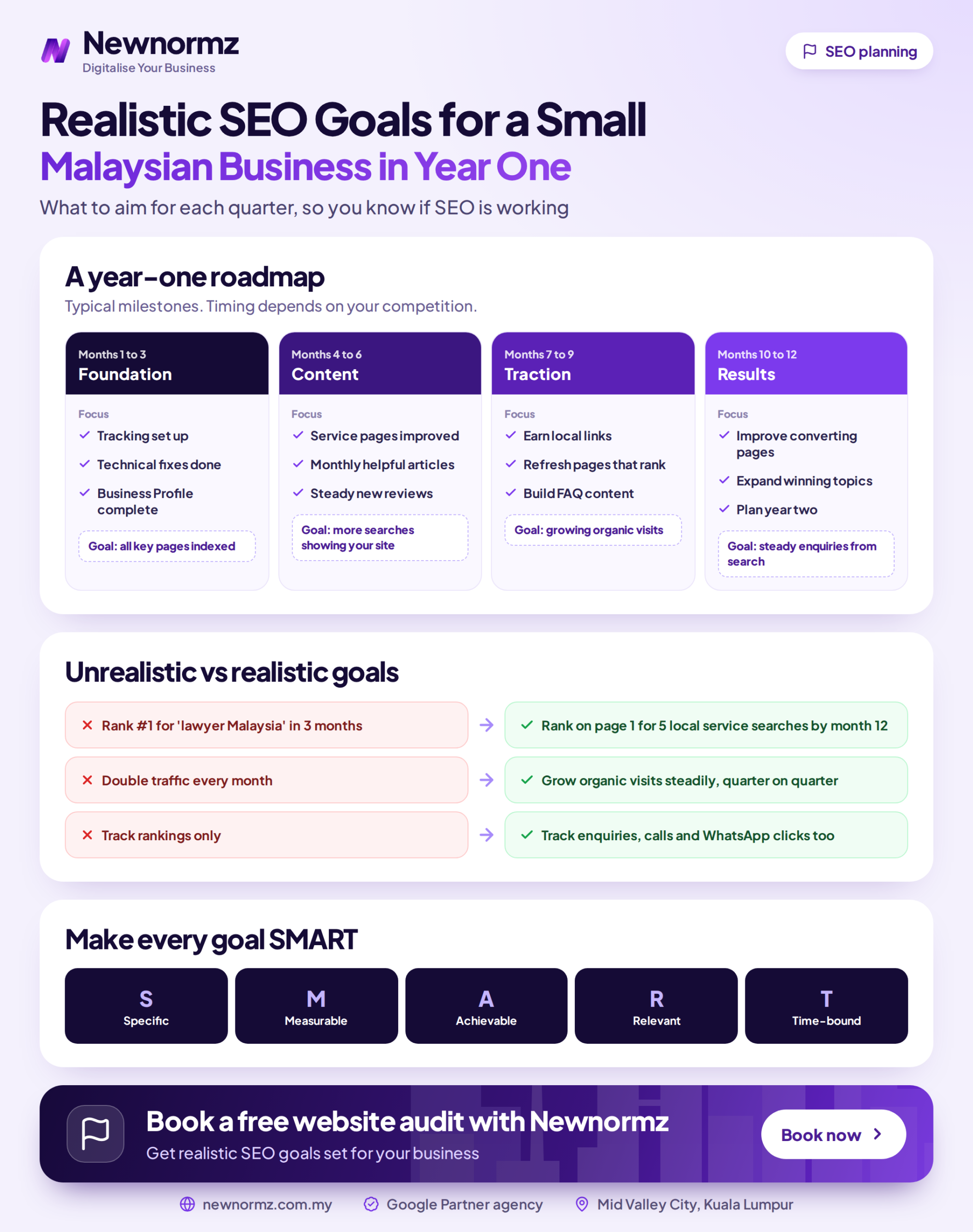
That table is the honest shape of the SEO results first year campaigns usually produce. Some campaigns move faster. Sunway TCM Centre had 80% of its target keywords on page 1 within 4 months, but that followed a full technical rebuild of a site that already had demand behind it. Treat it as the fast end of the range, not the norm, when you plan an SEO timeline for small business campaigns.
Each quarter builds on the work from the quarter before. That’s why choosing between a monthly retainer or a one-off project matters more than most owners expect. A project that stops after Q1 leaves Q2 to Q4 without anyone doing the work.
Mistake 4: Picking a Lead Target Without Doing the Ringgit Maths
“We want more leads” isn’t a target. The simplest honest SEO ROI Malaysia owners can calculate works backwards from your fee, your profit per customer and your close rate. Here is the calculation on the Newnormz SEO Starter plan (RM2,900 a month, prices exclude SST):
| Step | Calculation | Result |
|---|---|---|
| Annual SEO cost | RM2,900 × 12 | RM34,800 |
| Customers to break even | RM34,800 ÷ RM1,500 gross profit per customer | 23.2, so about 24 customers |
| Leads needed | 23.2 ÷ 25% close rate | About 93 organic leads a year |
93 leads works out to about 8 a month on average, but they won’t come in evenly. On the timeline above, most of them arrive in months 8 to 12. That’s the target for Q4, not for month 2. With a smaller budget the maths changes: RM1,500 a month is RM18,000 a year, which is 12 customers or 48 leads at the same assumptions.
If you’ve searched “SEO budget small business Malaysia” you’ll have seen prices all over the place. For reference, Newnormz’s published market ranges are RM800 to RM2,500 a month for freelancers and RM1,500 to RM8,000 for SME-focused agencies. Whatever you pay, run the same three lines of maths before you agree on a lead target.
For low-margin businesses that depend on walk-ins and nearby customers, local SEO in Malaysia usually pays back sooner than broad keyword work. Map Pack calls and direction requests turn into visits quickly.
Mistake 5: Quitting at Month 4 Because Ads Got Leads Faster
Google Ads will usually win a four-month comparison against SEO. That doesn’t make it the better channel. It means you’re comparing two different things. Ads are rented traffic: they work from day one and stop the day you stop paying. SEO builds traffic that compounds. It’s slow to start, then each ranking page keeps bringing in visitors without a cost per click.
If you stop SEO at month 4, you’ve paid for the slowest part of the work and left before the part that pays.
Newnormz take
Look at when results actually arrived. Times Parking reached 528,000 impressions, 416 ranking keywords and 31.5K clicks over a 6-month campaign. My Lovely Baby recovered 100% of the traffic it lost after a site upgrade, and got 85% of its target keywords onto page 1 within 9 months. In both cases the strongest results came after month 4.
Here’s the rule we use. If you need enquiries within 30 days, run Search ads while SEO builds, and judge each channel on its own KPI. Ads are judged on cost per lead this month. SEO is judged on its quarterly targets. We cover how to split budget and roles in running Google Ads alongside SEO.
Mistake 6: Accepting Reports That Only Show Rankings
A screenshot of rankings doesn’t tell you whether your SEO is working. A useful SEO progress report links what was done to what changed and then to what the business got from it. Each month, check that yours includes the following:
Monthly SEO report checklist
- ✓Ranking movement for the agreed target keywords, including terms climbing through positions 11 to 30
- ✓Search Console impressions and clicks, compared with last month and the same month last year
- ✓Organic WhatsApp, call and form key events from GA4
- ✓Google Business Profile calls, direction requests and website clicks
- ✓Work completed this month and the specific actions planned for next month
- ✓Google AI Overviews visibility for key queries, as an emerging secondary metric
Keeping this going is real work every month. Tags break when a developer updates the site. Search Console flags new indexing issues. Keyword targets need adjusting as rankings move. If you don’t want to own all that yourself, an SEO agency in Malaysia should be doing it for you and showing it in the report.
For a section-by-section template, see our guide to what a useful SEO report contains.
A One-Page Year-One SEO Goal Sheet You Can Copy
Here is a filled-in example for a fictional physiotherapy clinic in Subang Jaya. Every row ties a business goal to one KPI, one data source and one review month, which is all the SMART goals framework really asks for. The numbers are illustrations. Swap in your own.
| Business goal | SEO goal | KPI | Data source | Review |
|---|---|---|---|---|
| Be findable for every treatment | Index all 8 service pages, pass Core Web Vitals on mobile | 8 of 8 indexed, CWV “Good” | Search Console | Month 3 |
| Reach patients in nearby areas | 15 long-tail targets in English, BM and Chinese (e.g. “fisioterapi Subang Jaya”) | 10 of 15 in positions 1 to 30 | Search Console | Month 6 |
| Win Google Maps searches | Complete GBP profile, request a review after every visit | GBP calls and direction requests up on month 1 | GBP Performance | Month 6 |
| Turn searches into bookings | First long-tail terms on page 1 | 5+ organic WhatsApp, call or form leads a month | GA4 key events | Month 9 |
| Make SEO pay for itself | Hit the break-even lead number from your own maths | Cost per organic lead, customers won | GA4 plus clinic booking records | Month 12 |
Share this sheet with whoever runs your SEO before the work starts. If they push back on a row, ask why. That conversation is the core of briefing your SEO agency on goals, and it’s much easier in month 0 than in month 6.
FAQ: Realistic SEO Expectations Malaysia Owners Ask About
How long does SEO take to show results for a small business in Malaysia?
Expect the first ranking movement around day 60 to 90, and traffic and lead growth between months 4 and 8. Technical fixes usually take weeks 2 to 6. Authority keeps compounding from month 8 onwards, so year two normally costs the same as year one but delivers more.
What SEO KPIs should a small business track in the first six months?
Track five: indexed pages, impressions, target keywords moving through positions 11 to 30, organic WhatsApp, call and form conversions, and Google Business Profile actions. Domain authority scores and raw keyword counts are not worth tracking. The early numbers tell you whether the leads will follow.
Is it realistic to rank on page 1 of Google within three months?
For long-tail and location keywords it sometimes is. For competitive head terms on a young site it rarely is. Sunway TCM Centre had 80% of its target keywords on page 1 within 4 months, but that came after a technical rebuild and is the fast end of the range.
How many leads should I expect from SEO in year one?
Base it on your break-even number, not on a guess. At RM34,800 a year, RM1,500 gross profit per customer and a 25% close rate, you need about 93 organic leads. Expect most of them in months 8 to 12.
Can an SEO agency in Malaysia guarantee rankings?
No. Google says publicly that nobody can guarantee a ranking position. The Newnormz written guarantee works differently: if the agreed target keywords are not on page 1 within 12 months, the team keeps working free until they are. It guarantees continued work, not a particular position.
Should I run Google Ads while waiting for SEO to work?
Yes, if you need enquiries within 30 days. Ads bring leads while SEO is still building. Judge ads on cost per lead and SEO on its quarterly targets, and reduce ad spend on terms once you rank for them organically.
Not sure what your SEO should have delivered by now?
Newnormz runs SEO for 200+ Malaysian businesses on month-to-month terms, with a written page 1 guarantee and a 5.0 rating from 214+ Google reviews. Send us a WhatsApp message and a strategist will reply within business hours.
Prefer a form? Claim your free SEO audit

Bryan Tan is an SEO Specialist and CEO at Newnormz, helping hundreds of businesses achieve first-page rankings on Google. With a passion for driving organic growth, Bryan blends innovative strategies with hands-on experience to optimize websites for maximum visibility. Always at the forefront of the latest SEO insights and trends, he consistently adapts to the evolving digital landscape.