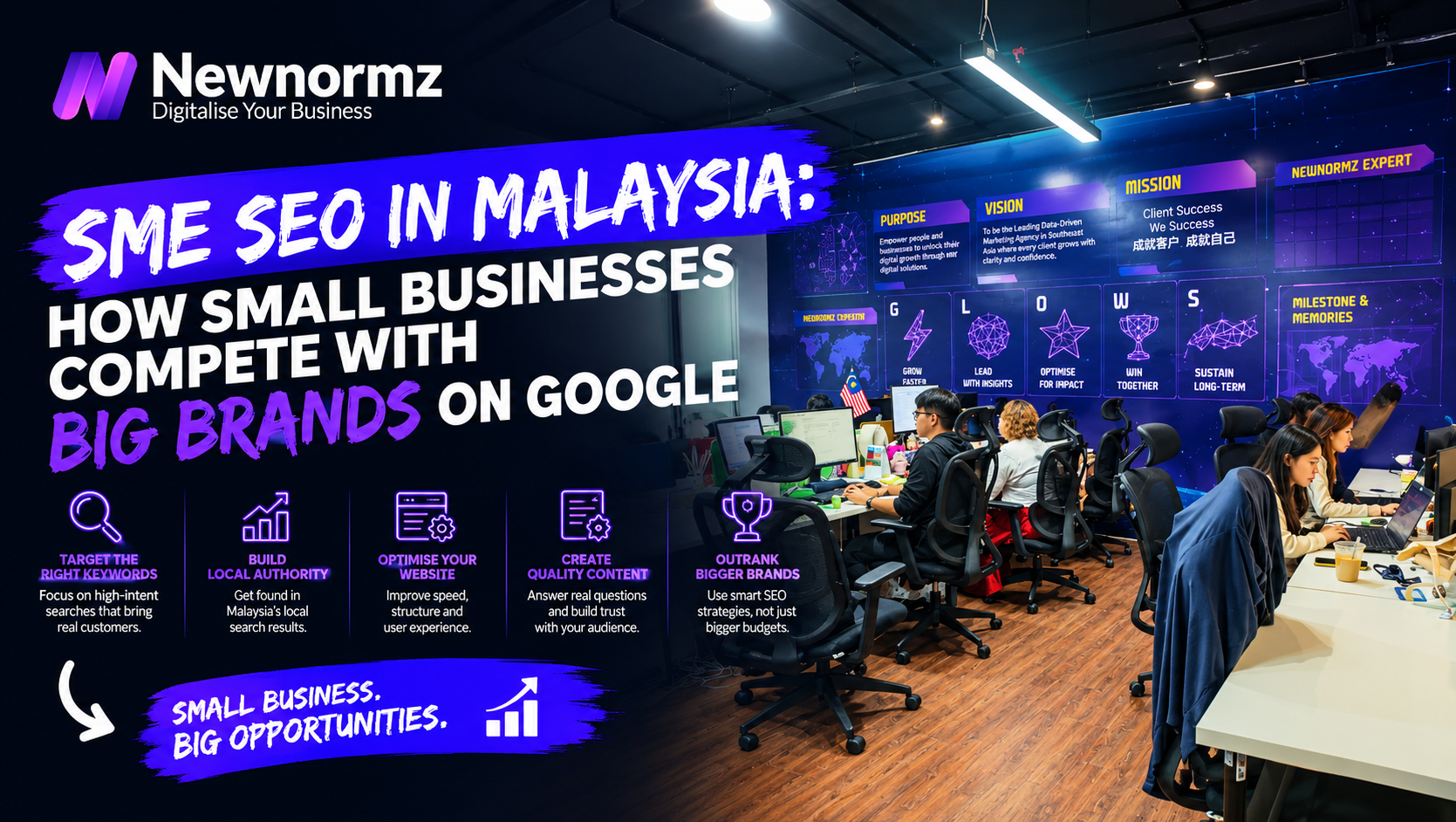
Yes, a small Malaysian business can beat big brands on Google, but not by fighting them for the same broad keywords. You will rarely outrank a national chain or a marketplace for a one or two word search like “aircon” or “skincare”. You can outrank them for the searches that actually bring paying customers to an SME: local searches, specific service and problem searches, and searches in Bahasa Malaysia or Chinese that big brands often ignore. Google ranks pages, not company size. A focused page that answers one specific question better than anyone else still wins, and that is where an SME should put its budget.
A Simple Way to Think About It
The Mall Entrance vs the Famous Stall
🏬 Fighting on their turf
A small kiosk sets up right next to the mall’s anchor tenant, selling the same things at the same prices. Shoppers walk straight past it.
🍜 Known for one thing
The stall down the road that everyone in the neighbourhood knows makes the best char kway teow. People drive past the mall to get there.
The sections below show how to be the stall people go looking for, on Google, instead of the kiosk nobody notices.
Why Big Brands Usually Win on Google
It is worth being honest about the size of the gap before talking about how to close it. Big brands have real advantages in search:
- Years of backlinks. News sites, directories, and partners have linked to them for a long time. Google treats those links as votes of trust.
- Brand searches. Lots of people search their name directly, which tells Google the brand is established.
- Budget. They can pay for content teams, developers, and agencies all at once.
That is why a new clinic will not outrank a hospital group for “health screening”, and a small online shop will not outrank Shopee or Lazada for “buy running shoes”. Anyone who tells you otherwise is selling you something.
But big brands also have predictable weaknesses. Their websites are built to cover everything, so most of their pages are generic. They usually write in one language. Changes go through layers of approval, so their pages sit unchanged for years. And they focus on high volume keywords because that is what their reports measure. That leaves a lot of valuable searches poorly served.
Where SMEs Actually Win
Malaysia had 35.4 million internet users at the end of 2025, about 98 percent of the population (DataReportal, Digital 2026 Malaysia), and Google handles roughly 93 percent of searches here (Statcounter, May 2026). Most of those searches are not broad, one word queries. They are specific: a location, a problem, a price question, a comparison. That is SME territory.
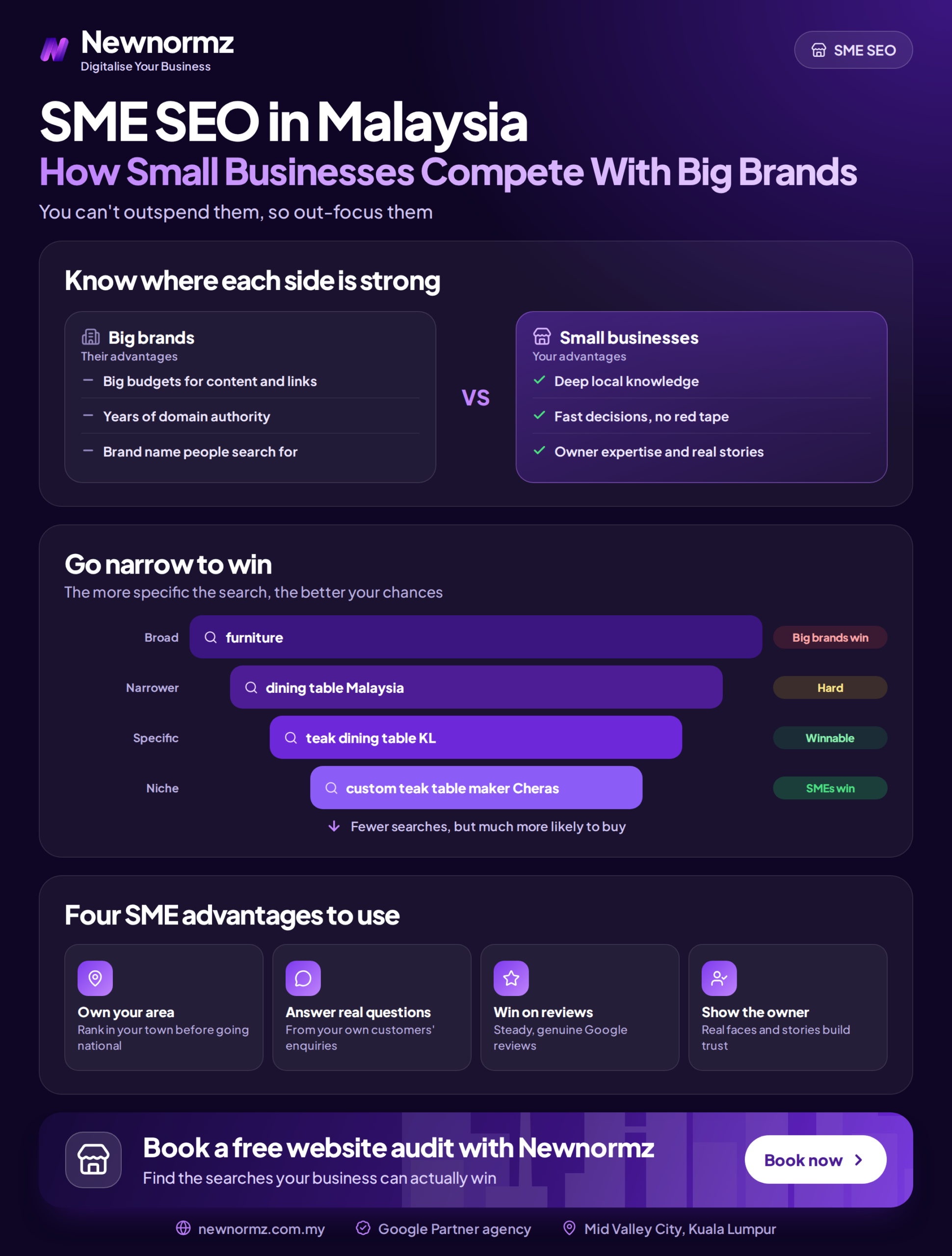
| Type of search | Example | Who usually wins |
|---|---|---|
| Broad, one or two words | “facial treatment” | Big brands and directories. Expensive and slow to compete for. |
| Local intent | “facial treatment Puchong” | The business with the strongest local signals, often an SME. |
| Specific problem | “facial for acne scars sensitive skin” | Whoever has a page that answers exactly that. Size matters less. |
| Price and comparison | “facial price KL RM” | Businesses willing to publish real prices. Big brands often avoid this. |
| Non-English | “rawatan muka jerawat” or a Chinese-language query | Often weakly served. A real opening for SMEs who write natively. |
Notice the pattern. As a search gets more specific, the advantage shifts away from brand size and toward relevance. Your job is to own the specific end of that list.
Local Search Is the SME’s Strongest Lever
For any business that serves customers in a physical area, the Google map results are the most level playing field in search. A national chain’s head office website does not automatically beat your outlet in Bangsar or Johor Bahru, because Google weighs distance, relevance, and prominence for each location.
The basics that move the needle:
- A fully completed Google Business Profile with the right primary category, real photos, accurate opening hours, and services listed.
- A steady flow of genuine reviews, with replies from the owner. Replying in the same language the customer wrote in is a small touch that big brands rarely bother with.
- A dedicated page on your website for each area or outlet you actually serve, with real local details, not the same text with the town name swapped.
- Consistent name, address, and phone number across your site, Google, and local directories.
If you want this done properly across multiple outlets or service areas, that is exactly what local SEO work covers.
Write the Content a Big Brand Cannot
Google has made it clear it rewards content that shows first-hand experience and real expertise. This is where being small is an advantage, not a handicap. A big brand’s content is usually written by a marketing team summarising what is already online. You are the person who actually does the work.
Content SMEs can write that big brands struggle to match:
- Real prices in RM. “How much does X cost in Klang Valley” pages attract buyers who are close to deciding. Publishing honest ranges builds trust fast.
- The questions your customers actually ask you. Every question you answer on WhatsApp or over the counter is a potential page.
- Specific use cases. Not “our services”, but one page per service, per problem, per type of customer.
- Bahasa Malaysia and Chinese pages, written properly by someone who speaks the language, not machine translated. Many local searches happen in these languages, and the competition there is often thinner.
Prioritise in the Right Order
The biggest mistake we see is SMEs spreading a small budget across everything at once. Order matters more than volume.
| Priority | What to do | Why it comes at this stage |
|---|---|---|
| 1. Fix the foundations | Fast mobile site, pages Google can index, clear page titles | Content and links are wasted if Google cannot properly read your site. |
| 2. Own your local presence | Google Business Profile, reviews, location pages | Usually the quickest route to enquiries for a local business. |
| 3. Build service and problem pages | One focused page per service and per common customer question | Targets the specific, high intent searches where size matters least. |
| 4. Earn local authority | Links from local media, associations, suppliers, and partners | Builds trust gradually so you can compete for more competitive terms over time. |
| 5. Expand outward | Broader topics, more languages, more areas | Only once the core pages are ranking and converting. |
What This Looks Like in Practice
A few results from campaigns we have run in Malaysia, to give you a realistic sense of scale and timing:
- Times Parking (parking management), 6 months: 528,000 impressions, 416 ranking keywords, and 31.5K clicks. A niche B2B service, competing on specific searches rather than broad ones.
- Oriental Kopi (F&B), 2 years: 6.31 million impressions, 24,500 more ranking keywords, and 468,000 clicks. A good example of what sustained effort compounds into over a longer timeframe.
- A KL confinement centre, on a budget of RM2,550 a month: qualified leads within 30 days, with Google Ads running alongside SEO while organic rankings built up.
That last one matters for most SMEs. You do not need a corporate budget, but you do need to spend what you have on the right searches.
What SEO Will Not Do for an SME
Being straight about the limits saves you money and disappointment:
- No one can guarantee a specific position. Google has said this publicly and repeatedly. Be wary of anyone promising “number one on Google”.
- It is not instant. Local and specific pages can start moving within a few months. Competitive terms take much longer.
- It will not beat a marketplace for generic product searches. If you sell online, target the specific product, use case, and brand questions instead.
If you need enquiries this month, run Google Ads on your most profitable searches while SEO builds. Then reduce ad spend as organic rankings take over the traffic you were paying for.
Frequently Asked Questions
How long does SEO take for a small business in Malaysia?
For local and very specific searches, you can often see movement within three to six months. Broader, competitive keywords usually take a year or more. The timeline depends on how much competition you face and the state of your website when you start.
Can I do SEO myself instead of hiring an agency?
Some of it, yes. Setting up your Google Business Profile, collecting reviews, and writing pages that answer your customers’ questions are things an owner can do well. Technical fixes, keyword strategy, and link building are where most SMEs benefit from outside help, because mistakes there are costly and hard to spot.
Do I need a big budget to compete with big brands?
No, but you need a focused one. A smaller budget spent on local and specific searches will usually outperform a larger budget spread across broad keywords you cannot realistically win.
Should my website have Bahasa Malaysia or Chinese pages?
If your customers search in those languages, yes. Write them properly with a native speaker rather than relying on auto translation, and treat each language version as its own page targeting the way people actually phrase the search.
Is SEO or Google Ads better for an SME?
They do different jobs. Google Ads brings traffic immediately but stops when you stop paying. SEO is slower but keeps working once you rank. Many SMEs start with both, then shift budget toward SEO as organic traffic grows.
Losing customers to bigger brands on Google?
Find the searches your business can actually win
Newnormz has run SEO campaigns across F&B, healthcare, ecommerce, and local services in Malaysia, backed by a performance guarantee of 70 percent of targeted keywords on Google’s first page.
30 minutes, no obligation, with a clear view of where your SME can outrank bigger competitors.

Bryan Tan is an SEO Specialist and CEO at Newnormz, helping hundreds of businesses achieve first-page rankings on Google. With a passion for driving organic growth, Bryan blends innovative strategies with hands-on experience to optimize websites for maximum visibility. Always at the forefront of the latest SEO insights and trends, he consistently adapts to the evolving digital landscape.