A good SEO brief tells your agency exactly what you sell, who buys it, who you’re up against, and what result would make the spend worthwhile. Without that, the agency is guessing. “We want to rank on Google” is not a brief, it is a wish, and most SEO campaigns that stall out in Malaysia trace back to a kickoff that started with a wish instead of a plan.
A Simple Way to Think About It
A Brief Is a Blueprint, Not a Wish List
😕 The Vague Ask
You tell a contractor you want “a nicer house” and walk away. Three months in, you’re arguing over the kitchen because you never said what you actually wanted.
✅ The Detailed Blueprint
You hand over exact room dimensions, materials, and a budget before the first wall goes up. The contractor builds it right the first time.
An SEO brief works the same way. What you put in front of your agency before you sign decides whether the next six months build something you actually wanted, or something you have to redo.
What a Strong SEO Brief in Malaysia Actually Needs
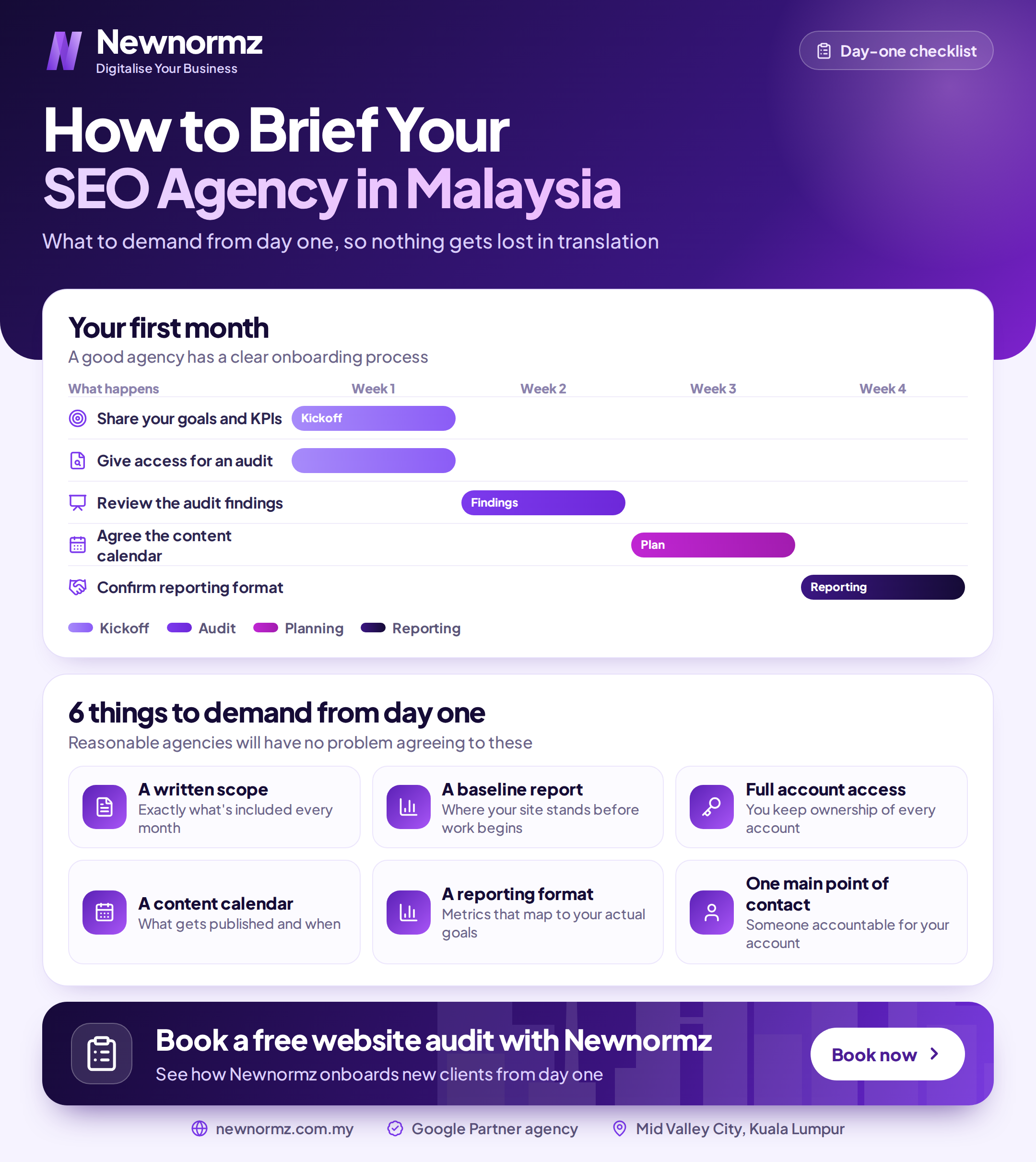
An SEO agency can only build a strategy as sharp as the information you give it. Hand over five things below and the agency has enough to work with from day one. Leave any of them out and expect the first draft strategy to be generic.
1. Goals Tied to Revenue, Not Just Traffic
Telling an agency you want “more traffic” is like telling a contractor you want a bigger room. Bigger for what. Say what the traffic needs to do: 50 qualified leads a month, less reliance on referrals, e-commerce revenue moving from RM200,000 to RM500,000 in 12 months. Specific niches produce specific, trackable results: a six-month medispa campaign we ran delivered a 700% traffic increase and 70% more ranking keywords, while a parking management client’s six-month campaign brought in 31,500 clicks off 416 ranking keywords. Neither number means anything without a goal it was measured against from the start.
2. Who Actually Searches for What You Sell
Your agency needs to know who is typing the query, not just that someone is. Give them industry, role, location, and what they search before they buy. If part of your market searches in Mandarin or Bahasa Malaysia, say so upfront. Local SEO in Malaysia often means running keyword research in more than one language, and an agency that never asks about this has already missed a chunk of your addressable market.
3. Three to Five Named Competitors
List the businesses whose rankings you actually want to beat, with URLs. A gap analysis against real competitors tells the agency where they’re winning and why, and gives them a benchmark for keyword difficulty and content depth instead of starting from zero.
4. A Budget Range and What Return Would Justify It
SEO pricing in Malaysia swings a lot depending on scope and competition. Share a budget range upfront so proposals come back realistic instead of padded. Then say what result would make that spend worth it. A confinement centre we worked with ran a RM2,550 monthly budget alongside Google Ads and had qualified leads inside 30 days, because the budget and the expected outcome were set together, not separately.
5. A Timeline With Actual Checkpoints
SEO is slow by nature. Meaningful organic gains generally take four to six months to show up. Set review points at 90 days, six months, and 12 months rather than expecting a straight line. Our longest-running case, a two-year F&B campaign, added 468,000 clicks and 24,500 more ranking keywords over that stretch, which is a timeline measured in years, not weeks. Any agency promising page-one rankings in 30 days is either overselling or using tactics that will cost you later.
Weak Brief vs. Strong Brief: What to Demand From Day One
| Weak Brief | Strong Brief (What to Demand) |
|---|---|
| “We want more traffic” | Named targets: leads per month, revenue, ranking positions |
| General demographics only | Buyer personas including language and search behaviour |
| No competitor URLs given | 3 to 5 direct competitors listed by name |
| Budget withheld or open-ended | Defined range with a stated return expectation |
| “As soon as possible” | Phased milestones at 90 days, 6 months, 12 months |
| Access handed over “later” | GA4, Search Console, and CMS access granted at kickoff |
Technical Access to Hand Over Before Kickoff
Delayed access is one of the most common reasons an SEO campaign underperforms in its first three months. Before work starts, have these ready:
- Google Analytics 4 access (Viewer or Editor)
- Google Search Console access
- Google Business Profile access, if you have a physical or service location
- CMS login, or a direct line to whoever manages your website
- Any existing keyword tracking reports
- Past SEO audits, if you have them
- Any history of Google penalties or manual actions
An agency that asks for this list without being prompted is one that plans to actually use it. An agency willing to start without it is telling you how the engagement will go.
Red Flags in an SEO Proposal
| Red Flag | Why It Matters |
|---|---|
| Guaranteed rankings | Google has stated publicly, more than once, that no one can guarantee a specific position |
| A proposal that reads like a template | If it could apply to any business in any industry, your brief was never actually read |
| No mention of your commercial goals | Audits and backlinks with no tie to leads or revenue means the brief was ignored |
| Vague reporting promises | Reports should tie rankings to leads or revenue, not just show keyword positions |
| Large upfront payment demands | Reputable agencies work on a retainer or milestone basis, not a lump sum with no deliverables attached |
Questions to Ask Before You Sign
Your brief sets the foundation, but the kickoff conversation should run both ways. Ask these before you commit:
- How do you approach keyword research for a multilingual audience in Malaysia?
- Can you show results from a client in my industry or at a similar size?
- What exactly gets reported, and how often will we review it together?
- What happens to the strategy when a Google algorithm update hits?
- What happens if we’re not at the agreed result by the six-month review?
An agency that hesitates on any of these is not ready to manage your search presence.
Turn the Brief Into the Strategy
Hiring an agency without a real brief usually ends in generic recommendations and a retainer that’s hard to justify by month three. The more specific your brief is, the faster the agency can get to the part that matters: the right keywords, the right audience, and the right content pointed at enquiries you actually want. That’s the difference between paying for rankings and paying for growth.
Why does an SEO agency need a brief before starting?
Without one, an agency has to guess at your commercial goals and market position. A brief tells them what you sell, who you want to reach, and which enquiries actually matter, so the keyword and content strategy is built around your business instead of a generic template.
How detailed does my SEO brief actually need to be?
It’s detailed enough once an agency can answer, from your document alone: what you sell, who you’re targeting, where you want to rank, and which leads or sales matter most. If they still have to ask you those basics, the brief was too thin.
What access does an agency need to get started?
At minimum, Google Analytics 4, Google Search Console, and either CMS access or a direct contact on your web team. Google Business Profile access matters too if you serve a physical location.
Why does competitor information matter so much in a brief?
Named competitors give the agency a real benchmark instead of a theoretical one. It shows where they’re outranking you, what keyword gaps exist, and roughly how much work it will take to close the distance.
What’s the real difference between a proper brief and a quick enquiry?
A quick enquiry (“we want to rank on Google”) gets a generic proposal back, because that’s all there is to respond to. A proper brief gives an agency enough business context to build a strategy that’s actually tailored, which is the whole point of paying for one.
Not sure your brief is strong enough yet?
Get a Second Opinion Before You Sign With Any Agency
Newnormz has run SEO campaigns across F&B, healthcare, ecommerce, and local services in Malaysia, backed by a performance guarantee of 70 percent of targeted keywords on Google’s first page.
30 minutes, no obligation, and no vague answers about your brief.

Bryan Tan is an SEO Specialist and CEO at Newnormz, helping hundreds of businesses achieve first-page rankings on Google. With a passion for driving organic growth, Bryan blends innovative strategies with hands-on experience to optimize websites for maximum visibility. Always at the forefront of the latest SEO insights and trends, he consistently adapts to the evolving digital landscape.