Schools, tutors and training centres in Malaysia rank on Google the same way any local business does, with one difference. Your buyers are parents and students making an important, seasonal decision, so they search in very specific terms and compare options carefully. To win, target the exact searches they type (subject, level, area and language), fully set up your Google Business Profile for nearby searches, build a separate page for every programme and branch, and publish answers to the questions parents actually ask. Expect real movement in 3 to 6 months, not a few weeks. Be careful with anyone who promises you a guaranteed number one spot, because Google has said publicly that no one can guarantee that.
A Simple Way to Think About It
Flyers at the School Gate vs Being the Name Parents Recommend
📄 Paying for flyers
You pay someone to stand at the school gate and hand out flyers every afternoon. The day you stop paying, the flyers stop, and so do the calls.
🗣️ Being the name parents mention
When another parent asks who to send their child to, your centre is the first name that comes up. You never paid for that, and it keeps working during the school holidays.
Ads work like the flyers and SEO works like the recommendation. Below is how education providers earn that position on Google.
Why Education Is a Search Problem Before It Is a Marketing Problem
Parents rarely pick a tuition centre or a private school on impulse. They shortlist and compare, check reviews, ask in the class WhatsApp group, and then go back to Google to check what they heard. Students choosing a diploma, and working adults choosing an HRD Corp claimable course, do the same thing.
In Malaysia, nearly all of that research goes through one channel. The country had 35.4 million internet users and 98% penetration at the end of 2025 (DataReportal Digital 2026 Malaysia). Google holds about 93% of the Malaysian search market (Statcounter, May 2026). If you don’t appear on Google when a parent is comparing options, you usually never make the shortlist.
Position also matters a great deal. Backlinko’s large click-through study found that the first organic result gets about 27.6% of clicks, while fewer than 1% of searchers click anything on page two. For an education provider, page two means almost no enquiries.
Many centres respond by spending more on Google Ads. Ads are useful, and a new branch that needs enquiries this month should run them. But ads and SEO do different jobs:
| Factor | SEO | Google Ads |
|---|---|---|
| Time to first results | Usually 3 to 6 months | Same day |
| When you stop spending | Rankings fade slowly, if at all | Traffic stops immediately |
| Cost per enquiry over time | Falls as rankings build up | Rises as competitors bid in peak intake season |
| How parents see it | Earned result, read as more trustworthy | Clearly labelled as sponsored |
| Best used for | Steady enrolment year after year | New branches, short intake pushes, testing new courses |
What Parents and Students Actually Type Into Google
Most education websites that fail at SEO are aiming at the wrong searches. “Tuition Malaysia” gets plenty of searches but brings very few enquiries. It’s also a search a single centre in Puchong has almost no chance of ranking for. The searches that fill classes are narrow ones: a subject, a level, an area, and often a language.
| Type of provider | Searches that bring enquiries | Biggest SEO lever |
|---|---|---|
| Tuition centres and home tutors | “SPM add maths tuition Subang”, “kelas tuisyen sains Shah Alam”, “补习中心 Puchong” | Google Business Profile, reviews, and a page for each subject and branch |
| International and private schools | “IGCSE school Cheras fees”, “international school near Mont Kiara”, “SPM vs IGCSE” | Clear curriculum and fee pages, plus comparison content parents use to decide |
| Private colleges | “diploma in nursing KL”, “foundation programme intake”, “course after SPM” | One detailed page per programme, and guidance content for school leavers |
| Training and upskilling providers | “HRD Corp claimable digital marketing course”, “Excel training KL corporate” | Course pages written for HR buyers, plus authority built through backlinks |
| Language and test prep | “IELTS preparation class PJ”, “MUET intensive course”, “Mandarin class for adults KL” | Pages for each test and level, and content that answers score and timeline questions |
Two things are easy to miss here.
Your keywords can go out of date. UPSR was abolished in 2021 and PT3 in 2022, yet many tuition websites still target them heavily. Searches for those exams drop every year, so parents now search by standard, form, subject and school-based assessment. If your pages still focus on exams that no longer exist, you’re competing for searches that are disappearing.
Parents don’t all search in English. Many parents search in Bahasa Malaysia or Chinese, especially for primary-level tuition and Chinese-medium schools. Competition in those languages is often much lower than in English. A properly written BM or Chinese page (written for those readers, not machine translated) is one of the cheapest ranking opportunities in this sector.
The Work That Actually Moves Rankings
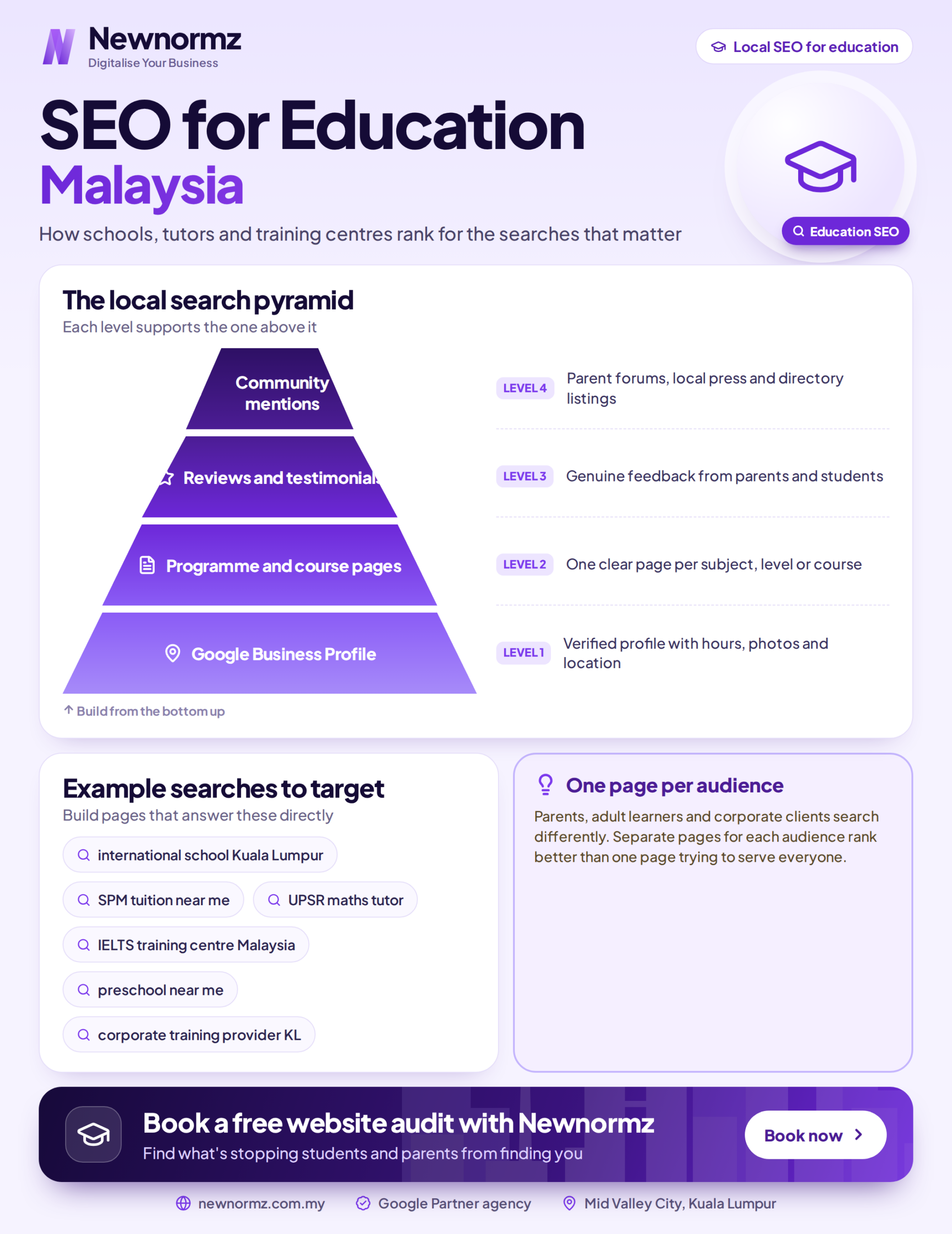
1. Local SEO, if you have a physical address
For tuition centres, preschools, enrichment classes and training centres with a classroom, the Google Maps results for “near me” searches are usually where most enquiries come from. This is where local SEO does most of the work:
- Claim and verify a Google Business Profile for each branch, with the most specific category available (for example “Tutoring service” or “Language school”, not just “School”).
- Keep your name, address and phone number exactly the same on your website, your profile, and directories like Waze and Facebook.
- Ask real parents and students for reviews after results come out or when a course finishes. Don’t offer discounts or gifts for reviews. Google’s policies prohibit incentivised reviews, and removed reviews can damage a profile.
- Post real classroom photos and your current timetable, and update the profile before every intake.
Home tutors without a centre can still show up locally. Set your profile up as a service-area business, hide your home address, and list the areas you cover.
2. One page per programme, not one page for everything
A single “Our Classes” page listing twelve subjects ranks for none of them. Each subject, level, course and branch that matters to you needs its own page answering what a parent would ask on the phone: who it’s for, what it covers, the class size and schedule, where it runs, and roughly what it costs. Parents in Malaysia expect to see fees in RM, even if it’s only a range. Pages that hide pricing tend to lose the enquiry to a competitor who shows it.
Add structured data (Course, LocalBusiness or EducationalOrganization schema) so Google understands what each page offers. It helps, but it doesn’t guarantee that special listings will appear in search results. Treat it as useful groundwork, not a ranking shortcut.
Also, only publish results you can prove. “Our students scored 9As” with no context, or pass rates nobody can check, hurts trust with parents and is exactly the kind of claim Google’s quality guidelines are designed to discount.
3. Content that answers the questions parents ask late at night
Education providers have a natural content advantage: parents and students have far more questions than there are good answers online. Articles like “SPM vs UEC: which opens more doors”, “How to choose a tuition centre for a Form 4 child”, “What to study after SPM if you like biology” or “How HRD Corp claims work for short courses” bring in readers weeks before they’re ready to enquire. When they are ready, they already trust your name.
Every article should target a specific search and link to the programme page it leads to. An article that doesn’t lead anywhere may get traffic, but it rarely brings enquiries.
4. A technically sound, mobile-first website
Most parents in Malaysia are browsing on a phone, often while waiting at pickup. If your site is slow, the timetable PDF won’t open on mobile, or the enquiry button is buried, you lose them. Check your Core Web Vitals in Google Search Console, make sure every programme page is indexed, and put a WhatsApp or enquiry button where a thumb can reach it.
5. Authority from the education ecosystem
For training providers and colleges competing nationally, backlinks decide who ranks between two equally good pages. The best links in this sector usually come from partnerships you already have: exam boards, industry bodies, partner universities, school events you sponsor, and local media coverage of student achievements.
Plan Around Your Intake Calendar, Not the Calendar Year
Education searches are seasonal. Searches for after-SPM courses rise around results season. Tuition searches rise at the start of the school year and again as exams get closer. Corporate training searches follow company budget cycles.
New pages usually take months to rank, so the page for your next intake should go live 3 to 6 months before the enquiry peak, not the week you open registration. If you’re late, use ads to cover this intake and start building organic rankings for the next one.
Mistakes That Quietly Cost Education Providers Enrolments
| Mistake | What it costs you | The fix |
|---|---|---|
| Chasing broad keywords like “tuition Malaysia” | Months of effort on a search you won’t rank for, from people who might not live near you anyway | Target subject, level and area combinations |
| One Google Business Profile shared by several branches | Only one branch shows up in Maps; the rest stay invisible | A verified profile and a website page for each branch |
| Blog posts about centre events and festive greetings | Content nobody searches for, so it gets no traffic | Write about the questions parents type into Google |
| Pages still built around UPSR or PT3 | Rankings for searches that are shrinking every year | Rebuild pages around current levels and assessments |
| Treating SEO as a one-off website project | Rankings slip after algorithm updates and as competitors keep improving | Monthly monitoring, new content each term, and regular review requests |
What This Looks Like in Practice
For GES Global, an education consultancy in Malaysia, we built the SEO strategy around searches that students and parents make while deciding: study destinations, specific courses, scholarship options, and country-by-country pathways. The work involved improving the key service pages, tightening keyword targeting, and publishing supporting content that answers what students ask before booking a consultation. The goal was to make the site useful to someone comparing their next academic step, because that’s what ranks and converts in this sector.
The same approach works outside education. Choosing a school is a high-trust decision, and so is choosing a medical aesthetics clinic. For Sunway Medispa, a six-month campaign delivered a 700% traffic increase and 70% more keywords ranking. For Times Parking, six months of SEO produced 416 ranking keywords and 528,000 impressions. These show what’s realistic over the 3 to 6 month period this article keeps coming back to.
If you need enquiries sooner, pair SEO with ads. A KL confinement centre with a RM2,550/month budget combined SEO with Google Ads and was getting qualified leads within 30 days, while its organic rankings were still building. A new tuition branch opening before an intake can use the same approach.
If you’d rather not run all of this yourself, an SEO agency in Malaysia that has worked with local businesses can usually tell you within one audit which of the levers above is holding you back most.
Frequently Asked Questions
How long does SEO take for a tuition centre or school?
Local results for a single branch can start improving within a few months once your Google Business Profile and branch page are set up properly. Broader rankings, such as national course keywords for a college or training provider, usually take 3 to 6 months or longer, depending on how strong the competition is.
I’m a home tutor. Do I need a website, or is a Google Business Profile enough?
A service-area profile with good reviews can bring enquiries on its own. A simple website with one page per subject lets you rank for many more searches and gives parents somewhere to check your background before they message you. If you can only do one thing, start with the profile.
Should I create Bahasa Malaysia or Chinese pages?
Yes, if your students’ parents search in those languages. Competition is usually lower than in English. Write the pages properly for those readers rather than running English copy through a translator, because parents notice the difference and so does Google.
Does SEO work for online courses and e-learning platforms?
It does, but without a physical location you lose the local Maps advantage. Rankings depend more on strong course pages, useful content and backlinks. Expect a longer timeline than a centre with a physical address.
Can anyone guarantee my centre will rank number one?
No. Google has said repeatedly that no one can guarantee a specific ranking position. A reputable provider can commit to measurable targets and a clear plan, but anyone promising the top spot is either misleading you or planning tactics that could get your site penalised.
Are parents finding your competitors first?
Find out what is stopping your school or centre from ranking before your next intake.
Newnormz has run SEO campaigns across F&B, healthcare, ecommerce, and local services in Malaysia, backed by a performance guarantee of 70 percent of targeted keywords on Google’s first page.
30 minutes, no obligation, with a clear look at your keywords, local listings and intake-season opportunities.

Bryan Tan is an SEO Specialist and CEO at Newnormz, helping hundreds of businesses achieve first-page rankings on Google. With a passion for driving organic growth, Bryan blends innovative strategies with hands-on experience to optimize websites for maximum visibility. Always at the forefront of the latest SEO insights and trends, he consistently adapts to the evolving digital landscape.