SEO will not free your hotel from Booking.com or Agoda overnight. Anyone who tells you it will is overselling. SEO can win back a set of searches the OTAs never earned: people typing your hotel’s name into Google, travellers looking for something specific near a landmark, and guests who check Google Maps before they book. Every booking you move from an OTA to your own website keeps the 15 to 25 percent commission in your hands. Most hotels see early movement within 3 to 6 months. The real shift in booking mix builds over the following year, and it keeps building for as long as you maintain the work.
A Simple Way to Think About It
The Taxi Driver and the Regular
🚕 The Taxi Driver
A driver brings a guest to your lobby, then keeps a quarter of what the guest pays for the room. Next year the same guest calls the same driver, not you.
🔑 The Regular
A guest who knows your address walks straight in, pays you in full, and comes back next time without asking anyone for directions.
You still need the taxi driver. The sections below show how to turn more of those guests into regulers who find you on their own.
What OTA Dependence Actually Costs You
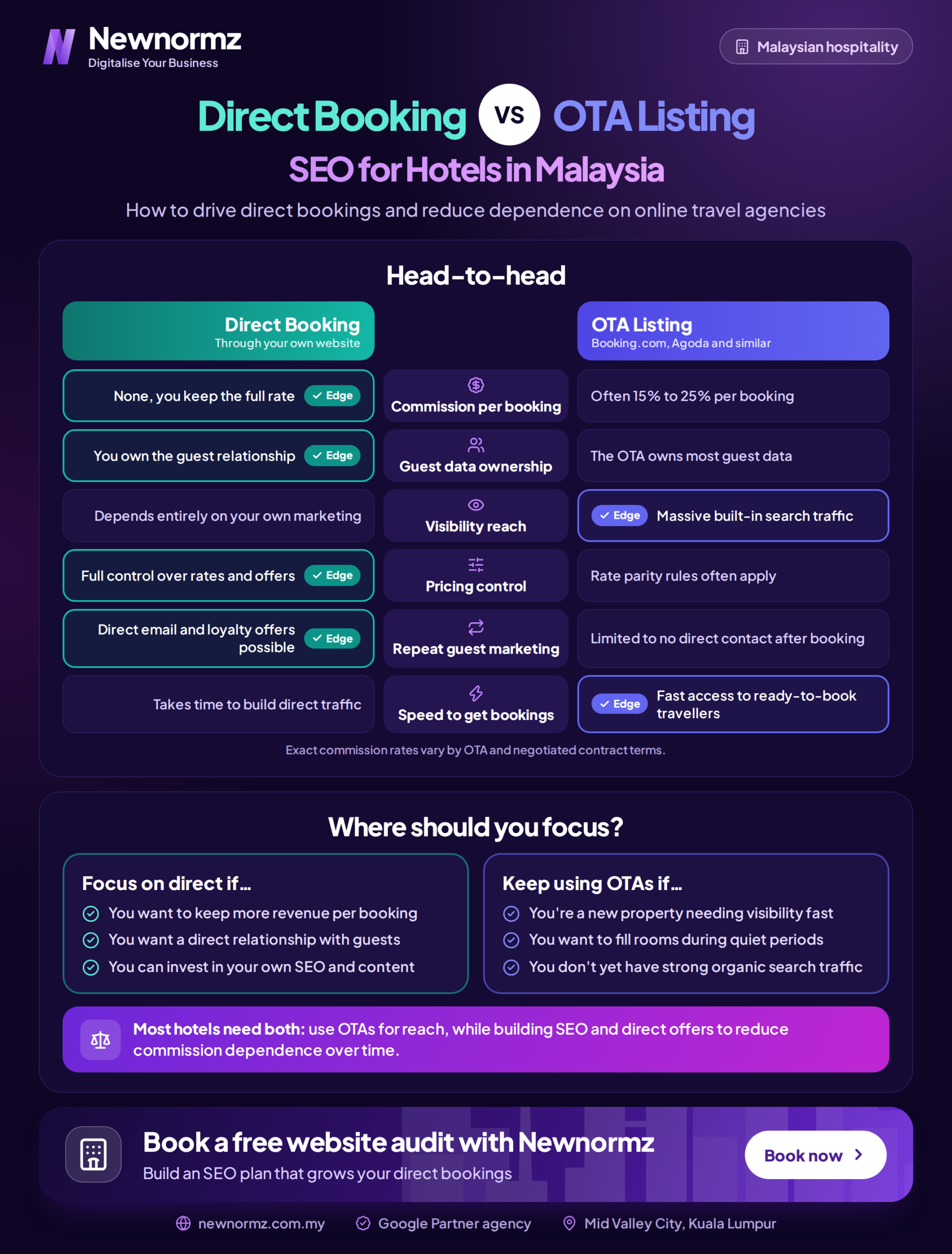
OTA commission in Malaysia usually runs between 15 and 25 percent per booking, depending on the platform and your contract. Take a hotel with RM500,000 in annual room revenue that comes entirely through OTAs. It pays RM75,000 to RM125,000 a year just to be listed and booked.
The commission is only the part you can see on an invoice. The bigger cost is structural. The platform owns the relationship with the guest, keeps most of the guest data, and decides how visible you are on any given day. Many OTA contracts also include rate parity terms, which limit how far you can undercut them on your own website.
| Factor | Direct Booking (Your Website) | OTA Booking |
|---|---|---|
| Cost per booking | No commission. You pay for the website, booking engine, and marketing | Typically 15 to 25 percent of the booking value |
| Guest data | You own the full record, including email | Mostly held by the platform |
| Pricing control | You can add packages, perks, and member rates | Often limited by parity terms in the contract |
| Repeat bookings | Come back to you through email, WhatsApp, or a brand search | Usually go back through the OTA app, with another commission |
Be Honest About Where You Can Beat the OTAs
This is where most hotel SEO advice falls apart. For a broad search like “hotel Kuala Lumpur”, page one belongs to Booking.com, Agoda, Trip.com, and Google’s own hotel search panel. These platforms have enormous domain authority and huge budgets. A single hotel website will almost never outrank them for that term, and spending your budget trying is money wasted.
The searches you can realistically win are narrower, and they tend to convert better. Google handles about 93 percent of searches in Malaysia, so these are the searches that matter.
| Search Type | Example | Who Usually Wins | Your Move |
|---|---|---|---|
| Broad city search | “hotel Kuala Lumpur” | OTAs and Google’s hotel panel | Don’t chase it with SEO. Stay listed on OTAs for this traffic |
| Your hotel’s name | “[Hotel Name] Melaka” | Should be you, but often isn’t | Top priority. Protect it first |
| Near a landmark | “hotel near KLCC”, “hotel dekat Jonker Street” | Google Maps results | Google Business Profile and local SEO |
| Specific need | “pet friendly boutique hotel Bangsar” | Up for grabs | Dedicated pages built around what makes your property different |
Win Your Own Name First
A lot of travellers find a hotel on an OTA, then Google its name to check the official website before they book. Hotel marketers call this the billboard effect. It is your best chance to convert a guest directly, and many hotels waste it.
Search your hotel’s name on your phone right now. If an OTA listing or an OTA ad shows up above your website, guests coming in at this stage get pushed straight back to the platform. Here is how to fix that:
- Put your hotel name and location in your homepage title tag, and make sure the page loads fast on mobile.
- Link your Google Business Profile to your official website, not to an OTA page.
- Connect your booking engine to Google’s hotel search so your official site appears in the price comparison next to the OTAs. Most major booking engines support this.
- Give guests a real reason to book direct, such as free breakfast, late checkout, or a room upgrade. Perks are usually allowed under parity terms when a lower price isn’t.
Own the Map for “Hotel Near…” Searches
When someone searches “hotel near Pavilion” or “hotel dekat Sunway Lagoon”, Google usually shows a map with a few hotel listings before any website. How visible you are there depends mostly on your Google Business Profile, which makes it one of the highest-return pieces of local SEO a hotel can do.
Get the basics right. Choose the correct primary category, fill in every amenity attribute Google offers (pool, parking, halal breakfast, airport shuttle), and upload real, recent photos of your rooms and lobby. Reply to reviews, including the negative ones. Keep your name, address, and phone number exactly the same on your website, OTA listings, and directories. When Google finds conflicting details across the web, it trusts your listing less.
Build Pages for the Guests You Actually Get
Every hotel has a guest profile that OTAs flatten into a generic listing. Business travellers near Mid Valley. Families heading to Legoland in Johor. Divers passing through Semporna. Couples looking for a quiet stay in Langkawi. Each of these groups searches differently, and each deserves a page written specifically for them.
Language matters here more than most hotels realise. Domestic travellers often search in Bahasa Malaysia (“hotel murah Ipoh”, “hotel bajet dekat pantai”). Visitors from Singapore, China, and Taiwan often search in Chinese. If your website is English only, you are invisible for these searches, and your competitors may be too. That makes it one of the easier gaps to close.
Room pages need the same care. Three room pages with near-identical copy give Google no reason to rank any of them. Describe what is actually different: the view, the bed setup, the size in square feet, who each room suits best.
Use Content to Reach Guests Earlier
A well-written guide to Penang street food or a weekend itinerary for Cameron Highlands can put your hotel in front of travellers weeks before they choose where to stay. To be honest about it, this kind of content rarely produces a booking on the first visit. Its job is to build familiarity and earn links from other sites, which in turn lifts the pages that do take bookings.
Write only what your team knows firsthand. A guide by the front desk manager on the three hawker stalls within walking distance beats a generic “top 10 things to do” list that every OTA blog already publishes.
Technical Issues That Quietly Lose Bookings
Hotel websites are usually beautiful and heavy. That is a problem when most travellers in Malaysia browse on their phones. Google’s own benchmark for good loading performance is a Largest Contentful Paint under 2.5 seconds. Uncompressed hero images and slideshows are the most common reason hotel sites miss it.
Check these specifically
- Booking engine handoff. Many engines run on a separate domain. If tracking isn’t set up across both domains, direct bookings show up in analytics as “referral” traffic, and you can’t tell whether SEO is working.
- Indexing. Make sure key pages aren’t accidentally blocked with a noindex tag, which happens often after a website redesign.
- HTTPS. Browsers label sites without it as “Not secure”. That is the last thing a guest wants to see before entering card details.
- Hotel structured data. Schema markup helps Google understand your address, star rating, price range, and amenities.
What to Expect, and How to Measure It
Google has said publicly, more than once, that no one can guarantee a specific ranking position. What you can expect is steady progress. Brand search and Google Business Profile fixes usually show results first, often within a few months. Long-tail and multilingual pages take longer and keep building over time.
Our own results show that compounding pattern. With Oriental Kopi, an F&B brand, two years of SEO produced 6.31 million impressions and 468,000 clicks, with 24,500 more keywords ranking. Sunway Medispa saw a 700 percent traffic increase over six months. Neither is a hotel, so treat them as proof of how SEO builds over time, not as a forecast for your property.
For a hotel, the only number that really matters is the share of room revenue coming through your own website compared with OTAs. Track it monthly. If traffic goes up but that share doesn’t move, the strategy needs changing. Whether you run SEO in-house or with an SEO agency in Malaysia, report against that share.
Frequently Asked Questions
Should I stop listing on OTAs once SEO starts working?
No. OTAs are still the best way to reach travellers who have never heard of you, especially international guests. The goal is a healthier mix: OTAs bring in new guests, and your website captures brand searches, repeat stays, and niche searches.
How long does hotel SEO take to show results?
Google Business Profile and brand search improvements often show movement within 3 to 6 months. Ranking for competitive landmark and niche searches usually takes longer, depending on your location and how active your competitors are.
Why does an OTA appear above my hotel when I search my own name?
Usually for one of two reasons. The OTA may be running paid ads on your hotel name, or its listing may simply be stronger than your website in Google’s eyes. The second can be fixed with better on-page SEO and a properly linked Google Business Profile. For the first, you may need to decide whether to bid on your own name in ads.
Do I really need Bahasa Malaysia or Chinese pages?
Only if those guests are a meaningful part of your market. For many properties in Melaka, Penang, Ipoh, and Johor Bahru, they are. Start with one well-written page per language for your most important room types rather than machine-translating the whole site.
Is SEO enough on its own, or do I need ads too?
SEO builds the long-term direct channel. Paid search can fill gaps while that happens, particularly during peak seasons and on your brand name. Most hotels do best with both, and add more SEO over time as organic rankings take over the traffic that ads were paying for.
Paying too much in OTA commission?
Find out how many of your bookings Google could be sending straight to you.
Newnormz has run SEO campaigns across F&B, healthcare, ecommerce, and local services in Malaysia, backed by a performance guarantee of 70 percent of targeted keywords on Google’s first page.
30 minutes, no obligation, and a clear view of which searches your hotel can realistically win.

Bryan Tan is an SEO Specialist and CEO at Newnormz, helping hundreds of businesses achieve first-page rankings on Google. With a passion for driving organic growth, Bryan blends innovative strategies with hands-on experience to optimize websites for maximum visibility. Always at the forefront of the latest SEO insights and trends, he consistently adapts to the evolving digital landscape.