AEO (answer engine optimisation) for an online store means writing your product and category pages so an AI system can lift a clear, factual answer straight from them. That covers Google’s AI Overviews, ChatGPT and voice assistants. In practice this is not a separate discipline from SEO. Google has said publicly that there are no special requirements to appear in AI Overviews beyond normal SEO best practice, and nobody can guarantee your page will be cited. What you can control is whether your pages contain the answer at all. Most Malaysian e-commerce sites lose here because the answer to “does this fit a 15-inch laptop?” or “does it deliver to Kuching?” is buried in a paragraph, stuck in an image, or missing. Fix that with real buyer questions, short direct answers, specific facts and clean structured data, and you give AI engines a reason to quote you instead of a marketplace listing.
A Simple Way to Think About It
Sealed Boxes vs a Straight Answer
📦 The Shop of Sealed Boxes
Every product sits in a sealed box with only a price sticker on it. A shopper with one simple question has nobody to ask, so they walk out and ask somewhere else.
🙋 The Assistant Who Answers
A shop assistant says “yes, it fits a 15-inch laptop” in one sentence. The shopper remembers it and repeats it word for word when a friend asks where to buy.
AI answer engines behave like that friend. They repeat the clearest answer they can find. The sections below show how to make your product pages the ones doing the answering.
What AEO Actually Changes for an Online Store
Classic e-commerce SEO aims to get a page ranked for a phrase like “insulated bottle Malaysia”. AEO aims to get your page used as the source when someone asks a full question, such as “which tumbler keeps ice longest for a day out in the heat?” or “is this sunscreen okay for sensitive skin?”
The audience is the same and the fundamentals are mostly the same. What changes is the shape of the content. A ranking page can get away with a long product description. An answer engine needs a sentence it can lift out and quote without the rest of the page around it.
In Malaysia, most of this still happens on Google, which holds roughly 93% of search market share (Statcounter, May 2026). For most stores, AI Overviews are the answer engine that matters most, with ChatGPT and other assistants a growing second channel. This is good news. Strong SEO service fundamentals and AEO pull in the same direction, so you don’t need two separate strategies.
| Area | E-Commerce SEO | E-Commerce AEO |
|---|---|---|
| Target | Keywords such as “buy ergonomic chair Malaysia” | Questions such as “is this chair suitable for someone 180cm tall?” |
| Win condition | Your page ranks and gets the click | Your page is quoted or cited inside the AI answer |
| Content shape | Optimised titles, descriptions, category copy, internal links | Short, self-contained answers, spec tables, FAQ blocks |
| Buyer stage | Discovering brands and comparing options | Checking suitability, usage, warranty and delivery before buying |
| Shared foundation | Crawlable pages, fast mobile experience, accurate structured data, content that actually answers the searcher | |
Why Your Own Site Still Matters When Shopee and Lazada Exist
You will rarely outrank Shopee or Lazada on a pure product keyword. They have too much authority and too many listings. Answers are a different contest, though. A marketplace listing usually holds a title stuffed with keywords, a few images and a spec block copied from the supplier. It seldom explains who the product suits, how to use it, or what happens when something goes wrong.
Your website can explain all of that. When an AI engine looks for a clear answer to “can this air fryer fit a whole chicken?”, a brand page with one direct sentence and the basket dimensions beats a marketplace listing that only says “large capacity”. You don’t need to beat the marketplaces on reach. You need to beat them on clarity, one question at a time.
How to Get Your Product FAQs into AI Answers
None of this needs a site rebuild. Start with your best-selling products and highest-traffic category pages, then work outward.
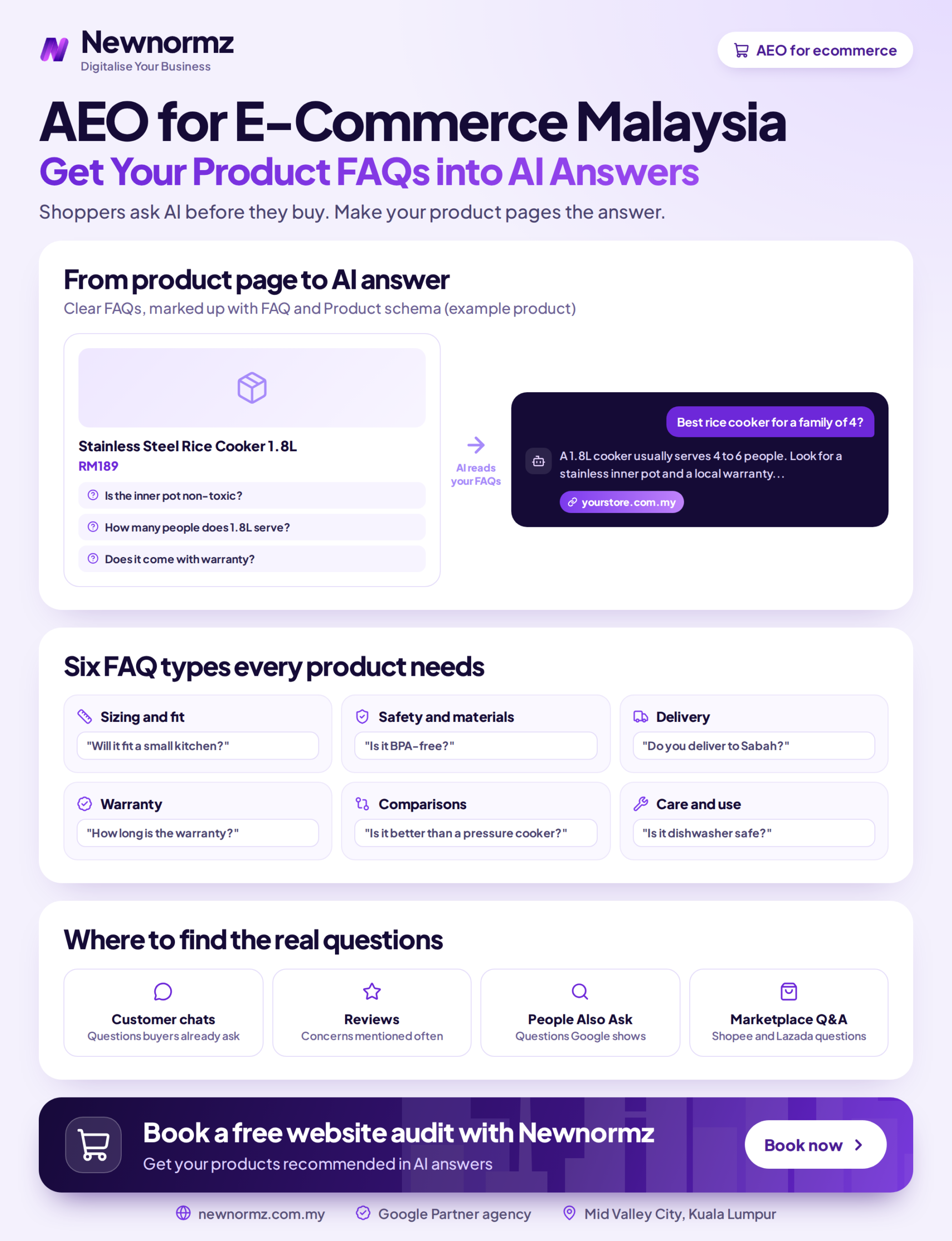
1. Collect the questions buyers actually ask
Don’t build FAQs from your internal spec sheet. Build them from what customers really ask. The best sources are usually ones you already have:
- Your WhatsApp and live chat history. The same ten questions probably come up every week.
- Questions and reviews on your own Shopee and Lazada listings.
- Google’s “People also ask” boxes for your main product categories.
- Search Console queries that are already phrased as questions.
Pay attention to language. Malaysian shoppers search in English, Bahasa Malaysia and Chinese, often mixed in one query. If buyers ask “kasut ni sesuai untuk kaki lebar ke?”, a BM version of that answer gives you something to be matched against.
2. Answer first, one question per entry
Each FAQ entry should open with the real question and put the answer in its first sentence. “Yes, the 40oz tumbler fits most car cup holders up to 7.5cm wide” can be quoted. “Great question! Our tumbler is designed with your lifestyle in mind…” cannot. Around 40 to 60 words per answer is a sensible working range. That is long enough to be useful and short enough to stand alone.
3. Replace adjectives with facts
“Premium quality” and “best value” give an answer engine nothing to repeat. Dimensions, weight, materials, compatibility, warranty length and delivery windows do. For Malaysian buyers, some facts carry extra weight because they decide whether someone buys at all: JAKIM halal certification for food and personal care, SIRIM certification for regulated electrical items, delivery times to Sabah and Sarawak, and whether you offer COD. If you have these, state them plainly on the page.
4. Add structured data, with honest expectations
Product markup (price, currency, availability, reviews where genuine) helps Google understand exactly what you sell, and it feeds merchant listings in Search. FAQPage markup is still valid for describing question-and-answer content. Be realistic about it, though: since August 2023, Google only shows FAQ rich results for well-known, authoritative government and health websites. Adding FAQ schema to a product page will not earn you an expandable FAQ in search results, and it is not a switch that puts you into AI Overviews. Its value is clarity, not a shortcut. The answers must also be visible on the page. Markup describing content shoppers can’t see breaks Google’s guidelines.
5. Make sure AI crawlers can actually read the page
Two technical checks catch many stores out. First, many AI crawlers don’t render JavaScript the way Googlebot does. If your FAQs or specs only appear after a script runs, some engines may never see them, so key answers should be in the HTML the server sends. Second, check your robots.txt. Some themes, plugins or security settings block crawlers such as OAI-SearchBot, which ChatGPT search uses. If you want to be cited there, don’t block it.
6. Keep answers current
An FAQ that quotes last year’s price, an old courier or a discontinued variant is worse than no FAQ at all, because an AI engine may repeat the wrong answer with confidence. Put a quarterly review on the calendar for your top pages. Check prices, stock notes, delivery times and anything else that has changed.
Common AEO Mistakes on Malaysian Product Pages
| Mistake | Why it hurts | Fix |
|---|---|---|
| Key details only inside product images or banners | Text baked into an image is hard for crawlers to extract reliably | Repeat every important spec as real text on the page |
| Promotional answers (“the best in Malaysia”) | Nothing factual for an answer engine to quote | State the fact: “Delivery to Klang Valley takes 1 to 2 working days” |
| FAQs only cover objections, not usage | Misses the “how do I clean / set up / store this” questions people ask AI tools | Add practical how-to questions taken from your support chats |
| Same supplier description copied across sites | Your page adds nothing the marketplace listing doesn’t already say | Write original copy with your own testing notes and buyer guidance |
| Schema that doesn’t match the page | Mismatched price or hidden FAQ content can break Google’s structured data guidelines | Generate markup from live page data and test it in Google’s Rich Results Test |
What to Expect, Honestly
AI answers are not a fixed ranking position. The same question can produce a different answer, with different sources, from one day or one user to the next. Anyone promising your products will “appear in ChatGPT” is promising something they don’t control.
What you can measure is direction. Google Search Console includes AI Overview appearances in its normal performance data, so watch impressions and clicks on the product and category pages you have reworked. In GA4, check referral traffic from sources like chatgpt.com and perplexity.ai. Timelines depend on how often your pages are crawled and how competitive your category is, so judge progress over months, not weeks.
For high-intent product searches where you need sales this month, organic answers and paid placement work well together. Google Ads, Shopping campaigns in particular, can cover the transactional queries while your AEO work builds up visibility on the research questions that come before them.
Frequently Asked Questions
Which pages should a Malaysian online store optimise for AEO first?
Start with your best-selling product pages and the category pages that already get search traffic. These are already being crawled and already matter to revenue, so clearer answers there pay off fastest. Buying guides come next.
Is FAQ schema still worth adding to product pages?
It is still valid markup and helps describe your content, but don’t expect visible FAQ rich results. Google limited those to authoritative government and health sites in 2023. Prioritise Product markup and well-written on-page answers first.
Do I need separate content for Bahasa Malaysia and Chinese searches?
If a meaningful share of your buyers asks questions in those languages, yes. A properly written BM or Chinese version of your key FAQs gives you a chance to be matched against those queries. Machine-translated text that reads badly helps no one, so have a fluent speaker review it.
Can AEO replace selling on Shopee and Lazada?
No, and it doesn’t need to. Marketplaces bring reach. Your own site gives you the room to answer buyer questions properly and build trust in your brand. Most Malaysian sellers do best running both.
Can anyone guarantee my products will appear in AI Overviews or ChatGPT?
No. Google has said repeatedly that no one can guarantee a specific position, and AI answers are even less predictable than rankings. What good work guarantees is that your pages contain clear, accurate answers worth citing.
Are your product pages answering buyers, or just listing prices?
Find out what’s keeping your store out of AI answers
Newnormz has run SEO campaigns across F&B, healthcare, ecommerce, and local services in Malaysia, backed by a performance guarantee of 70 percent of targeted keywords on Google’s first page.
30 minutes, no obligation, with a review of your top product pages, structured data and AI crawler access.

Bryan Tan is an SEO Specialist and CEO at Newnormz, helping hundreds of businesses achieve first-page rankings on Google. With a passion for driving organic growth, Bryan blends innovative strategies with hands-on experience to optimize websites for maximum visibility. Always at the forefront of the latest SEO insights and trends, he consistently adapts to the evolving digital landscape.