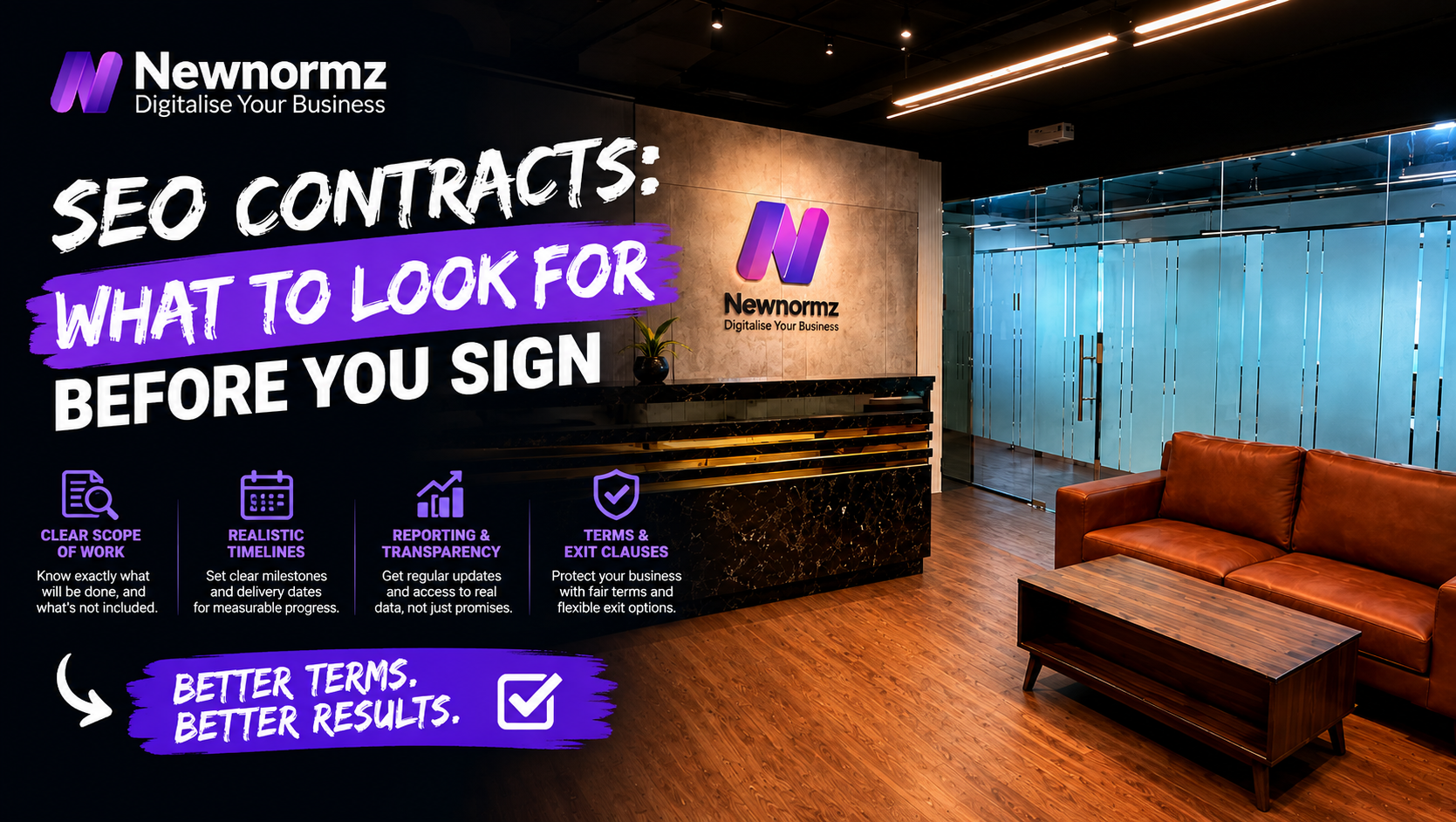
Before you sign an SEO contract, check five things: who owns your website and content after the contract ends, what counts as a deliverable versus just “activity,” whether reporting includes actual traffic and ranking data or just a summary of tasks done, what the exit terms are if you want to leave, and whether any part of the contract promises a specific ranking position. That last one is the biggest red flag. Google has publicly and repeatedly stated that no one, not even Google itself, can guarantee a specific ranking position. An agency that puts that promise in writing is either misinformed about how search works or hoping you won’t ask questions later.
Why the Contract Matters More Than the Pitch
Most businesses evaluate an SEO agency in Malaysia based on the sales call: the case studies they show, how confident they sound, the number they promise for month six. The contract is where all of that either gets locked in or quietly walked back. A good pitch and a vague contract is a common combination, not because agencies are dishonest, but because verbal promises are easier to make than promises you have to put your name to.
If you’ve been burned before, or you’ve heard from other business owners in Malaysia who paid for six months of “SEO” and ended up with a stack of blog posts and no traffic to show for it, the contract is usually where the gap was. Not the strategy. The paperwork.
Clause 1: Who Owns What When It’s Over
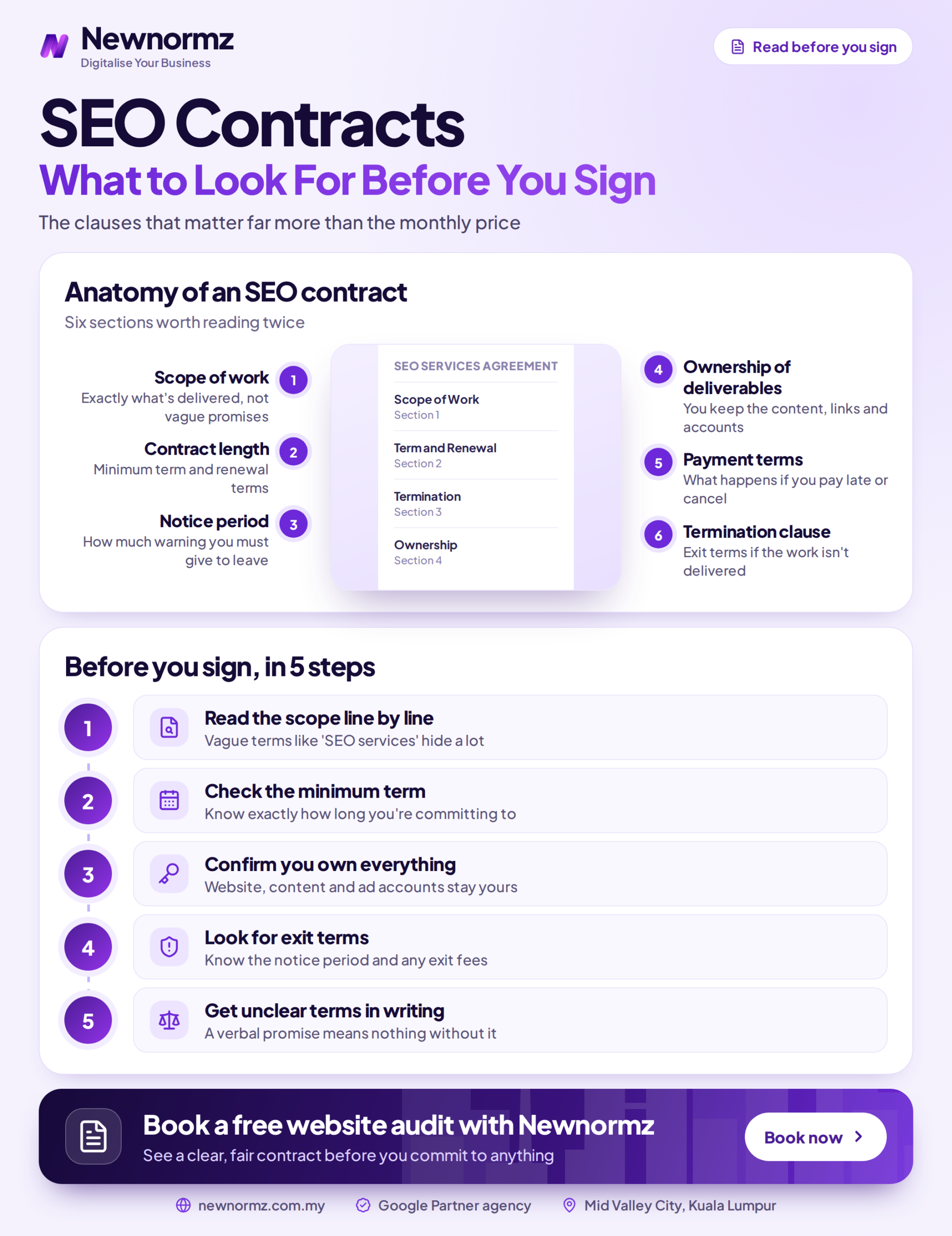
This is the one people skip and regret. Ask directly: if you leave the agency in six months, do you keep the content they wrote, the backlinks they built, admin access to your Google Search Console and Google Business Profile, and the website changes they made? Some agencies build campaigns on infrastructure they control, meaning if you leave, your rankings can collapse because the thing driving them (a subdomain, a linked asset, an ad account) was never actually yours.
A contract should state plainly that you retain ownership of your domain, your Google Search Console property, your Google Business Profile, your content, and your analytics data, regardless of who set them up. If an agency is reluctant to put that in writing, that reluctance is the answer.
Clause 2: What “Deliverable” Actually Means
“10 blog posts a month” and “10 blog posts a month optimized for keywords with actual search demand in your market” are not the same deliverable, but they read almost the same in a contract if you’re not looking closely. Vague activity-based line items (“ongoing optimization,” “monthly SEO work,” “technical improvements as needed”) let an agency bill you consistently without ever being accountable for a result.
Look for contracts that tie deliverables to something measurable: which pages, which keywords, what technical issues get fixed and by when. It doesn’t need to promise a ranking position (nobody honestly can), but it should be specific enough that you could tell, three months in, whether the work actually happened.
A Simple Way to Think About It
Renting vs. Building
🏚️ Renting a Furnished Flat
You get to live there and enjoy the furniture, but the moment you move out, everything goes with the landlord. You walk away with nothing to show for the years you paid rent.
🏠 Buying a House
You might hire someone to renovate it, but the house is still yours when they’re done. Whatever they build stays, no matter who does the next round of work.
A well-written contract makes sure your SEO campaign works like the house, not the flat. The clauses below on reporting and exit terms are how you check which one you’re actually signing up for.
Clause 3: Reporting You Can Actually Verify
A reporting clause should specify what you’ll receive, how often, and from what source. “Monthly reports” isn’t enough. You want to know whether reports pull from Google Search Console and Google Analytics directly (data you can log in and check yourself) or from an internal dashboard the agency controls and formats however it likes.
This matters because Malaysia’s search market is overwhelmingly one platform: Google holds roughly 93 percent of search market share here as of May 2026 (Statcounter). A report that doesn’t tie back to Google’s own data tools is much harder to verify independently.
| Clause | What to Check | Red Flag |
|---|---|---|
| Ownership | You keep domain, Search Console, content, and analytics access after exit | Agency-controlled accounts with no transfer clause |
| Deliverables | Specific pages, keywords, and fixes named, not just “monthly work” | Vague terms like “ongoing optimization” |
| Reporting | Tied to Google Search Console and Analytics, sent on a fixed schedule | In-house dashboard only, no raw data access |
| Ranking claims | Contract avoids promising a specific position (Google itself says no one can guarantee this) | “Guaranteed #1 ranking” or similar language |
| Exit terms | Clear notice period, no long lock-in, no penalty for leaving after the initial term | 12+ month lock-in with automatic renewal |
Clause 4: Ranking Guarantees Are a Warning Sign, Not a Selling Point
Google has stated publicly and repeatedly that no one can guarantee a specific ranking position, including Google itself, because rankings depend on hundreds of signals that change constantly and vary by searcher, location, and device. If a contract includes language like “guaranteed page 1” or “guaranteed #1 ranking for [keyword],” that’s not confidence, it’s a claim that isn’t technically possible to back.
What a credible contract can include is a performance guarantee tied to something measurable and within the agency’s actual control, such as a percentage of targeted keywords reaching page one within a defined timeframe, or specific technical and content deliverables completed on schedule. That’s a commitment to effort and process, which is what SEO actually is.
Clause 5: Exit Terms and Lock-In Periods
SEO takes time to show results, which is a fact, not an excuse. But that fact gets misused when agencies use it to justify 12-month lock-ins with no early exit option and automatic renewal clauses buried in the fine print. Look for the notice period required to end the contract, whether there’s a penalty for leaving early, and whether the contract auto-renews unless you actively cancel it.
A reasonable structure gives you an initial commitment period (often 3 to 6 months, enough time for meaningful movement) followed by month-to-month terms with a short notice period. That protects both sides: the agency gets enough runway to do real work, and you’re not stuck if the relationship isn’t working.
What a Real Campaign Actually Looks Like in a Contract
It helps to see what accountable SEO work looks like once it’s underway, not just on paper. Times Parking, a parking management company, ran a 6-month SEO campaign that produced 528,000 impressions, 416 ranking keywords, and 31.5K clicks, alongside a 600-visitor increase in organic traffic. Sunway Medispa saw a 700 percent traffic increase and 70 percent more keywords ranking within 6 months. Oriental Kopi, an F&B brand, ran a 2-year campaign that grew traffic by 43,300, reached 6.31M impressions, and added 24,500 ranking keywords.
None of those numbers were promised on day one. They were the result of consistent, documented, verifiable work over time, which is exactly what a well-written contract should protect and hold the agency accountable to.
Questions to Ask Before You Sign
Do I keep access to Google Search Console and my Google Business Profile if I cancel?
If the answer is unclear or the agency set these up under their own accounts without transferring ownership, ask for that to be corrected in writing before you sign.
What happens to the content and backlinks after the contract ends?
Content published on your website is typically yours regardless. Backlinks and any off-site assets should also be disclosed, since some tactics (like private blog networks) can be a liability rather than an asset if the agency stops maintaining them.
Is there a minimum lock-in period, and what’s the notice period after that?
A short initial term with month-to-month terms afterward is healthier than a long lock-in with auto-renewal.
Does the contract promise a specific ranking position?
If it does, treat that as a red flag rather than reassurance. Ask instead about the process, the keyword targets, and how progress will be measured against a percentage of targeted keywords or defined technical and content milestones.
Can I see a sample report before signing?
A sample report shows you exactly what you’ll be able to verify each month, and whether it pulls from Google’s own data or an internal summary you can’t independently check.
The Bottom Line
An SEO contract is not a formality to get past on the way to starting work. It’s the document that determines whether you own the results of your own investment, whether you can leave if things aren’t working, and whether what you’re being promised is even something SEO can deliver. With Malaysia’s internet population now at 35.4 million people and 98 percent penetration (DataReportal, Digital 2026 Malaysia), the competition for visibility in search results keeps rising, which makes it even more important that the agency you hire is contractually accountable, not just verbally reassuring.
If you’re evaluating a contract right now, or comparing it against what an local SEO partner should reasonably offer, it’s worth getting a second opinion before you sign anything.
Not sure what to look for in your current contract?
Get a free, honest review of your SEO contract and current results.
Newnormz has run SEO campaigns across F&B, healthcare, ecommerce, and local services in Malaysia, backed by a performance guarantee of 70 percent of targeted keywords on Google’s first page.
30 minutes, no obligation, no pressure to switch agencies.

Bryan Tan is an SEO Specialist and CEO at Newnormz, helping hundreds of businesses achieve first-page rankings on Google. With a passion for driving organic growth, Bryan blends innovative strategies with hands-on experience to optimize websites for maximum visibility. Always at the forefront of the latest SEO insights and trends, he consistently adapts to the evolving digital landscape.