Yes, SEO can bring more people through the door of a physical store. But the work that matters most for a retailer is not blogging. It is how your store shows up on Google Maps and in the local results at the top of a search. When someone nearby types “kedai cermin mata Subang Jaya” or “hardware shop near me”, Google shows a small group of stores on a map, and a lot of shoppers never scroll past it. Google decides which stores make that group based on three things: how relevant your listing is, how close you are, and how established your store looks online. You can’t change your distance. You can change the other two. Nobody can guarantee you the top spot (Google says so publicly), but a complete, consistent, well-run local presence is usually the cheapest reliable source of walk-ins a Malaysian retailer has.
A Simple Way to Think About It
The Signboard at the Junction
🚧 A great shop down a side lane
It has good stock and fair prices, but there’s no sign on the main road. People drive past every day without knowing it’s there.
🪧 The same shop with a sign at the junction
Same lane, same stock. There’s now a clear sign pointing the way, and people who were already looking for exactly this turn in.
For most Malaysian shoppers today, that junction is a Google search. The sections below cover how to put your sign there.
Why Search Now Decides Who Gets the Walk-In
Malaysia had 35.4 million internet users at the end of 2025, about 98 percent of the population (DataReportal, Digital 2026 Malaysia). Google handles roughly 93 percent of searches here (Statcounter, May 2026). So when a shopper in Kepong needs a new mattress or a parent in Bangsar needs school shoes, the first step is nearly always a Google search, usually on a phone.
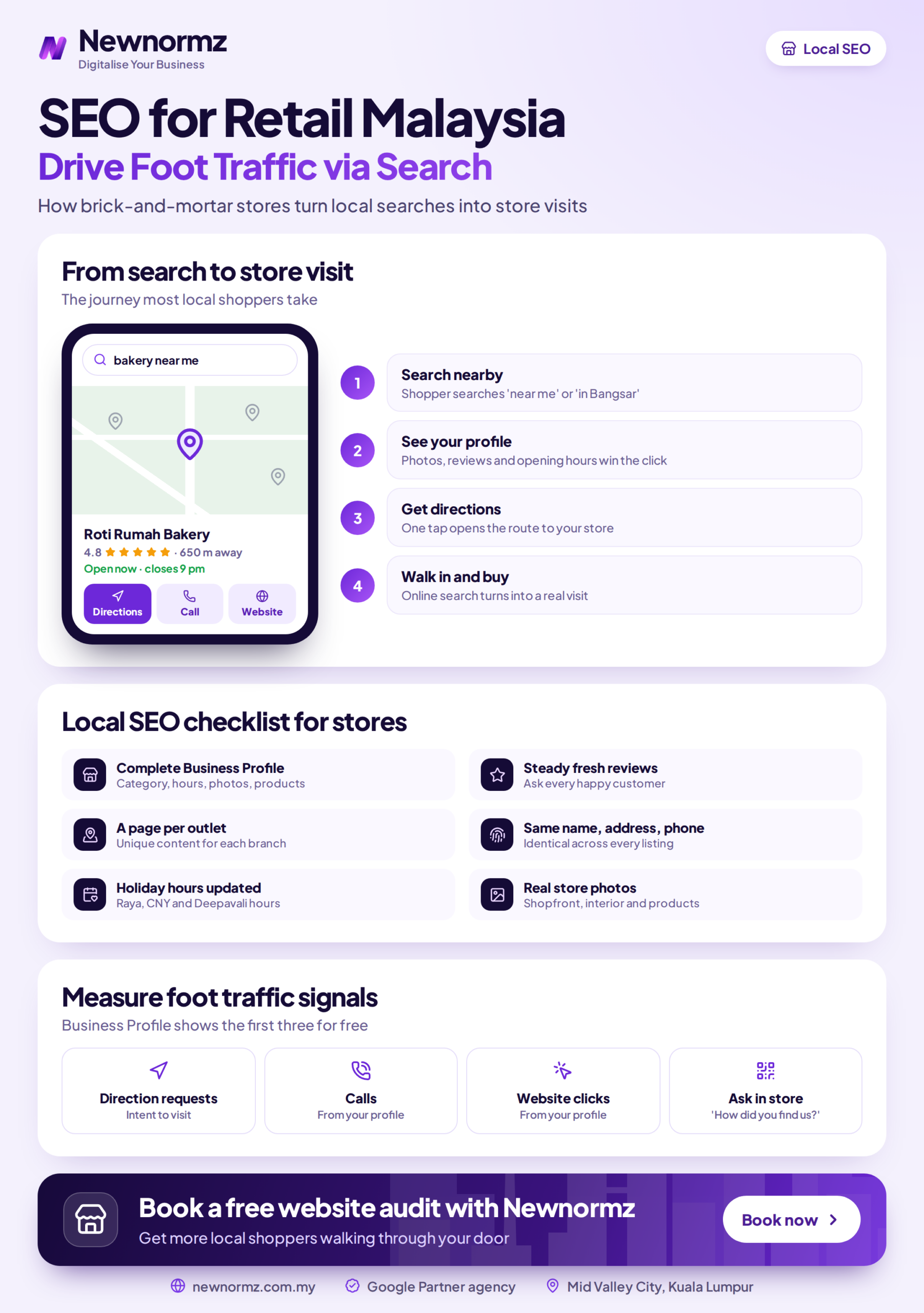
What they do next is predictable. They look at the map, open two or three listings, check the opening hours, skim the reviews and photos, then tap for directions. The whole thing takes less than a minute. Your store wins or loses during that minute, well before anyone sees your window display.
This is why a store with the right products and a good location can still lose to a competitor. If your listing shows the wrong hours on a public holiday, has three blurry photos from 2021, or has a phone number that goes nowhere, the shopper moves on. You never find out they looked.
How Google Decides Which Stores to Show
Google has said publicly that local results depend on three factors. Knowing them tells you where your effort will actually pay off.
| Factor | What Google is asking | What you can do about it |
|---|---|---|
| Relevance | Does this store match what the person searched for? | Choose the right categories, describe what you actually sell, and back it up with product and location pages on your website. |
| Distance | How far is the store from the searcher, or from the area they named? | Not much, beyond making sure your map pin and address are exactly right everywhere. |
| Prominence | How well known and trusted is this store? | Earn steady, genuine reviews, keep your details consistent across the web, and get mentioned by local sites and directories. |
Distance matters most, and it’s the one you can’t change once your lease is signed. That’s why the retailers who show up consistently are the ones who work hard on relevance and prominence. A store 800 metres away with a well-managed listing will often beat a store 300 metres away with a neglected one.
Where to Put Your Effort, in Order
Most retailers spread their effort too thin. Here is the order we’d work in for a typical Malaysian store, starting with what moves foot traffic fastest.
1. Your Google Business Profile
For a physical store, this listing matters more than your homepage. It’s what shows on Google Maps and in the local results, and for many shoppers it’s the only thing they look at before they visit.
- Pick the most specific primary category. “Optical store” is better than “store”. Then add secondary categories that honestly match your stock.
- Keep your hours accurate, including special hours. Hari Raya, Chinese New Year, Deepavali, and mall closures are exactly when people check before they drive over. Wrong hours on those days cost you trust fast.
- Add real photos regularly. Your shopfront (so people can find you), the inside, and the products people actually come in for. A shopper deciding between two stores will usually trust the one that looks active.
- Use Products and Posts. New arrivals, promotions, and in-store events. These show shoppers that someone is running the listing.
- Answer questions. Parking, halal status, payment methods, whether you do alterations or repairs. Answer them on the listing before someone decides not to bother asking.
2. Reviews, Earned the Honest Way
Reviews help your ranking, and they also decide whether people click. The most reliable way to get them is to ask at the counter, when the customer is happy and still in the shop. A small QR code at the till that links straight to your review form works better than a request sent days later.
Reply to every review, especially the bad ones. A calm, specific reply to a one-star complaint often does more for the next shopper’s trust than ten five-star reviews. Never buy reviews or offer rewards in exchange for them. It’s against Google’s policies, and listings do get their reviews removed or get suspended for it.
3. The Same Store Details Everywhere
Your store name, address, and phone number (often called NAP) should match exactly across Google, Waze, Apple Maps, Facebook, your mall’s directory, and any Malaysian business listings you’re on. When one site says “Lot G-12” and another says “Ground Floor, Unit 12”, or an old number is still live somewhere, Google gets less sure the details are right. So do shoppers.
This comes up a lot after a store moves or changes its number. The old details keep appearing on directories nobody remembers signing up for. A citation audit finds them so you can fix them.
4. Hyperlocal and Multilingual Keywords
You’re unlikely to rank for a broad term like “shoe store”. Big brands and marketplaces already own it. The better opportunity for a physical retailer is the search that names a place: a township, a mall, a landmark. “Flooring shop Kepong”, “kedai basikal Shah Alam”, “near Mid Valley”. These searches have less competition, and the person searching is often ready to visit today.
Malaysians also search in more than one language. The same shopper might type “kedai perabot Klang” on one day and “furniture shop Klang” the next, and Chinese-language searches matter a lot for some categories and neighbourhoods. If your website and listing only use English, you’re missing people who are already looking for you.
5. A Website That Backs Up the Listing
A strong Google Business Profile with a weak website behind it will hit a limit. Your site gives Google more evidence of what you sell and where, and it catches the shopper who wants more detail before making the trip.
- A page for each outlet, with the full address, a map, hours, parking notes, and what that particular branch stocks.
- LocalBusiness schema markup, so your store details are machine-readable.
- A fast, mobile-friendly layout with a tap-to-call button and a directions link near the top. Most of these visits happen on a phone, often while the person is already out.
- Hours and contact details that match your Google listing exactly.
This is where local SEO and on-site work have to be done together. Fixing one while the other falls behind is one of the most common reasons retail stores stall.
If You Have More Than One Outlet
Each physical location needs its own Google Business Profile, its own page on your website, and its own consistent listings. Don’t send every outlet’s listing to your homepage. Link each one to the page for that branch. Otherwise Google has to guess which store is relevant to which search, and it often guesses wrong. Shoppers in Penang end up looking at your Puchong branch’s hours.
Local SEO vs Google Ads for a Physical Store
Retailers often ask which one to spend on. They do different jobs, so the honest answer depends on when you need the walk-ins.
| Local SEO | Google Ads | |
|---|---|---|
| Speed | Profile fixes can show movement within weeks in less competitive areas. Broader gains usually take a few months. | Visible as soon as the campaign is approved. |
| Cost over time | Upfront work, then upkeep. The visibility doesn’t disappear the month you pause. | You pay for every click. Stop paying and the visibility stops too. |
| How it looks to shoppers | Organic map and search listings, with your reviews showing. | Labelled as sponsored. |
| Best for | Steady, everyday foot traffic from nearby shoppers. | New store openings, sales, festive peaks, and filling the gap while SEO builds. |
If your budget is tight and you’re not in a rush, start with local SEO. It’s the foundation, and ads that send people to a messy listing waste money anyway. If you need traffic this month, for a launch or a Raya sale, running Google Ads alongside SEO makes sense. One of our clients, a confinement centre in KL, combined the two on a budget of RM2,550 a month and was getting qualified leads within 30 days.
How to Tell If It’s Actually Working
I’ll be straight with you: nobody can link every walk-in to a Google search. A shopper might find you on Maps on Tuesday and come in on Saturday. You can still get a reliable picture from a few signals:
- Google Business Profile performance data: direction requests, calls, and website clicks, tracked month by month. Direction requests are the closest thing you’ll get to a foot traffic number.
- Ask at the counter. “How did you find us?” is basic, and it still works. Have staff tally the answers for a month.
- Search-only offers. A promo mentioned only in your Google Posts tells you exactly who came from there.
- Search Console: which location-based searches bring people to your outlet pages.
Set these up before you start, so you have a baseline to compare against. Otherwise, three months in, you’ll be guessing.
What Realistic Results Look Like
SEO builds on itself over time. Early wins usually come from fixing the listing: correct categories, accurate hours, fresh photos, consistent details. The bigger gains come later, as reviews build up and your website starts ranking for more local searches.
You can see that pattern in our own campaigns. For Oriental Kopi, an F&B brand with physical outlets, a two-year SEO campaign produced 43,300 in traffic growth, 6.31 million impressions, and 24,500 more ranking keywords. Sunway Medispa, a clinic people visit in person, saw a 700 percent traffic increase in six months. Neither is a retail shop in the strict sense, but both depend on people finding a physical location through search, which is the same challenge you have.
Frequently Asked Questions
Do I need a website if my store is already on Google Maps?
You can get walk-ins from a Maps listing alone, but you’ll hit a limit. A website gives Google more evidence of what you sell and where, helps you rank for product searches, and gives shoppers the detail they want before they make the trip.
My store is inside a mall. Does the mall’s listing cover me?
No. The mall’s listing ranks for the mall, not for what you sell. Your store needs its own Google Business Profile, with the correct lot number and an address format that matches the mall’s own.
How long before I see more foot traffic?
Fixing a neglected listing can make a difference within weeks, especially where there isn’t much competition. Wider gains from reviews, citations, and website content usually take a few months to build. Be wary of anyone promising a specific ranking by a specific date.
Can I pay Google to rank higher on Maps?
You can pay for ad placements that appear on Maps, but you can’t pay to move up in the organic map results. Those are earned through relevance, distance, and prominence.
Is retail SEO different from ecommerce SEO?
Yes. Ecommerce SEO aims for online purchases through product pages. Retail SEO for a physical store aims for directions, calls, and visits, so Google Maps, reviews, and location pages matter far more. If you do both, treat them as two separate plans.
Are nearby shoppers finding your competitor first?
Find out what’s keeping your store off the map, and what to fix first.
Newnormz has run SEO campaigns across F&B, healthcare, ecommerce, and local services in Malaysia, backed by a performance guarantee of 70 percent of targeted keywords on Google’s first page.
30 minutes, no obligation, with a clear look at your Google Business Profile, listings, and outlet pages.

Bryan Tan is an SEO Specialist and CEO at Newnormz, helping hundreds of businesses achieve first-page rankings on Google. With a passion for driving organic growth, Bryan blends innovative strategies with hands-on experience to optimize websites for maximum visibility. Always at the forefront of the latest SEO insights and trends, he consistently adapts to the evolving digital landscape.