You can rank in English, Bahasa Malaysia and Chinese at the same time, but not by translating one page three ways. Each language needs its own keyword research and its own page written for how those searchers actually type. Then a shared technical setup (separate URLs for each language plus correct hreflang tags) tells Google which version to show to whom. Most businesses shouldn’t launch all three at once. Start with the language where your buyers already are, get it ranking, then expand. Expect early movement within a few months and stable rankings across all three languages in six to twelve months, depending on how competitive your industry is in each language.
A Simple Way to Think About It
Two Kopitiam Menus
📄 The machine-translated menu
Every dish name was run through a translator. Customers can read the words, but they can’t tell what they’re ordering, so they point at a picture or walk out.
🍜 The menu written by a regular
It uses the names people actually shout at the counter. Nobody hesitates. They just order.
Search works the same way. The sections below show how to write each language version like the regular, and how to set up your site so Google serves the right menu to the right customer.
Malaysia Is Three Search Markets Sharing One Google
Malaysia had 35.4 million internet users at the end of 2025, about 98% of the population (DataReportal, Digital 2026 Malaysia). Google handles roughly 93% of searches here (Statcounter, May 2026). So whatever language your customer uses, they’re almost certainly searching on Google. That makes multilingual SEO in Malaysia simpler than in China or Korea, where you’d need to optimise for a different search engine entirely. Here, it’s one search engine, three languages, and three sets of results.
What gets overlooked is that each language returns a different set of results with different competitors. Someone searching “waterproofing contractor” sees one page one. Someone searching “kontraktor kalis air” sees another. Someone searching “水电工程公司” sees a third. You might rank well in English and not appear at all in the other two, even though all three people are looking for the same service.
Real queries are also messier than textbook examples. Plenty of Malaysians mix languages in a single search, like “kedai repair aircond near me” or “klinik gigi Cheras”. Your keyword research has to capture how people actually type, not how a dictionary would phrase it.
Translation Is Not Multilingual SEO
The most common mistake is running an English page through a translation tool and publishing the result. The page technically exists in BM or Chinese, but it rarely contains the phrases native speakers type. Sometimes the translated phrase gets almost no searches while a completely different phrase gets all the traffic. Nobody ever searches for a page like that, so it never ranks.
| Factor | Straight Translation | Multilingual SEO |
|---|---|---|
| Keywords | Whatever the translator produces | Researched separately for each language |
| Search intent | Assumed to match the English version | Checked against what actually ranks in that language |
| Page content | Mirror of the English page | Adapted: different FAQs, examples and emphasis where needed |
| Technical setup | Often the same URL with swapped text | Separate URL per language, linked with hreflang |
| Call to action | Translated word for word | Written natively, often pointing to WhatsApp or a phone number the audience prefers |
Translation isn’t useless. It’s a reasonable first draft. The problem is treating it as the finished product. A native speaker who knows your industry should rewrite it around the keywords research turned up.
What Each Language Version Needs
Don’t assume every English-speaking searcher is a corporate buyer or every BM searcher is a price-sensitive consumer. That kind of shortcut leads to bad pages. Look at the actual search results in each language and you’ll usually see patterns specific to your industry. These are the ones that come up most often.
English
English is usually the most competitive of the three, because most Malaysian businesses already publish in it. In B2B and professional services, English results tend to reward depth: service pages that explain scope and process, case studies, and comparison content. If you’re already ranking in English, this is your base. If you aren’t, don’t expect adding more languages to fix it.
Bahasa Malaysia
In many industries, BM search results are noticeably less crowded than English ones. That makes BM a real opportunity. Queries are often phrased as questions or practical needs (“berapa kos…”, “cara…”), so how-to content, pricing explainers and state-level service pages tend to fit well. Use Malaysian vocabulary, not Indonesian. The two languages overlap enough that Indonesian pages sometimes appear for Malay queries, and wording that sounds Indonesian can make your page read as foreign to a local visitor.
Chinese
Simplified Chinese is the standard in Malaysian Chinese-medium schools and most local Chinese media, so it’s the sensible default for most sites. Traditional characters are worth considering only if your data shows demand for them. Chinese keyword research is harder because many tools have weaker data for Chinese queries in Malaysia. Check the live results by hand. Also pay attention to where Chinese-speaking customers expect to contact you. For many businesses that’s WhatsApp, not a contact form.
The Technical Setup Google Needs
This is where most DIY multilingual sites break. You can have great content in three languages, but if Google can’t tell the versions apart, it may show the wrong one or index only one of them.
Give every language its own URL
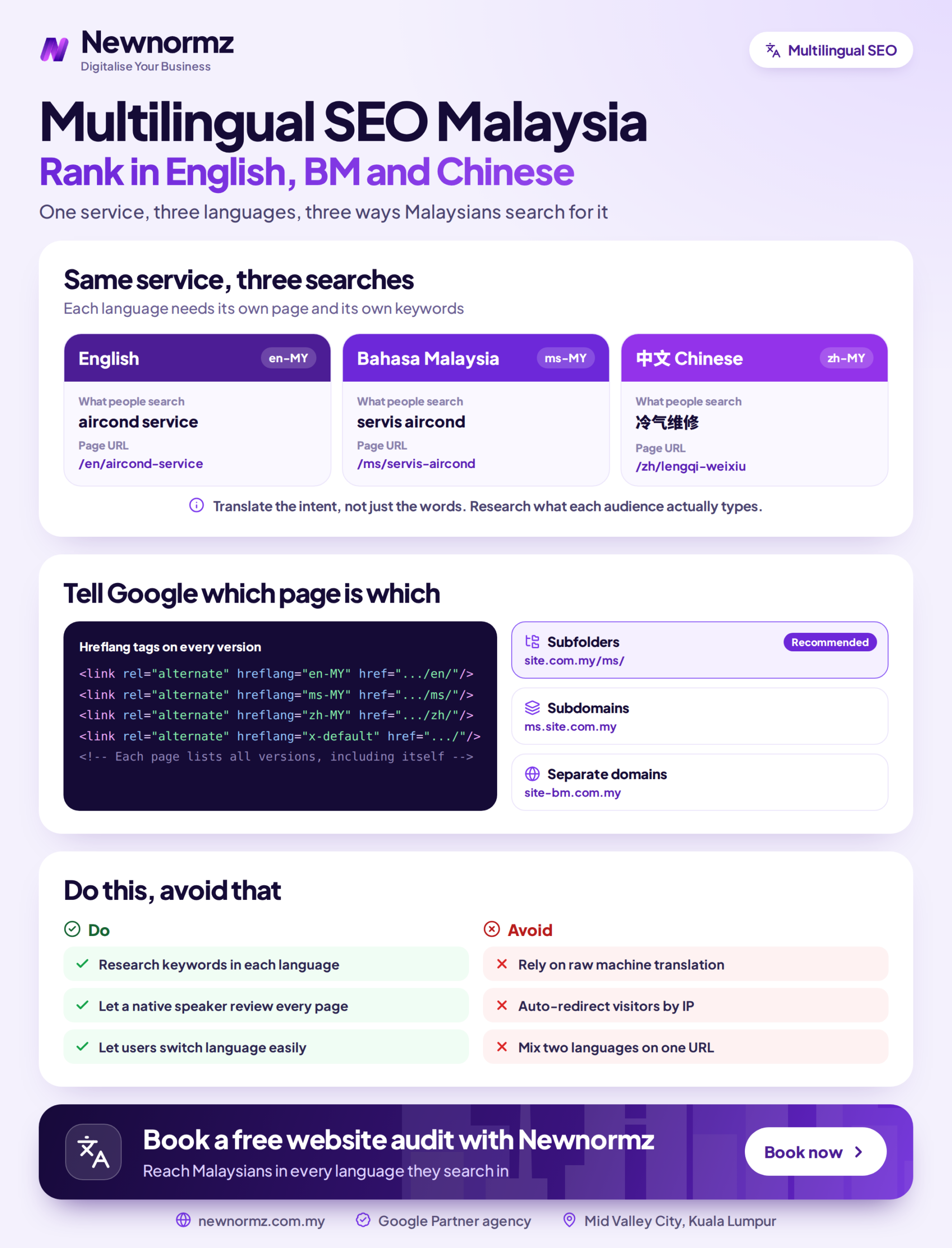
Each language version needs a distinct, crawlable URL. For most Malaysian SMEs, subfolders on one domain (/en/, /ms/, /zh/) are the easiest to manage and keep all your authority in one place. Avoid showing different languages at the same URL based on cookies or browser settings. Google generally crawls from one location without those preferences, so it may only ever see one version.
Set up hreflang properly
Hreflang tags tell Google which pages are language alternates of each other. A typical Malaysian setup uses en-MY, ms-MY and zh-Hans-MY (or zh-MY), plus an x-default for the fallback page. Two rules catch most people out. Every page must list all its alternates, including itself. And the tags must be reciprocal: if the English page points to the BM page, the BM page has to point back. If one side is missing, Google ignores the pair.
Don’t rely on on-the-fly translation widgets
Plugins that translate text in the visitor’s browser don’t create separate indexable pages. Visitors see Chinese, but Google still sees only English, so your site still ranks in one language. If you’re on WordPress, use a multilingual plugin that creates real, separate pages for each language.
Monitor each language separately
In Google Search Console, filter performance reports by URL folder so you can see impressions and clicks for each language. You can declare hreflang in your XML sitemap instead of the page head if that’s easier to maintain. Either way, check the indexing reports regularly. A language version that isn’t being indexed is invisible, however good it is.
Where to Start If You Can’t Do All Three at Once
Most businesses shouldn’t try to launch three full language versions in one go. You’ll end up with thin pages in three languages instead of strong pages in one. A better order:
- Get your strongest language ranking first. For most sites that’s English, but not always.
- Check your enquiries. If customers already WhatsApp you in BM or Chinese, that tells you where the demand is.
- Translate your top five to ten money pages into the second language (core services, top locations), fully researched and rewritten. Skip the blog archive for now.
- Measure for a few months, then decide whether the third language is worth the investment.
If you serve a specific area, combine this with local SEO. A BM or Chinese page targeting “near me” and town-level searches is often where the fastest wins are.
How Long It Takes
No one can promise a ranking position or date. Google has said so publicly many times. The ranges below are typical, not guaranteed, and competition in each language is the biggest variable.
| Stage | Typical Timeframe | What Affects It |
|---|---|---|
| New language pages indexed | A few days to a few weeks | Internal links, sitemap, overall site health |
| First rankings for lower-competition terms | Around 2 to 3 months | How crowded that language’s results are |
| Meaningful traffic from the new language | Around 4 to 6 months | Content quality and publishing consistency |
| Stable rankings across all three languages | Around 6 to 12 months | Ongoing optimisation in each language, not just launch |
Don’t judge the new language on traffic alone. Visitors who find a page in their own language often need less convincing when they enquire, and that shows up in lead quality before it shows up in raw numbers. If you want help planning this, our SEO service covers keyword research, page planning and technical setup for each language.
Frequently Asked Questions
Do I need a separate website for each language?
No. For most Malaysian businesses, one domain with a subfolder for each language is simpler to run and keeps your authority in one place. Separate domains make sense mainly when the language versions are effectively separate businesses.
Can I use AI or Google Translate to create the pages?
As a starting draft, yes. But have a native speaker who knows your industry rewrite it around keywords you’ve actually researched. Google cares whether a page is useful, not how it was produced, and raw machine output usually isn’t useful enough to rank.
Should my Chinese pages use Simplified or Traditional characters?
Simplified is the default for most Malaysian audiences, since it’s what local Chinese schools and media use. Only add Traditional if your enquiries or keyword data show real demand for it.
Will three language versions count as duplicate content?
Not if they’re properly set up. Pages in different languages aren’t duplicates. Problems come from sharing one URL across languages or from broken hreflang, which can make Google show the wrong version.
Which industries benefit most?
Any business whose customers don’t all speak the same language: healthcare, education, property, home services, retail and F&B are common examples. The quickest way to find out is to check whether competitors already rank in BM or Chinese for your core services. If nobody does, that’s an opening.
Ranking in only one language?
Find out which of Malaysia’s three search markets you’re missing.
Newnormz has run SEO campaigns across F&B, healthcare, ecommerce, and local services in Malaysia, backed by a performance guarantee of 70 percent of targeted keywords on Google’s first page.
30 minutes, no obligation, with a clear look at where your site stands in English, BM and Chinese search.

Bryan Tan is an SEO Specialist and CEO at Newnormz, helping hundreds of businesses achieve first-page rankings on Google. With a passion for driving organic growth, Bryan blends innovative strategies with hands-on experience to optimize websites for maximum visibility. Always at the forefront of the latest SEO insights and trends, he consistently adapts to the evolving digital landscape.