An SEO silo structure means grouping your pages into clear topic sections, then linking pages inside each section to each other. It helps Google see what your site is about and which page should rank for what. It will not force a ranking on its own, and nobody can guarantee one, but a messy structure is one of the most common things holding Malaysian business websites back.
A Simple Way to Think About It
Two Supermarkets, Same Products
🛒 Products dumped wherever there was space
Rice next to shampoo, noodles behind the fridges. You know they stock what you need, but you give up looking and leave.
🏷️ Clear aisles with signs overhead
Rice, noodles and cooking oil sit together under one sign. You find it in a minute and probably buy more than you planned.
Your website is the shop. Below is how to lay out the aisles so Google and your visitors both find what they came for.
What an SEO Silo Structure Actually Is
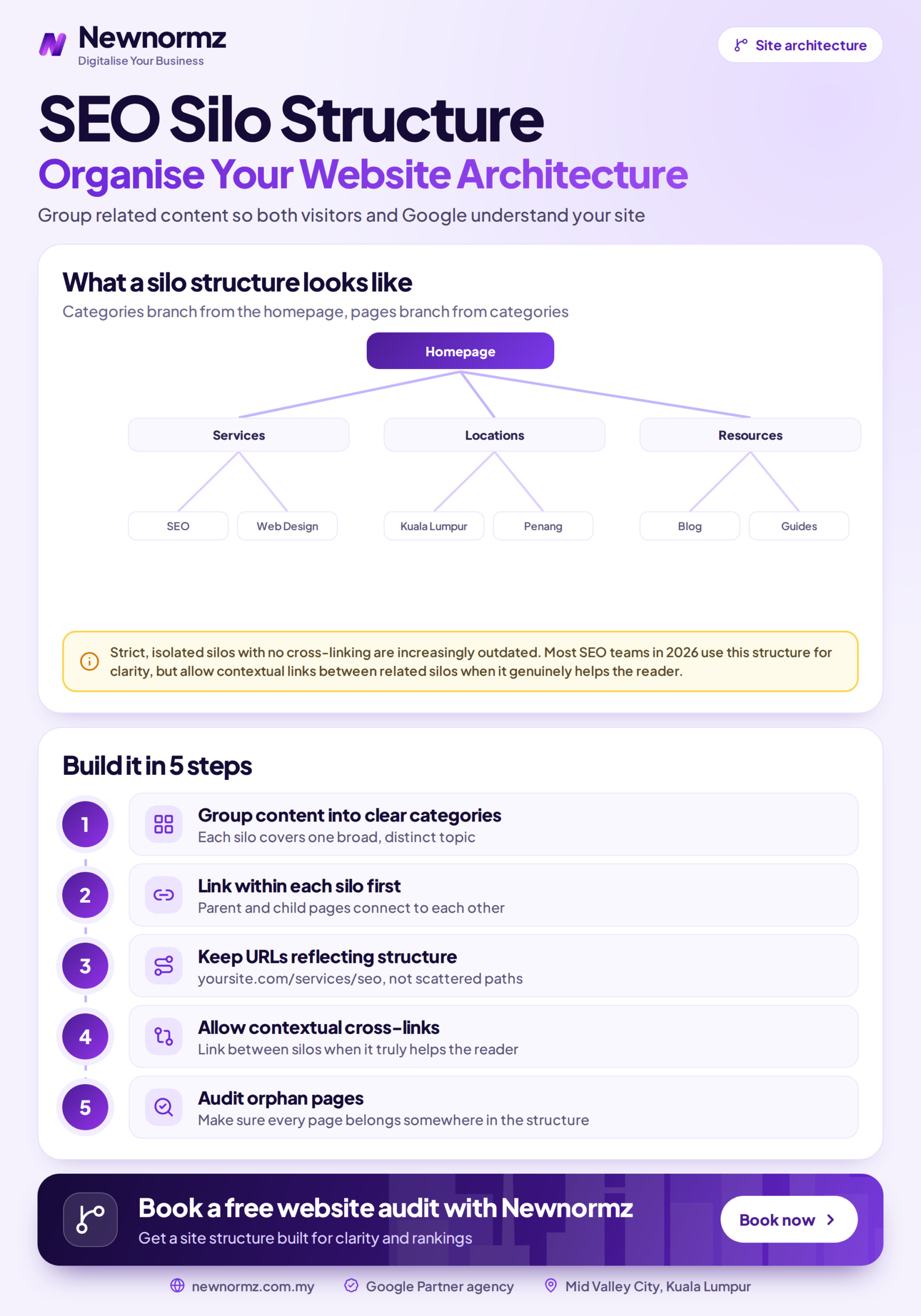
A silo is a group of pages about one subject. At the top sits a main page that covers the topic broadly. Beneath it are supporting pages that go deeper into specific parts of that topic. The pages in a silo link to each other, and they rarely link out to unrelated sections.
The point is clarity. When every page has an obvious home and an obvious job, Google has less guessing to do. Pages also stop competing with each other for the same search terms, which is a common problem on sites that grew without a plan.
| Level | Role | Example (digital marketing) |
|---|---|---|
| Pillar page | Covers the whole topic broadly | SEO services in Malaysia |
| Supporting pages | Cover one subtopic in depth | On-page SEO, technical SEO, link building |
| Detail articles | Answer one specific question | How to fix crawl errors, what meta tags do |
Why Structure Affects Rankings
Most SME websites in Malaysia were not planned. A page gets added when a new service launches, a blog post goes up when someone has time, and after two years nobody can say which page is meant to rank for what. Structure fixes that in a few practical ways:
- Clearer topic signals. A site that covers a subject in depth, in one organised place, is easier for Google to understand than one with a few scattered posts.
- Easier crawling. Pages that are properly linked are found and revisited more reliably than orphan pages nobody points to.
- Less internal competition. Each page targets its own keyword, so your own pages stop splitting rankings between them.
- Better use of new content. Every new article strengthens a section instead of sitting alone.
- Easier navigation for visitors. People who find the next relevant page quickly are more likely to stay and enquire.
Be realistic about it. Structure is one part of SEO, not a shortcut. It works best alongside solid content, keyword research and technical health. Google has said publicly that no one can guarantee a specific ranking position, and that applies here too.
Physical Silos vs Virtual Silos
There are two ways to build a silo, and the right one depends on the website you already have.
| Physical silo | Virtual silo | |
|---|---|---|
| How it works | Topics grouped by URL subfolder | Topics grouped by internal links, URLs unchanged |
| Best for | New sites or full rebuilds | Established sites with pages already ranking |
| Upfront effort | Higher | Lower, but needs a careful linking plan |
| Main risk | Changing URLs can break links and lose rankings if redirects are missed | Structure is less visible, so it drifts if nobody maintains it |
Physical silos
Each topic lives in its own folder, so the hierarchy shows in the address itself, for example yourwebsite.com/seo/technical-seo/. This is the cleanest option when you are building a new site or rebuilding an old one.
Virtual silos
You keep your current URLs and create the groupings through internal links instead. If your site already has pages that rank and bring in enquiries, this is usually the safer route. Changing URLs on a working site is a risk you only take when you have a clear reason and a proper redirect plan.
How to Build a Silo Structure, Step by Step
1. Pick your core topics
List the main services or product categories you want to be found for. Each becomes a silo. Most small businesses end up with three to seven. If you have more than that, your business may be trying to rank for too many unrelated things at once.
2. Map the pages under each topic
Give every silo one pillar page and a set of supporting pages. For an agency, the pillar could be your SEO service page, with supporting pages on on-page work, technical fixes and link building. Assign one target keyword per page, based on real keyword research, not guesses.
3. Fix the content you already have
Some existing pages will fit, some need rewriting, and some overlap so heavily they should be merged. Anything you merge or move needs a 301 redirect. Then write new pages only to fill genuine gaps.
4. Build the internal links
This is the step that actually creates the silo. The pillar links down to every supporting page. Each supporting page links back up to the pillar and across to close relatives in the same silo. Links between different silos should be rare and only used when the connection is genuine. Use descriptive anchor text so both people and Google know what the destination is about.
If your business serves specific areas, this also applies to location pages. A local SEO section works best when each area page sits clearly under one parent, not floating on its own.
5. Keep it maintained
A silo is not a one-off project. Every new post should be placed in the right section and linked properly from day one. Review the structure a few times a year, because that is when orphan pages and stray links start to appear.
Common Silo Mistakes
- Mixing unrelated topics in one silo. Off-topic pages dilute what the section is about.
- Linking between silos too freely. It blurs the boundaries you just built.
- Restructuring with no keyword plan. Neat folders do not help if the pages target nothing in particular.
- Letting new pages go in without a home. Structure breaks slowly, one unplanned post at a time.
- Ignoring old content. Outdated or overlapping pages should be updated, merged or redirected, not left to compete.
Overlapping pages are also the usual cause of keyword cannibalisation, where two of your own pages fight for the same search. A clean silo plan prevents most of it.
Frequently Asked Questions
How long does a silo structure take to show results?
There is no fixed timeline. Google needs time to recrawl and reassess your pages, so many sites start seeing movement after a few months, but it depends on your competition, your content and how much you changed.
Can I add silos to an existing website?
Yes. A virtual silo lets you reorganise through internal links without changing URLs, which protects pages that already rank.
Do I need a lot of content first?
No. Start with your core service pages, then add supporting content where the gaps are. A small, well-organised site beats a large, messy one.
Does it work for ecommerce sites?
Yes. Category pages act as pillars, product pages and buying guides support them, and links between related products stay within the same category.
Is your site structure holding you back?
Find out where your pages are scattered and what to fix first
Newnormz has run SEO campaigns across F&B, healthcare, ecommerce, and local services in Malaysia, backed by a performance guarantee of 70 percent of targeted keywords on Google’s first page.
30 minutes, no obligation, including a review of your site architecture.

Bryan Tan is an SEO Specialist and CEO at Newnormz, helping hundreds of businesses achieve first-page rankings on Google. With a passion for driving organic growth, Bryan blends innovative strategies with hands-on experience to optimize websites for maximum visibility. Always at the forefront of the latest SEO insights and trends, he consistently adapts to the evolving digital landscape.