Grey hat SEO is any tactic that isn’t clearly banned today but bends Google’s guidelines to get results faster than earning them would. Think paid guest posts, expired domain redirects, reciprocal link swaps, and location pages cloned for every town in the Klang Valley. Some of these work for a while. The problem is that “grey” is not a permanent category. Google keeps redrawing the line, and tactics that were grey in 2022 got written into its spam policies by 2024. If your business can’t afford to lose its rankings overnight, most grey hat tactics are a bet you don’t need to make.
A Simple Way to Think About It
The Emergency Lane on the Federal Highway
🚨 Cutting through the emergency lane
You skip the jam every morning and feel clever about it. Then one day there’s a roadblock waiting at the end of the lane, and the summons wipes out every minute you ever saved.
🛣️ Leaving the house earlier
You sit in the same traffic as everyone else, but you planned for it. You arrive on time every day and never check the mirror.
Below, we go through the tactics that live in that emergency lane, how Google treats each one today, and which ones are actually just the normal road with a bad reputation.
What “grey hat” actually means
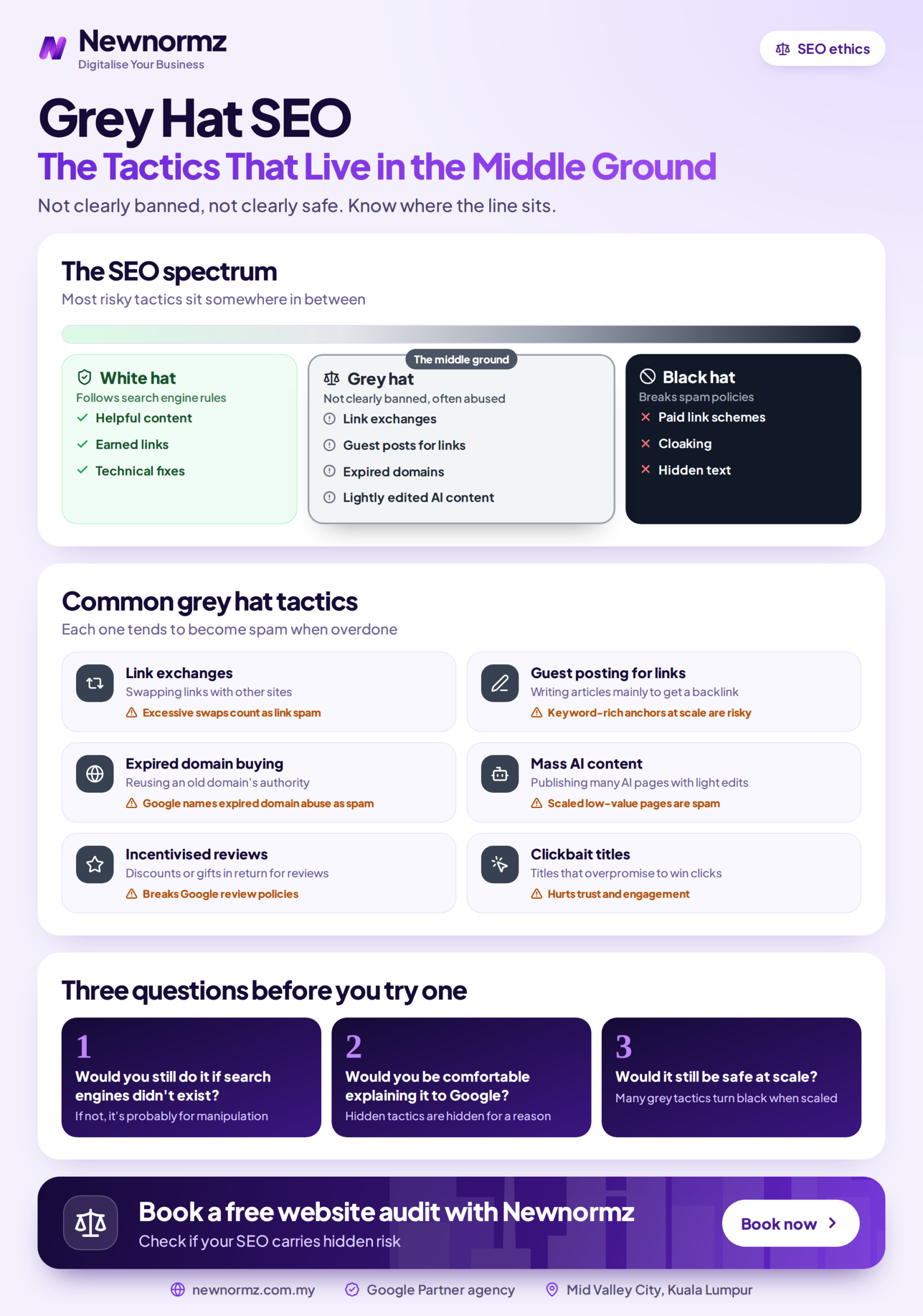
The SEO industry splits tactics into three buckets. White hat follows Google’s guidelines. Black hat breaks them on purpose: cloaking, hacked links, hidden text. Grey hat sits in between. These are tactics Google hasn’t explicitly punished yet, or punishes inconsistently, or that sit in a technically allowed shape but serve a manipulative purpose.
Here’s the part most articles skip. Grey hat is not a stable category. It’s a waiting room. Google’s March 2024 spam policy update is the clearest example: it added three new named violations (expired domain abuse, scaled content abuse, and site reputation abuse). All three had been sold for years as “grey but fine.” Overnight, they became black hat by definition, and sites built on them lost traffic.
So the useful question is never “is this allowed right now?” It’s “if Google decides to enforce against this next year, what happens to my business?”
The common grey hat tactics, one by one
Paid guest posts
This is the most common one in Malaysia. You pay a blog RM150 to RM800 to publish an article with a dofollow link back to your site. Google’s link spam policy is explicit: buying links that pass ranking value is a violation unless the link is marked rel="sponsored" or nofollow. Most paid guest post sellers promise the link will be dofollow and “natural looking.” That promise is the grey part. The more of these links you have, and the more obviously the host site sells them to anyone, the higher your exposure.
Expired domain redirects
Someone buys an expired domain that used to have strong backlinks, then 301 redirects it to your site to pass that authority along. When the old domain was genuinely related to your business (say, you acquired a competitor), this is normal. When it’s a defunct Penang travel blog redirected to a Shah Alam aircon servicing company, it’s exactly what Google now calls expired domain abuse.
Link exchanges
“You link to me, I link to you.” A handful of these between genuine partners (a supplier and a retailer, say) is ordinary business. Google’s guidelines specifically call out excessive link exchanges. The trouble is that nobody outside Google knows where “excessive” starts, which is the definition of grey.
Cloned location pages
One page for “plumber Petaling Jaya,” another for “plumber Subang Jaya,” another for “plumber Puchong,” all with the same text and only the town name swapped. Google calls these doorway pages. If you genuinely serve each area and each page has real, specific information (response times, local projects, the actual team that covers it), location pages are fine. If they’re copy-paste with a find-and-replace, they’re a liability.
Mass-produced AI content
Publishing hundreds of thin AI-written articles to catch every long-tail keyword. Google has said clearly that using AI to write content is not the problem. Producing content at scale mainly to manipulate rankings, with little value for readers, is. That’s scaled content abuse, and it doesn’t matter whether a human or a tool wrote it.
Keyword-stuffed Google Business Profile names
This one is very Malaysian. A clinic registered as “Klinik Sri Aman” appears on Google Maps as “Klinik Sri Aman | Best 24 Hour Clinic Cheras KL.” It often does help Maps rankings in the short term, which is why it’s everywhere. It also breaks Google Business Profile guidelines, competitors can report it with one click, and suspensions do happen. If you’re investing in local SEO, this is the first thing we’d fix, not add.
Risk at a glance
| Tactic | Legitimate version | Where it tips into a violation |
|---|---|---|
| Guest posts | Writing for a relevant publication because their readers are your customers | Paying for dofollow links on sites that sell to anyone, in any niche |
| Domain redirects | Merging a business or brand you actually acquired | Buying unrelated expired domains only for their backlinks |
| Link exchanges | Linking to real partners, suppliers, or associations | Joining link swap groups or trading links as a routine |
| Location pages | One page per area you truly serve, with specific local detail | Near-identical pages with only the town name changed |
| AI-assisted content | Drafting faster, then adding real expertise and editing properly | Publishing hundreds of unedited pages to catch keywords |
| Business Profile name | Your real, registered business name | Adding keywords and locations that aren’t part of your actual name |
Look at the middle column. Almost every grey hat tactic has a legitimate twin. What separates the two is intent and scale, and those are exactly what Google’s systems keep getting better at detecting.
Why grey hat is a worse deal than it looks
The pitch for grey hat is always speed. And sometimes it is faster, for a while. But look at what you’re actually trading.
The downside is lopsided. A grey hat tactic might save you a few months. A manual action or an algorithmic hit can take far longer than that to recover from, and you still have to undo the tactic afterwards. You’re risking the whole asset to speed up one part of it.
You often don’t know it’s happening. Many Malaysian business owners find out their previous agency bought links only when rankings collapse and someone finally pulls a backlink report. If your agency won’t show you exactly where your links come from, treat that as your answer.
It doesn’t compound. Content that genuinely answers your customers’ questions keeps earning traffic and links for years. Bought links do nothing after the seller’s site gets devalued, and you’ll need to keep buying more to stand still.
For context on what the slower route produces: our 2-year campaign for Oriental Kopi grew traffic by 43,300, generated 6.31M impressions, and added 24,500 more ranking keywords. Sunway Medispa saw a 700% traffic increase in six months. Neither relied on shortcuts. Not every campaign moves at that pace, and anyone who guarantees you a specific ranking position is saying something Google itself has repeatedly said no one can promise.
If you need results faster, do this instead
The honest answer to “SEO is too slow” is usually not grey hat SEO. It’s pairing SEO with something that is fast by design.
- Run paid search alongside SEO. Our client, a KL confinement centre, spent RM2,550 a month and got qualified leads within 30 days by pairing Google Ads with their SEO work. Ads cover the gap while organic rankings build.
- Fix the technical basics first. Slow pages, broken internal links, and missing indexing are the quickest legitimate wins, and they’re often ignored because they aren’t exciting.
- Go after the keywords you can actually win. Bahasa Malaysia and Chinese-language searches are often far less competitive than English equivalents, and plenty of Malaysians search that way.
- Earn links with things worth linking to. Local data, a genuinely useful price guide, a comment for a local news story. Slower per link, but each one stays.
A good SEO agency in Malaysia should be able to explain every tactic it uses on your site in plain language, and none of those explanations should include “Google probably won’t notice.”
Frequently asked questions
Is grey hat SEO illegal?
No. Grey hat SEO is not a legal issue in Malaysia or anywhere else. It’s a question of breaking Google’s rules, not the law. The penalty is lost rankings and traffic, which for many businesses hurts just as much.
How do I know if my current agency is using grey hat tactics?
Ask for a full list of the backlinks they’ve built and where each one came from. Check for clusters of links from unrelated blogs, sudden redirects from domains you don’t recognise, or location pages that read identically. If they’re vague or refuse, that tells you a lot.
Can I recover if my site has already been hit?
Usually, yes, but it takes work. You remove or disavow the manipulative links, clean up thin or duplicated pages, and submit a reconsideration request if there’s a manual action in Search Console. Recovery from algorithmic drops tends to come with later updates, not overnight.
Are all paid links bad?
No. Sponsorships, advertorials, and directory listings are normal marketing. They just need to be marked with rel=”sponsored” or rel=”nofollow” so they don’t pass ranking value. The violation is paying for a link specifically to manipulate rankings and hiding that it was paid.
Is using AI to write content grey hat?
Not by itself. Google judges content on whether it’s helpful, not on how it was produced. It becomes a problem when AI is used to churn out large volumes of low-value pages whose only real purpose is to rank.
Not sure what’s been done to your site?
Find out if grey hat tactics are putting your rankings at risk
Newnormz has run SEO campaigns across F&B, healthcare, ecommerce, and local services in Malaysia, backed by a performance guarantee of 70 percent of targeted keywords on Google’s first page.
30 minutes, no obligation, including a plain-language review of your backlink profile.

Bryan Tan is an SEO Specialist and CEO at Newnormz, helping hundreds of businesses achieve first-page rankings on Google. With a passion for driving organic growth, Bryan blends innovative strategies with hands-on experience to optimize websites for maximum visibility. Always at the forefront of the latest SEO insights and trends, he consistently adapts to the evolving digital landscape.