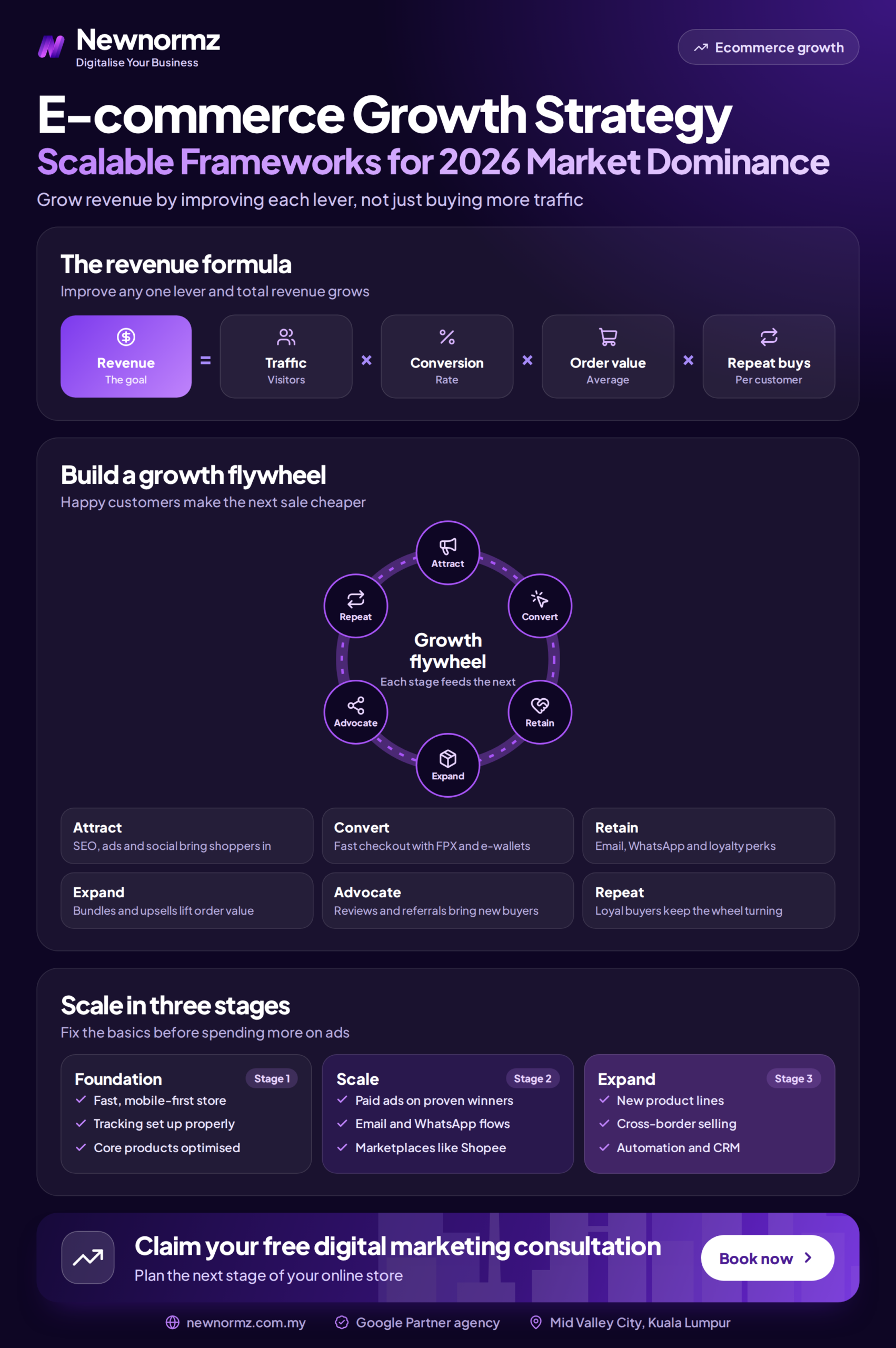
A scalable e-commerce growth strategy in 2026 depends less on finding a new channel and more on doing things in the right order. First fix your site speed, mobile checkout and tracking. Then make your product pages convert. Then build search traffic, including visibility in Google’s AI answers. Only after that should you put serious paid budget behind the products that already sell. Keep the customers you win through email and WhatsApp, so a repeat sale doesn’t cost you the same as a brand-new one. Nobody can promise you “market dominance” by a certain date, and anyone who does is selling you a slogan. What you can build is a store where every extra ringgit of traffic turns into more profit, not more leakage.
A Simple Way to Think About It
The Leaky Bucket
🪣 Pouring Faster
Your bucket has a hole in the bottom, so you pour water in faster. It never fills up, and the water bill keeps climbing.
🔧 Patching First
You spend ten minutes patching the hole. Now every cup you pour stays in, and you need less water to fill it.
The framework below is built on that idea: find where the store leaks, fix it, and only then add volume.
Why Most Malaysian Online Stores Hit a Ceiling
The pattern is familiar. A brand launches on Shopee, Lazada or TikTok Shop, grows on vouchers, live selling and ads, and then growth flattens. More sellers bid for the same audiences, so every order costs more to win. Meanwhile the brand’s own website gets some traffic but converts poorly on mobile, and nobody is quite sure why.
Most stores react by spending more. That works for a while. The trouble is that marketplace customers belong to the marketplace, and paid traffic stops the day the budget stops. If those are your only two engines, you’re renting all of your growth.
That doesn’t mean you should walk away from marketplaces. Many Malaysian shoppers start their product searches there, and ignoring them would be a mistake. It means you shouldn’t depend on them alone. A growth strategy that scales adds channels you own, and it adds them in an order where each one makes the next one cheaper.
A Four-Layer Framework That Actually Scales
Each layer should be working before you lean hard on the next. If you skip ahead, for example by scaling ads before the checkout works on mobile, you pay to send buyers into a leak.
| Layer | What It Covers | Move On When |
|---|---|---|
| 1. Foundation | Fast mobile pages, a simple checkout, working analytics and conversion tracking | Pages load quickly on a mid-range phone using mobile data, and you can see exactly where visitors drop off |
| 2. Conversion | Product pages, reviews, clear shipping and returns, local payment options such as FPX, DuitNow and e-wallets | Visitors who reach a product page buy at a rate your margins can support |
| 3. Demand capture | SEO for category and product pages, Google Shopping and Search ads, marketplace presence | You know which channels bring in buyers at a cost per order you can sustain |
| 4. Retention | Email, WhatsApp, reorder reminders, loyalty offers | Repeat customers bring in a growing share of revenue each quarter |
Where the Leaks Usually Are
Most stores we audit don’t need a rebuild. They need a handful of fixes that are cheap compared with the revenue they’re losing. Common ones: checkout forces shoppers to create an account, a shipping fee first appears at the final step, the shopper’s preferred payment method is missing, or a product page has one photo and a description copied from the supplier. Each one quietly sends buyers back to the marketplace, where the same product is two taps away.
Fix these before you spend another ringgit on traffic. You’ll feel the difference in every channel you add afterwards.
Search in 2026: Ranking and Getting Quoted
In 2024, Gartner predicted that traditional search engine volume would fall by 25% by 2026 as people moved to AI chatbots. Treat that as a forecast, not a measured result. What is measurable: Google still holds around 93% of search market share in Malaysia (Statcounter, May 2026), and with 35.4 million internet users and 98% penetration at the end of 2025 (DataReportal), Google is still where most buying research starts.
What has changed is the results page itself. AI Overviews now answer many questions before anyone clicks, so a store needs two things: pages that rank, and pages that are easy to quote. In practice, the pages that get pulled into AI answers tend to answer one specific question clearly, carry structured product data (price, availability and reviews marked up with schema), and belong to a brand that other trusted sites mention.
Now the honest part. Nobody controls what an AI answer chooses to cite. Google has said publicly that no one can guarantee a specific ranking position, and the same logic applies to AI results. Any agency promising you a guaranteed spot in ChatGPT or Gemini is overselling. What you can do is make your pages the clearest, best-structured and most credible option available, which is also what wins in regular search.
Category Pages Do the Heavy Lifting
For most stores, the biggest organic opportunity is category pages, not the blog. People search things like “running shoes women Malaysia”, “kasut sukan wanita” or the Chinese equivalent, and a well-built category page can rank for all of them. That means a genuinely useful intro, filters that don’t create thousands of thin duplicate URLs, and short buying guidance that answers the questions shoppers actually ask. This is the kind of groundwork a structured SEO service should prioritise before it touches anything else.
Paid Ads: Scale What Already Converts
Ads are your fastest lever and your least durable one. They’re excellent for testing demand and for scaling products that have already shown they sell. They’re a poor fix for a site that doesn’t convert.
A sensible split for most Malaysian stores: Google Shopping for shoppers who already know what product they want, Search ads for high-intent queries, Meta and TikTok for discovery, and retargeting to bring back people who abandoned a cart. Well-structured Google Ads campaigns give you clean data on which products and search terms actually make money, and that feeds straight back into your SEO priorities.
One warning. Moving budgets around every day because of a single good or bad day usually does more harm than good. Give campaigns enough conversions to learn from before you judge them. Plan ahead for 11.11, 12.12, Raya and Chinese New Year too, in terms of stock, site capacity and creative, so peak season doesn’t expose the leaks you haven’t fixed.
Pairing the two channels works outside e-commerce as well. A KL confinement centre we worked with ran SEO alongside Google Ads on a RM2,550 monthly budget and saw qualified leads within 30 days, because the ads produced signal quickly while the organic work built up in the background.
Do You Actually Need a Custom-Built Store?
Usually not at first. Shopify and WooCommerce handle the needs of most Malaysian stores perfectly well. A slow site is more often caused by too many apps, tracking scripts and heavy theme features than by the platform itself, and it can often be fixed without a rebuild.
Custom development starts to make sense when you hit specific limits: complex pricing or B2B ordering, inventory that has to sync across several warehouses and marketplaces, or a theme so bloated that stripping it back costs more than starting clean. Headless setups are a real option for large catalogues backed by an in-house development team, but they add cost and complexity. Pick one because you’ve outgrown what you have, not because it’s the trend.
The Numbers That Tell You It’s Working
Traffic and impressions are useful early signals. They aren’t the goal. These are the numbers worth reviewing every month:
| Metric | What It Tells You | Warning Sign |
|---|---|---|
| Conversion rate by device | Whether your site turns visits into orders | Mobile converts far below desktop |
| Customer acquisition cost | What each new customer costs across all channels | Rises month after month while order value stays flat |
| Customer lifetime value | How much a customer is worth over time | Most customers buy once and never come back |
| Contribution margin per order | Profit after product cost, shipping, platform fees and ad spend | Revenue grows while margin shrinks |
| Organic share of revenue | How dependent you are on paid channels | Still close to zero after a year of trading |
If you only track one thing, make it contribution margin. A store that grows revenue while losing money on each order isn’t scaling. It’s burning cash faster.
How Long This Takes, Honestly
Conversion fixes can show results within weeks. Ads produce data within days, but it takes weeks to optimise them properly. Organic search takes months, and it compounds after that.
Our own campaigns show that shape clearly, even though they aren’t pure e-commerce stores. In six months, Times Parking reached 528,000 impressions, 416 ranking keywords and 31.5K clicks. Sunway Medispa saw a 700% traffic increase over the same six-month window. Oriental Kopi is the example of what staying with it looks like: over two years, the F&B brand reached 6.31 million impressions and 468,000 clicks and added 24,500 ranking keywords. The first six months build the base, and the gains after that come from growth on top of growth.
So plan for a quarter to fix the foundation and conversion, and at least six months before judging your organic channel. Keep paid running throughout to fund growth in the meantime.
Frequently Asked Questions
Should I focus on marketplaces or my own website?
Both, for different jobs. Marketplaces give you reach and shoppers who are ready to buy. Your own website gives you better margins, your customer data and a direct line to repeat buyers. The risk is depending on marketplaces alone, where fees and competition are set by someone else.
How much should I spend on ads?
There’s no universal figure, so be wary of anyone who quotes one without seeing your numbers. Work backwards from your margin and lifetime value to find the most you can afford to pay for a customer. Then start with a test budget large enough to produce meaningful conversions on your best-selling products.
Does AI search mean SEO no longer matters?
No. AI answers are built largely from pages that are already well structured and trusted, and Google still handles the vast majority of searches in Malaysia. Optimising for AI visibility is an extension of good SEO, not a replacement for it.
Can a small store compete with big brands?
Yes, in the right places. Big brands rarely build strong pages for specific long-tail searches, niche product categories or Bahasa Malaysia and Chinese-language queries. A small store that owns those searches can win steady, profitable traffic without trying to outspend anyone.
What should I fix first?
Mobile checkout and conversion tracking. If you can’t see where buyers drop off, every other decision is a guess. If the checkout leaks, every other channel costs more than it should.
Is your online store leaking sales?
Find out exactly where your e-commerce growth is stuck, before you spend more on traffic.
Newnormz has run SEO campaigns across F&B, healthcare, ecommerce, and local services in Malaysia, backed by a performance guarantee of 70 percent of targeted keywords on Google’s first page.
30 minutes, no obligation, and a clear look at where your store loses buyers.

Bryan Tan is an SEO Specialist and CEO at Newnormz, helping hundreds of businesses achieve first-page rankings on Google. With a passion for driving organic growth, Bryan blends innovative strategies with hands-on experience to optimize websites for maximum visibility. Always at the forefront of the latest SEO insights and trends, he consistently adapts to the evolving digital landscape.