Yes, a Malaysian startup can start building organic traffic with no money for an agency, but “zero budget” really means you pay with time instead of ringgit. Free tools cover keyword research, technical checks and tracking. What they cannot do is speed things up. New websites usually need months before rankings move, and no one can promise you a specific position on Google. The startups that get somewhere pick narrow, local, high-intent keywords, fix the technical basics before writing, and publish a few genuinely useful pages instead of many thin ones.
A Simple Way to Think About It
Flyers vs. The Stall Everyone Recommends
📄 Handing out flyers
You stand outside the mall with a stack of paper. People take one while you are there. The moment you go home, nobody finds you.
🍜 Becoming the stall people recommend
It takes months of showing up and serving well. After that, strangers get sent to you by people who have never met you.
With no budget you cannot hand out flyers, so the stall is your only route. The steps below are how you build it.
Why Startups Should Start SEO Before They Have Budget
Most founders put SEO off until there is money for it. Meanwhile, competitors keep publishing pages and collecting the search visibility you will later have to compete against.
The audience is already there. Malaysia had 35.4M internet users at the end of 2025 (DataReportal Digital 2026 Malaysia), and Google holds roughly 93% of the local search market (Statcounter, May 2026). If a buyer searches for what you sell and you have no page that answers them, you are invisible to the biggest group of potential customers.
Be realistic about the trade. Paid ads give you traffic this week and stop when the budget does. SEO gives you nothing for a while, then compounds. A startup with more time than cash is well placed for the second one. For a sense of scale, Times Parking saw 528,000 impressions, 416 ranking keywords and 31.5K clicks from a 6-month SEO campaign. That was a funded campaign, so treat it as an illustration of what sustained work can produce, not a benchmark for a DIY start.
Step 1: Pick Keywords You Can Actually Win
The most common startup mistake is chasing broad terms like “digital marketing Malaysia”. Established agencies with years of content and links own those results. A new site will not crack them for a long time, and may never.
Go narrower. Long-tail keywords have lower search volume, but the person typing them usually knows what they want. A searcher using a specific, location-qualified phrase is much closer to buying than someone typing a single generic word.
What Good Startup Keywords Look Like
- “SEO package for startup Malaysia”
- “affordable SEO for small business KL”
- “best keywords for ecommerce Malaysia”
- A product or service plus a city, such as “[your service] Penang” or “[your service] Johor Bahru”
Do not ignore language. Many Malaysians search in Bahasa Malaysia or Chinese, and in some industries those results are far less crowded than the English ones. If your customers search that way, checking those queries is free and can be a real advantage.
Three free tools cover most of this work:
| Free tool | What it does for a startup | Where it falls short |
|---|---|---|
| Google Search Console | Shows the queries your site already appears for, plus indexing problems | Only useful once the site has some impressions |
| Google Keyword Planner | Gives ideas and rough volume ranges for Malaysian searches | Volumes are ranges, not exact figures |
| Google search itself | Autocomplete and “People also ask” show how real people phrase questions | No volume data, so you judge by relevance |
Step 2: Fix the Technical Basics First
Publishing content on a site Google struggles to crawl is wasted effort. Broken links, missing page titles, slow pages and a poor mobile layout all hold rankings back, however good the writing is.
For a new site, check these before you write anything:
- Mobile layout: Google indexes the mobile version of your site, so that is the version that gets judged.
- Page speed: Compress images, avoid heavy plugins and use decent hosting. Slow pages lose visitors before they read a word.
- HTTPS: A secure site is a baseline expectation, for Google and for visitors.
- Clean URLs: Short and descriptive, such as /seo-package-startup, not a string of numbers.
- Sitemap: Submit it in Google Search Console so your pages are found sooner.
- Page titles and descriptions: Every page needs its own, written for the keyword it targets.
An hour spent on this now saves you from discovering months later that half your pages were never indexed.
Step 3: Publish Fewer Pages, Make Each One Useful
Writing for traffic alone produces pages that rank and never convert. Every page should either bring in the right visitor or move them closer to contacting you. Think of your content in three layers:
- Awareness: Answers to questions your buyers already search for.
- Consideration: Comparisons and guides that help them weigh options, such as in-house vs agency.
- Decision: Service and landing pages with a clear offer and one clear next step.
With zero budget, start at the bottom. Build your service pages first, because that is where buyers decide. Then add a small number of articles that support them.
Two solid articles a month beats ten shallow ones. Add what only you know: local pricing in RM, what customers in your city ask, how Shopee or Lazada fits into the buying decision. That detail is hard for a bigger competitor or a generic AI-written page to copy.
Step 4: Earn Links Without Paying for Them
Links from other sites remain a strong ranking signal, and buying them is the fastest way to get into trouble. Free routes that work:
- Google Business Profile: Set it up properly if you serve customers locally. It also feeds local SEO visibility.
- Credible local directories: Industry associations and reputable Malaysian business listings.
- Partners and suppliers: Ask clients, suppliers and event organisers you already work with to mention or link to you.
- Guest articles: Write for a respected Malaysian industry blog or publication. One relevant link beats many weak ones.
- Original local insight: A small survey or a short case write-up gives other sites a reason to cite you.
How Long Before Anything Happens?
Honestly, plan for months, not weeks. Google does not publish a timeline and nobody can guarantee a ranking position, so be wary of anyone who does. What you can track are the early signs, in roughly this order:
| Signal | What it means | What to do |
|---|---|---|
| Pages appear as indexed | Google can find and read your site | Fix any pages marked as excluded |
| Impressions start rising | You are showing up for some searches, even on page 3 or 4 | Strengthen the pages gaining impressions |
| Long-tail keywords reach page 1 | Your narrow targeting is working | Build more content around the same topics |
| Enquiries mention Google | Traffic is turning into leads | Improve the page’s call to action and track it |
Where DIY Runs Out and Help Pays Off
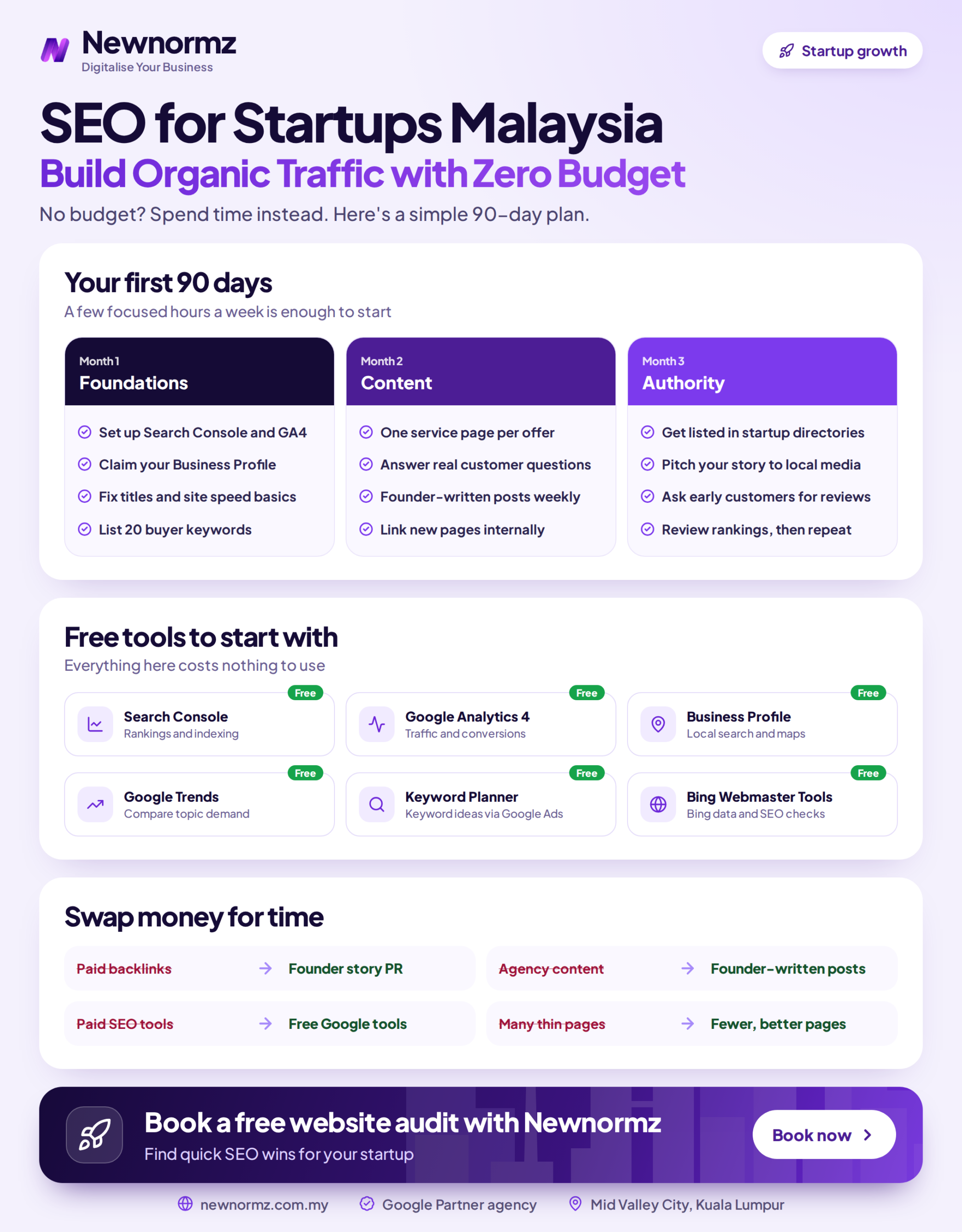
DIY SEO is a sensible start. Keyword research, basic fixes and your first pages are all within reach of a motivated founder. The gap tends to show once you need to connect technical health, content planning and lead tracking, and you cannot tell which problem is holding you back.
That is the point where a specialist saves time rather than adds cost. An SEO service can audit the site, rank the fixes by impact and give you a roadmap, so your limited hours go to the work that matters. If you have a small budget but no spare time, it is also a fair way to spend it.
Frequently Asked Questions
How long does SEO take for a Malaysian startup?
Expect several months before rankings and traffic move in a meaningful way. Early signs such as indexing and rising impressions often come first. It depends on your competition, your site’s condition and how consistently you publish, and no honest provider can promise an exact timeline.
Is SEO worth it if I cannot spend anything?
Yes, if you can put in the time. The core tools are free. What you give up is speed, so SEO suits a startup that can wait, not one that needs customers next week.
Should I use SEO or Google Ads first?
If you need leads quickly and have some budget, ads are faster. If you have no budget, SEO is the realistic starting point. Many startups end up using both, with ads covering the gap while organic rankings build.
What should I prepare before starting?
Know which two or three services or products make you money, set up Google Search Console and a Google Business Profile, and make sure your site works properly on a phone. That is enough to begin.
Do I need to write in English only?
No. If your customers search in Bahasa Malaysia or Chinese, content in those languages can reach people your English-only competitors miss. Check how your buyers actually search before deciding.
Not sure where your startup site stands?
Find out what is holding your new website back on Google
Newnormz has run SEO campaigns across F&B, healthcare, ecommerce, and local services in Malaysia, backed by a performance guarantee of 70 percent of targeted keywords on Google’s first page.
30 minutes, no obligation, and a clear list of what to fix first.

Bryan Tan is an SEO Specialist and CEO at Newnormz, helping hundreds of businesses achieve first-page rankings on Google. With a passion for driving organic growth, Bryan blends innovative strategies with hands-on experience to optimize websites for maximum visibility. Always at the forefront of the latest SEO insights and trends, he consistently adapts to the evolving digital landscape.