A sales executive screenshots a customer’s WhatsApp complaint and posts it on their Instagram Story with a laughing emoji. Two weeks later, the intern who set up your TikTok account leaves, and the login leaves with them. A social media policy template that only deals with the first problem is half a policy. The template below covers both jobs: how staff behave online, and how the company keeps control of its own accounts. It goes clause by clause, gives a checklist for each clause, and is written for Malaysian law and the way Malaysians actually use social media.
This guide is for HR managers, marketing leads and SME owners who need to issue a policy this month. It is a marketing practitioner’s template, not legal advice, so have an employment lawyer check your final version before you issue it.
Key takeaways
- ✓Fix account ownership first. Every brand page, ad account and WhatsApp Business number should belong to the company and have at least two company-side admins.
- ✓Customer data in staff WhatsApp chats is a PDPA exposure, and most US-style templates never mention it.
- ✓Content touching race, religion and royalty (3R), and festive posts, need a review step by someone from that community and a native-speaker language check.
- ✓Employee advocacy needs rules too: staff disclose that they work for you, and nobody poses as a customer.
- ✓Offboarding is where most policies fail. Remove access on the last working day, not when someone remembers.
Why Most Social Media Policy Templates Fail Malaysian Companies
Most templates you’ll find are lifted from US HR websites. They spend pages on personal conduct, such as not swearing online or not posting from the office party, and stop there. Very few say who owns the Facebook page, who holds the TikTok login, or what happens to the customer chats on a salesperson’s phone.
They are also written in a legal tone nobody finishes reading. A social media policy for employees only works if staff can remember the five things they must never do. A 12-page PDF they signed on day one and never opened again doesn’t do that.
The gap shows up most clearly when we audit social accounts. One problem comes up again and again.
✗ The brand’s page is tied to a former intern’s personal login
Someone junior sets up the TikTok account with their own email and phone number, or creates the Facebook page from their personal profile, because that was the fastest way to start. They leave. Now the company can’t log in, can’t run ads from the account, and can’t reset the password without that person’s help. Getting it back through platform support is slow and never guaranteed.
✓ The fix
Move every account to a company-owned email and phone number, hold the assets inside a company business portfolio (Meta) or Business Center (TikTok), and make sure at least two current staff have full admin access. Then write that rule into the policy so it can’t happen again.
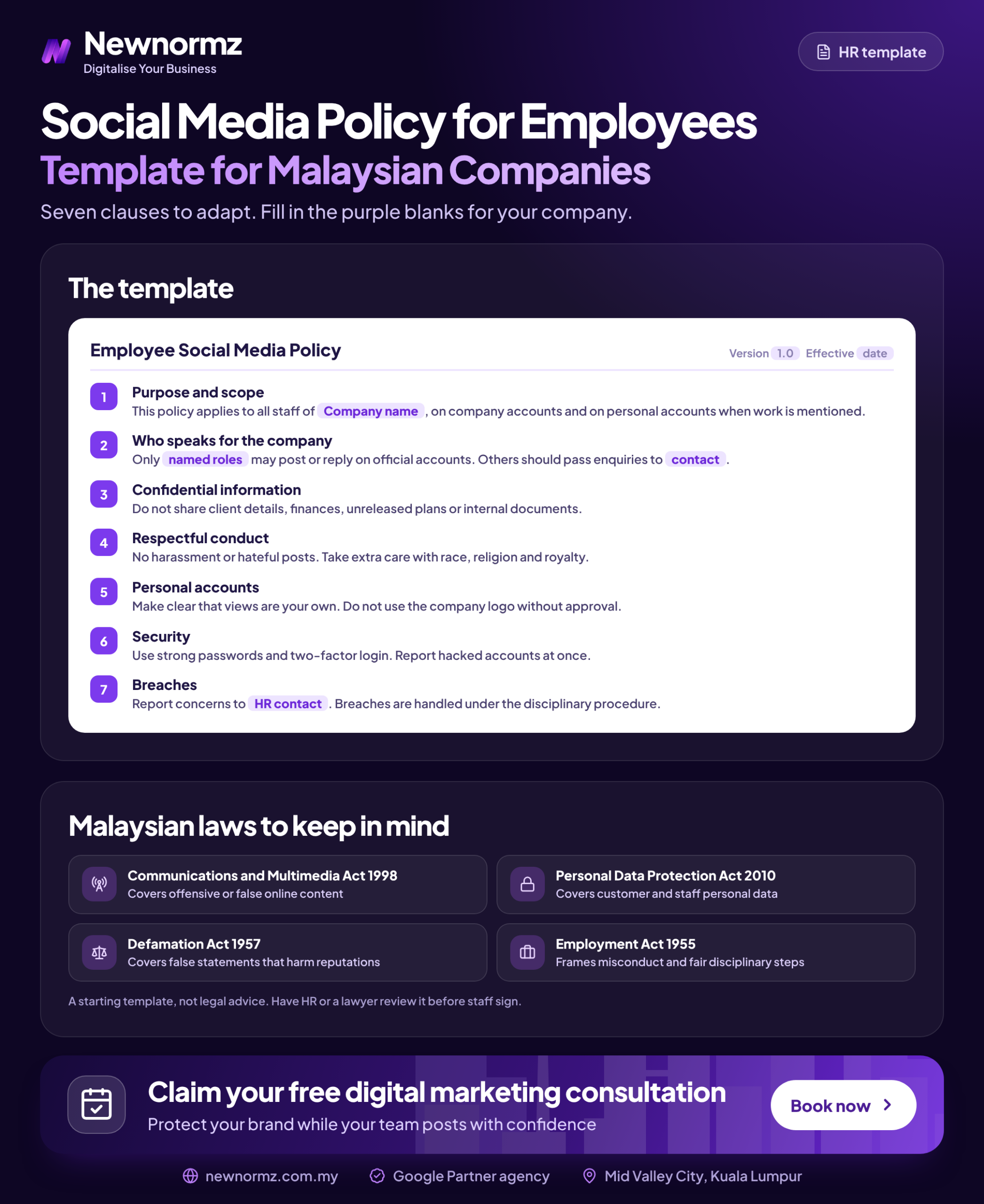
The Social Media Policy Template: 9 Clauses, Section by Section
Each clause below has template wording you can copy and adapt, then a short checklist to confirm the clause is actually working in practice. Treat it as a social media policy sample: replace the [bracketed] parts with your company’s details, and cut anything that doesn’t apply.
Clause 1. Scope and Who the Policy Covers
Keep the scope wide. Freelancers and agencies often hold more account access than full-time staff, and WhatsApp is where most Malaysian customer conversations happen, so leave it out and you’ve left a gap.
Template wording
This policy applies to all full-time, part-time and contract employees, interns, freelancers and agencies working for [Company]. It covers company accounts and any personal account where the content refers to [Company], its clients, products or staff. It applies to all platforms, including Facebook, Instagram, TikTok, YouTube, LinkedIn, X, Xiaohongshu, WhatsApp and Telegram, and to platforms that launch after this policy is issued.
Clause 1 checklist
- ✓Interns, freelancers and agencies are named in the scope.
- ✓Agency contracts reference this policy.
- ✓Messaging apps (WhatsApp, Telegram) are listed, not just “social media”.
- ✓Personal accounts are covered only where content touches the company.
Clause 2. Company Account Ownership, Access and Passwords
This is the clause most templates skip, and it’s the costliest gap in practice. A social media account ownership policy says one thing clearly: brand accounts belong to the company, and access is granted to people, never owned by them.
In practice, that means your Facebook pages, Instagram accounts and ad accounts sit inside a company-owned Meta business portfolio (what used to be called Business Manager), managed through Meta Business Suite. TikTok accounts and ad accounts sit in TikTok Business Center. Your LinkedIn Company Page has at least two super admins who are current employees. In the Meta portfolio’s settings you can require two-factor authentication for everyone with access, and you should.
Template wording
All company social media accounts, pages, ad accounts and WhatsApp Business numbers are the property of [Company]. They must be registered to a company email address and company phone number, and held in the company’s Meta business portfolio, TikTok Business Center or equivalent. No company account may be created on or linked to a personal profile. Each account must have at least two company-side administrators. Two-factor authentication is mandatory. Passwords are stored only in the company password manager. [Role, e.g. Marketing Manager] maintains an access register listing every person and agency with access, their access level and the date it was granted.
Clause 2 checklist
- ✓Every page and ad account sits in a company-owned business portfolio or Business Center.
- ✓At least two current employees have full control on each asset.
- ✓Two-factor authentication is switched on for every person with access.
- ✓Login emails and recovery phone numbers are company-owned, not personal.
- ✓An access register exists and was updated in the last 90 days.
Clause 3. Who Can Speak for the Brand
Your company social media guidelines need a named list of people who can post, reply or comment as the brand. Everyone else can share approved content, but they don’t speak for the company.
The part most policies forget: what staff do when a customer tags them personally in a complaint. The answer is acknowledge politely, don’t argue, and hand it to the named owner. Our guide to answering customer complaints on social covers the reply side in detail.
Template wording
Only the following roles may post, comment or reply on behalf of [Company]: [list roles]. Brand posts follow the approval flow: [drafted by X, approved by Y]. Media and journalist enquiries go to [name/role]. If you are tagged in or sent a complaint about [Company] on your personal account, reply once with “Thank you for raising this, I’ve passed it to our team who will contact you,” then forward it to [name/role] with a screenshot. Do not debate, explain or apologise on the company’s behalf.
Clause 3 checklist
- ✓Spokespeople are named by role, with a backup for leave.
- ✓A written approval flow exists for brand posts and paid ads.
- ✓Staff have a copy-paste reply for complaints they’re tagged in.
- ✓Brand voice guidelines for staff (tone, words to avoid, languages) are attached.
Clause 4. Confidential Information and Customer Data (PDPA)
Most Malaysian businesses run sales and support on WhatsApp, and that is where a social media policy and the Personal Data Protection Act 2010 (PDPA) meet. Customer names, phone numbers, ICs, addresses, invoices and, for clinics, health details all sit in chat threads. When those threads live on a salesperson’s personal phone, the company has little control over who sees them or where they’re backed up.
The fix is operational as much as written: run customer chats on the WhatsApp Business App (or the WhatsApp Business Platform) on a company-owned number and device. When someone leaves, the number and the chat history stay with you. Check the specific PDPA obligations for your industry with your lawyer.
Template wording
You must not post, share or forward screenshots of customer chats, invoices, quotations, contracts, patient or client records, or any internal document, on any social platform or group, including private Stories and close-friends lists. Customer conversations must be handled only on company WhatsApp Business numbers on company-approved devices. Customer personal data must not be stored on personal phones, personal cloud backups or personal messaging accounts. All handling of personal data must follow [Company]’s PDPA policy.
Clause 4 checklist
- ✓Every customer-facing WhatsApp number is registered to the company.
- ✓Chat backups go to a company account, not a staff member’s personal Google Drive or iCloud.
- ✓“Screenshot” is named explicitly, including private Stories.
- ✓The clause points to your existing PDPA notice and policy.
Clause 5. Personal Posts That Touch the Company
This is the acceptable use of social media at work clause, plus the off-hours part. Staff are entitled to a personal life online. The policy only steps in where a post identifies the company, its clients or colleagues, or damages them.
Malaysian employers can treat serious online misconduct as a disciplinary matter under the company’s code of conduct, but it has to go through due process and the response has to be proportionate. How that applies under the Employment Act 1955 and your own contracts is a question for your lawyer, not a template.
Template wording
If you identify yourself as working for [Company] and post about our industry, add “Views are my own” to your profile or post. Do not publicly criticise, mock or share details about clients, customers or colleagues. Do not harass or bully anyone online. Personal use of social media during working hours should not affect your work [or: follow your department’s rules]. Posts made outside working hours that breach this policy or the code of conduct may be handled under [Company]’s disciplinary procedure.
Clause 5 checklist
- ✓The clause links to the existing code of conduct, not a separate punishment list.
- ✓Off-hours conduct is mentioned, with a clear trigger (it touches the company).
- ✓A lawyer has reviewed the disciplinary wording.
Clause 6. 3R, Festive Content and Sensitive Topics
This is the clause US templates don’t have, and the one that can turn a single post into a national story. Content touching race, religion and royalty (the 3R) needs a review step. So do festive posts: a Hari Raya, Chinese New Year or Deepavali visual should be checked by someone from that community before it goes out, because small details (the wrong greeting, food or attire, the wrong colour) get noticed fast.
Language matters just as much. Bahasa Malaysia and Chinese posts should be written or checked by a native speaker, not run through machine translation. Our own strategists work in English, Bahasa Malaysia and Chinese for this reason. The Communications and Multimedia Act 1998 and the Online Safety Act 2025 both shape what can be published, and MCMC is the regulator, so read up on Malaysia’s social media licensing rules before you write this clause.
Template wording
Company accounts must not publish content commenting on race, religion or royalty, or on political issues, without approval from [role]. Festive and cultural content must be reviewed by a team member from the relevant community before publishing. Posts in Bahasa Malaysia, Chinese or any other language must be written or checked by a fluent speaker. Staff must not use company accounts to share or react to sensitive news, and should follow Malaysian law, including the Communications and Multimedia Act 1998 and the Online Safety Act 2025, on personal accounts.
Clause 6 checklist
- ✓Named reviewers exist for Hari Raya, CNY and Deepavali content.
- ✓BM and Chinese captions go to a native speaker before publishing.
- ✓Scheduled posts are paused and reviewed during sensitive national news.
- ✓Political and 3R topics need sign-off from a named senior role.
Clause 7. Employee Advocacy and Product Posts
Staff sharing company content can reach people your page never will. Employee advocacy guidelines keep that honest: staff disclose the relationship, never pose as customers, and never write fake reviews. Staff who also run their own creator or KOL accounts need a separate rule, because paid brand deals with your competitors can become a conflict of interest.
Advocacy works best when staff have something worth sharing. A steady supply of approved posts and short videos from your content creation for your brand channels gives them that without each person improvising.
Template wording
You are encouraged to share approved company content. When you post about [Company]’s products or services, make clear that you work here (for example “I work at [Company]”). Never post reviews, ratings or comments that pretend to come from a customer, and never ask friends or family to do so. If you run a personal creator account with paid brand partnerships, declare it to [role] and get approval before working with any business in our industry.
Clause 7 checklist
- ✓Disclosure wording is given, not left to staff to invent.
- ✓Fake reviews and posing as customers are banned in plain words.
- ✓Staff creators have a declaration step.
- ✓A shared folder of approved content exists and is refreshed monthly.
Clause 8. Crisis and Negative Comment Escalation
A social media crisis response plan doesn’t need to be long. It needs severity tiers, a named owner per tier and a response time. The single most useful rule: don’t delete, don’t argue, screenshot and escalate. Deleting a complaint usually brings back a louder one, often with your deletion as the new story.
The timeframes below are examples. Set your own based on your team’s working hours and who is actually reachable on a Saturday night.
| Severity | Example | Owner | Response time (example) |
|---|---|---|---|
| Tier 1: Complaint | One negative comment or review about late delivery or poor service | Community manager or page admin | Public reply within 2 working hours, then move to WhatsApp or DM |
| Tier 2: Viral complaint | A complaint being shared widely, picked up by a KOL, a Facebook group or the media | Marketing head plus a director | Internal call within 1 hour, approved holding statement the same day |
| Tier 3: Legal, safety or 3R issue | Food safety or injury claim, data leak, 3R allegation, contact from police or MCMC | CEO or director, with legal counsel | Escalate within 30 minutes; nothing posted until counsel approves |
The people answering these comments are under real pressure, especially in Tier 2. Build rotation and support into the plan, and see our guide on handling negative comments without burning out.
Clause 8 checklist
- ✓Three tiers are defined with an example each.
- ✓Owners have mobile numbers listed, including after-hours contacts.
- ✓“Don’t delete, don’t argue, screenshot and escalate” appears word for word.
- ✓A pre-approved holding statement is drafted in EN, BM and Chinese.
Clause 9. Offboarding and Breaches
Offboarding is where good policies quietly fail. Access should be removed on the last working day, as a checklist item HR and marketing sign off together, not something IT gets to eventually. Breaches should run through your existing disciplinary procedure, with consequences proportionate to the harm.
Template wording
On or before your last working day, all access to company social media accounts, ad accounts, business portfolios, scheduling tools and WhatsApp Business numbers will be removed, and you must hand over any company devices, logins and content files. You must not change, delete or download company account content after notice is given. Breaches of this policy will be handled under [Company]’s disciplinary procedure, and the response will depend on the seriousness of the breach.
Offboarding checklist (last working day)
- ✓Remove the person from the Meta business portfolio, TikTok Business Center and LinkedIn Page admins.
- ✓Transfer any page roles or ad accounts they owned to a current admin first.
- ✓Collect the company phone and hand the WhatsApp Business number to their replacement.
- ✓Change shared passwords and revoke access in the password manager and scheduling tools.
- ✓Update the access register and have HR and marketing both sign off.
Social Media Policy Checklist: Audit Your Current Setup in 30 Minutes
Run this before you issue the policy. Any item you can’t tick is a risk that exists today, whatever the document says.
30-minute social media policy checklist
- ✓A list of every brand account on every platform, including old ones nobody posts on.
- ✓Admin register showing who has access to each account and at what level.
- ✓Zero former staff, interns or past agencies with remaining access.
- ✓Two-factor authentication on for every admin.
- ✓Login emails and recovery numbers owned by the company.
- ✓Ad accounts and payment methods held in the company’s business portfolio.
- ✓Every customer WhatsApp number registered to the company, on a company device.
- ✓Passwords stored in a password manager, not a shared spreadsheet.
- ✓Written approval flow for brand posts and ads.
- ✓Escalation contacts named for all three crisis tiers, with after-hours numbers.
- ✓Festive and 3R content reviewers named for the next 12 months of holidays.
- ✓Native-speaker checkers available for BM and Chinese posts.
- ✓Offboarding checklist built into HR’s exit process.
- ✓Agency contracts confirm the company owns all accounts, content and ad data.
This checklist covers governance. To review performance as well (content, audience, ads and reporting), work through our full social media audit template.
From our audits
The item that fails most often isn’t the obvious one. Companies usually remember to remove a departed manager, but they forget the agency they stopped working with two years ago, which still has access to the ad account and its payment method. Check partner access in the business portfolio, not just the people list.
Rolling It Out So Staff Actually Read It
A policy nobody reads protects nobody. The rollout matters as much as the wording.
Write a one-page summary
Put the ten rules that matter on one page, written as “do” and “don’t”. This is what staff will actually remember.
Run a 20-minute briefing
Walk through two or three real-looking scenarios: a tagged complaint, a screenshot of a customer chat, a festive post. Scenarios stick far better than clause numbers.
Translate it properly
Offer Bahasa Malaysia and Chinese versions for staff who prefer them, checked by native speakers, the same way our strategists work across all three languages.
Get sign-off at onboarding
New staff, interns and agencies sign the policy before they get any account access. Existing staff sign the updated version once.
Review every 12 months
Review the policy yearly, and sooner after a platform change, a new law, a new platform you start using, or an incident.
The policy should also fit your wider plan for each channel. If you haven’t written one yet, start with a practical social media strategy, so the rules support what the accounts are supposed to achieve.
Small Business Version: The 1-Page Social Media Policy for Teams Under 10
A social media policy for small business doesn’t need nine clauses. With five staff, the risks are concentrated: one person usually holds every login and the boss’s personal WhatsApp is the sales line. These five clauses cover most of the exposure.
[Company] social media policy (1 page)
1. Ownership. All company social accounts and WhatsApp Business numbers belong to [Company], use company emails and phone numbers, and have at least two admins: [Owner] and [Name]. Two-factor authentication is on for everyone.
2. Customer data. Never post or forward screenshots of customer chats, invoices or details. Customer chats happen only on the company WhatsApp number.
3. Spokesperson. Only [Name] posts or replies as the company. If a customer tags you in a complaint, reply once to say you’ve passed it on, then send it to [Name].
4. Sensitive content. No company posts about race, religion, royalty or politics. Festive and non-English posts are checked by someone from that community or a native speaker.
5. Leaving. On your last day, all account access is removed and the company phone and WhatsApp number are handed back. Breaches are handled under our normal disciplinary process.
When the Policy Is the Easy Part
A policy sets the rules. Someone still has to run them every day: approve posts, answer comments in three languages before a complaint becomes Tier 2, keep the brand voice consistent, and spot a problem in a Facebook group before it reaches your page.
That’s the ongoing work behind a well-run account. At Newnormz, community management, active social listening, and analytics and reporting are part of how our team runs social media for Malaysian brands, alongside content and paid social. If your team would rather focus on the business, a social media marketing agency in Malaysia can take on the daily running while your company keeps ownership of every account.
Social Media Policy FAQs
What should a social media policy for employees include?
It should cover scope, company account ownership and access, who can speak for the brand, confidential and customer data, personal posts that touch the company, sensitive content, employee advocacy, crisis escalation, and offboarding. Most templates only cover personal conduct, so check that account ownership and offboarding are in yours.
Can a Malaysian company take action against an employee for a personal social media post?
In some cases, yes: serious online misconduct that harms the company, leaks confidential information or harasses colleagues can be treated as a disciplinary matter. The company still has to follow due process under its code of conduct and respond proportionately. Check how this applies to your contracts with an employment lawyer.
Who owns a company Facebook page or TikTok account when the employee who created it leaves?
The company should, but in practice whoever controls the login or admin role controls the account. If it was created on a personal profile or email, you depend on that person’s cooperation to get it back. Holding accounts in a company Meta business portfolio or TikTok Business Center, with two company admins, prevents this.
Does a social media policy need to cover PDPA and customer data in WhatsApp?
Yes. For most Malaysian businesses, WhatsApp is where customer personal data actually sits, so the policy should ban screenshots of customer chats and require customer conversations to run on company-owned WhatsApp Business numbers. Link the clause to your existing PDPA policy.
Should employees disclose they work for the company when posting about its products?
Yes, always. A simple “I work at [Company]” keeps employee advocacy honest and avoids posts reading like fake customer reviews. Give staff the exact wording so they don’t have to guess.
Is a social media policy necessary for a small business with five staff?
Yes, but it can be one page. Small teams are often more exposed because one person holds every login and the sales WhatsApp sits on a personal phone. The five-clause version above covers ownership, data, spokesperson, sensitive content and offboarding.
Free social media audit
Not sure who still has the keys to your brand accounts? We’ll check.
- ✓An access review of your Facebook, Instagram, TikTok and LinkedIn accounts: who has admin rights and who shouldn’t
- ✓A look at how enquiries move from your social accounts to WhatsApp and your team
- ✓A review of your content, comment handling and brand voice across languages
Newnormz plans, creates and runs social media and paid social for Malaysian brands, and judges every campaign on enquiries, not just views. 5.0 rating from 214+ Google reviews.

Bryan Tan is an SEO Specialist and CEO at Newnormz, helping hundreds of businesses achieve first-page rankings on Google. With a passion for driving organic growth, Bryan blends innovative strategies with hands-on experience to optimize websites for maximum visibility. Always at the forefront of the latest SEO insights and trends, he consistently adapts to the evolving digital landscape.