Short verdict
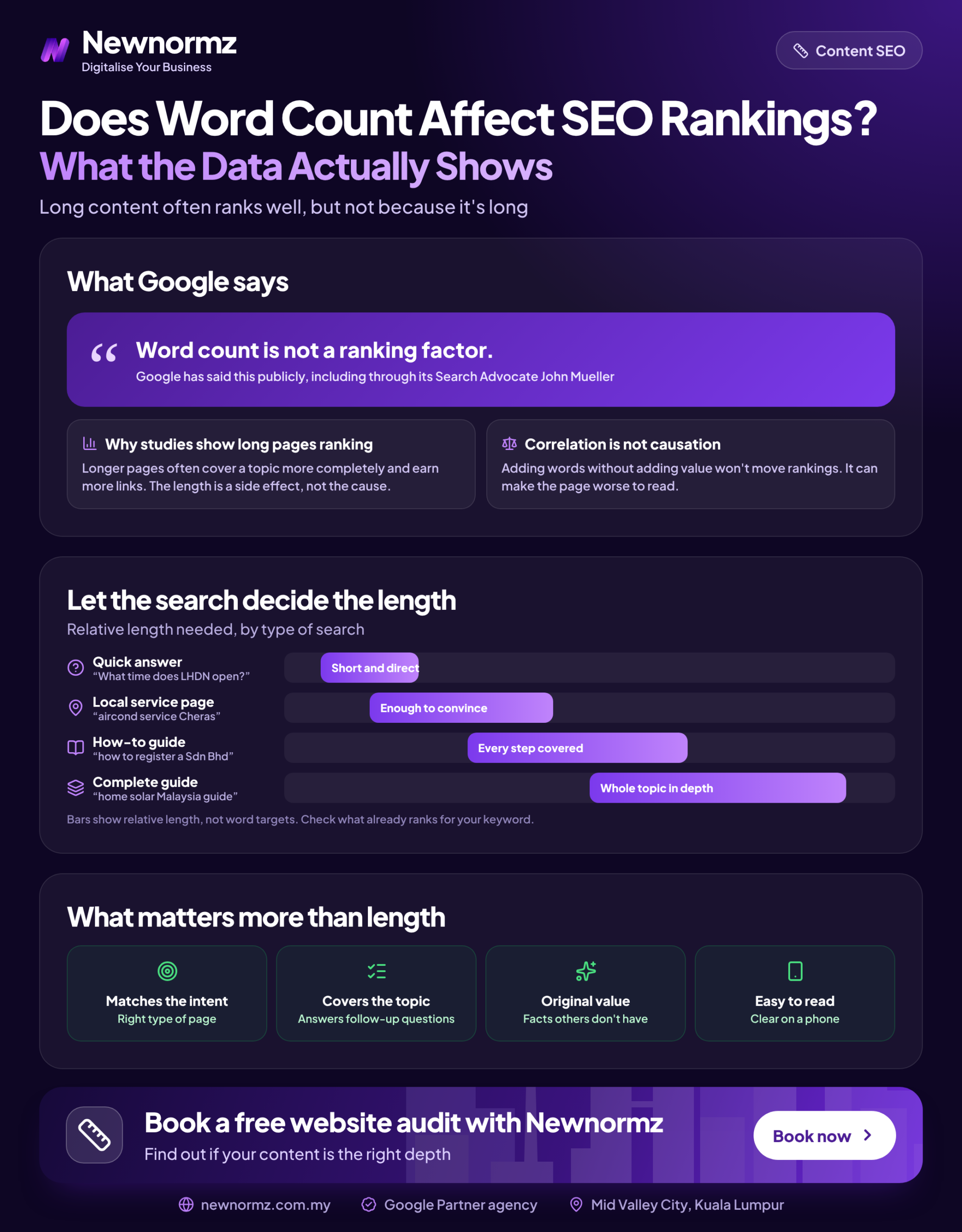
No. Word count is not a ranking factor, and Google says so in its own guidance. Content length SEO comes down to one question: how many words does this page need to fully answer this search? For a local service query that might be 600 words. For a cost comparison with ten sub-questions it could be 2,500. The right number depends on search intent, the language you write in and what the current top results already cover, and this guide shows you how to measure all three.
Content Length SEO: Word Count Is Not a Ranking Factor, and Google Has Said So
Google Search Central publishes a self-assessment list for helpful, reliable, people-first content. One of its questions asks whether you are writing to a particular word count because you heard Google has a preferred one. Google answers that question on the page itself: it doesn’t.
That should settle the word count ranking factor debate, yet the “write 2,000+ words to rank” advice is still everywhere in Malaysian marketing circles. Agencies quote it, freelancers price by it, and business owners end up paying for 2,500-word articles that answer a 300-word question.
Google has also said publicly that no one can guarantee a specific ranking position. So anyone promising that a word target will put you on page 1 is making a promise Google itself won’t make.
What follows is a practical way to decide the length of each page you publish, based on the search results for that query rather than a rule of thumb.
Why Long Articles Keep Showing Up on Page 1 Anyway
If length doesn’t matter, why do so many top-ranking pages run long? Backlinko and Semrush have both published large studies finding that pages in the top positions tend to have more words than pages further down. The pattern is real. The mistake is reading it as cause and effect.
Long pages rank because of what usually comes with length, not the length itself:
- Backlinks. A thorough guide with original data or a clear framework gets cited by other sites. A thin page rarely does.
- Subtopic coverage. A page that answers the main question plus the five follow-ups people ask gives Google more reasons to see it as complete. This is the idea behind writing for topical coverage.
- Long-tail matches. More sections mean more phrases, so the page appears for dozens of related searches it was never explicitly written for.
Our work with Oriental Kopi shows the mechanism. We optimised their content around “kopi”, “white coffee” and “3 in 1 coffee”, with full schema markup. Ranked keywords grew 350%, and over the two-year campaign the site gained 24,500 more ranking keywords. That reach came from covering the topic cluster properly. Nobody set a word target.
Newnormz take
Does word count matter for SEO? Only indirectly, as a side effect of depth. If you copy the length of a top-ranking page without copying its links, its subtopics and its intent match, you get the cost of a long article and none of the benefit.
Length is what a page ends up with after it answers the question well. It never causes the ranking.
Long Form vs Short Content SEO: Side by Side
Each length band has jobs it does well. The ringgit figures below use an illustrative writer rate of RM0.20 a word so you can compare bands. Your actual rate will differ.
| Criterion | Short (300 to 800 words) | Mid (800 to 1,800) | Long (1,800+) |
|---|---|---|---|
| Best search intents | Navigational, transactional, “near me”, quick definitions | Service pages, single how-to tasks, category guides | Comparisons, cost guides, multi-step processes, YMYL topics |
| Typical time to produce | A few hours | One to two days | Several days, including research and review |
| Writing cost (illustrative) | RM60 to RM160 | RM160 to RM360 | RM360 and up |
| Backlink potential | Low | Moderate | Highest, if it contains original data or a framework |
| Long-tail coverage | Narrow, one main query | A handful of related queries | Wide, often dozens |
| Mobile readability | Easiest | Good with clear subheadings | Needs jump links and answer-first sections |
| AI Overview passage extraction | Strong when the answer sits in the opening lines | Strong with question-led headings | Strong only if each section answers one thing clearly |
| Refresh effort | Low | Moderate | High, with more prices, screenshots and facts to go stale |
When Short Content Wins
Someone searching “aircond service Puchong” or “TCM near me” wants a phone number, a price range and proof you serve their area. They are often standing in their kitchen with a broken unit. A 2,500-word essay on the history of air conditioning gets in their way.
Short pages also win for definitions that fit in a featured snippet, and for product pages where buyers want price, stock and delivery time. In Malaysian ecommerce you are competing with Shopee and Lazada listings that show all three at a glance, so burying them under paragraphs of copy loses the sale.
When Long Form Earns Its Cost
Long form pays off when the searcher has many linked questions. “How much does a renovation cost in KL” brings questions about materials, contractor types, permits and timelines. Covering them on one page beats making the reader open five tabs.
It also earns its keep on YMYL (your money or your life) topics such as health, finance and legal, where E-E-A-T signals like author credentials, sources and worked examples take up space. Linkable guides are the third case: the page other sites cite as the reference.
How Long Should a Blog Post Be for SEO? Measure the SERP, Not a Rule of Thumb
Type “how long should blog post be SEO” into Google and you will mostly find a single number quoted back at you. There is no universal ideal blog post length for SEO. The search results for your exact query tell you what Google currently thinks a complete answer looks like. This process takes about 30 minutes per keyword.
Search the exact query in an incognito mobile view
Use Chrome’s device toolbar or your phone in private mode so your own history doesn’t skew the results. Mobile matters because that is what most of your Malaysian readers see.
Note the intent type
Is page 1 full of service pages, blog guides, product listings or a map pack? If it’s mostly service pages and Google Maps results, a long blog post is the wrong format, whatever its length.
Check the word count of the top 5 organic results
Ahrefs and Semrush both have content tools that report length, or you can paste each page’s main body into a free word counter. Skip the menu, footer and comments.
Drop the outliers
Forum threads, directory listings, marketplace pages and YouTube results rank for reasons that have nothing to do with their text. Leave them out of your average.
List the subtopics the top 3 all cover
Write down every H2 and H3 they share. If all three explain pricing, pricing is a requirement, not an option.
Aim for the range that covers those subtopics plus one thing they miss
That extra thing might be a local price example, a BM-language FAQ or a mistake you see in real projects. It’s your information gain, and it matters more than adding words.
Once you have the range and the subtopic list, you can brief a writer properly. Our step-by-step SEO blog framework covers how to turn that list into an outline.
A Worked Example: What 1,500 Extra Words Actually Costs You
These numbers are illustrative. Assume a writer charges RM0.20 a word. A 3,000-word article costs RM600, and a 1,500-word article on the same topic costs RM300. If the top 5 results average around 1,300 words, that extra RM300 buys length nobody asked for.
What the same RM300 could buy instead
- ✓An original photo or diagram that no competitor can copy
- ✓Time with an in-house expert for a named quote, which strengthens E-E-A-T
- ✓Updating two older posts that already get impressions but have slipped
The decision rule: if the top 5 average under 1,200 words, spend your budget on more pages, not longer ones. Ten focused 1,000-word pages that each target a different query will usually bring in more traffic than three 3,000-word pages. If you would rather hand the planning to a team, our SEO content writing services brief each page against its own SERP.
Malaysian Search Changes the Length Maths
Most “ideal length” advice comes from US and UK studies of English-language results. If you have searched for “SEO content length Malaysia” or “long form content Malaysia”, you have probably landed on that same global advice with a local headline. Length works differently here in three ways.
Bahasa Malaysia search. Many BM queries have far fewer well-built pages competing for them than the English version does. In our audits, a tight, well-structured BM page often outranks a long translated one because the competition is thinner and the reader wants the answer quickly.
Chinese content. Chinese text has no spaces between words, so most word counters treat long runs of characters as a handful of “words” and get the length badly wrong. Compare Chinese pages by character count against other Chinese results, or better, by subtopic coverage.
Mobile and WhatsApp. Malaysian readers mostly arrive on phones, often from a link shared in a WhatsApp group. Under mobile-first indexing, Google also judges your page on its mobile version. Long pages for Malaysian readers therefore need a table of contents with jump links and an answer at the top of every section, or readers scroll once and leave.
Malaysia note
Our SEO department has 10+ specialists working in English, Bahasa Malaysia and Chinese, and we brief each language against its own SERP. A topic that needs 1,800 words in English can need far less in BM, and a Chinese version is planned by sections, never by a translated word target.
Thin Content and Padding: The Two Failures We See Most in Audits
Most length problems we find fall into one of two opposite mistakes. Both cost rankings, and the fix for each is different.
✗ Service pages with 150 words and nothing a buyer needs
A heading, two lines of “we provide quality service” and a contact button. There is no price, no process and no area served. Google sees nothing that sets the page apart, which is what thin content means in SEO terms, and buyers leave to find a competitor who answers their questions.
✓ The fix
Add the facts a buyer uses to decide: what you do, who it suits, how pricing works, the steps, proof and where you operate. The page gets longer because it now has useful content in it.
✗ Blog posts padded to 2,500 words to hit a target
A 300-word generic intro, the same point repeated in three sections, and the answer hidden in paragraph twelve. Readers bounce, AI systems can’t find a clean passage to quote, and you paid for every wasted word.
✓ The fix
Cut the repetition, put the answer in the first 100 words and restructure the rest under specific headings. Expect the post to shrink, often by a third or more.
There is no minimum word count for SEO. Thin content SEO problems come from missing substance, not from falling below a number. If your site has many pages of either type, our guide to pruning thin and bloated pages explains when to merge, rewrite or remove them.
How Many Words Should a Service Page Have?
The honest answer to how many words for a service page is that there’s no target. Build the page from this list and let the length follow:
What every service page needs
- ✓What the service is, in plain words
- ✓Who it suits, and who it doesn’t
- ✓A price range, or a clear explanation of how pricing works
- ✓Your process, step by step
- ✓Proof: results, reviews or project photos
- ✓Areas served, named specifically
- ✓An FAQ answering the objections you hear on the phone
- ✓A WhatsApp button, because that’s how most Malaysians will contact you
Most service pages land at 600 to 1,200 words once those pieces are in place. That’s the result of the content, not a goal to write towards.
Doing this properly takes real work. You have to pull pricing logic out of the sales team, photograph projects, collect proof and map service areas, then repeat it for every service and location. If that’s more than your team can take on, it’s the kind of rebuild an SEO agency in Malaysia should handle as part of the engagement.
Depth Over Length: What Gets a Page Cited in AI Overviews
Google AI Overviews and ChatGPT don’t read your page as a whole. They pull individual passages that answer a specific question. A clearly answered 60-word section can be quoted, while a vague 3,000-word page gives them nothing clean to lift. That’s content depth vs word count in practice.
Rankings still come first, though. Industry studies put roughly 76% of AI Overview citations on pages that already rank in the traditional top 10. Answer format helps you get cited once you’re in the running. It doesn’t replace ranking.
Client example
Sunway TCM Centre: page 1 rankings and AI Overview citations
Problem: The site needed a technical rebuild before its treatment content could compete.
What we did: Fixed crawling and indexing, then restructured the content for answer engines (AEO), so each treatment question had a clear, quotable answer.
Result: +150% keywords and 80% of target keywords on page 1 within 4 months, including “TCM Malaysia” and “Acupuncture KL”. The centre now appears in Google AI Overview results for treatment searches.
What made the difference was structure and answer format, not page length. Our guide to question-based content for AI answers shows how to build sections that get quoted.
Before You Add Words to an Old Post, Check This
Search intent and content length are linked here too. Open Google Search Console, go to the Performance report, filter by the page and look for queries where it gets impressions but sits between positions 8 and 20. Those queries tell you what Google already associates with the page.
Updating an existing post is often the cheapest ranking win you have. We cover the full process in our piece on why refreshed content wins.
FAQ
Is word count a Google ranking factor?
No. Google’s people-first content guidance says it has no preferred word count. Long pages often rank because they earn more links and cover more subtopics, not because of their length.
How long should a blog post be for SEO in 2026?
As long as it takes to cover what the top-ranking results cover, plus one thing they miss. Measure the top 5 results for your exact query and aim for that range.
What is the minimum word count for a page to rank?
There isn’t one. A 300-word page can rank if it fully answers a simple query. A page counts as thin when it is missing substance, not when it falls below a number.
Does long-form content rank better than short content?
Only for queries that need depth. Comparisons, cost guides and YMYL topics usually reward long form. Local, transactional and definition queries usually reward short, direct pages.
How many words should a service page have?
Most land between 600 and 1,200 words once they include pricing, process, proof, areas served and an FAQ. Build from that content list, not from a word target.
Can a short article appear in Google AI Overviews?
Yes. AI Overviews quote individual passages, so a short page with a clear, direct answer can be cited. It usually needs to rank well first, since industry studies find most citations come from top-10 pages.
Should Bahasa Malaysia or Chinese articles be as long as English ones?
Not necessarily. Check each language’s own search results. BM results often have thinner competition, and Chinese pages should be measured by character count or subtopic coverage, because word counters misread them.
Will adding more words to an existing post improve its ranking?
Only if the new words answer a query the page is already close to ranking for. Check Google Search Console for queries at positions 8 to 20. If there is no gap, tightening the post usually helps more.
Free SEO audit
Find out which of your pages are thin, which are padded and which just need restructuring
Newnormz runs SEO for 200+ Malaysian businesses on month-to-month terms, with a written page 1 guarantee and a 5.0 rating from 214+ Google reviews. Prefer to talk first? WhatsApp us on +60 17-588 2291.
- ✓A page-by-page check of your content against the length and subtopics of the top results
- ✓The thin service pages and padded posts that are holding your rankings back
- ✓Search Console queries where one focused section could move a page onto page 1

Bryan Tan is an SEO Specialist and CEO at Newnormz, helping hundreds of businesses achieve first-page rankings on Google. With a passion for driving organic growth, Bryan blends innovative strategies with hands-on experience to optimize websites for maximum visibility. Always at the forefront of the latest SEO insights and trends, he consistently adapts to the evolving digital landscape.