
Content freshness SEO means updating the substance of a page: new data, corrected facts, current examples, more useful internal links, not just changing the date stamp on it. Google has said plainly that editing a visible date without changing the content underneath it does nothing for rankings. What has changed is the stakes. AI Overviews and AI Mode run several related searches before writing an answer, and a page that still reflects last year’s prices, tools or numbers is a weak candidate to be cited in any of them. For a Malaysian SME owner deciding where to spend a limited marketing budget, the real question isn’t whether to publish more content, it’s which pages already on your site are quietly going stale and costing you visibility right now.
A Simple Way to Think About It
The Shopfront That Never Changes
🪧 The Window Display From 2019
A shop with the same faded posters and a price list taped to the glass for years. People walk past without a second look, even if the stock inside is still good.
🌱 The Window That Gets Restocked Every Season
A shop that rotates its window with what’s actually in stock and what’s actually selling. Regulars know it’s worth walking past again.
Your website works the same way. The sections below cover what counts as a genuine refresh and what’s just rearranging the furniture.
What Actually Counts as Content Freshness
Google’s own Search Central guidance is direct about this: adding or removing content, or editing the visible date, without changing the substance of a page will not improve rankings. A page earns a real freshness signal when it gains new statistics, corrected information, added sections, updated internal links or examples that reflect the current state of a topic.
Freshness is not the same thing as evergreen content, and both have a job. Evergreen guides stay useful for years with only light edits. Freshly updated pages are what capture the traffic spikes that follow algorithm updates, seasonal search behaviour, and shifts in what buyers are actually asking. Malaysian SMEs feel the gap most on service pages that were written once at launch and never touched again.
| Signal Type | Example | Effect on AI Search Visibility |
|---|---|---|
| Real freshness | New pricing, updated statistics, an added FAQ section | Increases the chance of being cited in AI Overviews |
| Real freshness | Corrected factual errors, new internal links to recent pages | Improves crawl priority and re-indexing speed |
| False freshness | Changing the published date only | No ranking benefit, per Google Search Central |
| False freshness | Rewriting sentences without new information | No measurable improvement in AI citation rate |
Why Freshness Now Shapes AI Search Visibility
Google AI Overviews and AI Mode use a technique called query fan-out: the system runs several related searches behind the scenes before it writes a single answer. A page that is current and well-maintained has a better chance of matching one of those supporting queries than a page that hasn’t been touched since it was published.
None of this replaces the fundamentals. These AI features still sit on top of Google’s core ranking and quality systems, so a page still needs accurate information, working links, a clear answer and proper indexing to stay a credible citation candidate. Google has also said that clicks arriving from AI Overviews tend to be higher quality, meaning visitors who land on the page stay longer. That makes freshness work double duty: it’s an SEO signal and a conversion lever at the same time.
One detail worth checking on any content update: whether a page’s dateModified structured data actually matches the last-updated text visible to readers. Google’s publisher guidance warns that inconsistent or excessive date signals confuse which date its systems choose to show. A proper content audit, the kind built into our SEO services, catches this instead of treating a date swap as a shortcut.
How Often Different Types of Pages Actually Need Updating
Update frequency should match how fast a page’s information decays, not a fixed calendar rule. A pricing page and a two-year-old how-to guide don’t go stale at the same speed, and treating them the same wastes budget on one and neglects the other.
| Page Type | Refresh Cadence | Why It Decays |
|---|---|---|
| Core service pages | Every 3 to 6 months | Pricing, process and offers shift over time |
| Blog and guide content | Every 6 to 12 months | Statistics, tools and best practices age quickly |
| Product or listing pages | As soon as stock, price or specs change | Directly affects trust and conversion |
| Campaign landing pages | At campaign launch and again at close | A misaligned offer hurts both SEO and ad spend |
How Newnormz Runs a Content Freshness Audit
Newnormz maps a client’s site against these page types before recommending a schedule, because a fixed monthly rewrite wastes budget on pages that barely change and leaves fast-moving pages dangerously out of date. The audit looks at search intent, competitor gaps, pages that are losing rankings, and Core Web Vitals before any rewriting starts.
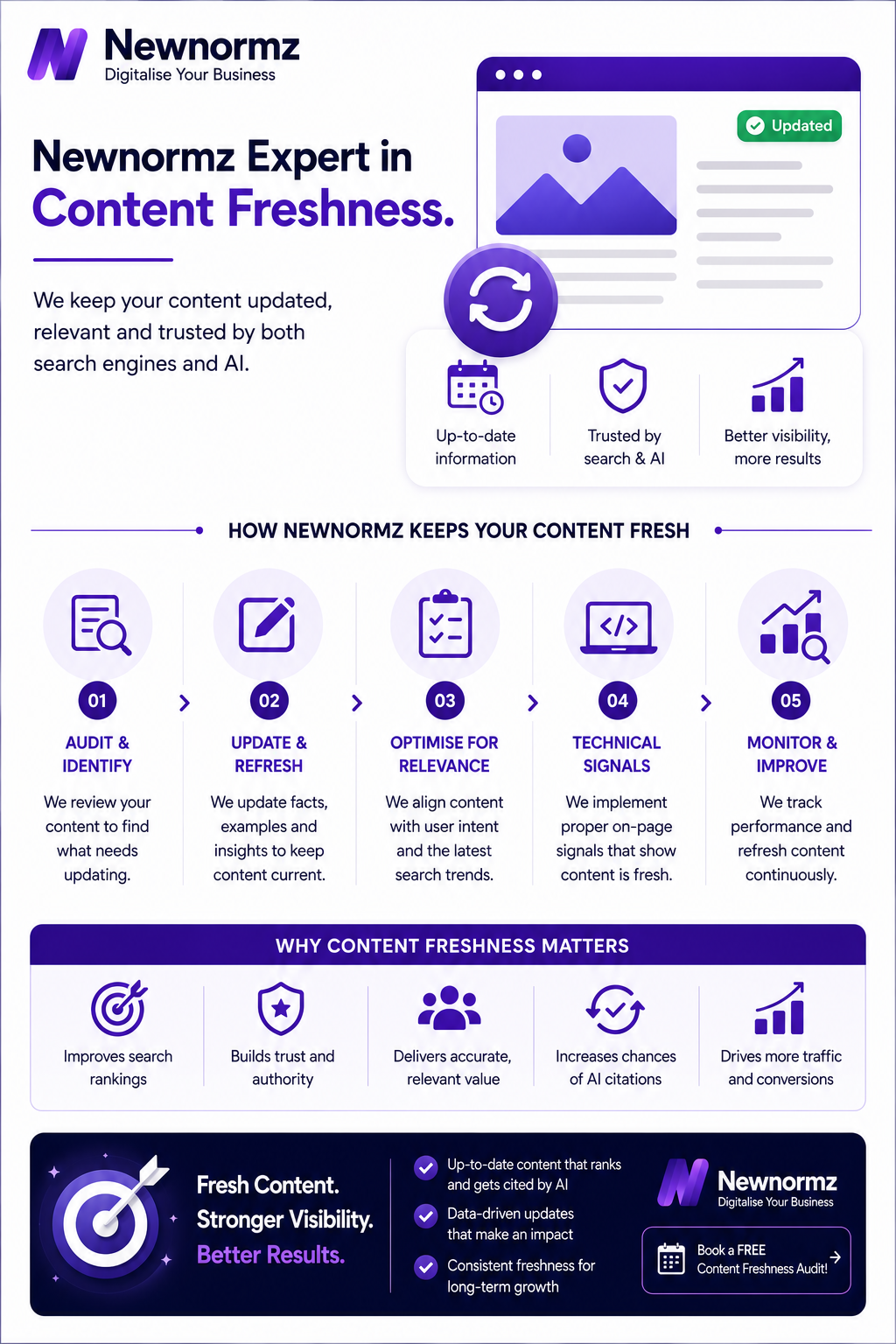
This is also where the payoff shows up as a pattern rather than a single spike. Our two-year local SEO campaign for Oriental Kopi added 24,500 more ranking keywords over that period, not from one overhaul but from continuous work across the site. Sunway Medispa’s six-month campaign added 70 percent more ranking keywords the same way: steady attention to what was already published, not a single rewrite. For most SME owners, tracking which pages need attention across an entire site while also running the business isn’t realistic, which is exactly why this gets handed to a team that treats it as an ongoing process rather than a one-off task.
Keep Your Content Fresh and Visible
Stale pages lose ground in both classic search and AI Overviews while competitors who update on a schedule keep pulling ahead. Freshness isn’t about publishing more, it’s about making sure what’s already live still reflects reality.
Frequently Asked Questions About Content Freshness SEO
Which website pages should Malaysian SMEs refresh first?
Core service pages, high-traffic articles, and any page that’s visibly losing rankings to a competitor. Those give the fastest return on the time spent.
Can changing the published date alone improve SEO performance?
No. Google has said this directly: a date change with no real content change behind it does not move rankings. Update the date after you’ve updated the facts, links and examples, not before.
How do you tell evergreen content apart from time-sensitive content?
Look at how fast the facts on the page change. A page built on pricing, tools or statistics decays fast. A page built on a stable process or principle can go longer between edits.
Which pages have the best shot at AI Overview visibility?
Pages that are already clear, well-structured and performing reasonably well, then kept accurate and current. AI features build on top of existing quality signals, they don’t replace them.
Can refreshing an old article actually recover lost traffic?
It can, but the update needs to come with a keyword, competitor and internal-link check attached. A refresh done in isolation, with no view of why the page lost ground, recovers less.
What does a content freshness audit actually cover?
A review of outdated pages, declining rankings, weak or missing sources, and a prioritised action plan, so you know which pages to touch first instead of guessing.
Not sure which pages are going stale?
Get a Prioritised List of What to Refresh First
Newnormz has run SEO campaigns across F&B, healthcare, ecommerce, and local services in Malaysia, backed by a performance guarantee of 70 percent of targeted keywords on Google’s first page.
30 minutes, no obligation, just a clear list of what to update first.

Bryan Tan is an SEO Specialist and CEO at Newnormz, helping hundreds of businesses achieve first-page rankings on Google. With a passion for driving organic growth, Bryan blends innovative strategies with hands-on experience to optimize websites for maximum visibility. Always at the forefront of the latest SEO insights and trends, he consistently adapts to the evolving digital landscape.