Image SEO for AI search means giving every photo on your website a file name, alt text, caption and structured data tag that a machine can actually read, since Google Images, Google Lens, ChatGPT, Perplexity and AI Overviews cannot see a picture the way a person does. If your product shots are still named IMG_4821.jpg with blank alt text, both Google and every AI answer engine built on top of it are skipping your images when they decide who gets cited or shown.
A Simple Way to Think About It
The Warehouse With No Labels
📦 No Labels, No Shelf Numbers
A warehouse where every box looks identical, with nothing written on the outside. An order comes in, the picker walks the aisles hoping to recognise the right box by sight, and most of the time it never leaves the shelf.
🏷️ Every Shelf Marked, Every Box Named
The same warehouse, but every shelf has a number and every box says exactly what’s inside. The picker finds the right item in seconds and the order goes out the same day.
Your website images work the same way. The labels are the file name and the alt text, and the sections below show exactly what Google and AI search tools expect to find written on them.
What Is Image SEO?
Image SEO is the practice of writing a photo’s file name, alt text, caption and structured data so that search engines and AI systems can accurately understand what the image shows. None of these systems interpret pixels the way a person does. They read the metadata layer around the image and infer the content from there.
Semrush found that image packs appeared in 55.62% of standard US Google results on 29 April 2024, which gives a sense of how much visibility a well-optimised image library can still capture. This isn’t about paid image advertising or video SEO. It’s specifically about the on-page work: alt text, file names, compression and structured data.
Why Image SEO Matters for AI Search in 2026
AI answer engines read alt text and image captions the same way they read the rest of a page’s copy, then use that metadata to decide which website earns a citation inside a generated answer. Google has said plainly that descriptive alt text helps both Google and assistive technologies understand what an informative image is showing, and that it also weighs file names, captions and the surrounding page context when it evaluates an image.
There’s a nuance worth getting right here: decorative images (a background texture, a divider graphic) should carry an intentional empty alt attribute, while product and informative images need a real description. Malaysian SME websites tend to get this backwards, either leaving everything blank or stuffing keywords into images that should be silent.
Malaysia had 35.4 million internet users and 98% penetration by the end of 2025, and Google still holds roughly 93% of the country’s search market. For SMEs in ecommerce, F&B and professional services, that means the competition for visibility isn’t only happening in Google’s classic results anymore. Customers are increasingly asking AI tools to research a purchase before they ever click through to a website, and an unlabelled product photo simply doesn’t exist as far as those tools are concerned.
The Core Elements of Image SEO
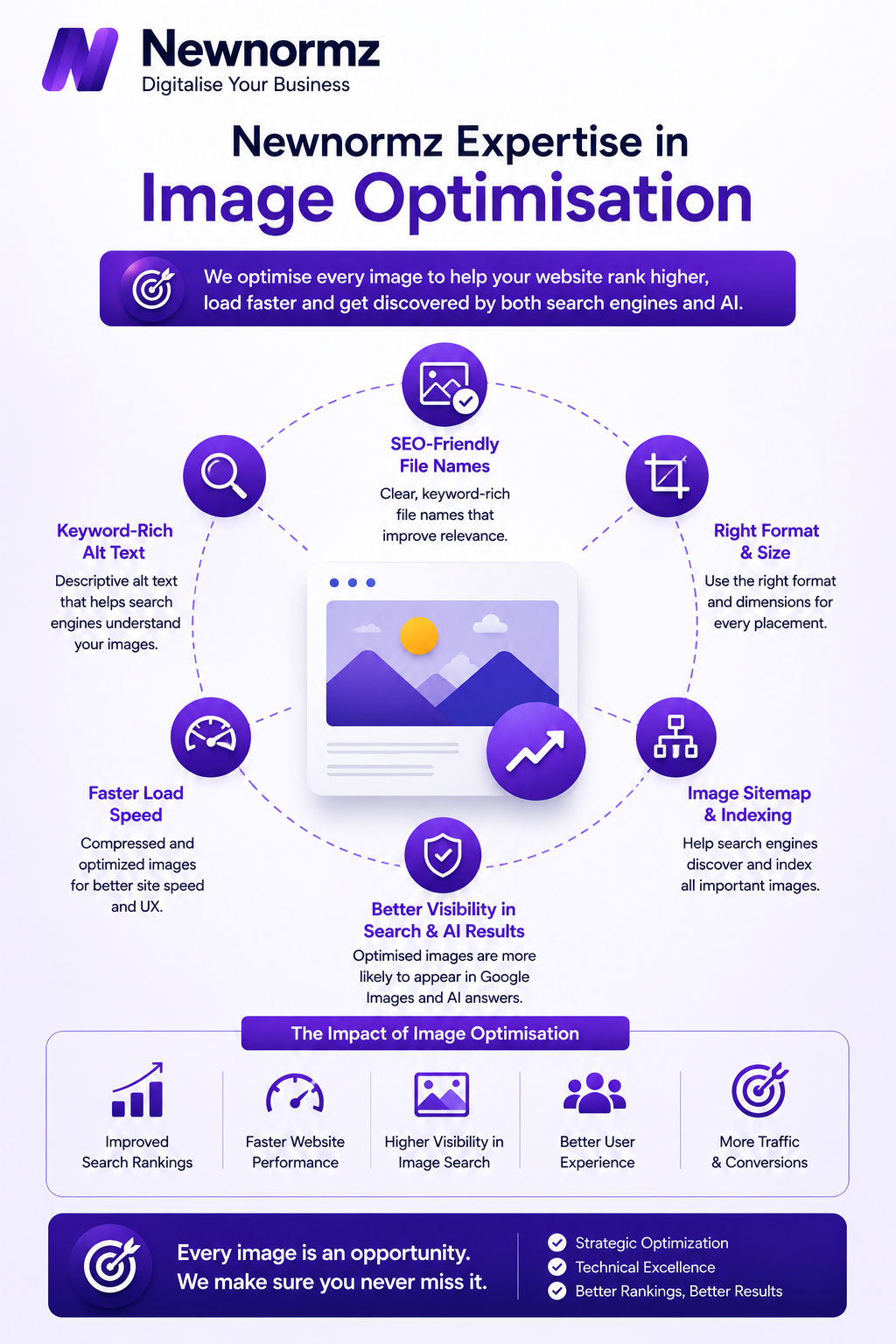
Five elements decide whether an image ranks in Google Images or gets ignored: file name, alt text, compression and format, responsive sizing, and structured data.
Descriptive Alt Text and Semantic File Names
Alt text should describe the image in roughly 80 to 125 characters, include the target keyword only where it reads naturally, and skip filler phrases like “image of” or “photo of”. File names carry equal weight. Renaming a file to mid-century-teak-dining-chair.jpg instead of leaving it as IMG_4273.jpg is one of the highest-impact fixes a Malaysian SME site can make in a single afternoon, and it costs nothing but time.
Compression, Format and Core Web Vitals
Google recommends WebP or AVIF for most website images, since both formats balance file size against quality at a compression setting around 75 to 85, and neither needs to exceed about 2,500 pixels in width for standard web use. Slow-loading images weaken Largest Contentful Paint, one of the three Core Web Vitals every Newnormz website build is checked against. Better image performance improves the experience for visitors and supports how Google evaluates the page overall.
| Factor | What It Means | Impact |
|---|---|---|
| Alt text | 80 to 125 character description, keyword placed naturally | Ranking signal for Google Images, citation signal for AI engines |
| File name | Descriptive, hyphen-separated words instead of a camera default | Faster identification by Google Images and Bing Visual Search |
| Compression | WebP or AVIF at roughly 75 to 85 quality | Faster load speed and stronger Core Web Vitals scores |
| Structured data | ImageObject and Article schema markup | Eligibility for rich results and clearer parsing by AI tools |
If your product catalogue runs into the hundreds of images, a technical SEO audit from Newnormz identifies exactly which ones are blocking your rankings before you spend a single ringgit on new content.
Common Image SEO Mistakes Malaysian SMEs Make
Most Malaysian SME websites repeat the same handful of image errors, and every one of them is fixable within a single audit cycle:
- Uploading camera default file names straight from a phone or product shoot.
- Leaving alt text blank instead of writing a short description, or forgetting the intentional empty tag decorative images actually need.
- Skipping compression, which slows down product pages on the mobile networks most Malaysian shoppers browse on.
- Reusing one generic alt text across an entire product gallery.
- Ignoring structured data, so AI engines have nothing to parse when deciding whether to cite the image.
Checking a product catalogue against W3C’s own alt text decision tree usually settles which images need a full description versus an empty tag, a distinction most Malaysian catalogues get wrong by default.
How Newnormz Turns Your Images Into an AI Search Asset
Newnormz helps Malaysian SMEs optimise large image libraries as part of its SEO services. A technical audit checks missing alt text, poor file names, oversized images and broken structured data, then hands back a priority fix list within five business days, so you know what to fix first instead of guessing.
This work isn’t theoretical. CHAGEE grew its ranking keywords by 95% and placed 160 keywords on Google’s first page within five months. Hairdepot recorded a 90% increase in ranking keywords and passed 650 page-one keywords within six months. Image fixes were part of the underlying technical work behind both results, not a separate add-on.
Every Newnormz SEO package starts from RM2,800 per month and covers image and content optimisation for Google Search, AI Overviews, ChatGPT and Perplexity together, since a business’s local SEO visibility and its AI visibility now depend on the same underlying signals.
Help Google and AI Understand Your Images
Malaysian SME websites lose Google Images traffic and AI citation opportunities every time a product photo goes up with blank alt text or a camera-generated file name. None of that is a design problem. It’s a labelling problem, and it’s one an audit can find in days, not months.
Frequently Asked Questions About Image SEO
Why are my product images missing from Google Images?
Usually a combination of blank alt text, camera-generated file names, missing compression or missing structured data. An audit checks all four and tells you which one is actually blocking each image.
How does Newnormz write alt text for website images?
Clear, descriptive and concise, generally under 125 characters, with the keyword included only where it reads naturally rather than forced in.
Can better image SEO actually help visibility in ChatGPT or Google AI Overviews?
Yes. AI tools rely on alt text, captions and structured data to understand what an image shows, the same metadata Google Images depends on, so fixing it helps both at once.
Which image SEO issue shows up most often on Malaysian SME websites?
Blank alt text, camera-generated file names and oversized image files are the three Newnormz finds most often during technical audits.
Is image optimisation included in Newnormz SEO packages?
Yes, it’s included in every SEO package, which starts from RM2,800 per month.
How quickly can image SEO improvements show results?
It varies by site and catalogue size, but Hairdepot recorded a 90% increase in ranking keywords within six months of combined technical and image SEO work.
Are your product photos invisible to AI search?
Find out which images on your site are costing you traffic
Newnormz has run SEO campaigns across F&B, healthcare, ecommerce, and local services in Malaysia, backed by a performance guarantee of 70 percent of targeted keywords on Google’s first page.
30 minutes, no obligation, and you’ll know exactly which images to fix first.

Bryan Tan is an SEO Specialist and CEO at Newnormz, helping hundreds of businesses achieve first-page rankings on Google. With a passion for driving organic growth, Bryan blends innovative strategies with hands-on experience to optimize websites for maximum visibility. Always at the forefront of the latest SEO insights and trends, he consistently adapts to the evolving digital landscape.