Internal link SEO is the practice of connecting the pages you already have on your own website, using descriptive anchor text, so Google can crawl every important page and understand how your topics relate to each other. For most Malaysian SME websites, the content needed to rank is already published. It is simply disconnected: buried three or four clicks deep, with no links pointing to it, and invisible to Google as a result. Fixing that structure is often faster and cheaper than writing new articles or chasing new backlinks.
A Simple Way to Think About It
The Library With No Signs
📚 No Directory at the Entrance
Every book the visitor needs is somewhere in the building, but there are no shelf labels and nothing pointing them the right way. Most people wander for a minute, then leave without finding it.
🗺️ A Directory Right by the Door
Every shelf is labeled, and a map near the entrance sends each visitor straight to the right section. Staff can also see which sections get the most traffic and keep them stocked.
Below is what that directory actually looks like on a Malaysian SME website, and how to build one without writing a single new article.
What Internal Link SEO Actually Means
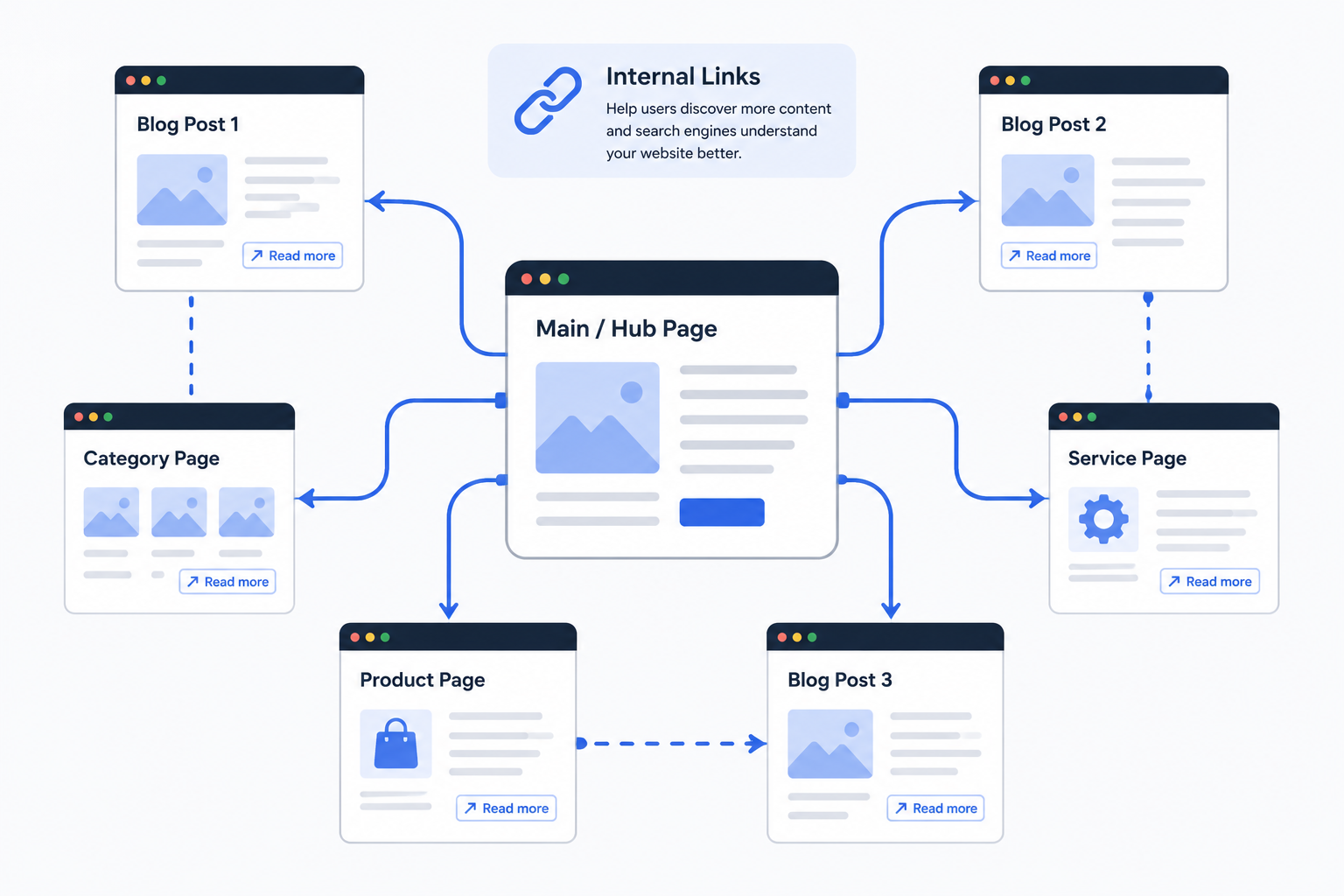
Internal link SEO means linking one page on your website to another page on the same domain, using anchor text that tells both the reader and Google what the destination page covers. Every internal link has three parts: the page the link sits on, the page it points to, and the words used to describe that link.
Google recommends linking to every important page from at least one other page on your site, because that is how its crawlers discover new content and judge how it relates to everything else you have published. A service page with no internal links pointing to it is much harder for Google to find, no matter how well it is written.
Get the source page, destination page, and anchor text right across your service pages, blog posts, and category pages, and two things happen: Google finds and indexes your content faster, and ranking strength flows toward the pages that actually generate enquiries.
How Internal Links Build Topical Authority
Topical authority is the trust Google builds up for a website that covers one subject in real depth, not just once, but repeatedly and in a connected way. Internal linking is the structural proof of that depth. A single article about, say, Google Ads budgeting signals interest in one keyword. A cluster of connected pages covering Google Ads setup, budgeting, targeting, and reporting, all linked back to one central hub page, signals expertise across the whole subject.
Semrush’s own guidance on topic clusters makes the same point: sites that organise related content into clearly linked clusters tend to out-rank sites where similar information is scattered across disconnected pages with no structure tying it together.
In practice this means picking one pillar page per core service, then linking every supporting blog post or sub-service page back to that pillar using anchor text that names the specific subtopic, not generic phrases like “click here.”
Where Malaysian SME Sites Lose Rankings to Weak Internal Linking
Click depth is the number of clicks needed to reach a page starting from the homepage, and it has a direct, well-documented relationship with how often Google bothers to crawl that page. The deeper a page sits, the less crawl attention it gets.
On most SME websites, the pages buried deepest are exactly the ones that matter most: service pages, older blog posts that used to rank, and category pages that could be passing authority around if anyone linked to them. None of this requires new content to fix. It requires rerouting the links you already have so authority reaches the pages currently sitting at three clicks or more from the homepage.
| Click Depth From Homepage | Typical Crawl Behaviour | Common Page Type Found Here |
|---|---|---|
| 0 to 1 clicks | Crawled frequently and reliably | Homepage, main navigation pages |
| 2 clicks | Crawled regularly if linked from strong pages | Category pages, top service pages |
| 3+ clicks | Crawled rarely, easy to fall out of the index | Older blog posts, secondary service pages, orphan pages |
A Five-Step Fix You Can Run This Month
1. Map your money pages first
List every service and product page that generates enquiries before you touch a single blog post. These are the pages that need the most internal links pointing at them, not the other way round.
2. Group related content into clusters
Assign one hub page per topic, then link every supporting article back to that hub with anchor text that names the subtopic it covers.
3. Link from your strongest pages to your weakest
A blog post that already ranks well can pass real authority to a quiet service page in a single edit. Find your top three traffic pages and check what they currently link to.
4. Write anchor text that describes the destination
Drop “click here” and “read more” entirely. Name the actual topic the reader is about to land on, since that anchor text is also what tells Google what the destination page is about.
5. Audit for orphan pages every quarter
Any page with zero internal links pointing to it stays effectively invisible to Google, no matter how good the content on it is. A quarterly crawl of your own site will catch these before they cost you rankings.
Internal Links Are Not a Backlink Replacement
Internal links and backlinks solve different problems, and treating one as a substitute for the other is a common mistake. Internal links control how authority moves around inside your own site. Backlinks bring authority in from outside it. You need both, and fixing your internal structure is simply the cheaper, faster place to start because it does not depend on anyone else linking to you.
It is also worth being honest about limits here. Google has stated publicly, more than once, that no one, including Google itself, can guarantee a specific ranking position. Internal link SEO improves crawlability and distributes the authority you already have; it does not override everything else that goes into a ranking decision.
| Signal | Internal Links | Backlinks |
|---|---|---|
| Who controls it | You, entirely | Another website’s owner |
| Cost to fix | Low: editing existing pages | Higher: outreach, content, time |
| What it proves to Google | Site structure and topic depth | Outside trust and reputation |
How Newnormz Builds This Into Every Campaign
Newnormz’s SEO services in Malaysia start with a full site architecture audit before any new content is planned: click depth, anchor text, and existing topic clusters are all reviewed, then internal links are rebuilt around the service pages that actually generate enquiries. This is the same structural thinking behind Newnormz’s local SEO work, where a well-linked site structure also helps location-specific pages get found.
Every client gets a free website audit worth RM1,200 that includes an AI visibility check. As a Google Partner agency, Newnormz has worked with brands including Chagee, Finsource, and Sunway Chinese Medicine to reorganise scattered content into a clearer, better-linked structure.
Wondering if broken links are costing you rankings?
Find Out Which of Your Pages Google Can’t Find
Newnormz has run SEO campaigns across F&B, healthcare, ecommerce, and local services in Malaysia, backed by a performance guarantee of 70 percent of targeted keywords on Google’s first page.
30 minutes, no obligation, structural link map included.

Bryan Tan is an SEO Specialist and CEO at Newnormz, helping hundreds of businesses achieve first-page rankings on Google. With a passion for driving organic growth, Bryan blends innovative strategies with hands-on experience to optimize websites for maximum visibility. Always at the forefront of the latest SEO insights and trends, he consistently adapts to the evolving digital landscape.