
Many Malaysian business owners invest in SEO and then wait. They watch their keyword rankings creep up, but struggle to answer one critical question: is this actually making money?
SEO takes time, the results are not always obvious, and traditional marketing metrics do not always translate cleanly to organic search. For SME owners juggling tight budgets and quarterly targets, this ambiguity can make SEO feel like a gamble rather than a business decision.
The truth is that SEO ROI Malaysia is measurable. It just requires tracking the right metrics, understanding realistic timelines, and connecting organic performance to actual business outcomes such as leads, sales, and customer acquisition costs.
This guide breaks down exactly how to do that, with a framework built for the Malaysian market.
Table of Contents
What SEO ROI Actually Means for Malaysian Businesses

Return on investment for SEO is the ratio of business value generated through organic search compared to the total cost of your SEO efforts, including agency fees, content production, and any tooling.
This typically comes down to a few core questions:
- How many qualified leads are coming through organic search each month?
- What is the revenue value of those leads?
- How does the cost per lead from SEO compare to Google Ads or social media advertising?
- Is organic traffic growing in a way that compounds over time?
The challenge many businesses face is measuring SEO against the wrong benchmarks. Ranking on page one for a keyword is not SEO ROI. Traffic volume alone is not SEO ROI. Revenue and business growth are.
Book a free website audit with Newnormz and find out exactly where your organic search stands.
6 Metrics to Track SEO ROI in Malaysia
Tracking the right data is the foundation of understanding your SEO ROI Malaysia performance. Below is a breakdown of the key metrics every Malaysian SME should monitor:
| Metric | What to Track | Why It Matters |
| Organic Traffic | Monthly sessions from search engines | Shows how many users SEO is bringing in |
| Keyword Rankings | Position for target keywords on Google | Measures visibility and competitiveness |
| Leads Generated | Form fills, calls, enquiries from organic | Ties SEO directly to business pipeline |
| Conversion Rate | % of organic visitors who convert | Reveals how well the site turns traffic to revenue |
| Revenue from Organic | Sales or deals attributed to organic search | The clearest measure of SEO ROI Malaysia |
| Cost per Lead (CPL) | Total SEO spend divided by leads | Benchmark against paid channels like Google Ads |
Organic Traffic Quality Over Quantity
Raw traffic numbers can be misleading. A spike in sessions means nothing if those visitors are not your target audience. Malaysian businesses should segment organic traffic by:
- Geographic location (are visitors from KL, Selangor, Penang, or JB where your business operates?)
- Device type (mobile traffic dominates in Malaysia, so mobile conversion rates matter)
- Landing page (which pages are generating enquiries?)
- New vs returning users (returning users often indicate brand trust building)
Lead Attribution from Organic Search
If your website has a contact form, WhatsApp button, or phone number, you need to track which visitors came from organic search before converting.
Google Analytics 4 combined with Google Search Console gives you this attribution at no additional cost.
For businesses running multiple channels (SEO, paid ads, social), clear attribution prevents you from misreading which channel is actually generating leads.
Find out more about the SEO tools in Malaysia you can use to track and monitor your website performance.
Realistic SEO ROI Timelines for Malaysian SMEs
One of the most common reasons businesses feel let down by SEO is misaligned expectations on timing. Here is what a realistic SEO ROI timeline looks like for most Malaysian businesses:
- Months 1 to 3: Technical groundwork and content foundation. Rankings begin shifting for lower-competition keywords. Traffic may show early movement. Lead volume is usually minimal at this stage.
- Months 3 to 6: Targeted keywords start ranking on page one. Organic traffic shows meaningful growth. First measurable leads from organic search begin appearing.
- Months 6 to 12: Compounding growth kicks in. Multiple keywords ranking. Lead volume increases steadily. Cost per lead from SEO drops significantly compared to paid channels.
- Month 12 onwards: SEO becomes a consistent, lower-cost lead generation channel. Content assets continue generating traffic and leads without additional spend per click.
The compounding nature of SEO is what separates it from paid advertising. Google Ads stops the moment your budget runs out. A well-optimised page continues generating leads for months or years after it ranks.
Get a free website audit from Newnormz and receive an honest assessment of your current SEO performance and growth potential.
SEO vs Paid Ads: Where the ROI Difference Shows Up

Malaysian SMEs frequently ask whether SEO or Google Ads gives a better return. The honest answer depends on your business goals and timeline, but the data consistently favours SEO for long-term cost efficiency.
- Cost per lead: Paid advertising in competitive Malaysian industries such as legal services, property, and F&B can cost RM 30 to RM 150+ per click. SEO does not charge per click. Once pages rank, leads arrive without incremental cost.
- Trust signals: Organic results carry higher trust among Malaysian consumers. Appearing organically signals credibility that paid placements cannot replicate in the same way.
- Scalability: Paid campaigns require proportional budget increases to scale. SEO generates exponential returns as domain authority grows and more pages rank simultaneously.
- Longevity: Paid traffic stops with the campaign. Organic rankings, once established, generate returns for months without additional spend.
That said, paid advertising remains valuable for immediate lead generation while SEO builds momentum. The strongest Malaysian SME marketing strategies combine both channels strategically.
Discover the clear difference between Google Ads vs SEO in Malaysia.
How to Calculate SEO ROI for Your Malaysian Business

The basic SEO ROI formula is straightforward:
SEO ROI = (Revenue from Organic Search – SEO Cost) / SEO Cost x 100
For example, if your business spends RM 3,000 per month on SEO and generates RM 15,000 in monthly revenue attributable to organic search, your SEO ROI is 400%.
The harder part is attributing revenue accurately. To do this:
- Set up goal tracking in Google Analytics 4 for key conversion actions such as form submissions, WhatsApp clicks, and phone number clicks.
- Use UTM parameters consistently across all non-organic campaigns so attribution stays clean.
- Review Google Search Console monthly to understand which queries are generating impressions and clicks.
- Cross-reference organic session data with CRM leads to identify which deals originated from search.
Why Many Malaysian Businesses Struggle to See SEO ROI
After working with businesses across Malaysia, Newnormz has identified the most common reasons SEO investment fails to deliver measurable returns:
- Targeting the wrong keywords: Ranking for high-volume keywords that attract the wrong audience generates traffic but no leads. SEO ROI comes from ranking for terms your target buyers actually search.
- Poor landing page experience: Traffic arriving at a slow, confusing, or unconvincing page will not convert. SEO drives visitors; the website converts them.
- No tracking infrastructure: Businesses with no Google Analytics setup or broken conversion tracking cannot see the ROI even when it exists.
- Inconsistent effort: SEO requires sustained execution. Stopping after 3 months means losing ground to competitors who continue.
- Agency mismatch: Some agencies focus on vanity metrics such as rankings and traffic without tying activity to business goals. Choosing the wrong SEO partner costs time and money.
How Newnormz Helps Malaysian Businesses Improve SEO ROI
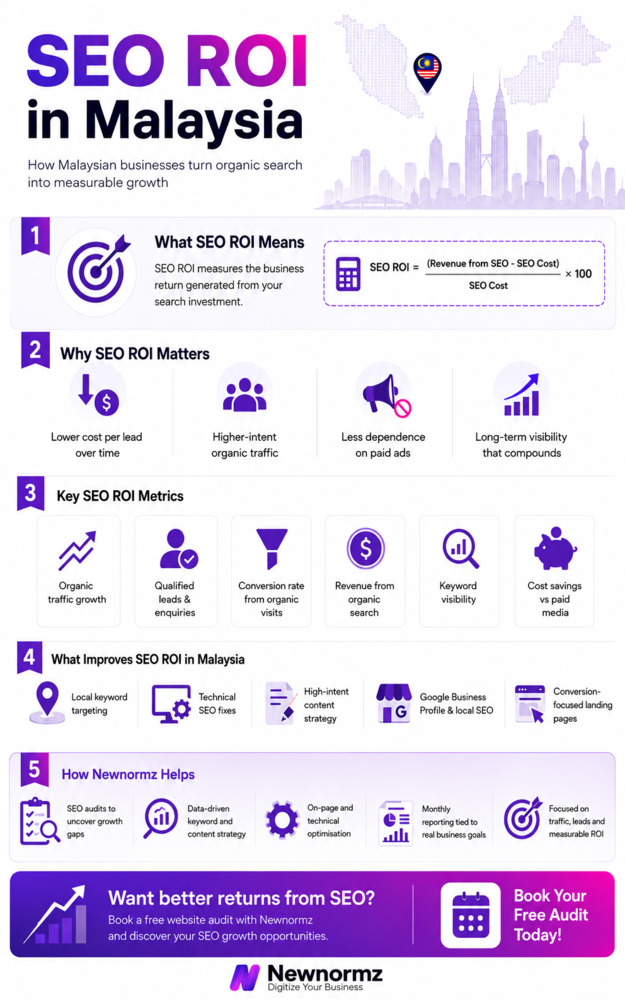
SEO agency Newnormz turns SEO into a measurable growth channel by connecting keyword strategy, content planning, technical optimisation, and conversion-focused reporting.
Our team identifies search terms that match real buying intent, local demand, and the customer journey in Malaysia.
Every SEO campaign is built around practical business outcomes. This includes improving pages that already have ranking potential, fixing technical issues that block visibility, strengthening content for high-intent searches, and tracking performance through tools such as Google Analytics, Google Search Console, and monthly SEO reports.
For SMEs, this approach makes SEO easier to justify because progress is tied to clear indicators such as organic traffic growth, keyword movement, enquiry quality, landing page performance, and cost savings compared to relying only on paid advertising.
Having Newnormz’s SEO services onboard becomes a structured investment designed to help Malaysian businesses attract the right audience, convert more visitors, and build a stronger digital presence over time.
Start Measuring What Actually Drives Growth.
SEO ROI in Malaysia should not feel unclear or difficult to justify. With the right tracking, strategy, and reporting, SEO can show exactly how organic search contributes to leads, enquiries, customer acquisition, and long-term revenue growth.
The shift starts when your business stops focusing only on rankings and traffic volume, and starts connecting SEO activity to real commercial outcomes.
When every keyword, landing page, content update, and technical fix is measured against business impact, SEO becomes more than a marketing expense. It becomes a growth channel you can confidently invest in.
Newnormz makes that shift with SEO strategies built around measurable ROI. Every recommendation is designed to help you attract better-quality traffic and turn organic visibility into business results.
Book a free website audit with Newnormz today and get a clear view of your current organic performance, missed opportunities, and next steps for stronger SEO ROI.
Frequently Asked Questions About SEO ROI in Malaysia

As the Core Strategists at Newnormz, we don’t just follow digital trends, we engineer them. Our team bridges the gap between technical precision and creative growth, ensuring that every SEO campaign, ad spend, and web interface serves a single purpose: scaling your business with measurable ROI. By blending data-driven insights with a deep understanding of market psychology, we transform digital presences into high-performance engines. At Newnormz, our strategy is simple: Think bigger, optimize faster, and lead the norm.