Mobile-first indexing means Google mainly reads and judges the mobile version of your website, not the desktop one you probably checked when it was built. If your phone version has less content, loads slowly or is hard to tap through, that is the version your rankings are based on. In Malaysia, where almost everyone searches from a phone, fixing your mobile site is one of the most practical SEO jobs you can do. It will not guarantee a ranking (nobody can), but it removes problems that quietly hold good pages back.
A Simple Way to Think About It
The Renovated Lobby Nobody Walks Through
🏢 The showpiece lobby
You spent months on a grand front entrance with marble floors and a proper reception desk. Almost nobody uses it.
🚪 The side door everyone uses
It is narrow, the sign is missing and the corridor is bare. But this is the door your customers and the building inspector both walk through.
Most business owners review the lobby. Google reviews the side door. The sections below cover what it finds there and how to fix it.
What Mobile-First Indexing Actually Means
Google crawls the web with a smartphone crawler first. The mobile version of each page is what gets stored in its index and used to decide where you rank. Your desktop site can still look complete, but it is no longer the version being judged.
The problem is that many sites were designed on a desktop and then shrunk down. Text gets cut, tabs get removed, internal links disappear from the menu, and structured data is left off the mobile template. Whatever is missing on the phone version is, as far as Google is concerned, missing from your page.
That is why a site can look fine on your laptop and still underperform in search. If you have only ever reviewed it on a desktop, you have been checking the wrong version.
Why It Matters More in Malaysia
DataReportal’s Digital 2026 Malaysia report recorded 35.4 million internet users and 98 percent internet penetration at the end of 2025. GSMA Intelligence counted 44.0 million cellular mobile connections. DOSM’s 2024 ICT survey put mobile phone usage among individuals at 99.5 percent. Statcounter data from May 2026 shows Google holding roughly 93 percent of the Malaysian search market.
Put those together and the picture is simple. Your customers are on phones, and they are searching on Google. Three local habits make it more pressing:
Searches in more than one language
People search in English, Bahasa Malaysia, Chinese or a mix of all three, depending on what they are looking for. Your mobile pages need to display every language cleanly, including Chinese characters and Malay phrases, and carry the terms your customers actually type.
Searches with an immediate need
Phrases like “kedai berhampiran saya”, “kontraktor Selangor” or “clinic Cheras” usually come from someone ready to act. If the page is slow, or the call and WhatsApp buttons are hard to find, that person goes to the next result. This is where local SEO and mobile usability overlap the most.
Competitors who already fixed this
More Malaysian businesses now invest in SEO. A weak mobile site is harder to hide when the business ranking next to you has a fast, clean one.
What Google Finds When Mobile and Desktop Do Not Match
These are the gaps we see most often when comparing the two versions of a local business site. None of them show up if you only look at the desktop.
| What differs on mobile | What Google sees | What it costs you |
|---|---|---|
| Service descriptions shortened or removed | A thinner page with fewer relevant terms | Weaker relevance for the searches you want |
| Menu hides links to key pages | Fewer internal links pointing to those pages | Important pages are harder to find and rank |
| Structured data only on the desktop template | No markup at all | Fewer chances at rich results in search |
| Heavy images and slow scripts | Poor real-world loading and responsiveness | Visitors leave before they enquire |
| Tiny buttons, cramped layout | A page that is hard to use on a phone | Lower conversion even when traffic arrives |
Five Mobile SEO Factors to Check First
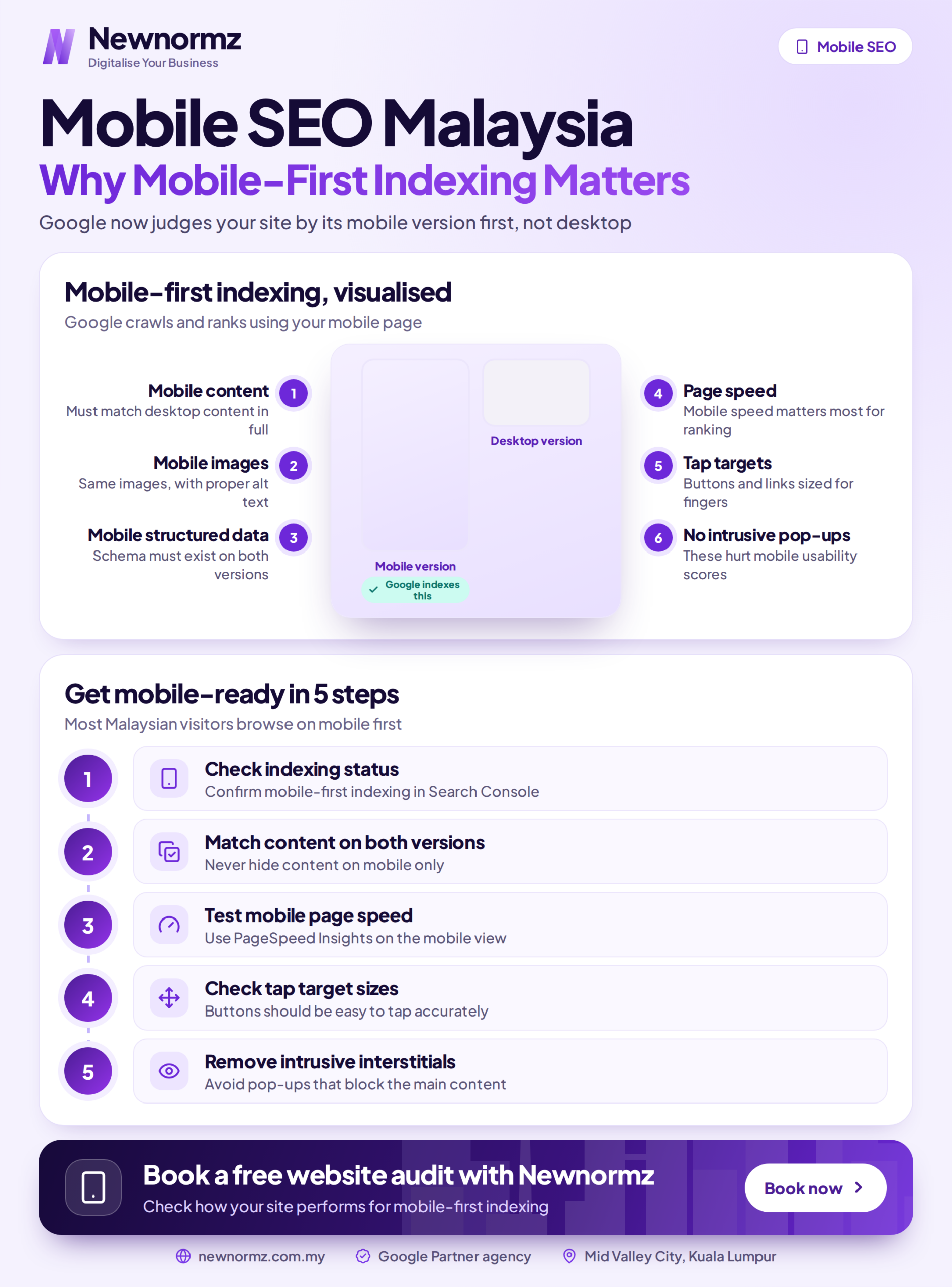
1. Page speed and Core Web Vitals
Google measures mobile experience through three Core Web Vitals. Largest Contentful Paint is how quickly your main content appears, and Google treats 2.5 seconds or less as good. Interaction to Next Paint is how fast the page reacts when someone taps, with 200 milliseconds or less as good. Cumulative Layout Shift is how much the page jumps around while loading, with 0.1 or less as good.
The usual culprits on Malaysian SME sites are uncompressed images, bloated themes and cheap shared hosting. Run your key pages through PageSpeed Insights and check the Core Web Vitals report in Search Console for the real-user picture.
2. Responsive design
A responsive site uses one URL and adjusts its layout to the screen. This is the setup Google recommends, and it is the easiest to keep consistent. Older sites built on legacy themes are often not truly responsive, even if they technically shrink to fit.
3. Content parity
Every important element on desktop should exist on mobile: service descriptions, testimonials, headings, internal links, image alt text and structured data. Content that is collapsed into a tap-to-open section is fine. Content that is deleted from the mobile template is not.
4. Navigation people can actually use
Small tap targets, crowded menus and sideways scrolling push visitors away. Put the actions that matter, such as call, WhatsApp and directions, where a thumb can reach them without zooming.
5. Local signals on mobile
Phone searches with local intent tend to bring up the map pack, Google Business Profile listings and location-based organic results. A complete profile, steady review collection and consistent name, address and phone details across directories all support your visibility here. Businesses serving areas like Shah Alam, Cheras, Georgetown or Johor Bahru feel this most.
Six Mobile SEO Mistakes We See on Malaysian SME Sites
| Mistake | Why it hurts | The fix |
|---|---|---|
| Never testing on a real phone | Layout and tap problems go unnoticed | Walk through your key pages on a mid-range phone on mobile data |
| Pop-ups that cover the page | Frustrates visitors, and Google has said intrusive interstitials can count against a page | Use small banners that do not block the content |
| Large, uncompressed images | Slow loading, especially on weaker connections | Compress images and use modern formats such as WebP |
| Unclaimed or half-filled Google Business Profile | Less presence in local map results | Claim it, complete every field and ask for reviews |
| Different business details across directories | Mixed signals about who and where you are | Use one exact name, address and phone format everywhere |
| No structured data on the mobile version | Google gets less context about your business and content | Make sure the same markup loads on mobile and desktop |
These problems stack. A site that has not been touched in a couple of years usually has several of them at once.
How Long Mobile SEO Fixes Take to Show
Technical fixes such as speed, crawlability and content parity can be shipped in weeks, and Google picks them up as it recrawls your pages. Rankings and enquiries move more slowly, because they depend on competitors, content and local signals as well. Be wary of anyone who promises a fixed position. Google has said publicly that no one can guarantee one.
What a mobile audit does give you is a clear, prioritised list of what is holding the site back. That is the starting point for any proper SEO service, because there is little point building links and content on a foundation that Google struggles to read.
Frequently Asked Questions
What is mobile SEO?
It is the work of making your website load quickly, display properly and rank well on smartphones. It covers speed, layout, content consistency, navigation and local signals.
Do I need a separate mobile website?
No. A single responsive site is the setup Google recommends. It keeps desktop and mobile content the same and avoids the extra technical problems that separate mobile URLs create.
Does mobile-first indexing mean Google ignores my desktop site?
Not exactly, but the mobile version is what Google mainly uses for indexing and ranking. If something exists only on desktop, treat it as missing from a search point of view.
How can I check my own mobile site?
Open your main pages on a real phone and try to call, message and find your address. Then run them through PageSpeed Insights and review the Core Web Vitals report in Google Search Console.
Does this apply outside Kuala Lumpur?
Yes. Mobile-first indexing applies to every site, and phone usage is high across Selangor, Penang, Johor Bahru and beyond. The local signals you focus on will differ by area.
Is your mobile site holding you back?
Find out what Google sees when it visits your site on a phone
Newnormz has run SEO campaigns across F&B, healthcare, ecommerce, and local services in Malaysia, backed by a performance guarantee of 70 percent of targeted keywords on Google’s first page.
30 minutes, no obligation, and we check your mobile speed and content gaps first.

Bryan Tan is an SEO Specialist and CEO at Newnormz, helping hundreds of businesses achieve first-page rankings on Google. With a passion for driving organic growth, Bryan blends innovative strategies with hands-on experience to optimize websites for maximum visibility. Always at the forefront of the latest SEO insights and trends, he consistently adapts to the evolving digital landscape.